

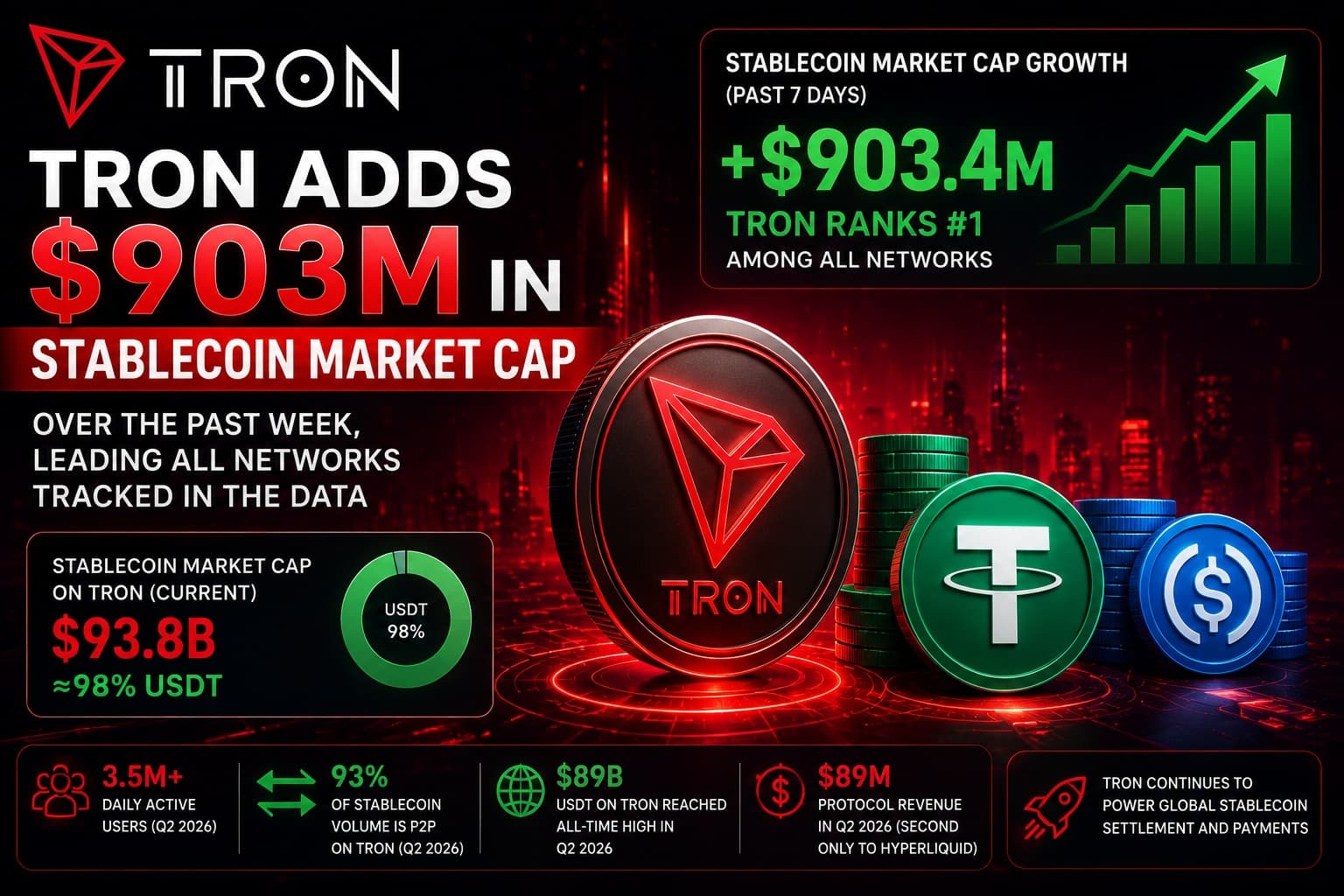
TRON added $903.4 million to its stablecoin market capitalization over the past week, according to data highlighted by TRON DAO, making it the fastest-growing network among those tracked in the dataset. The increase reinforces TRON’s position as one of the dominant settlement networks for dollar-pegged digital assets, particularly USDT.
TRON Leads Weekly Stablecoin Growth
TRON DAO highlighted a sharp increase in stablecoin market capitalization on the network, reporting an additional $903.4 million over the previous week.
BINANCE:TRXUSDT
That figure places TRON ahead of the other networks included in the dataset and adds another data point to a broader trend: stablecoins are becoming one of the most important sources of activity on public blockchains.
The distinction between stablecoin growth and token-price performance is important.
 Robinhood’s Evolving Wealth Management Strategy Targets the Future of Retail Investing→
 Fed Rate Hike May Not Rattle Crypto Markets, Grayscale Says→
 Solana Tokenized Equity Supply Surges to Record $684M Amid Multi-Platform Expansion→
 XRP Ledger Foundation Advances Ecosystem Resilience with Strategic Infrastructure Upgrades→
A blockchain can attract large amounts of dollar-denominated liquidity without necessarily producing an equivalent increase in demand for its native asset. Stablecoins are used for payments, trading, remittances, collateral and settlement, while the underlying network token serves a different economic function.
In TRON’s case, the latest stablecoin expansion therefore says more about network utility and liquidity demand than it does about the immediate outlook for TRX.
USDT Remains the Dominant Asset on TRON
The most important component of TRON’s stablecoin economy is Tether’s USDT.
Current DeFiLlama data show approximately $93.8 billion in stablecoins on TRON, with USDT representing roughly 98% of that total.
This concentration is significant.
Rather than hosting a highly diversified collection of stablecoins, TRON functions primarily as a large-scale settlement environment for USDT.
That specialization has become one of the network’s defining characteristics.
CoinDesk Research reported in July that USDT supply on TRON reached an all-time high of approximately $89 billion during Q2 2026. At the same time, TRON’s share of the overall stablecoin market increased to 28.7%, up from 27.3% at the end of Q1.
The same report found that TRON accounted for more than 47% of all USDT in circulation at the time.
The latest weekly increase suggests that this momentum continued beyond the end of Q2.
Why Stablecoins Matter More Than TRX Price
Stablecoin market capitalization is increasingly becoming a useful measure of blockchain utility.
When users hold USDT on a network, they are effectively using that blockchain as financial infrastructure. They may be moving dollars between exchanges, sending remittances, paying suppliers, transferring capital between countries or maintaining liquidity for trading.
This makes stablecoin supply different from speculative token market capitalization.
A rising stablecoin balance can indicate that users and businesses are willing to keep digital-dollar liquidity on a particular blockchain.
That is particularly relevant for TRON because the network has developed a strong position in peer-to-peer stablecoin transfers.
CoinDesk Research reported that approximately 93% of TRON’s stablecoin transfer volume was peer-to-peer during Q2 2026, the highest share among the benchmarked networks. TRON also averaged approximately 3.5 million daily active users during the quarter.
These figures provide important context for the latest $903.4 million increase.
The growth is occurring on a network that already has substantial stablecoin liquidity and large-scale transactional activity.
Independent Data Shows a Slightly Different Weekly Figure
There is an important data-quality issue that readers should understand.
TRON DAO’s post reports a $903.4 million weekly increase, while the current DeFiLlama snapshot available to CryptoQuorum shows approximately $436.9 million of seven-day growth in TRON’s stablecoin market capitalization.
This does not necessarily mean one source is wrong.
Stablecoin dashboards can differ because of:
- different snapshot times;
- different token coverage;
- methodology for identifying bridged assets;
- changes in historical data;
- revisions to blockchain or token classifications.
The TRON DAO figure should therefore be attributed specifically to the dataset cited in its announcement rather than presented as an independently verified universal measurement.
For a news report, that distinction matters.
The broader conclusion remains supported by multiple datasets: TRON’s stablecoin base is exceptionally large and continues to expand.
Expert Opinions: TRON Is Becoming a Settlement Layer
Recent research provides a useful explanation for why stablecoin activity has become so important to TRON.
CoinDesk Research described TRON in its Q2 report as moving toward a dual role combining payments and DeFi, while highlighting its stablecoin dominance, user activity and protocol revenue. The report said TRON generated approximately $89 million in protocol fees during Q2, second only to Hyperliquid among the benchmarked networks.
An independent H1 2026 review from CertiK similarly described stablecoin settlement as the central driver of TRON’s network performance. CertiK reported that stablecoin supply on TRON increased 9.2% during H1 to approximately $89.2 billion and that the network processed around $4.01 trillion in stablecoin transfer volume during the period.
The significance is not simply that TRON holds billions of dollars in stablecoins.
It is that the network appears to be developing a specialization around moving dollar-denominated value.
That is a different competitive position from blockchains that primarily compete for DeFi liquidity, NFT activity or smart-contract experimentation.
TRON’s Low-Cost Model Supports Stablecoin Transfers
One reason TRON has attracted substantial USDT activity is its transaction-cost structure.
For users transferring stablecoins, particularly in emerging markets and cross-border transactions, transaction fees can materially influence which blockchain they choose.
TRON has spent years positioning itself around relatively low-cost, high-throughput transactions.
CryptoQuorum previously examined this development in [TRON 2026: The Global Digital Payment Pivot], highlighting the network’s growing role in stablecoin transfers, remittances and digital payments. TRON 2026: The Global Digital Payment Pivot
The economic incentive is straightforward.
If two networks can move the same dollar-denominated asset, users have a reason to prefer the network that offers an attractive combination of cost, speed, liquidity and accessibility.
That creates a network effect.
More USDT liquidity attracts more users and services. More users create more transaction activity. More activity makes the network more useful as a settlement layer, potentially attracting additional stablecoin liquidity.
The Global Stablecoin Market Is Expanding Too
TRON’s growth is occurring within a much larger stablecoin market.
Stablecoins have evolved from primarily crypto-trading instruments into infrastructure for payments, settlement and financial applications.
CryptoQuorum recently reported on the growing importance of stablecoins as the financial system moves toward tokenized money and on-chain settlement. The broader trend is visible across multiple networks rather than being exclusive to TRON.
At the same time, competition is intensifying.
Solana, Ethereum, BNB Chain, Arbitrum and other networks are attracting stablecoin liquidity and developing their own payment infrastructure.
CryptoQuorum’s recent coverage of [Solana’s $3 billion weekly stablecoin minting activity] shows how quickly competing networks can accumulate dollar liquidity. Over $3 Billion in Stablecoins Minted on Solana in One Week
This means TRON’s position cannot be judged simply by its absolute stablecoin market capitalization.
Its share of global stablecoin activity and its ability to retain users will be equally important.
USDT Concentration Creates Both Strength and Risk
TRON’s dependence on USDT is one of its greatest strengths, but it is also a potential source of concentration risk.
With roughly 98% of the network’s stablecoin market capitalization represented by USDT in the current DeFiLlama snapshot, changes in Tether’s issuance strategy, regulatory environment or distribution across blockchains could have a disproportionate impact on TRON’s stablecoin economy.
The concentration also means that TRON’s growth is closely tied to demand for dollar-denominated liquidity.
If users increasingly prefer USDC or another stablecoin, or if competing networks become more attractive settlement environments, TRON could face pressure.
CryptoQuorum’s previous analysis of [Chainlink and stablecoins] examines how interoperability, reserve transparency and infrastructure are becoming increasingly important as stablecoins expand across multiple blockchain networks. Chainlink and Stablecoins
What the $903.4 Million Increase Could Mean
There are several possible interpretations of the latest increase.
1. More demand for digital dollars
The simplest explanation is that users and institutions are putting more stablecoin liquidity on TRON.
2. Greater settlement activity
Additional stablecoin supply provides deeper liquidity for transfers, exchanges and payments.
3. Continued USDT dominance
Because USDT represents almost all of TRON’s stablecoin base, continued USDT expansion remains the primary driver of the network’s stablecoin economy.
4. Increasing competition between chains
TRON’s weekly performance also demonstrates how aggressively blockchain networks are competing to become settlement layers for digital dollars.
5. Limited direct implication for TRX
Stablecoin growth should not automatically be interpreted as a bullish TRX price signal. Network usage and native-token valuation are related but distinct economic variables.
TRON’s Position in the Stablecoin Race
The latest data reinforce a trend that has been developing throughout 2026.
TRON is increasingly functioning less like a general-purpose blockchain competing for every category of Web3 activity and more like a specialized stablecoin settlement network.
Its combination of large USDT liquidity, high user activity and substantial peer-to-peer transfer volume gives it a distinctive position in the market.
The $903.4 million weekly increase highlighted by TRON DAO is therefore significant not simply because of the size of the number, but because it adds liquidity to a network that already operates at enormous scale.
At the same time, the discrepancy between the TRON DAO figure and the current DeFiLlama weekly reading is a reminder that blockchain data should always be interpreted with attention to methodology and timing.
The most defensible conclusion is not that TRON has definitively “won” the stablecoin race.
It is that TRON continues to demonstrate exceptionally strong demand for stablecoin settlement, led overwhelmingly by USDT.
If that demand persists while stablecoins become more integrated into cross-border payments, merchant settlement and institutional finance, TRON could remain one of the most important blockchain rails for digital dollars.
The next phase of the competition will be less about who can issue the most tokens and more about which networks can convert stablecoin liquidity into reliable, high-volume financial infrastructure.
Disclaimer: This article is for informational and educational purposes only and does not constitute financial, investment, trading, legal or tax advice. Stablecoin market-cap figures can change rapidly and may differ between data providers because of methodology, timing and asset classification. TRON DAO’s reported $903.4 million weekly increase is presented as an attributed figure and should not be interpreted as an independently audited measurement. Cryptocurrency and stablecoin markets involve significant technological, regulatory, liquidity and counterparty risks. Readers should conduct their own research and verify current data before making financial decisions.