

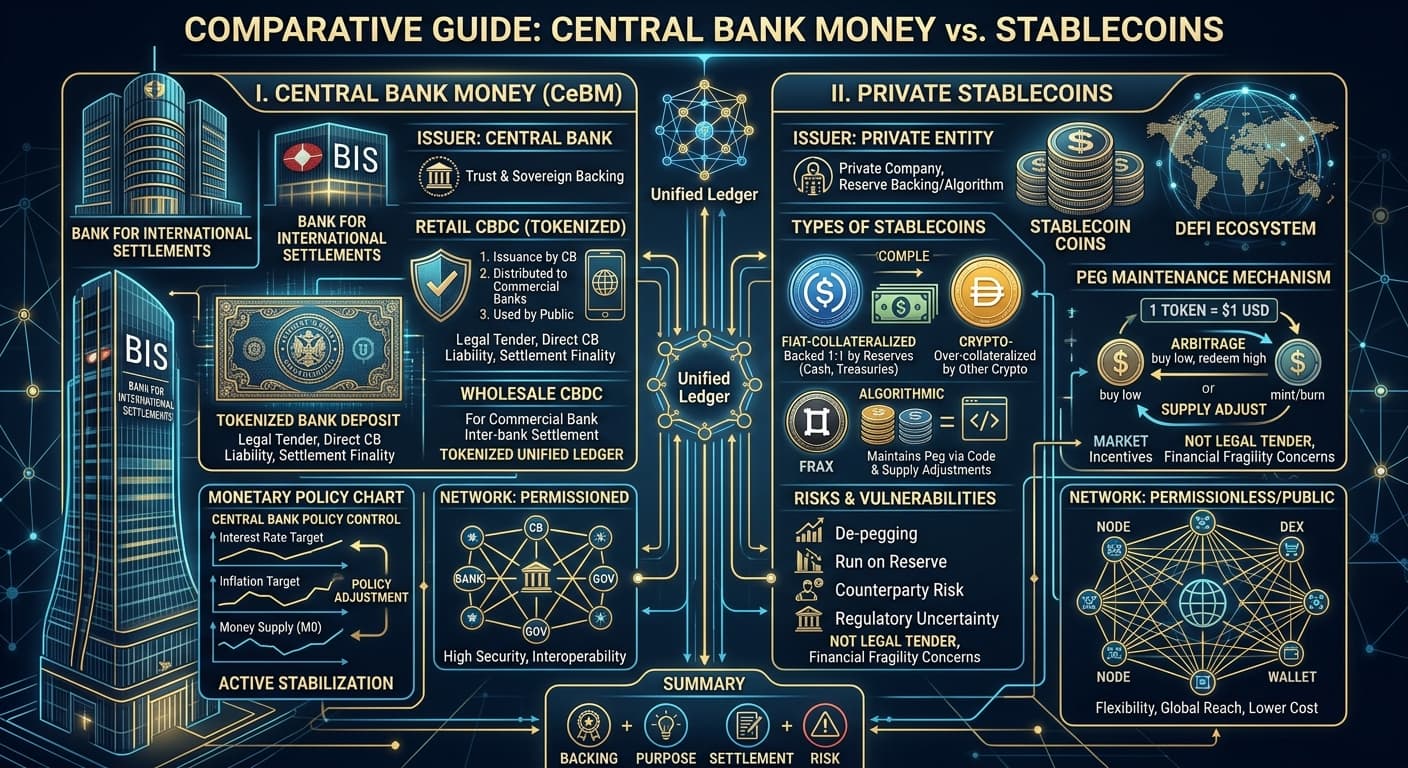
At the Jackson Hole Economic Policy Symposium on August 28, 2026, Bank for International Settlements (BIS) General Manager Pablo Hernández de Cos delivered a definitive critique of private digital currencies. Speaking to global central bankers and policymakers, Hernández de Cos asserted that private pegged digital assets cannot credibly function as a widespread means of payment at scale.
Instead, the head of the central bank umbrella organization urged authorities and institutional markets to pivot toward tokenized bank deposits. In his view, tokenized commercial bank money offers a far more direct, compliant, and stable framework to harness distributed ledger technology (DLT) while preserving the core pillars of the global monetary system.
The address arrives at a critical juncture for digital asset regulation, coming just one day after the BIS-affiliated Financial Stability Institute (FSI) released a cross-jurisdictional study revealing stark divergence in how major financial hubs govern digital asset issuers.
The Three Failings: Singleness, Interoperability, and Financial Integrity
To dismantle the premise that private digital currencies can replace sovereign payment rails, Hernández de Cos outlined three fundamental properties that any asset must possess to operate effectively as money: singleness, interoperability, and financial integrity.
 ECB’s Isabel Schnabel Calls for Central-Bank Money on Blockchain to Modernize Monetary Policy→
 xStocks Leads Tokenized Stock Issuance With $17M→
 Charles Schwab Executive Names 5 Cryptos to Watch→
 Brian Armstrong Rallies Crypto Voters as Pressure Mounts on Senate Leadership to Pass the CLARITY Act→
1. Loss of Singleness of Money
In a stable monetary system, one unit of currency must equal another regardless of form or issuer—a dollar in a commercial bank account must exchange seamlessly for a physical dollar bill or a dollar at a neighboring institution. Private digital tokens fail this test when secondary market prices trade at a discount or premium to par value.
Hernández de Cos pointed out that a merchant accepting Circle’s USDC cannot automatically process a transfer from a consumer holding Tether’s USDT without converting the token first. Slippage, DEX fees, and market price fluctuations mean the final settled value frequently deviates from one dollar, fracturing the concept of uniform money.
2. Platform Isolation and Friction
Interoperability remains a key hurdle across public and private blockchain networks. Converting assets across different smart contract ecosystems or bridging tokens across Layer 1 and Layer 2 protocols introduces transaction fees, execution delays, and security vulnerabilities.
Without standardized inter-ledger communication protocols, private tokens create walled gardens that hinder high-volume commercial throughput.
3. Degradation of Financial Integrity
The BIS chief highlighted severe vulnerabilities regarding Anti-Money Laundering (AML) and Counter-Financing of Terrorism (CFT) compliance. A growing proportion of on-chain value transfers occur directly between unhosted, self-custodied wallets that operate outside established Know Your Customer (KYC) regulatory perimeters.
According to the BIS, this structural opacity prevents private tokens from meeting global institutional integrity standards.
The Banking Sector Dilemma: Deposit Flight and Credit Costs
Beyond structural design flaws, the BIS warned of profound macroeconomic risks if non-bank issuers absorb a major share of transactional liquidity.
When retail users and institutions convert traditional bank deposits into private tokens issued by non-bank entities, commercial lenders lose a vital source of cheap, stable funding. To maintain their balance sheets, banks are forced to source replacement funding from wholesale money markets at significantly higher interest rates.
| Mechanism Stage | Process / Action | Structural Economic Consequence |
|---|---|---|
| 1. Capital Reallocation | Commercial Bank Deposits | Shifted into Non-Bank Reserve Accounts |
| 2. Balance Sheet Impact | Commercial Bank Loss | Deprived of Low-Cost Retail Funding |
| 3. Liquidity Replacement | Wholesale Replacement | Lenders forced to borrow at higher market rates |
| 4. Macroeconomic Outcome | Real Economy Impact | Elevated borrowing and credit rates for consumers |
This structural shift creates a direct passthrough effect: as commercial banking funding costs rise, lenders pass those expenses onto households and corporate borrowers through higher loan interest rates.
While advocates such as U.S. Treasury Secretary Scott Bessent contend that reserve-backed tokens bolster demand for U.S. Treasury bills and lower government borrowing costs, the BIS cautions that this dynamic places an unfair burden on real-economy consumer credit.
Global Regulatory Patchwork: FSI Comparative Analysis
The BIS critique is backed by data from an FSI report comparing digital asset regulatory regimes across five major jurisdictions: the United States, the European Union (under MiCA), the United Kingdom, Hong Kong, and Singapore.
The report identifies dangerous regulatory arbitrage opportunities created by fragmented legal definitions:
- US Restrictions vs. Global Flexibility: The American regulatory framework limits non-bank payment token issuers from engaging in activities like lending, staking, proprietary trading, or third-party crypto custody. Conversely, other jurisdictions allow broader financial activities under single corporate banners.
- Entity-Level vs. Group-Level Supervision: Most existing regimes focus compliance obligations strictly on the token-issuing subsidiary rather than the parent holding company. The FSI warns that conglomerate structures can easily shift risky financial activities into unmonitored entities within the same corporate group.
Real-World Payment Data: Speculation vs. Commercial Usage
Market statistics further support the BIS position that private tokens serve primarily as trading collateral rather than everyday payment instruments.
According to a joint study by Boston Consulting Group (BCG) and Allium, public blockchains processed over $62 trillion in gross token volume over a 12-month period. However, only 7%—approximately $4.2 trillion—represented genuine economic transfers. Observable bilateral payments for physical goods and commercial services accounted for just $350 billion to $550 billion, proving that mainstream commercial merchant adoption remains in its infancy.
Comparison: Private Issued Tokens vs. Tokenized Bank Deposits
The following WordPress-optimized table compares the structural characteristics of private digital tokens against tokenized bank deposits as evaluated by the BIS:
| Feature / Criteria | Private Digital Tokens | Tokenized Bank Deposits |
| Issuer Type | Non-Bank FinTechs / Private Entities | Regulated Commercial Banks |
| Singleness of Money | Vulnerable to par-value de-pegging & DEX friction | Guaranteed 1:1 par value backed by central bank reserves |
| Regulatory Supervision | Fragmented across entity-level frameworks | Comprehensive group-level prudential oversight |
| AML / KYC Compliance | High risk due to self-custodied wallet transfers | Integrated into existing banking compliance rails |
| Banking System Impact | Drains low-cost retail deposits, raising credit costs | Retains deposits within the regulated banking system |
| Primary Use Case | Crypto trading liquidity & cross-border transfers | Programmable wholesale finance & institutional settlement |
Expert Opinions and Industry Perspectives
Include expert opinions from macroeconomists, digital asset strategists, and financial infrastructure analysts to provide a balanced overview of the debate:
Dr. Helena Vance, Senior Fellow at the Center for Financial Stability:
“Pablo Hernández de Cos’s speech marks a formal line in the sand for international regulators. Central banks are clearly indicating that while they embrace tokenization technology, they will not cede the foundational settlement layer to non-bank entities. Tokenized bank deposits represent the compromise that preserves traditional credit creation while enabling smart contract automation.”
Julian Thorne, Head of Institutional Research at Decentra Capital:
“While the BIS points out legitimate issues around singleness and self-custody compliance, they understate the immediate utility that private tokens provide in global trade. Businesses in emerging markets rely on these assets not out of speculation, but because traditional interbank clearing is slow and expensive. Tokenized deposits will take years to achieve cross-border interoperability.”
Sofia Ramirez, Regulatory Lead at European FinTech Forum:
“The FSI’s finding regarding group-level supervision is the real takeaway for lawmakers. Without consolidated oversight across corporate entities, financial groups can bypass regional rules like MiCA. We expect global regulators to mandate consolidated group audit requirements within the next two years.”
Strategic Outlook: The Battle for On-Chain Liquidity
The central bank umbrella group’s firm stance reinforces ongoing efforts to construct sovereign on-chain infrastructure. As the European Central Bank prepares to deploy Project Pontes and the BIS advances its multi-bank Project Agorá, the financial sector is heading toward a hybrid model.
Private pegged tokens will likely continue to dominate decentralized finance (DeFi) trading pools and international remittances. However, for high-value wholesale settlement, corporate liquidity management, and mainstream commercial transactions, tokenized deposits and wholesale CBDCs are positioning to become the official standards of global commerce.
Disclaimer
This article is provided for informational and educational purposes only and does not constitute financial, legal, or investment advice. Digital asset markets and tokenized financial instruments carry inherent risks. Readers should perform independent research and consult qualified financial professionals before engaging in digital asset transactions or node infrastructure deployment.