

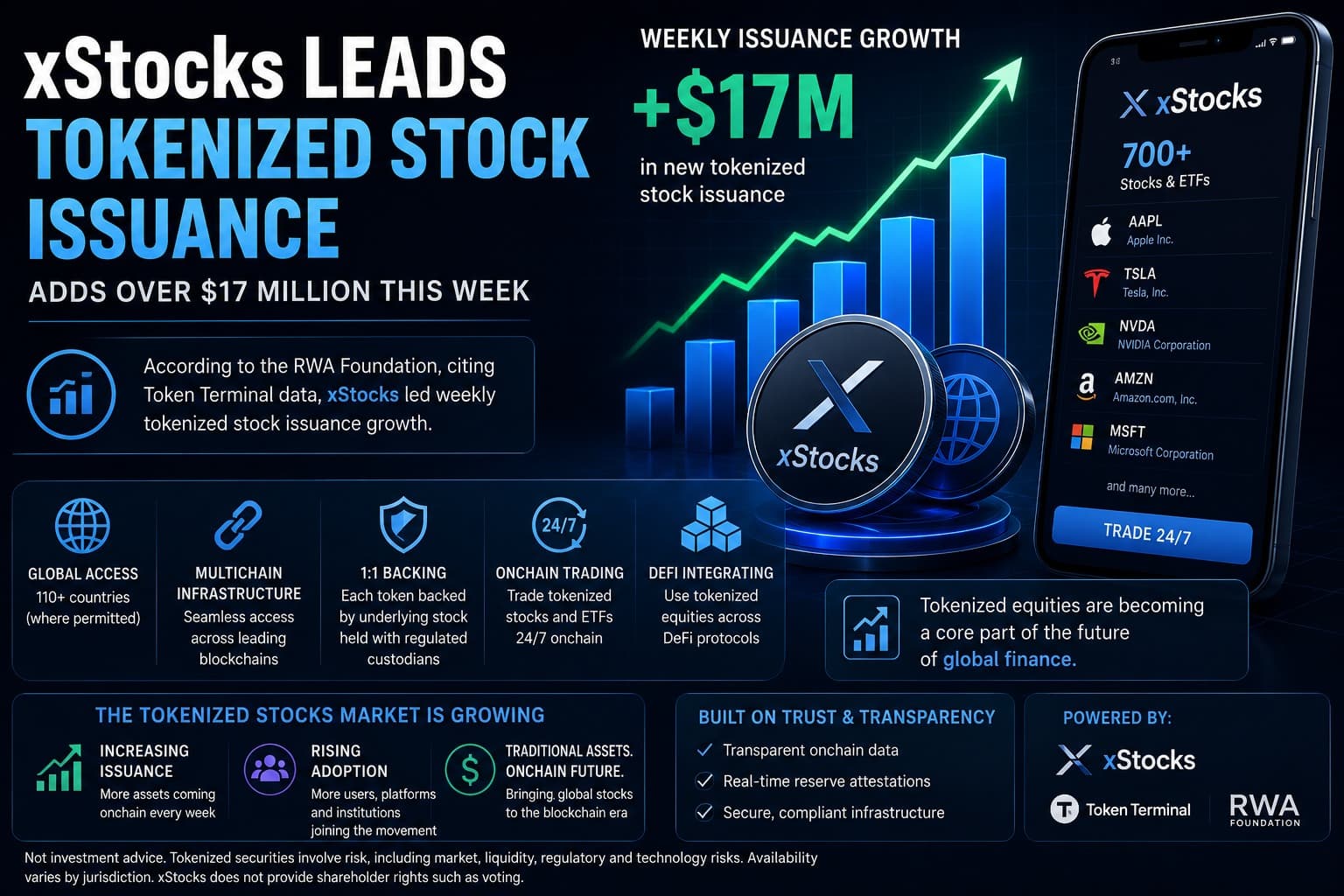
xStocks led weekly growth in tokenized-stock issuance, adding more than $17 million in new issuance over the past seven days, according to a recent update from the RWA Foundation citing Token Terminal data. The update was published on August 28, 2026.
The number itself is relatively small compared with traditional equity markets. But within the rapidly expanding real-world asset sector, weekly issuance growth is an important indicator because it measures the amount of new financial exposure being brought onto blockchain infrastructure.
BINANCE:BTCUSDT
The development also comes as xStocks continues to expand its asset range, distribution network and presence across decentralized finance.
According to the company’s current website, xStocks now lists more than 700 stocks and ETFs, reports more than $35 billion in transaction volume, and operates across more than 110 countries, subject to geographic restrictions.
 Morgan Stanley Sees $10T Tokenized Asset Market→
 SEC Proposes Expanding Cross-Trading for Funds→
 XRP Asia Officially Launches in Seoul to Accelerate XRP Ledger Adoption Across the Asia-Pacific Region→
 SEC Proposes New Crypto Custody Rules→
The broader question is becoming increasingly important:
Are tokenized equities moving from an experimental crypto product into a genuine financial-market infrastructure?
Recent data suggests that the market is moving in that direction.
What the $17 million issuance figure actually means
Issuance growth should not be confused with trading volume or the market capitalization of the entire xStocks ecosystem.
When a tokenized stock is issued, a blockchain-based representation of an underlying financial asset is created through the issuer’s primary-market process.
For xStocks, each product represents economic exposure to a specific stock or ETF and is designed to be backed 1:1 by the corresponding underlying asset held with a regulated custodian.
That means the $17 million figure is best understood as new tokenized stock supply, rather than $17 million of trading activity.
The distinction is important.
A market can have:
- high issuance but low secondary-market activity;
- low issuance but very high trading volume;
- substantial assets outstanding but limited liquidity;
- or strong issuance combined with growing trading activity.
The last scenario would be particularly significant because it would indicate that both supply and market utilization are expanding.
xStocks is becoming a major tokenized-equity platform
The latest issuance figure follows a period of rapid expansion for xStocks.
The platform currently describes its network as supporting more than 700 stocks and ETFs, with the assets designed to be available across multiple blockchains and integrated into wallets, exchanges and DeFi protocols.
Token Terminal independently describes xStocks as an RWA issuer providing blockchain-based representations of stocks and ETFs, with 1:1 collateralization and multichain functionality.
The scale is notable because the tokenized-equity sector was relatively small only a few years ago.
Token Terminal wrote in April that adoption of tokenized public equities remained limited for more than two years after the first products appeared in 2023, before xStocks and Ondo helped push the category past $1 billion during 2025.
That transition illustrates an important change.
The industry is no longer primarily asking whether stocks can be tokenized.
It is increasingly asking how tokenized equities can achieve:
- sufficient liquidity;
- reliable pricing;
- regulatory compliance;
- broad distribution;
- interoperability;
- integration with DeFi.
xStocks is attempting to address several of these requirements simultaneously.
Why tokenized stocks matter to DeFi
The real significance of an equity token is not simply that a stock appears on a blockchain.
The more important question is what users can do with it once it is there.
Traditional shares generally exist inside brokerage and clearing infrastructure.
A blockchain-native representation can potentially interact with smart contracts, wallets, decentralized exchanges and lending protocols.
This creates a concept known as composability.
A tokenized equity could potentially become part of a broader onchain financial strategy:
Stock exposure → tokenized asset → wallet → DEX → collateral → lending → liquidity
The actual availability of each function depends on the specific asset, jurisdiction and application.
But the architecture opens possibilities that are difficult to implement within traditional market infrastructure.
This is one reason Token Terminal has described tokenized stocks as sitting at the intersection of TradFi and DeFi, with 24/7 trading, fractional access and composability among the key characteristics of the sector.
Expert and data perspective
The most useful independent perspective here is not a price prediction but the data itself.
Token Terminal tracks xStocks as an RWA issuer and provides dedicated metrics for the project, including issuance and other ecosystem indicators.
That makes the reported $17 million weekly increase more useful as a market-structure signal than as a bullish price prediction.
The important question is whether new issuance continues to translate into deeper liquidity and sustained secondary-market demand.
Solana is becoming a key venue for tokenized equities
The xStocks expansion is closely connected to Solana’s broader real-world asset market.
CryptoQuorum recently reported that Solana’s RWA ecosystem crossed $4 billion in total value, highlighting the increasing role of tokenized financial products on the network.
The growth is not limited to stocks.
Solana’s RWA ecosystem includes tokenized Treasuries, private credit, commodities, funds and other financial products.
xStocks has become particularly important because equities provide a much larger potential addressable market than most crypto-native assets.
The world’s public stock markets represent trillions of dollars in capitalization.
Even a very small migration of that value onto blockchain networks would create a substantial new market.
xStocks has expanded beyond U.S. equities
Another important development is the geographic expansion of the xStocks framework.
The company announced in July that it was moving beyond U.S.-listed equities, beginning with Hong Kong-listed stocks and planning expansion toward additional international markets including the UK, EU and South Korea.
That changes the potential scope of the platform.
The original proposition was relatively straightforward:
Bring U.S. stocks onchain.
The broader proposition is considerably larger:
Create an interoperable onchain representation of global capital markets.
If successful, this could allow investors and financial applications to access a much broader range of equity exposure without relying exclusively on traditional market hours and infrastructure.
However, regulatory restrictions remain a major factor.
The 24/7 market advantage has limitations
One of the strongest selling points for blockchain-based equities is continuous availability.
Traditional U.S. stock exchanges operate during defined market sessions.
Blockchain networks can operate continuously.
xStocks says its assets can trade 24/7 onchain, while centralized platforms such as Kraken currently offer 24/5 trading for supported products.
That distinction matters.
The underlying stock market does not suddenly become a 24/7 exchange simply because a token representing economic exposure exists on a blockchain.
During periods when the underlying market is closed, liquidity and pricing mechanisms can behave differently.
Spreads may widen, and price discovery may depend more heavily on available liquidity and market-making infrastructure.
Therefore, “24/7 trading” should not be interpreted as identical to conventional exchange trading around the clock.
Tokenization does not necessarily mean stock ownership
This is one of the most important points for readers and investors.
An xStock does not necessarily provide the same legal rights as directly owning the underlying stock.
According to xStocks’ documentation, the tokens provide economic exposure to the referenced equity or ETF, while holders do not receive shareholder rights such as voting rights.
Kraken’s risk disclosure makes the distinction even more explicit: holders of xStocks do not directly own the underlying shares and do not have voting rights or direct legal claims to those shares.
This means investors should not automatically equate:
xStock = traditional share
Instead:
xStock = tokenized economic exposure to a traditional asset
That distinction is critical from both an E-E-A-T and investor-protection perspective.
Geographic restrictions remain significant
Tokenized equities are also subject to jurisdictional restrictions.
For example, Kraken currently states that xStocks are not available to users in the United States and certain other jurisdictions.
The restrictions illustrate a broader issue facing tokenized securities.
Blockchain technology can make an asset globally transferable from a technical perspective.
That does not mean the underlying financial product can legally be offered to everyone everywhere.
Securities law, investor eligibility, custody rules and local regulations still apply.
As tokenized equities become larger, compliance infrastructure will become just as important as blockchain infrastructure.
xStocks and Chainlink: the infrastructure layer
The growth of tokenized stocks also increases demand for reliable financial data.
A blockchain-based equity platform needs to know the current value of the underlying asset.
It may also need information about:
- corporate actions;
- dividends;
- stock splits;
- market status;
- collateralization;
- cross-chain transfers.
This is where oracle infrastructure becomes important.
CryptoQuorum recently examined how Chainlink is being integrated into the tokenized-equity ecosystem across Coinbase, Robinhood, xStocks and Ondo.
The broader architecture therefore looks increasingly like:
Traditional asset → regulated custody → tokenization → oracle data → blockchain → DeFi liquidity
Each layer needs to work correctly.
A token by itself does not create a functioning financial market.
Issuance growth is only one part of the story
The $17 million weekly increase is encouraging for the sector, but issuance alone cannot determine whether the market is becoming sustainable.
Several additional metrics deserve attention.
| Metric | Why it matters |
|---|---|
| New issuance | Measures expansion of tokenized supply |
| Assets outstanding | Shows the size of the tokenized market |
| Trading volume | Measures actual market activity |
| Liquidity | Determines how efficiently assets can be traded |
| Active holders | Indicates user adoption |
| DeFi integrations | Measures composability |
| Redemption activity | Shows connection with the underlying assets |
| Geographic availability | Determines potential market size |
A healthy tokenized-equity market needs more than new tokens.
It needs liquidity, users, infrastructure and trust.
That is why future issuance figures should be considered alongside trading volume and assets outstanding.
Why the latest figure matters for the RWA sector
The RWA market has been searching for a category capable of attracting large-scale mainstream demand.
Tokenized Treasury products have already established a significant market because they can provide blockchain users with access to yield-bearing government securities.
Tokenized equities introduce another dimension.
Stocks are familiar.
They have established valuation frameworks, deep global liquidity and enormous market capitalization.
If blockchain infrastructure can make equity exposure easier to distribute and integrate with digital financial applications, the potential market is considerably larger.
This is why the latest xStocks issuance figure deserves attention even though $17 million is small relative to traditional equities.
The signal is about direction and infrastructure adoption.
What could come next for xStocks
Several developments could determine whether the current growth becomes a lasting trend.
1. More international equities
Expanding beyond U.S. markets would significantly increase the available asset universe.
2. Deeper DeFi integration
The more tokenized equities can be used as collateral or liquidity assets, the more utility they gain.
3. Institutional adoption
Asset managers and financial institutions could become major issuers and users of tokenized securities.
4. Better liquidity
Professional market makers and deeper onchain venues could reduce spreads and improve price discovery.
5. Regulatory clarity
Clear rules could allow tokenized securities to move from niche crypto applications toward mainstream financial infrastructure.
The bigger picture: stocks are becoming blockchain-native assets
The latest RWA Foundation update is only one data point, but it arrives during a much larger transformation.
xStocks is expanding its asset universe.
Solana is growing its RWA ecosystem.
Kraken and other platforms are distributing tokenized equities.
Chainlink is providing infrastructure for pricing and interoperability.
And DeFi protocols are beginning to treat tokenized real-world assets as financial building blocks.
CryptoQuorum has previously examined the broader Solana tokenization trend and its implications for global capital markets.
The common theme is clear:
Blockchain is increasingly being used not only to create new financial assets, but to redesign how existing assets are issued, transferred and used.
That is a much larger development than simply putting stocks on a blockchain.
Bottom line
xStocks adding more than $17 million in tokenized stock issuance in one week is a notable data point for the rapidly expanding RWA market.
The immediate figure should not be mistaken for trading volume or total market capitalization.
Its importance lies in what it represents: continued creation of blockchain-based equity exposure and growing demand for infrastructure capable of supporting those assets.
With more than 700 stocks and ETFs listed on the xStocks platform, the category is already far beyond its experimental stage.
The next test is whether issuance growth can translate into deeper liquidity, more users, greater DeFi utility and wider institutional adoption.
If that happens, tokenized stocks could evolve from a niche crypto product into a meaningful component of global digital financial infrastructure.
For now, the $17 million weekly increase is another signal that the race to put traditional equities onchain is accelerating.
Disclaimer: This article is for informational and educational purposes only and does not constitute investment, financial, legal or tax advice. Tokenized securities and digital assets involve significant risks, including market, liquidity, custody, counterparty, regulatory and technology risks. xStocks may not be available in all jurisdictions, and tokenized representations may provide economic exposure rather than the same ownership rights as the underlying securities. Readers should review the relevant issuer and platform documentation and conduct independent research before making any investment decision.