

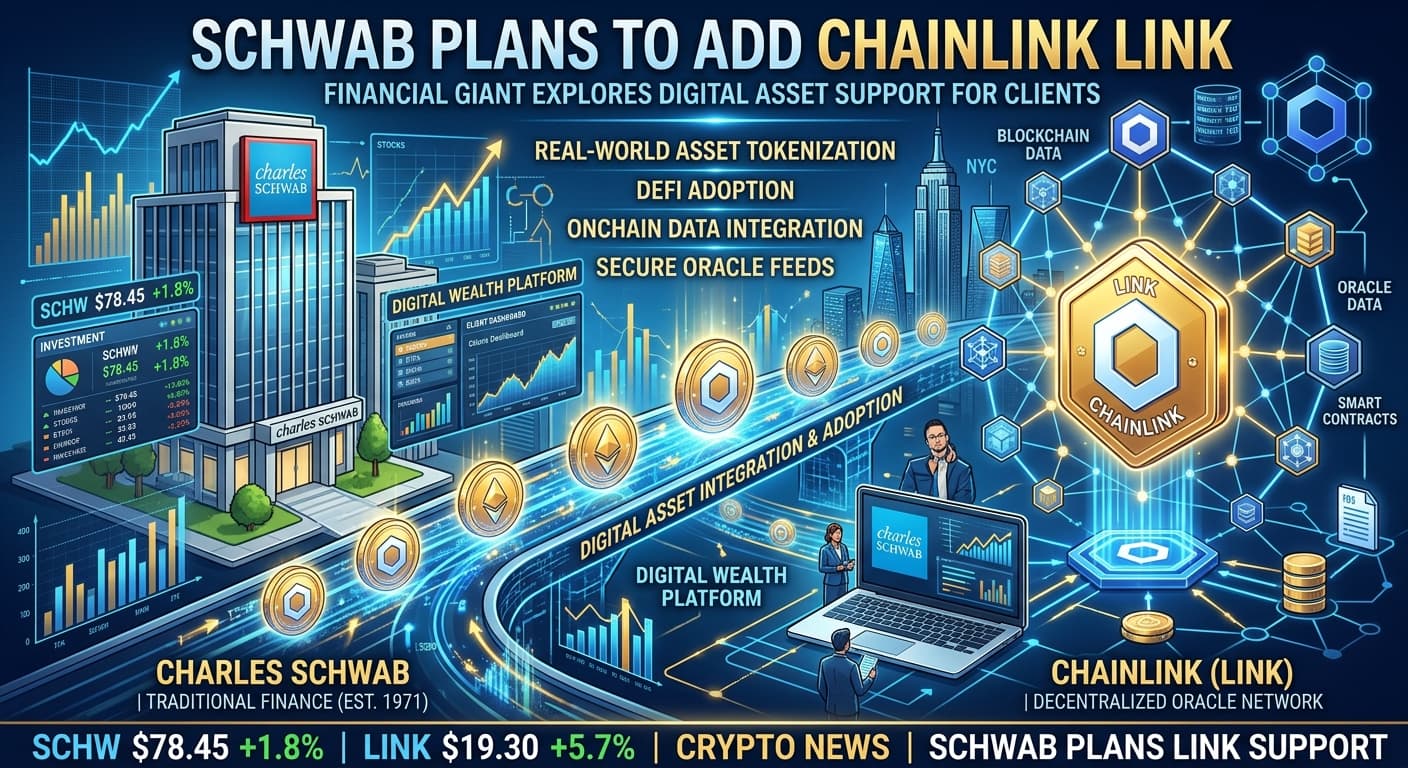
Charles Schwab is preparing to expand its direct cryptocurrency offering with Chainlink LINK, alongside Solana (SOL) and Avalanche (AVAX).
The U.S. brokerage announced on August 27 that the three assets will become available to eligible Schwab Crypto clients in the coming months. The expansion follows the May 2026 rollout of Schwab Crypto, which initially gave clients direct access to Bitcoin and Ethereum.
BINANCE:LINKUSDT
The development is significant for the cryptocurrency market because Schwab is not a specialist crypto exchange. It is one of the largest investment services companies in the United States, with tens of millions of brokerage accounts and trillions of dollars in client assets.
According to Schwab’s latest July figures, the company had 39.9 million active brokerage accounts and $13.04 trillion in total client assets at the end of July 2026.
 Mastercard and BVNK have launched a new global payments platform→
 Fink: Data Center Moratorium Risks Recession→
 Ripple, Meritz Bring Tokenization to Korea→
 SEC Sets Compliance Seminar for Nov. 19→
That scale makes the addition of LINK more than another exchange listing.
It represents another step in the integration of established digital assets into traditional brokerage infrastructure.
Schwab Crypto moves beyond Bitcoin and Ethereum
When Schwab Crypto began rolling out in May, the platform initially focused on Bitcoin and Ethereum.
That approach was relatively conservative.
Bitcoin and Ethereum dominate the digital-asset market by market capitalization, institutional recognition and established infrastructure. Starting with those two assets allowed Schwab to enter the crypto market while keeping the initial product offering narrow.
The planned addition of SOL, AVAX and LINK changes that equation.
Schwab is effectively moving from a two-asset crypto offering toward a broader digital-asset allocation platform.
The company says the new assets were selected as established cryptocurrencies that align with client demand. Schwab also says it intends to add additional cryptocurrencies and digital assets over time.
For LINK, however, there is an additional dimension.
Chainlink is not simply another blockchain token competing for transaction activity. Its network provides decentralized oracle infrastructure that connects blockchain applications with external data and services.
That makes the asset particularly relevant to the broader tokenization and institutional-finance narrative.
Why the LINK addition matters
The immediate impact is straightforward: Schwab clients will eventually be able to buy and sell LINK directly through the Schwab Crypto platform.
But the strategic significance goes further.
Traditional investors typically interact with financial markets through regulated brokers, custodians and established financial platforms.
Crypto markets historically developed through specialized exchanges and self-custody infrastructure.
Schwab’s expansion helps narrow that gap.
An investor who already uses Schwab for stocks, ETFs and other investments can increasingly manage digital assets through the same broader financial ecosystem.
Schwab says clients can view and trade cryptocurrency alongside traditional investments through Schwab.com, Schwab Mobile and thinkorswim. The company also provides digital-asset education and 24/7 client support.
That combination may be more important for mainstream adoption than the number of assets listed.
The barrier is not always a lack of interest in cryptocurrency.
For many investors, it is the complexity of opening accounts across multiple platforms, moving funds between providers and learning unfamiliar trading interfaces.
A major brokerage can remove some of those frictions.
Schwab’s scale has increased since the original announcement
The figures attached to Schwab’s crypto expansion also deserve careful attention.
The Chainlink announcement highlighted Schwab’s roughly 40 million brokerage accounts and $11.77 trillion in client assets, figures that correspond to earlier 2026 reporting.
Schwab’s more recent official monthly report shows that the business had grown further by July.
| Schwab metric | March 2026 | July 2026 |
|---|---|---|
| Active brokerage accounts | 39.1M | 39.9M |
| Total client assets | $11.77T | $13.04T |
| Daily average trades | 9.9M | 11.6M |
| Crypto assets at launch | BTC, ETH | BTC, ETH |
| Planned additions | — | SOL, AVAX, LINK |
Schwab reported $13.04 trillion in total client assets and 39.9 million active brokerage accounts as of July 31.
The difference is important for E-E-A-T reporting because current company metrics should be distinguished from figures published earlier in the year.
The broader trend, however, remains the same: Schwab operates at a scale where even a small increase in crypto participation could represent meaningful capital flows.
What LINK brings to Schwab’s crypto platform
LINK is the native token of the Chainlink network.
Chainlink’s core infrastructure is designed to connect smart contracts with data and services that exist outside blockchain networks.
This includes market-price data, proof-of-reserve information, cross-chain interoperability and other infrastructure used by decentralized applications and financial institutions.
The distinction between LINK and the Chainlink network is important.
Buying LINK gives an investor exposure to the digital asset.
It does not mean the investor directly owns the underlying infrastructure, applications or companies that use Chainlink technology.
Nevertheless, the token has become closely associated with the growth of blockchain-based financial infrastructure.
That makes Schwab’s decision notable from an institutional-adoption perspective.
Expert opinion: a different kind of crypto exposure
Schwab’s Head of Digital Assets, Joe Vietri, said the expansion is intended to give clients more choices for building a digital-asset allocation alongside the investing and banking experience they already use.
He also emphasized Schwab’s focus on familiar cryptocurrencies supported by education, tools and resources designed to help clients understand how digital assets may fit into broader investment goals.
That language provides an important clue about Schwab’s strategy.
The brokerage is not presenting crypto as a completely separate financial universe.
Instead, digital assets are being incorporated into a conventional portfolio-management environment.
This approach could encourage investors to think about Bitcoin, Ethereum, LINK, SOL and AVAX alongside stocks, bonds and ETFs rather than treating crypto as an isolated speculative market.
Schwab’s own educational materials also acknowledge that cryptocurrencies can materially increase portfolio volatility and that even relatively small allocations can affect overall portfolio performance.
That risk-aware positioning is consistent with a brokerage targeting mainstream investors.
LINK joins a broader institutional trend
Schwab’s decision comes at a time when Chainlink infrastructure is becoming increasingly visible across tokenized financial markets.
Just one day before the Schwab announcement, CryptoQuorum reported on Chainlink’s growing role across Coinbase, Robinhood, xStocks and Ondo in tokenized equities. These platforms are using Chainlink infrastructure for market data, interoperability and other components required to bring traditional assets onchain.
That creates an interesting feedback loop.
Institutional adoption can increase awareness of LINK.
At the same time, greater institutional participation in tokenization can increase demand for the infrastructure provided by the Chainlink ecosystem.
The two trends are related, although they should not be confused.
Schwab listing LINK does not automatically mean that Schwab is adopting Chainlink oracle infrastructure.
The announcement concerns direct trading access to the LINK token.
That distinction is essential.
Why tokenization could strengthen the Chainlink narrative
The growth of tokenized stocks, funds and other real-world assets is creating a larger demand for blockchain infrastructure capable of connecting traditional markets with decentralized applications.
A tokenized stock needs accurate pricing.
A lending protocol needs reliable collateral valuation.
A cross-chain application needs secure messaging and asset transfer.
A tokenized fund may need information about its net asset value.
These are precisely the kinds of problems Chainlink has been targeting.
CryptoQuorum’s recent analysis of tokenized equities examined how Chainlink is being used across Coinbase, Robinhood, xStocks and Ondo as tokenized assets become increasingly integrated with DeFi.
This makes the Schwab announcement strategically interesting.
A traditional brokerage is giving its clients access to the token associated with infrastructure increasingly used in the tokenization sector.
That does not guarantee LINK appreciation.
But it potentially increases the asset’s visibility among investors who previously accessed cryptocurrency primarily through specialist exchanges.
Schwab’s crypto strategy remains measured
Despite the significance of the announcement, Schwab is taking a relatively controlled approach.
The company has not announced dozens of tokens.
Instead, the platform is expanding from BTC and ETH to five major digital assets:
- Bitcoin
- Ethereum
- Solana
- Avalanche
- Chainlink
The company describes the expansion as a deliberate effort to add established digital assets that align with customer demand.
That suggests Schwab is likely to prioritize liquidity, market maturity, operational considerations and regulatory factors when evaluating additional assets.
The company also states that the planned additions are expected to become available in the coming months rather than immediately.
That distinction matters.
LINK is announced for Schwab Crypto, but it is not yet available for trading through the platform.
The actual rollout date remains unspecified.
Trading costs and platform integration
Schwab currently charges 75 basis points, or 0.75%, on the dollar value of each crypto trade through Schwab Crypto. The company describes this pricing as among the lowest in the industry.
The platform is also designed to integrate cryptocurrency with Schwab’s existing investment experience.
Clients can access digital assets alongside traditional investments through Schwab’s website, mobile application and thinkorswim trading platform.
For investors who already use Schwab, that integration may be more consequential than the addition of any single token.
The brokerage is effectively creating a bridge between traditional portfolio management and direct crypto trading.
What Schwab’s move could mean for LINK
There are several potential consequences.
1. Greater retail accessibility
Millions of Schwab clients will potentially have another regulated brokerage route to purchase LINK.
2. Increased mainstream visibility
LINK becomes visible to investors who may never have opened an account with a dedicated crypto exchange.
3. Portfolio diversification
Investors can potentially consider LINK alongside BTC and ETH within the same brokerage ecosystem.
4. Institutional signaling
A major U.S. brokerage treating LINK as an established digital asset may reinforce the perception that the token has achieved a higher level of market maturity.
5. Stronger tokenization narrative
The addition comes while Chainlink infrastructure is expanding across tokenized equities and other real-world assets.
None of these developments guarantees higher demand or a higher LINK price.
The actual impact will depend on trading volumes, client adoption, market conditions and the continued development of Chainlink-based applications.
What investors should watch next
The most important metric after the rollout will not simply be whether LINK appears in Schwab’s asset list.
It will be how clients use the platform.
Key indicators include:
- LINK trading volume;
- the number of clients trading digital assets;
- crypto assets under custody or administration;
- additional tokens added by Schwab;
- institutional crypto products;
- integration with tokenized securities;
- regulatory developments;
- growth in Chainlink-based financial applications.
Schwab has already indicated that more digital assets may be added over time.
If the brokerage continues expanding its crypto offering, today’s announcement could eventually be viewed as one step in a much broader transformation of traditional brokerage services.
The bigger picture: crypto moves deeper into traditional finance
The most important part of this story is not simply that Schwab plans to list LINK.
It is that one of America’s largest investment platforms is gradually integrating cryptocurrency into an existing financial ecosystem used by millions of investors.
The May launch of BTC and ETH was the first step.
The planned addition of SOL, AVAX and LINK represents the next stage.
And the company’s statement that it intends to add more digital assets suggests the process may continue.
For Chainlink, the development provides another major distribution channel for LINK.
For traditional investors, it makes digital assets more accessible through a familiar brokerage.
And for the broader cryptocurrency industry, it provides another indication that the line separating traditional finance from digital assets continues to become less distinct.
The next question is whether other major brokerages will follow.
If they do, crypto adoption may increasingly depend not on convincing investors to enter a new financial system, but on bringing digital assets directly into the financial systems investors already use.
That may ultimately prove to be one of the most important drivers of mainstream cryptocurrency adoption.
Disclaimer: This article is provided for informational and educational purposes only and does not constitute investment, financial, legal or tax advice. Cryptocurrency and digital-asset markets are highly volatile. RLUSD and XRP involve different risks, and past performance or adoption does not guarantee future results. Readers should conduct independent research and consult a qualified financial professional before making investment decisions.