

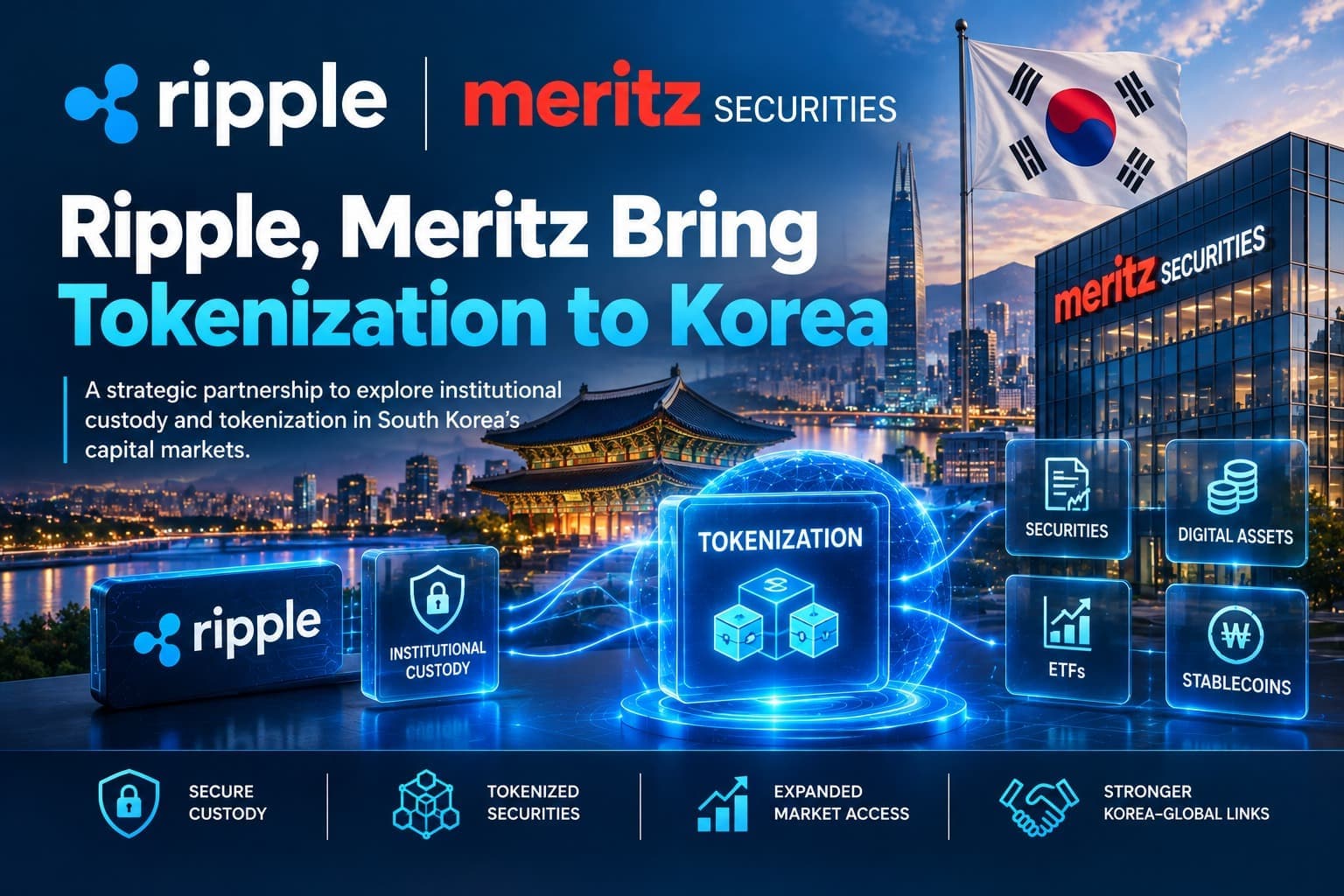
Ripple has partnered with South Korea’s Meritz Securities to explore institutional digital-asset custody and tokenization, extending Ripple’s infrastructure deeper into one of Asia’s most active financial markets.
Announced on October 14, the strategic partnership will examine how Ripple Custody and Ripple’s tokenization infrastructure could be integrated into Korea’s capital markets. The companies plan to begin within Meritz Securities’ existing business scope and current regulations before potentially expanding their cooperation as South Korea’s digital-asset framework develops.
BINANCE:XRPUSDT
The agreement is notable for both companies. Meritz becomes Ripple’s first securities-firm partner in Korea and its fourth Korean institutional relationship announced in 2026, following projects spanning insurance, banking and cross-border payments.
But the announcement should be interpreted carefully. It is an infrastructure partnership and exploration agreement—not confirmation that Meritz has launched tokenized securities, a stablecoin or an XRP-based product.
 Morgan Stanley Sees $10T Tokenized Asset Market→
 Nasdaq CEO: Tokenization Could Unlock Billions→
 Securitize Brings Tokenized Stocks to Solana→
 SEC Sets Compliance Seminar for Nov. 19→
Ripple Custody Moves Deeper Into Korean Finance
At the center of the partnership is Ripple Custody, the company’s platform for regulated financial institutions to store, transfer and settle digital assets.
Institutional digital-asset infrastructure involves substantially more than maintaining a cryptocurrency wallet. Banks, securities firms and asset managers need controls around private keys, transaction authorization, governance, compliance and auditability.
Ripple says its custody infrastructure allows financial institutions to maintain control over their keys while implementing programmable approval processes and other security controls.
That infrastructure could become increasingly important as conventional securities move onto blockchain networks.
Meritz Securities is exploring several areas of digital finance, including spot digital-asset ETFs, fractional investment products, security tokens, digital-asset trading platforms and Korean won-denominated stablecoins.
The partnership does not mean all those products will be launched. Instead, Ripple’s technology is being evaluated as potential infrastructure as Meritz prepares for a financial market in which traditional and blockchain-based assets increasingly coexist.
Ripple provides additional technical details on its Ripple Custody platform.
Meritz Is Preparing for Tokenized Capital Markets
The timing of the agreement matters.
South Korea has been gradually developing a regulatory framework for bringing digital assets and tokenized securities into the regulated financial system. Securities firms therefore need infrastructure capable of meeting conventional financial-market requirements while interacting with blockchain-based assets.
Meritz is approaching the transition in stages.
“This partnership lays the foundation for combining Ripple’s global digital asset infrastructure with our capital markets capabilities,” Byungha Kang, Managing Director of the Strategic Planning Unit at Meritz Securities, said in Ripple’s announcement.
Kang added that the securities firm intends to prepare “safe and trusted digital asset financial services in stages” as Korea’s regulatory framework evolves.
That qualification is important.
The companies are not bypassing the existing securities system. Their stated approach is to begin with activities permitted under current rules and expand as the regulatory environment changes.
For an introduction to the broader market, CryptoQuorum’s guide to real-world asset tokenization explains how stocks, bonds, funds and other traditional assets can be represented and managed through blockchain infrastructure.
Korea Becomes an Important Market for Ripple
The Meritz agreement is part of a broader institutional expansion by Ripple in South Korea.
Earlier this year, Ripple partnered with Kyobo Life Insurance on a project designed to explore Korea’s first tokenized government-bond settlement using blockchain infrastructure.
The project uses Ripple Custody to support tokenized government-bond transactions in a regulated institutional environment, with the companies examining whether blockchain can reduce settlement friction.
Ripple also works with Kbank, Korea’s first internet-only bank, which is deploying digital-asset wallet infrastructure through Ripple Custody.
Jeonbuk Bank, meanwhile, became Ripple’s first Korean regional-bank customer for Ripple Payments, using the company’s infrastructure for cross-border remittances.
Meritz extends that institutional footprint into securities.
Ripple now has announced relationships spanning Korean banking, insurance and capital markets, giving the company several different channels through which its infrastructure can be tested against real financial-industry requirements.
Ripple Sees Institutions Moving Toward Real-World Utility
Fiona Murray, Ripple’s Managing Director for Asia Pacific, characterized Korea as a market moving beyond experimentation.
“Korea is one of the most dynamic digital asset markets in the world and its institutions are preparing to move from exploration to real-world utility,” Murray said.
According to Ripple, the company now operates across more than 60 markets and has more than 85 regulatory licenses globally.
Those figures come from Ripple and should be understood as company-reported metrics, but they help explain the strategy behind the Meritz partnership.
Ripple is increasingly positioning itself not simply as a blockchain payments company, but as an infrastructure provider spanning payments, custody, tokenization, stablecoins and institutional financial markets.
That strategy is also visible in Ripple Prime.
CryptoQuorum recently reported on Ripple Prime’s expansion with Brevan Howard, which extends Ripple’s institutional business across brokerage, clearing and financing.
Its Delta One business similarly connects digital assets with U.S.-listed equities, indices and traditional institutional market infrastructure.
The Meritz agreement adds another component: the custody and tokenization layer required to securely hold and manage blockchain-based financial assets.
Why Custody Matters for Tokenization
Tokenization receives considerable attention for potentially making securities transferable around the clock or enabling faster settlement. But those benefits cannot operate at institutional scale without reliable custody.
A tokenized bond or stock still needs mechanisms controlling who can hold it, who can transfer it and under what conditions a transaction can be authorized.
Regulated institutions also need to manage operational and cybersecurity risks.
Private-key loss or compromise can have consequences fundamentally different from errors in conventional account-based financial infrastructure. Governance rules therefore need to determine who can authorize transactions and what happens if credentials are compromised.
This makes custody one of the foundational layers connecting traditional finance with blockchain networks.
Ripple says its platform supports tokenized real-world assets, stablecoins and cryptocurrencies while allowing institutional customers to retain control of their keys.
For Meritz, the immediate value may therefore be less about any individual cryptocurrency and more about preparing infrastructure capable of supporting multiple forms of digital financial assets.
Security Tokens Could Become a Key Use Case
Among the areas Meritz is examining, security tokens have particularly strong relevance to its existing securities business.
Tokenized securities can represent conventional financial instruments using blockchain-based records while remaining subject to applicable securities regulation.
Potential applications include equities, bonds, fractional investments and fund interests.
The attraction is not simply that an asset becomes a blockchain token.
Well-designed tokenization infrastructure can potentially combine ownership records, transfers, compliance rules and settlement within more programmable systems. That could reduce some reconciliation processes and allow financial institutions to develop new distribution models.
But tokenization does not automatically create liquidity or eliminate legal obligations.
A security remains dependent on the rights attached to the underlying instrument, its regulatory treatment, custody structure and the ability of investors to trade or redeem it.
Those distinctions will be critical as Korean institutions move from pilot programs toward commercial products.
No Confirmed XRP Role in the Meritz Partnership
For XRP investors, an important distinction needs to be made.
Ripple’s announcement does not state that Meritz Securities will use XRP. It also does not confirm that the XRP Ledger will host any future Meritz tokenized securities or that RLUSD will be used for settlement.
Ripple and XRP are related but should not be treated as interchangeable.
The company operates multiple institutional businesses that do not necessarily require XRP, and Ripple Custody can support a range of digital assets and blockchain networks.
Therefore, it would be premature to conclude that the Meritz partnership creates direct demand for XRP.
That could change if the companies later announce specific products using the XRP Ledger, XRP or RLUSD. Until then, the evidence supports a narrower conclusion: Meritz is evaluating Ripple’s custody and tokenization infrastructure.
CryptoQuorum has separately covered RLUSD’s growth beyond $2 billion and Ripple’s efforts to position the stablecoin for institutional payments, settlement and tokenization use cases.
Korea Is Emerging as an Institutional Tokenization Market
The Meritz partnership also fits a much larger global trend.
Major banks, exchanges, asset managers and market-infrastructure providers are increasingly examining how conventional securities can operate on blockchain rails.
The focus is shifting from whether assets can technically be tokenized toward questions of custody, legal ownership, compliance, liquidity and interoperability.
South Korea has characteristics that make it particularly relevant to that transition: significant participation in digital-asset markets, sophisticated financial institutions and an evolving regulatory framework for tokenized financial products.
Ripple’s four Korean institutional relationships in 2026 suggest the company sees an opportunity to establish infrastructure before the market reaches greater commercial scale.
For Meritz, the partnership provides access to technology already designed for institutional digital assets without requiring the securities firm to build every custody and tokenization component internally.
What Comes Next
The most important next development will be evidence of actual products.
The companies have not announced a commercial launch date, transaction volume or specific tokenized security arising from the partnership.
They have also not disclosed financial terms.
That makes the agreement strategically significant but still preliminary.
Investors should watch for subsequent announcements identifying which products Meritz chooses to prioritize, which blockchain networks are used, how custody is structured and whether Korean regulators approve or establish additional requirements for those services.
A launch involving tokenized securities, digital-asset ETFs, stablecoins or a trading platform would represent a more concrete stage of adoption.
For now, the partnership demonstrates something broader: regulated securities firms are increasingly building the infrastructure they may need before tokenized capital markets become mainstream.
Disclaimer: This article is for informational purposes only and does not constitute investment, financial or legal advice. The partnership is exploratory, and references to potential digital-asset products do not mean those products have been approved or launched.