

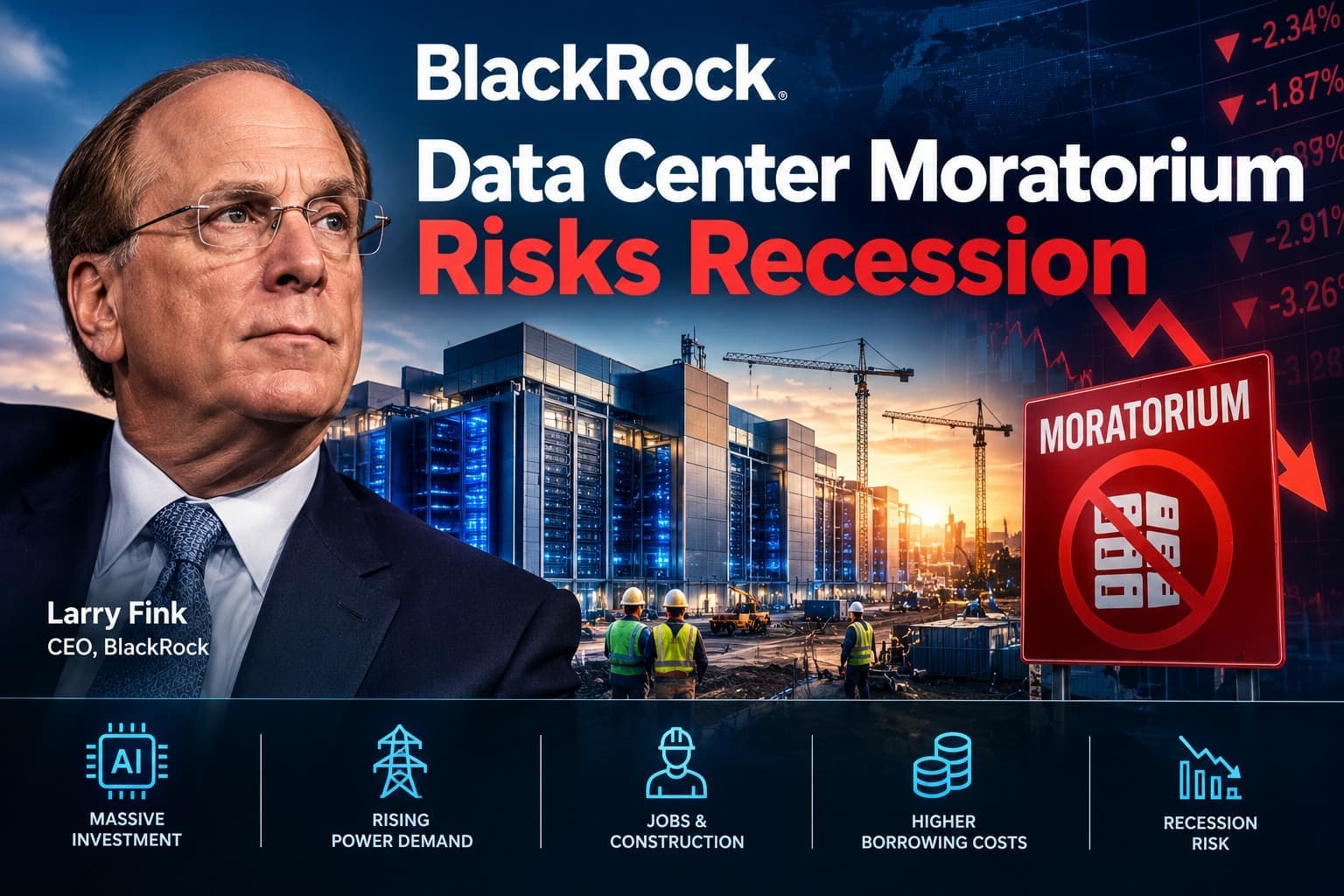
BlackRock CEO Larry Fink has warned that stopping data-center construction in the United States could push the economy into recession, arguing that the artificial intelligence infrastructure boom has become an increasingly important engine of investment and job creation.
“If we have a moratorium of some sort in this country, we will be in a recession,” Fink told CNBC on October 14. “So much of our economy is based on the build-out of this capex.”
His warning comes as the extraordinary capital spending behind artificial intelligence collides with growing concerns over electricity demand, water consumption, infrastructure costs and the impact large data centers can have on local communities.
Fink’s statement should not be interpreted as a consensus recession forecast. It represents his assessment of how important AI-related capital expenditure has become to the U.S. economy. But BlackRock’s own research illustrates the scale of the investment cycle: the firm estimates annual investment in data centers and AI chips could exceed $700 billion by 2030.
 Ripple, Meritz Bring Tokenization to Korea→
 IMF Sees Global Growth at 3.1% in 2026 as AI Boom Offsets Energy Shock→
 SEC Sets Compliance Seminar for Nov. 19→
 Ripple Expands Prime Brokerage With Brevan Howard→
The debate is therefore becoming much larger than technology. It now touches economic growth, interest rates, energy infrastructure, employment and financial markets.
Why Fink Says Data Centers Matter to the Economy
Artificial intelligence requires enormous physical infrastructure.
Behind cloud-based AI models are semiconductor plants, servers, cooling systems, power generation, transmission networks and enormous computing facilities.
That construction requires capital and labor.
Fink argued that data centers are creating jobs at a time when the United States already faces shortages of skilled workers, including electricians, plumbers and welders.
He rejected the idea that the facilities themselves are fundamentally the problem, instead emphasizing their contribution to investment and employment.
The argument reflects a major shift in how the AI boom affects the economy.
AI is no longer primarily a software story. Building the infrastructure required to train and operate increasingly sophisticated models has become an industrial investment cycle involving construction, energy, semiconductors and capital markets.
BlackRock describes the development as a “once-in-a-generation industrial buildout.”
Its research estimates that approximately 148 gigawatts of additional power capacity could be required by the end of the decade to meet projected U.S. data-center demand.
AI Is Becoming a Macroeconomic Force
The timing of Fink’s comments is particularly important because AI investment is already affecting economic forecasts.
The International Monetary Fund’s October 2026 World Economic Outlook estimates global economic growth of 3.1% this year and 3.4% in 2027, with AI-related investment helping support activity despite geopolitical and energy pressures.
The IMF also warns that this creates concentration risk.
If expectations for AI productivity prove overly optimistic and investment falls sharply, weaker capital expenditure and declining asset prices could affect economic growth.
That makes the current debate unusually complicated.
Restrict infrastructure too aggressively and investment could decline. Allow unlimited expansion without addressing electricity, water and community concerns and the buildout could create different economic and political problems.
Fink is clearly emphasizing the first risk.
BlackRock Says the U.S. Needs More Private Capital
Fink’s broader argument concerns capital formation.
“We need to unlock private capital to grow the U.S. economy by 3%,” he told CNBC.
That objective becomes harder when both government and corporations are competing aggressively for financing.
The federal government requires enormous amounts of capital to finance budget deficits. At the same time, technology companies, utilities, data-center developers and infrastructure operators need financing for the AI buildout.
That competition could contribute to structurally higher borrowing costs.
Fink separately warned that the United States may face “higher interest rates for longer” because the AI investment cycle and government deficits are simultaneously creating massive demand for capital.
That matters well beyond Silicon Valley.
Higher Treasury yields can increase mortgage rates, corporate borrowing costs and the hurdle rate for new investments. They can also affect valuations across stocks, bonds, real estate and digital assets.
In other words, the AI boom may stimulate economic activity while simultaneously increasing competition for capital.
Power Is the Critical Bottleneck
The largest physical constraint may be electricity.
BlackRock estimates approximately 194 GW of U.S. data-center power demand by 2030 under the projections used in its research, compared with 19 GW in 2025.
Even allowing for uncertainty in long-term forecasts, the direction is clear: electricity requirements are increasing rapidly.
The challenge is that computing infrastructure and electrical infrastructure operate on very different timelines.
Technology companies can deploy new chips and servers relatively quickly. Large power plants, substations and transmission projects can take years to permit and construct.
BlackRock’s research describes this as a collision between the fast-moving technology industry and a power sector designed around reliability, regulation and long-duration investment.
Developers are responding with strategies such as locating facilities in regions with available power, signing long-term electricity agreements and building generation capacity alongside computing infrastructure.
BlackRock does not currently expect power constraints to stop the AI buildout entirely. Instead, it expects the system to adapt through investment, new generation and changes in where data centers are built.
Why Communities Are Pushing Back
The economic benefits do not eliminate legitimate local concerns.
Large computing facilities can consume enormous quantities of electricity. Cooling can also require substantial water resources depending on the technology and location.
Residents and policymakers increasingly question who should bear the cost of upgrading grids needed to support hyperscale computing facilities.
If utilities spend billions on new generation and transmission, regulators must determine how those costs are allocated among technology companies, businesses and residential customers.
That creates a political problem.
Nationally, a data center may represent AI leadership, investment and economic growth. Locally, residents may see higher electricity demand, construction activity, water usage and changes to land use.
Those competing perspectives explain why calls for tighter permitting requirements or temporary restrictions have gained attention.
Fink’s argument is effectively that policymakers should solve those infrastructure problems without shutting down the investment cycle itself.
BlackRock Has Significant Exposure to the Buildout
There is another important E-E-A-T consideration when evaluating Fink’s comments: BlackRock is not a neutral observer.
The company is one of the world’s largest asset managers and a major infrastructure investor.
BlackRock completed its acquisition of Global Infrastructure Partners in 2024, substantially expanding its exposure to infrastructure investment. It later participated in the AI Infrastructure Partnership, which was established to mobilize capital for data centers and supporting energy infrastructure.
That does not invalidate Fink’s economic argument, but readers should understand the commercial context.
BlackRock and its clients can potentially benefit from large-scale investment in power generation, digital infrastructure and data centers.
Fink’s position should therefore be evaluated alongside independent economic research, community concerns and energy-market analysis rather than treated as an objective prediction that a construction pause would automatically produce a recession.
Higher Rates Could Complicate the AI Boom
The financing environment may itself become a constraint.
Data centers, power generation and semiconductor infrastructure are extraordinarily capital intensive. Many projects therefore depend on access to debt markets.
Higher interest rates increase their financing costs.
That tension became visible this week as AI-infrastructure stocks came under pressure amid expectations for tighter U.S. monetary policy.
The larger question is whether the enormous investment requirements of AI can remain economically attractive if borrowing costs remain elevated.
Fink’s answer appears to be that the investment still needs to happen because the economic and strategic benefits justify the capital required.
But markets ultimately have to determine which projects can generate adequate returns.
Not every data center will necessarily be profitable, and not every AI infrastructure investment will produce the productivity gains investors currently expect.
The IMF Sees the Same Opportunity — and the Same Risk
The AI investment cycle also connects directly with the IMF’s latest global outlook.
The IMF sees technology investment supporting economic resilience but warns that growth is increasingly concentrated among economies participating in the AI boom.
That creates a two-sided macroeconomic risk.
If AI delivers substantial productivity gains, the infrastructure investment occurring today could expand economic capacity for years.
If returns disappoint, capital spending could fall, technology valuations could decline and financial conditions could tighten.
Fink is focused on another version of the downside scenario: investment being interrupted by policy rather than by disappointing economic returns.
The causes would be different, but the transmission mechanism could be similar — less capital expenditure, weaker construction activity and reduced demand across industries connected to the buildout.
What This Means for Financial and Crypto Markets
The debate also matters for Bitcoin and other digital assets, although there is no direct causal relationship between data-center construction and cryptocurrency prices.
The connection runs through macroeconomics.
Massive AI infrastructure spending can support GDP growth and corporate earnings. But intense demand for financing can also contribute to higher bond yields and tighter financial conditions.
Higher real yields typically increase competition for capital by making government bonds and other yield-bearing assets more attractive.
Conversely, stronger productivity and economic growth could improve corporate profitability and investor confidence.
Crypto investors should therefore focus less on whether a particular data center is approved and more on the larger variables: capital expenditure, interest rates, Treasury yields, inflation, energy prices and financial liquidity.
These forces increasingly link technology investment with traditional and digital markets.
The AI Boom Has Become an Infrastructure Story
Fink’s warning illustrates how dramatically the artificial intelligence narrative has evolved.
Two years ago, the central questions concerned models, chips and software companies.
Now the debate increasingly concerns electricity grids, construction workers, debt markets, power generation and hundreds of billions of dollars in physical infrastructure.
BlackRock estimates investment in data centers and AI chips could exceed 2% of U.S. GDP annually by 2030.
At that scale, the buildout is large enough to affect economic growth and capital markets.
Whether a nationwide moratorium would actually trigger a recession cannot be known in advance and would depend heavily on its scope, duration and broader economic conditions.
But Fink’s warning highlights an important reality: AI infrastructure is no longer a niche technology investment.
It is becoming part of the physical and financial architecture of the U.S. economy.
Disclaimer: This article is for informational purposes only and does not constitute investment or financial advice. Economic forecasts and scenario assessments are uncertain, and Larry Fink’s recession warning represents his view rather than a guaranteed economic outcome.