

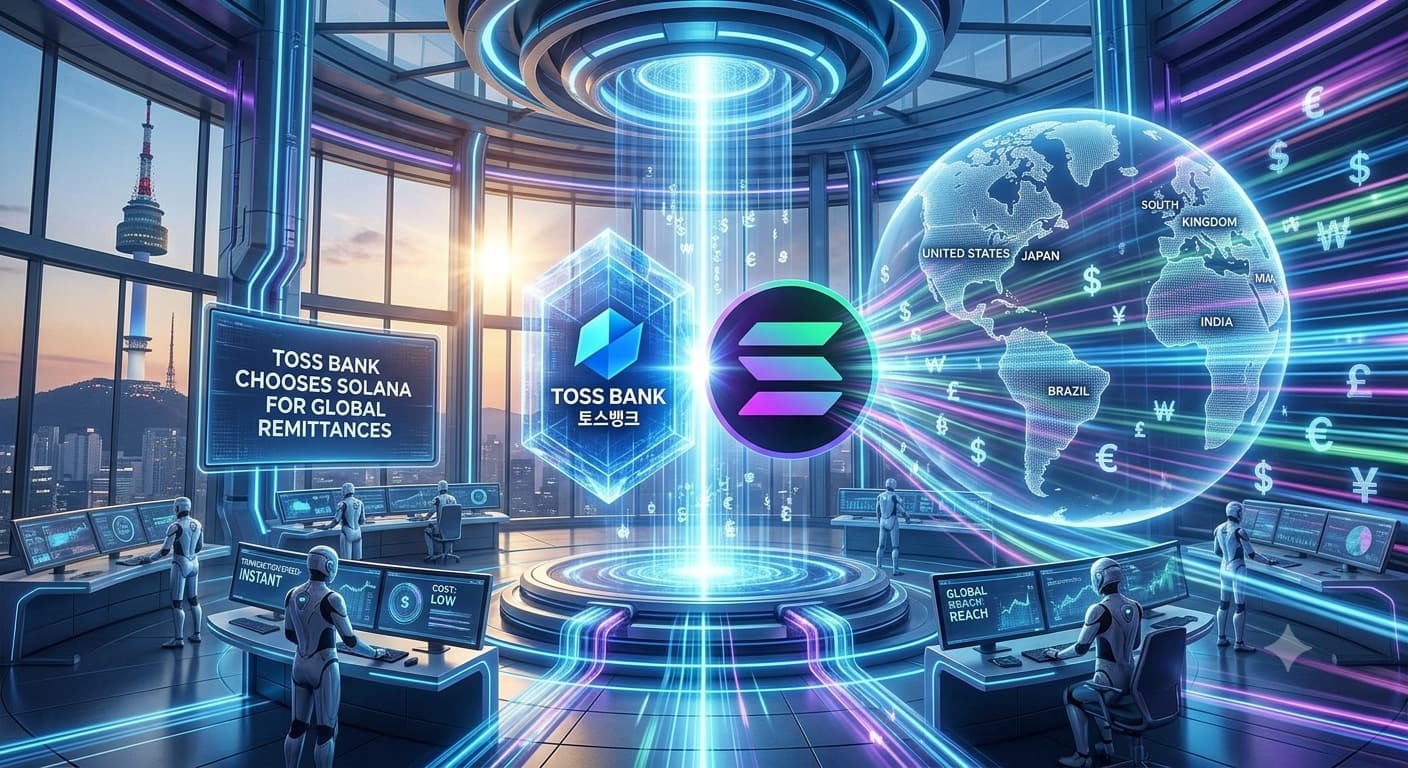
South Korea‘s third-largest internet-only bank has signed an agreement with the Solana Foundation to test blockchain-powered cross-border payments — the first partnership of its kind between a Korean digital bank and the Solana ecosystem.
On June 22, 2026, the Solana Foundation’s official X account broke the news with a single sentence that sent ripples across the fintech and crypto worlds: Toss Bank is set to use Solana for its global remittance and settlement proof of concept. The South Korean bank’s 15 million customers, the announcement stated, will be able to experience faster and more cost-effective global digital finance with Solana.
CRYPTOCAP:TOTAL Real-Time Chart
The deal, formalised in a Memorandum of Understanding signed on June 19 in Seoul, signals something larger than one bank adopting a new piece of technology. It represents the steady, irreversible advance of public blockchain infrastructure into mainstream financial services — and Solana is positioning itself at the forefront of that shift.
What Toss Bank Actually Signed
The MOU in Detail
Toss Bank signed a strategic memorandum of understanding with the Solana Foundation on cooperation for “blockchain-based next-generation financial infrastructure” at Toss’s Sinnonhyeon office in Seocho-dong, Seoul, on June 19.
 Cross River Brings RLUSD Into Core Banking→
 MoneyGram Joins XDC Network as Institutional Validator→
 Mastercard and BVNK have launched a new global payments platform→
 Fink: Data Center Moratorium Risks Recession→
The agreement focuses on developing next-generation cross-border payment infrastructure using blockchain technology. The two sides will conduct a phased proof of concept for international remittances on the Solana network, evaluate blockchain-based payment and settlement systems, and explore financial services involving stablecoins and digital assets.
The MOU covers four areas: a proof of concept for global remittance and settlement infrastructure built on Solana; joint research into blockchain-based payment and settlement models; exploration of stablecoin and digital asset financial services; and a longer-term cooperation framework that includes integration with overseas banking partners and AML/KYC compliance systems.
Crucially, this is a proof of concept, not a live product launch. The distinction matters enormously in a regulated banking environment. A proof of concept proves a mechanism works under controlled conditions; it does not commit a regulated bank to settling real customer money on a public chain tomorrow. What it does do is signal serious intent — and Toss Bank is not the kind of institution that signs MOUs for show.
Not a Greenfield Experiment
The context for this PoC is important. Toss Bank serves 15 million customers across South Korea as the country’s third-largest internet-only bank, and its overseas remittance service already covers 30 countries and 7 major currencies. That existing footprint gives the Solana-based proof of concept a non-trivial addressable base from day one.
In January, Toss Bank launched its “See-As-You-Send Overseas Remittance” service supporting transfers to 30 countries in seven major currencies, with real-time transfers within one hour already available for the euro, Singapore dollar, and pound. The blockchain layer being tested is an upgrade to a working product, not a speculative pivot.
Why Solana? The Technical Case
Speed and Cost That Traditional Banking Cannot Match
The choice of Solana for global remittances is not coincidental. Correspondent banking — the system underpinning most international wire transfers today — is slow, opaque, and expensive. Value moves through chains of intermediary banks, each adding fees and delays. Cross-border transfers through correspondent banking can take days and stack up fees at each hop. A public chain settles in seconds and exposes one transparent cost layer instead of several hidden ones.
Solana is a global top-tier public blockchain whose strengths lie in high performance, capable of processing tens of thousands of transactions per second, and low transaction costs. For a bank handling high volumes of relatively small consumer remittances, those economics are transformative.
Solana’s technical case is straightforward: sub-second finality and transaction fees measured in fractions of a cent make it a credible rail for high-volume cross-border settlement, where SWIFT-era correspondent banking costs are the baseline to beat.
Stablecoins as the Settlement Layer
The PoC does not involve customers buying or holding SOL tokens. Instead, Toss Bank is testing whether stablecoins — digital tokens pegged to fiat currencies — can act as the value transfer mechanism on top of Solana’s infrastructure. A dollar-pegged or won-pegged token can move the value while the chain handles final settlement, sidestepping the pre-funded nostro accounts that make traditional remittance corridors slow and capital-heavy.
In the first phase, Toss Bank will design the user experience and connect its existing overseas transfer service to Solana’s high-throughput network to measure speed, cost, and reliability.
Expert Opinions: What Industry Leaders Are Saying
Lily Liu, Solana Foundation: A New Standard for Remittances
The strongest statement on the partnership came from Lily Liu, chair of the Solana Foundation, who attended the Seoul signing ceremony in person. “We will set a new standard for faster, more seamless global remittances by combining the trust of traditional finance with the efficiency of blockchain,” Liu said.
That framing — combining trust with efficiency — is deliberate. The biggest barrier to blockchain adoption in banking has never been technical capability. It has been institutional trust. By partnering with a regulated consumer bank rather than a crypto-native startup, Solana is demonstrating that public blockchain infrastructure can meet the compliance and reliability standards that banks require.
Park Jin-hyeon, Toss Bank: A Starting Point, Not an Endpoint
Park Jin-hyeon, head of strategy at Toss Bank, said the cooperation was a starting point for gradually applying blockchain-based digital financial infrastructure to the financial services it is already operating. He said the bank will work with Solana to verify the possibility of enabling experiences in global digital finance.
“This partnership marks the first step toward integrating blockchain-based digital infrastructure into our existing financial services,” Park said. The language of gradual, phased integration is important: Toss Bank is signalling that blockchain adoption is strategic roadmap planning, not a one-off experiment.
Solana’s Growing Institutional Roster
The Toss Bank deal does not stand alone. The deal fits into a broader South Korean push to build a stablecoin-ready payments stack. Earlier this year, Shinhan Card and Woori Bank each announced separate stablecoin and Solana-linked pilots, and the Solana Foundation has worked with Wavebridge on a Korean won-pegged stablecoin for banks.
Beyond South Korea, Solana’s financial institution pipeline has been growing rapidly. In May, Western Union launched its USDPT stablecoin on Solana, using the network for regulated payment settlement. Earlier, Solana partnered with Google Cloud to launch Pay.sh, a payment framework designed to enable stablecoin transactions between users, applications, and AI agents.
The Bigger Picture: South Korea’s Blockchain Ambitions
Regulatory Pressure Accelerates Adoption
The timing of the Toss Bank-Solana agreement is tied directly to South Korea’s shifting regulatory landscape. South Korea plans to impose foreign exchange controls on crypto transfers starting December 2026, creating urgency for institutions to establish compliant blockchain payment frameworks ahead of that deadline.
Toss Bank plans to review the feasibility of applying blockchain infrastructure across areas including payments, digital assets and tokenized assets, starting with overseas remittances, while responding to domestic moves to legislate stablecoin-related rules. The PoC is, in part, regulatory preparation.
The Viva Republica IPO Factor
There is a corporate dimension to the announcement that deserves mention. Toss Bank’s parent company Viva Republica is preparing for a US IPO in 2026 at a valuation exceeding $10 billion. The Solana partnership adds a blockchain dimension to Toss’s product roadmap as the company pitches itself to American investors.
Viva Republica has raised over $1.2 billion from investors, including GIC, Sequoia China, and Kleiner Perkins. A credible blockchain infrastructure story enhances that narrative considerably — but as analysts have noted, the PoC results will matter more than the MOU announcement for any investor conducting serious due diligence.
What to Watch From Here
The Toss Bank-Solana partnership is a significant development, but the work is still ahead. Several critical questions remain unanswered: which specific stablecoin the PoC will use, which transfer corridors will be prioritised, and what timeline Toss Bank has set for moving from proof of concept to production.
The main questions now are whether the proof of concept can meet Korean regulatory standards, reduce transfer friction, and fit into Toss Bank’s existing financial services. No public launch date has been announced yet.
What the announcement does confirm is that the conversation in institutional finance has decisively shifted. The question is no longer whether public blockchain infrastructure will be used for cross-border payments. The question is which networks, which institutions, and at what speed. On June 22, 2026, Toss Bank and the Solana Foundation gave their answer.
CRYPTOCAP:TOTAL Real-Time Chart
Disclaimer: This article is for informational purposes only and does not constitute financial advice. Always conduct your own research before making investment decisions.