

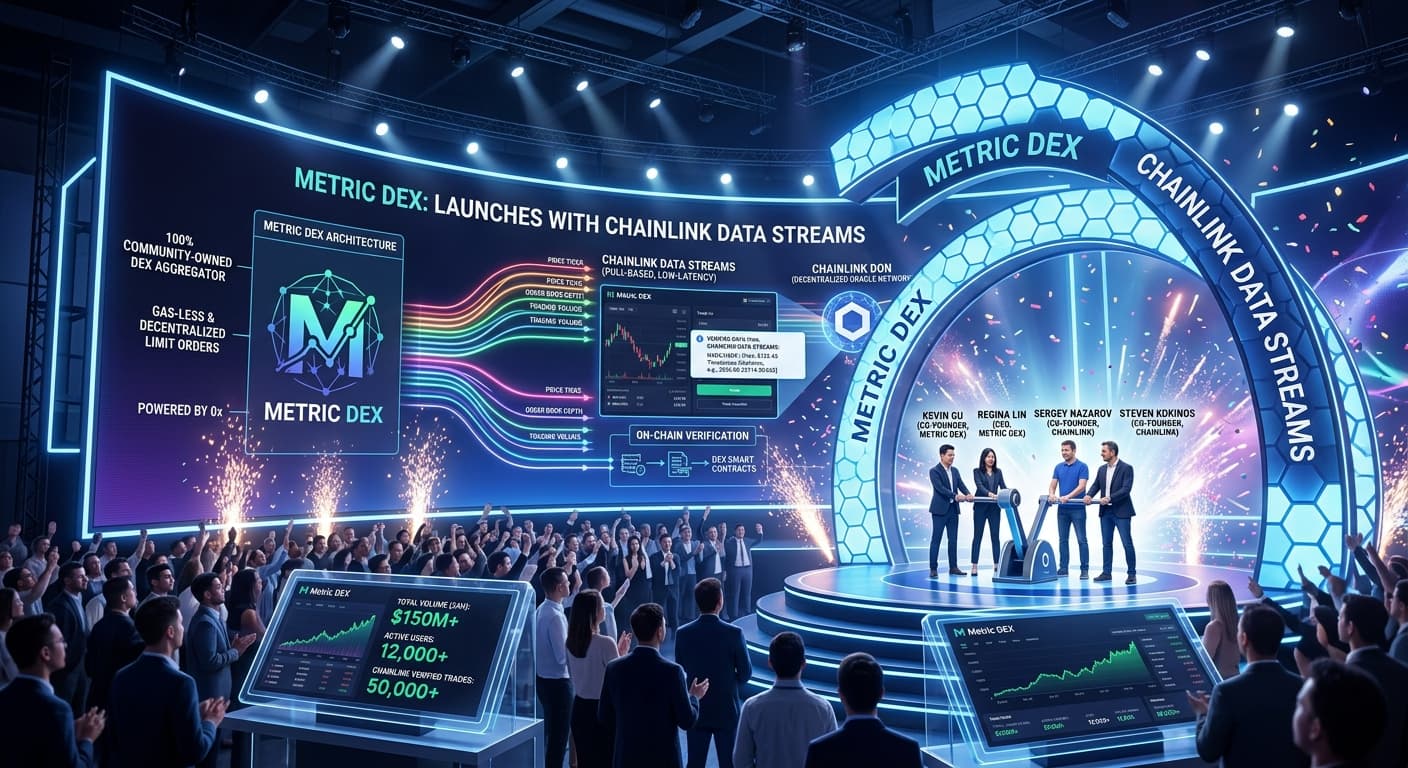
Metric has launched a new decentralized exchange (DEX) that is now live on Robinhood Chain and BNB Chain, with Chainlink Data Streams selected as its recommended price oracle solution.
The launch was announced by Chainlink on August 26, highlighting Metric’s focus on bringing deeper onchain liquidity to tokenized assets through active liquidity pools. Metric says its infrastructure is designed for tokenized stocks, ETFs, commodities, real-world assets (RWAs) and major crypto assets.
CRYPTOCAP:TOTALDEFI Real-Time Chart
The development is significant because tokenization is increasingly moving beyond simply putting financial assets on a blockchain. The next challenge is creating markets where those assets can be priced, traded and used in DeFi with sufficient liquidity.
Metric is attempting to address that problem by combining active liquidity pools with external reference pricing rather than relying exclusively on conventional onchain price discovery.
 Securitize Brings Tokenized Stocks to Solana→
 Backpack Links Tokenized Stocks to Real Shares→
 Ondo Expands Intelligent Portfolios to Seven→
 Ondo and KakaoPay Securities Explore Global Distribution of Korean Equities→
Why the launch matters for tokenized assets
Tokenized assets have grown rapidly across the blockchain industry, but liquidity remains one of the biggest structural challenges.
Creating a token representing a stock, ETF, commodity or other real-world asset is only the first step. Investors also need venues where those tokens can trade efficiently.
This creates a familiar problem.
Traditional financial markets benefit from established exchanges, market makers, reference prices, clearing infrastructure and large pools of capital. A newly tokenized asset may have the blockchain infrastructure necessary for issuance but still lack the market depth required for efficient trading.
Metric’s approach is aimed at this gap.
The project describes its active pools as markets where tokenized assets can trade against external reference prices while retaining onchain liquidity and DeFi composability. Metric previously said its pools were designed for tokenized equities, RWAs and crypto assets, with the goal of providing continuous trading and deeper liquidity.
That makes the oracle layer particularly important.
Chainlink Data Streams provides the price reference
A DEX dealing with tokenized traditional assets cannot rely exclusively on the token’s own trading history if the underlying asset has a reference market elsewhere.
For example, a tokenized representation of an equity may trade onchain while the underlying security continues to trade on a traditional exchange.
The DEX therefore needs reliable information about the external market.
Chainlink Data Streams is designed for precisely this type of low-latency application. Chainlink describes Data Streams as a pull-based oracle system that provides high-frequency market data to onchain applications, with sub-second data delivery and information such as prices, market status and liquidity indicators.
That architecture differs from traditional push-based oracle models.
With a push oracle, data is periodically written onchain according to predefined update conditions. With a pull-based system, an application can request a fresh signed report when it needs the information.
For active trading markets, that distinction can matter.
A price that was accurate several seconds or minutes ago may not be sufficient for an application dealing with rapidly changing market conditions.
Why external pricing can improve RWA markets
Metric’s model is built around a relatively simple concept: tokenized assets do not necessarily need to establish an entirely new price discovery mechanism onchain.
Instead, an onchain market can reference pricing from established markets while allowing execution and liquidity to occur on blockchain infrastructure.
This approach could be particularly useful for tokenized equities and ETFs.
Chainlink says its Data Streams infrastructure can provide real-time pricing for U.S. equities, ETFs, foreign exchange and commodities, while also supplying metadata that helps applications distinguish fresh prices from stale information and recognize market closures or trading halts.
That functionality becomes increasingly important when traditional assets are represented on networks that operate 24/7.
A U.S. stock exchange can close for the weekend. A blockchain does not.
Without appropriate market-status information, an onchain application could potentially continue operating against a reference price that no longer represents an active traditional market.
Context-aware oracle data therefore becomes more than a simple price feed.
The connection between liquidity and accurate pricing
There is another important part of Metric’s design.
Liquidity and pricing are closely connected.
A DEX with shallow liquidity can produce large price movements from relatively small trades. That creates slippage and can make the market unattractive to larger traders.
Conversely, deeper liquidity can improve execution and make tokenized assets more useful as collateral or components of other DeFi applications.
Metric’s active-pool model is intended to address this by anchoring pool pricing to external reference values while allowing liquidity to remain onchain. The company has previously described its pools as permissionless and composable, meaning they can potentially be integrated into other DeFi applications.
This is an important distinction from simply launching another spot-token exchange.
If tokenized assets can become usable within lending protocols, derivatives markets, automated strategies and collateral systems, their utility can expand significantly.
BNB Chain is becoming an important RWA venue
The launch also fits into a broader expansion of tokenized assets on BNB Chain.
BNB Chain reported in June that its ecosystem had more than 709 tokenized stocks and ETFs, with cumulative tokenized-stock trading volume exceeding $5 billion and market capitalization surpassing $1 billion.
The network has also positioned itself as infrastructure for a broader range of RWAs, including U.S. Treasury products, money-market funds, private credit, real estate, equities, ETFs and commodities.
That provides Metric with a potentially significant addressable market.
The more tokenized assets become available on a blockchain, the greater the potential demand for venues where those assets can trade and interact with DeFi applications.
BNB Chain‘s low-cost EVM environment also gives developers a relatively familiar infrastructure for building these applications.
CryptoQuorum has previously examined the broader shift toward tokenized real-world assets in its analysis of Solana‘s RWA expansion and crypto market trends in 2026.
Robinhood Chain adds another dimension
The Robinhood connection is equally notable.
Chainlink’s developer documentation confirms that Data Streams became available on Robinhood Chain Mainnet in July 2026, alongside Chainlink Data Feeds and CCIP support.
That means the Metric launch arrives within a broader effort to establish oracle and interoperability infrastructure on Robinhood’s blockchain.
For tokenized assets, this could become strategically important.
Robinhood has a large existing financial-services user base, while blockchain-based markets can potentially offer around-the-clock settlement and programmable asset functionality.
The combination creates an interesting bridge between a consumer-facing financial platform and onchain capital markets.
However, availability of infrastructure should not be confused with guaranteed adoption. The long-term significance of the launch will depend on actual trading activity, liquidity, user participation and the number of tokenized assets that ultimately gain meaningful volume.
Expert opinions: the oracle problem is becoming more important
Chainlink’s own documentation illustrates why oracle infrastructure has become a critical component of DeFi.
The company says Data Streams is designed to support latency-sensitive applications including perpetual futures, options and tokenized markets. It also provides liquidity-weighted bid/ask information and volatility data that can be used for more sophisticated risk-management systems.
There is also broader evidence that the market is moving toward more sophisticated RWA infrastructure.
DeFiLlama‘s Q1 2026 RWAfi report estimated that onchain RWA market capitalization had reached approximately $28.6 billion, while only around $2.81 billion was deployed within DeFi protocols. That gap illustrates the difference between tokenization and actual DeFi utilization.
In other words, the industry does not only need more tokenized assets.
It needs markets, liquidity and composability.
That is precisely where a DEX such as Metric is attempting to position itself.
What could Metric change for DeFi?
If the model works at scale, tokenized assets could become much more integrated into the broader DeFi economy.
Potential applications include:
- 24/7 trading: Blockchain markets can operate outside traditional exchange hours.
- Collateral: Tokenized assets could potentially be integrated into lending and credit markets.
- Liquidity: Active pools can provide continuous onchain execution.
- Composability: Tokenized assets can potentially interact with other smart contracts.
- Global access: Blockchain infrastructure can reduce some of the geographic limitations associated with traditional markets.
- Programmable finance: Tokenized securities can become components of automated strategies.
But these benefits depend on regulatory and structural constraints.
A token representing a traditional security does not necessarily provide unrestricted ownership rights. KYC, investor eligibility, transfer restrictions, custody arrangements and jurisdictional requirements can all affect how an RWA token is used.
BNB Chain itself notes that many tokenized RWA platforms use KYC/AML controls, wallet whitelisting and transfer restrictions to comply with regulatory requirements.
Therefore, the growth of tokenized markets should not be viewed as simply “traditional finance without rules.”
Instead, blockchain is increasingly being used to redesign parts of the existing financial infrastructure.
The bigger picture: from tokenization to usable markets
Metric’s launch highlights a fundamental transition in the RWA sector.
The first phase was about putting assets onchain.
The second phase is about making those assets liquid and useful.
A tokenized stock that sits in a wallet but cannot trade efficiently has limited utility. A tokenized Treasury product that can be used as collateral or integrated into an automated financial strategy has substantially greater potential.
This is why oracle infrastructure matters.
Accurate external pricing is one of the bridges connecting traditional markets with blockchain execution.
Metric is betting that active liquidity pools, reference pricing and DeFi composability can create a more functional market structure for tokenized assets.
Chainlink, meanwhile, is expanding its role as the data infrastructure connecting those onchain markets to external financial information. Chainlink’s own metrics currently show more than $33 trillion in cumulative transaction value enabled and approximately $48.3 billion in total value secured across its oracle ecosystem, although these are Chainlink-defined metrics rather than independent measures of economic activity.
What to watch next
The launch is significant, but the real test starts now.
Investors and developers should watch:
- Actual trading volume on Metric.
- Liquidity depth across active pools.
- Number and type of tokenized assets supported.
- Oracle coverage and update performance.
- Integration with lending and other DeFi protocols.
- Activity on Robinhood Chain versus BNB Chain.
- Regulatory treatment of tokenized securities.
Metric’s arrival does not guarantee that tokenized assets will immediately achieve deep liquidity.
But it addresses one of the industry’s most important bottlenecks: connecting tokenized real-world assets to functioning, continuously priced onchain markets.
The combination of Metric, Chainlink Data Streams, BNB Chain and Robinhood Chain therefore represents more than another DEX launch.
It is another test of whether blockchain infrastructure can move RWAs from passive tokenized representations into active, composable financial markets.
If that transition succeeds, the next phase of tokenization may be defined less by how many assets are issued onchain and more by how efficiently those assets can actually be traded and used.
CRYPTOCAP:TOTAL3 Real-Time Chart
Disclaimer: This article is for informational and educational purposes only and does not constitute investment, financial, legal or tax advice. Tokenized assets, decentralized exchanges, cryptocurrencies and DeFi protocols involve substantial risks, including market volatility, smart-contract vulnerabilities, oracle failures, liquidity risk, regulatory restrictions and potential loss of capital. Readers should conduct independent research and consult qualified professionals before making financial decisions.