

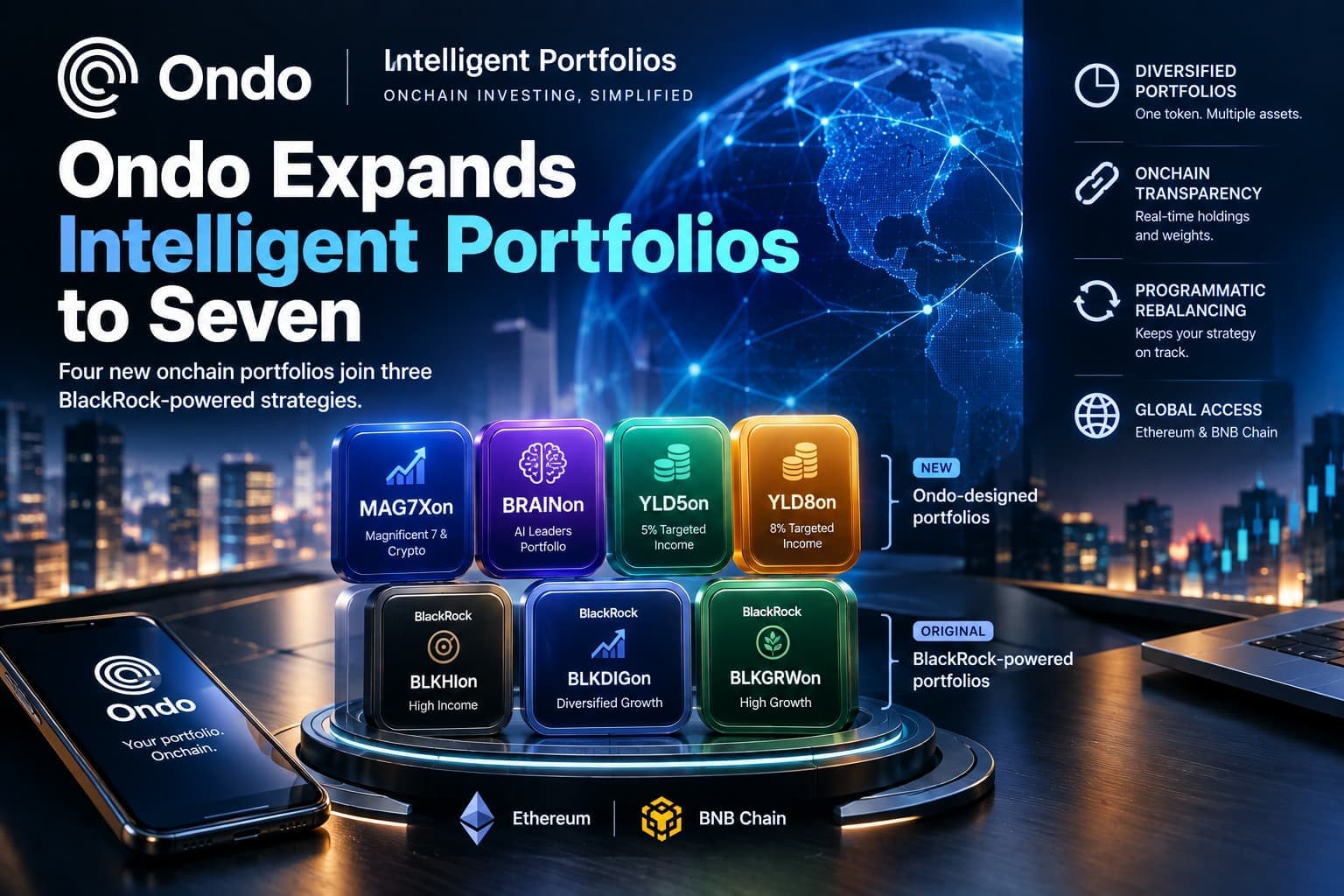
Ondo Expands Intelligent Portfolios lineup from three products to seven, adding new strategies focused on Big Tech, artificial intelligence, crypto exposure and targeted income.
The four new products are MAG7Xon, BRAINon, YLD5on and YLD8on. They join three portfolios launched in September using portfolio strategies developed by BlackRock for Ondo: BLKHIon, BLKDIGon and BLKGRWon.
Ondo said the expanded lineup is available to eligible investors outside the United States on Ethereum and BNB Chain, through supported wallets, exchanges and decentralized-finance applications. The company describes the products as single onchain tokens representing diversified baskets rather than individual securities.
Four new portfolios target different market themes
The new products are designed around distinct investment themes. Rather than requiring users to buy several tokenized assets individually, each portfolio packages a predetermined allocation into one transferable token.
 Ondo and KakaoPay Securities Explore Global Distribution of Korean Equities→
 What Are Real-World Assets (RWA)? A Guide to Tokenization→
 Ondo Intelligent Portfolios Bring BlackRock Strategies Onchain→
 CFTC Clarifies Tokenized Collateral Rules and On-Chain Recordkeeping→
| Portfolio | Focus | Model provider | Structure |
|---|---|---|---|
| MAG7Xon | Magnificent 7 + crypto | Ondo | 80% equal-weight Magnificent Seven, 15% Bitcoin, 5% Ethereum |
| BRAINon | Artificial intelligence | Ondo | Roughly 85% equities and 15% AI-focused ETFs |
| YLD5on | Targeted income | Ondo | Targets approximately 5% income |
| YLD8on | Targeted income | Ondo | Targets approximately 8% income |
MAG7Xon combines Apple, Microsoft, Alphabet, Amazon, NVIDIA, Meta and Tesla with Bitcoin and Ethereum. Ondo’s current product documentation specifies an 80% equal-weight allocation to the seven technology companies, with 15% in Bitcoin and 5% in Ethereum.
BRAINon takes a broader approach to the artificial-intelligence theme. Ondo describes it as a modified market-cap strategy covering areas such as semiconductors, AI infrastructure and power, with the target structure split between individual equities and AI-themed ETFs.
YLD5on and YLD8on are designed around income rather than a specific technology theme. Ondo says the 5% portfolio can use high-yield and covered-call ETFs, corporate and government bonds, securitized debt and REITs, while the 8% strategy incorporates high-yield preferred securities, covered-call equity ETFs, corporate bonds and REITs. The stated percentages are targets, not guaranteed returns.
From three BlackRock strategies to seven products
The expansion follows the launch of the original three portfolios on September 24.
Those portfolios — Ondo High Income Powered by BlackRock, Ondo Diversified Growth Powered by BlackRock and Ondo High Growth Powered by BlackRock — use model portfolio strategies developed by BlackRock specifically for Ondo. They give eligible non-U.S. investors economic exposure to diversified baskets through a single token.
BlackRock Global Head of Model Portfolio Solutions Lisa O’Connor said tokenization provides a new way to deliver established portfolio-construction approaches through digital infrastructure. Her comments, reported by The Block, emphasized that diversified strategies can be incorporated into tokenized investment products and delivered through a single instrument.
That distinction is significant because BlackRock is not the manager or sponsor of the seven onchain portfolios. Ondo’s disclosures state that BlackRock’s role is limited to providing nondiscretionary model portfolio strategies for the initial three products. Ondo manages, sponsors and administers the portfolios.
How the single-token model works
The central concept is relatively straightforward.
Each portfolio token tracks a basket of underlying tokenized assets. Investors hold the portfolio token rather than separately managing every underlying position. Ondo says the constituent holdings are fully backed 1:1, with dividends and other income generally reinvested at the underlying-asset level.
The portfolios are also designed for programmatic rebalancing. As market prices change, the actual weights of the holdings can move away from their target allocations. Rebalancing subsequently adjusts those underlying positions back toward the model’s base weights.
Ondo says the process is visible onchain, allowing users to inspect the portfolio’s constituents, weights and rebalancing activity.
This creates a different product structure from a conventional ETF.
Ondo’s documentation explicitly says Intelligent Portfolio tokens are not ETFs, tokenized individual stocks or tokenized ETFs. They are tracker certificates that provide economic exposure to a weighted basket of underlying tokenized securities and other eligible assets. Investors do not receive direct shareholder rights in the underlying companies.
Why the development matters for tokenized markets
The expansion reflects a broader shift in the real-world-assets sector from tokenizing individual securities toward tokenizing portfolio construction itself.
Traditional investing often separates asset selection, portfolio weighting, custody, rebalancing and settlement across multiple intermediaries. A blockchain-based portfolio token can combine some of those functions into a single onchain instrument.
Ondo is positioning this as an extension of its existing tokenization business. The company’s platform already provides access to tokenized U.S. stocks and ETFs, while its newer portfolio products bundle those instruments into predefined strategies.
For investors interested in the wider RWA sector, CryptoQuorum’s Real-World Assets coverage tracks developments in tokenized securities, funds and institutional blockchain infrastructure.
The new portfolios also connect directly with the growing convergence between artificial intelligence and financial markets. BRAINon provides a dedicated AI-equity strategy, while MAG7Xon combines mega-cap technology companies with Bitcoin and Ethereum.
CryptoQuorum readers can follow additional developments in this area through the site’s AI & Crypto coverage.
The role of DeFi and 24/7 markets
Ondo’s model is also designed around the characteristics of blockchain infrastructure.
The company says eligible holders can transfer the portfolio tokens peer-to-peer and use them within supported DeFi applications, subject to jurisdictional and platform restrictions. The underlying assets themselves are tied to traditional markets, while the portfolio token provides an onchain representation of the overall allocation.
John Hoffman, Ondo’s managing director and head of product portfolios, has argued that tokenization is moving beyond simply putting individual assets on a blockchain. In a September discussion about the launch, he described the next stage as bringing portfolio construction itself onchain and compared the development to a potential “SPY moment” for onchain finance.
That is an industry executive’s interpretation rather than an established market outcome. The more measurable development is that portfolio strategies can now be represented by transferable blockchain tokens and rebalanced according to predefined rules.
Access remains subject to restrictions
The expansion should not be interpreted as universal retail access.
Ondo’s current product page states that the products are not available in the United States or to U.S. persons. The company also lists additional restrictions for other jurisdictions, including qualified-investor requirements in the European Economic Area and United Kingdom and professional-client requirements in Switzerland. Minting and redemption require onboarding and eligibility checks.
Secondary trading availability can also differ from primary issuance and redemption. Ondo states that portfolio tokens can trade through supported secondary markets, while minting and redemption operate around the trading hours of their underlying markets.
For that reason, the launch represents an infrastructure and product-development milestone rather than evidence that tokenized portfolio products have become equivalent to conventional funds or ETFs.
A broader experiment in onchain asset management
The seven-product lineup gives Ondo a wider range of strategies to test on blockchain infrastructure: concentrated exposure to the largest U.S. technology companies, an AI-focused equity theme, and two income-oriented approaches alongside the original BlackRock-developed portfolios.
The larger significance may be the underlying architecture. Instead of treating tokenization solely as a method for representing one security onchain, the model applies blockchain infrastructure to the portfolio layer — allocation, transparency, transfers and rebalancing.
That direction is consistent with Ondo’s stated strategy of moving financial-market infrastructure onchain. Whether these products gain significant adoption will depend on factors including liquidity, regulation, costs, investor demand and the practical advantages users receive compared with established investment vehicles.
For now, Ondo has expanded its Intelligent Portfolio lineup to seven products, with four strategies designed internally and three based on BlackRock-developed model portfolios.
Disclaimer
This article is for informational purposes only and does not constitute investment, financial, tax or legal advice. Target yields are not guaranteed, and digital-asset and tokenized-security investments involve market, liquidity, regulatory, counterparty, custody and technology risks. Product availability and eligibility vary by jurisdiction and may change.
Sources: Ondo Finance official product documentation and announcement.