

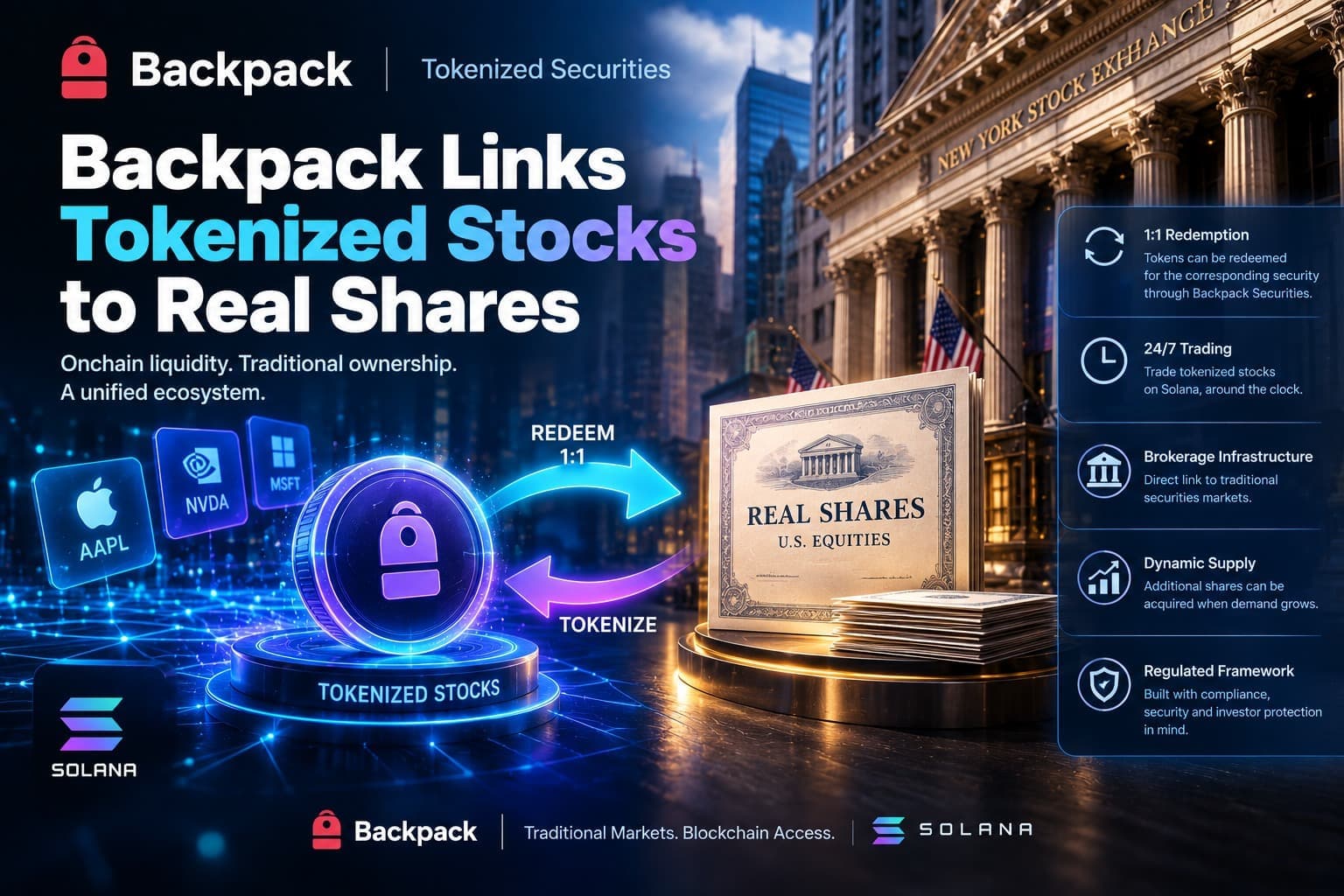
Backpack is expanding the connection between traditional equities and blockchain markets by allowing its tokenized securities to move back into the corresponding underlying shares through its brokerage infrastructure.
The mechanism was highlighted in a recent Solana post featuring Vibhu Norby, who explained how Backpack handles supply and redemption when demand for an onchain stock exceeds the number of tokens already available.
BINANCE:SOLUSDT
“Backpack is a full brokerage, so it’s one-to-one,” Norby said, describing a model in which the platform seeds onchain liquidity and can progressively acquire additional shares through its brokerage operation when demand grows.
The development is important because not all blockchain-based stock products provide the same legal or economic connection to an underlying security. Backpack’s model is designed around a two-way path: traditional securities can be converted into tokenized form on Solana, and the tokenized position can subsequently be redeemed back through the brokerage system.
 Ondo Expands Intelligent Portfolios to Seven→
 Ondo and KakaoPay Securities Explore Global Distribution of Korean Equities→
 What Are Real-World Assets (RWA)? A Guide to Tokenization→
 Ondo Intelligent Portfolios Bring BlackRock Strategies Onchain→
Backpack launched its securities business in June 2026 specifically around that connection between traditional brokerage ownership and blockchain-native distribution. Its stated objective is to combine real securities ownership, tokenization and a unified account structure.
How the Backpack model works
The basic structure resembles a bridge between two financial systems rather than a replacement for one with the other.
Backpack Securities says users can purchase and hold traditional U.S. securities through brokerage infrastructure and then convert those positions into tokenized securities on Solana. The reverse transaction allows the tokenized position to be converted back into the corresponding security entitlement through Backpack.
That creates a four-stage process:
| Stage | What happens |
|---|---|
| 1. Buy | An investor acquires the underlying equity through brokerage infrastructure |
| 2. Tokenize | The position is converted into a blockchain-based token |
| 3. Trade | The token can be transferred and traded on Solana, subject to eligibility and platform rules |
| 4. Redeem | The tokenized position can be converted back into the corresponding security through Backpack |
The important point is that the token is not presented merely as a price tracker. Backpack’s published product descriptions state that its securities, including tokenized MSTR, MU, LLY and other equities, are redeemable 1:1 for the underlying securities through Backpack Securities.
This two-way structure is becoming a defining feature of Backpack’s approach to onchain equities.
What “one-to-one” means
The phrase “one-to-one” can sound simple, but it is worth understanding precisely.
For Backpack-issued securities, the company says that each token is redeemable for one corresponding unit of the underlying security. Its documentation also distinguishes these products from many tokenized stock instruments that primarily provide synthetic or contractual exposure to a stock price.
However, investors should not automatically assume that holding a token is identical in every legal respect to holding the company’s ordinary stock directly in a traditional brokerage account.
The SEC has explicitly warned that tokenized securities can differ in structure and that the rights attached to a tokenized instrument may be materially different from those of the underlying security. The Commission’s January 2026 statement also distinguishes securities tokenized by issuers from securities tokenized by unaffiliated third parties.
Backpack’s own materials therefore matter more than the generic label “tokenized stock.” The relevant questions are who holds the underlying asset, what the token legally represents, how redemption works and which shareholder rights are carried through.
A dynamic supply model
Norby’s comments also point to another part of the architecture: supply can expand in response to demand.
Suppose an onchain token has been created against a pool of underlying shares, but demand for the token increases faster than the available token supply.
Under the mechanism described by Norby, Backpack can purchase additional shares through its brokerage side and then mint additional tokenized units against those positions. The intended result is an elastic token supply that remains connected to underlying securities rather than relying solely on a fixed pool of tokens.
Backpack’s existing product documentation supports the general concept. Its tokenized MSTR, for example, is described as a Solana-based security backed by the corresponding underlying stock and redeemable 1:1 through Backpack Securities.
Economically, this resembles the mint-and-redemption mechanism used elsewhere in tokenized real-world assets, although the legal structures and custody arrangements can differ significantly between issuers.
Why brokerage infrastructure matters
The brokerage component is one of the most important parts of Backpack’s model.
Backpack Securities was launched as a securities platform built around the idea that blockchain distribution should connect to established ownership and settlement infrastructure rather than operate as a completely separate financial system.
The company says traditional security entitlements on Backpack are governed by New York law under UCC Article 8 and that users can move between traditional securities and tokenized positions through deposits and withdrawals. (Backpack)
That infrastructure provides the pathway through which an investor can move from an onchain position back into traditional securities.
In other words, Solana supplies the blockchain-based distribution and trading environment, while the brokerage layer provides the connection to the conventional securities system.
This is materially different from a token that simply mirrors the price of Apple, Nvidia or another company while offering no mechanism for delivery or redemption of the underlying security.
24/7 trading changes the market structure
One of the attractions of putting equities on a blockchain is the potential for trading outside traditional exchange hours.
Backpack’s tokenized securities are designed to trade on Solana around the clock. Its MSTR, MU, LLY and other product pages describe 24/7 trading alongside redemption into traditional securities.
That creates a mismatch with conventional equity markets.
A Nasdaq-listed stock normally trades during defined exchange sessions, while an onchain representation can remain transferable during nights, weekends and other periods when traditional exchanges are closed.
The result is potentially faster price discovery around events such as earnings, corporate announcements or unexpected market developments. Backpack has specifically highlighted this feature in connection with tokenized Micron and Strategy securities.
There is also a structural caveat: the underlying U.S. stock market can be closed even when the tokenized market remains active. That means liquidity, pricing and spreads may behave differently outside traditional market hours.
Backpack is expanding beyond a handful of stocks
The model has already expanded well beyond the first tokenized equity launches.
Backpack introduced tokenized SpaceX in June, followed by Micron, SanDisk and other securities. In September, the company added Forward Industries, Hertz and an iShares MSCI South Korea ETF among other products.
On October 3, Backpack also launched tokenized BlackRock shares ($BLK) on Solana, with the company stating that each token can be redeemed 1:1 for a traditional BlackRock share through Backpack Securities.
The widening product range suggests that the focus is shifting from demonstrating that one stock can be represented onchain to building a broader equity market accessible through blockchain infrastructure.
Solana’s own ecosystem reporting shows the same trend at the network level. In September, tokenized-equity supply on Solana reached a reported $684 million, while the network hosted products from multiple providers, including Backpack Securities, xStocks, Ondo, Sunrise, Superstate and Securitize.
Vibhu Norby: the equity can move between systems
Norby’s comments offer a useful description of the intended user experience.
He explained that a user can move equity from a brokerage account onto the blockchain and later take it back offchain, with the equity remaining connected throughout the process.
That concept is central to the broader tokenization thesis: blockchain infrastructure does not necessarily have to replace securities markets. Instead, it can provide another distribution and transaction layer while maintaining a link to conventional custody and ownership systems.
The approach is consistent with Backpack co-founder and CEO Armani Ferrante’s earlier description of Backpack Securities as a bridge between traditional securities ownership and blockchain-native distribution. He said the platform was built around three layers: real ownership through brokerage infrastructure, blockchain distribution through tokenization and unified capital across the platform.
These are company executives’ views and product-design objectives, rather than independent evidence that the model will become a dominant market standard.
How the model fits the wider tokenization market
Backpack is not operating in isolation.
Ondo has built a large tokenized-stock and ETF platform on Solana, while the SEC has been developing a regulatory framework for tokenized securities and recently issued temporary exemptive relief for certain onchain venues trading tokenized NMS stocks.
CryptoQuorum recently covered the SEC’s new crypto custody proposal and its Innovation Exemption for tokenized NMS stocks. Those developments address different pieces of the same emerging infrastructure: custody, trading and the legal treatment of securities represented on blockchain networks.
The significance of Backpack’s approach is therefore not simply that another platform has launched stock tokens. It is the attempt to connect 24/7 blockchain liquidity with a defined route into traditional equity ownership.
What investors should examine
The phrase “backed 1:1” should not be treated as the end of the analysis.
Investors evaluating a tokenized security should examine the legal entity issuing the token, the custody arrangement, the exact redemption process, geographic eligibility, shareholder rights, fees, liquidity and the rules governing transfers.
The SEC itself emphasizes that tokenization does not remove a financial instrument from securities law simply because ownership records or representations exist on a blockchain.
Backpack’s product disclosures also state that availability is jurisdiction-dependent. Its European platform, for example, identifies region-specific brokerage arrangements and warns users that investing in stocks carries the risk of losing capital.
That means “real shares onchain” is best understood as shorthand for a specific legal and technical structure, not as a universal description of all blockchain-based equity products.
The bigger significance for Solana
Backpack’s redemption mechanism illustrates where tokenized equities may be heading.
The first generation of blockchain stock products largely focused on creating digital representations of familiar market prices. The next stage is more ambitious: connect those representations to underlying securities, provide two-way movement between brokerage and blockchain environments, and create liquidity that can operate beyond traditional exchange hours.
For Solana, the development adds another use case to a network already supporting tokenized equities, stablecoins and other real-world assets.
For traditional finance, the experiment raises a different question: whether blockchain-based distribution can become complementary infrastructure for securities markets rather than a parallel system operating outside them.
Backpack’s model does not answer that question yet. But by providing a stated 1:1 redemption path and dynamically increasing token supply as demand grows, it offers a concrete example of how the two systems can be connected.
Disclaimer
This article is for informational purposes only and does not constitute investment, financial, legal or tax advice. Tokenized securities involve market, liquidity, custody, technology, counterparty and regulatory risks. The availability, rights and redemption mechanics of individual products can vary by jurisdiction and may change. Readers should review the relevant issuer documentation and consult qualified professional advisers before making investment decisions.