

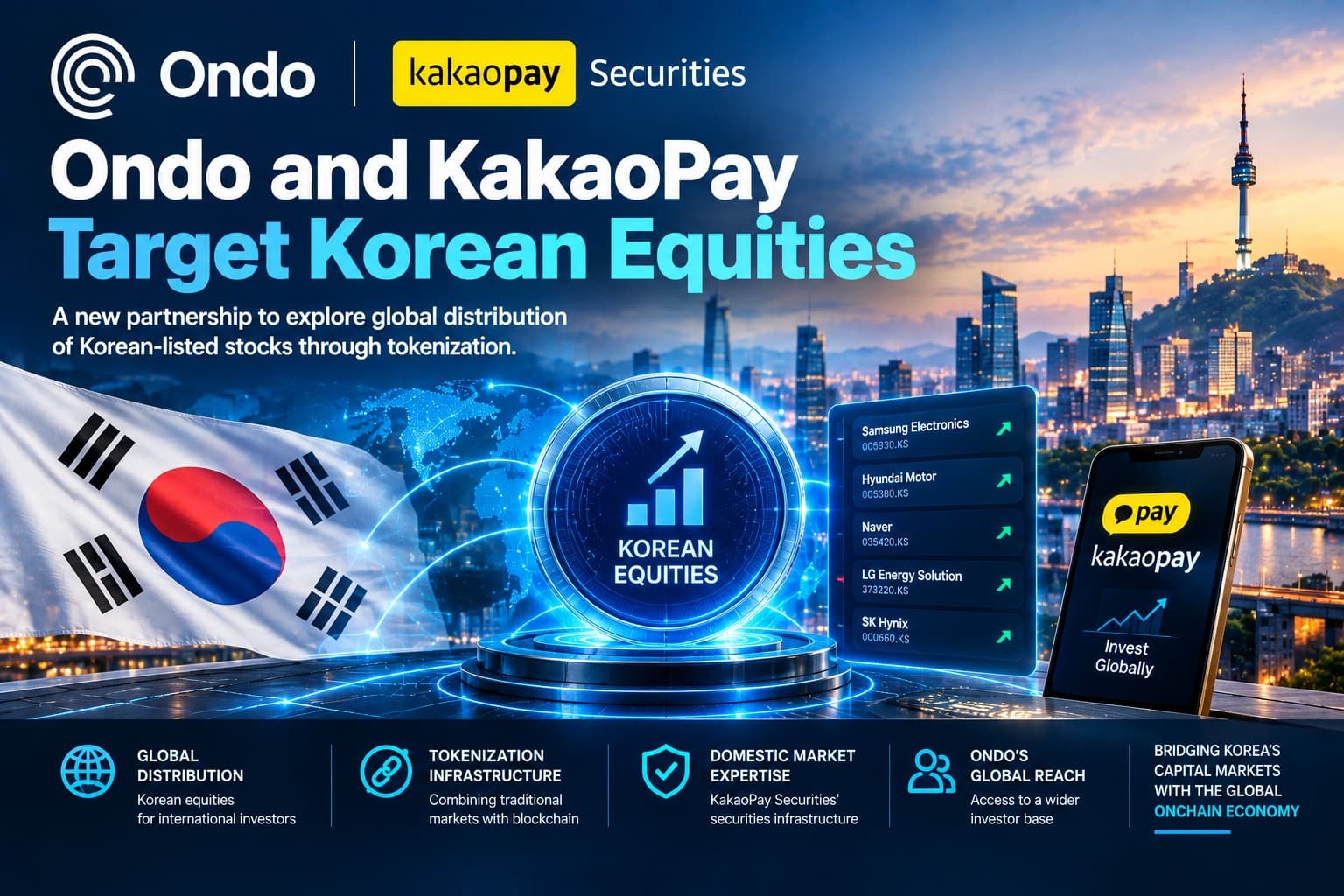
Ondo Finance and KakaoPay Securities are exploring a new framework for distributing Korean-listed stocks to overseas investors, combining Ondo’s global tokenization infrastructure with KakaoPay Securities’ domestic securities capabilities. The memorandum of understanding creates a path toward tokenized Korean equities, but no commercial product or launch date has been announced.
The partnership was highlighted by Ondo as South Korea’s financial and digital-asset markets continue moving toward greater onchain integration. KakaoPay Securities said the companies will jointly study overseas distribution, stock-tokenization infrastructure and business cooperation aimed at international retail investors.
The timing is notable.
South Korea is preparing a legal framework for security tokens, with amendments to the Electronic Registration Act and Financial Investment Services and Capital Markets Act scheduled to take effect on February 4, 2027. The Financial Services Commission has also said its roadmap will cover tokenization of conventional securities including stocks, bonds and funds, alongside infrastructure developed with the Korea Securities Depository and securities firms.
 What Are Real-World Assets (RWA)? A Guide to Tokenization→
 Ondo Intelligent Portfolios Bring BlackRock Strategies Onchain→
 CFTC Clarifies Tokenized Collateral Rules and On-Chain Recordkeeping→
 Solana Tokenized Stocks Smash Records with 850K Unique Holders and Institutional Adoption→
That means the Ondo-KakaoPay initiative is arriving as Korea’s regulators are preparing the market structure that could eventually support this type of product.
Why Korean stocks are becoming a tokenization target
South Korea is one of Asia’s most active digital-asset markets, but access to its listed companies remains more dependent on conventional brokerage and cross-border investment channels.
KakaoPay Securities has explicitly identified “globalization of K-stocks” as one of its strategic priorities. At a July 2026 press briefing, the company said it wanted to expand access for overseas retail investors and build a global gateway for Korean shares.
Tokenization offers a possible additional distribution mechanism.
Instead of representing a Korean share only through a traditional brokerage account, a properly structured token could represent a claim linked to an underlying security and move through blockchain infrastructure.
That could make settlement and transfer processes more programmable and potentially reduce some of the friction associated with international access.
But tokenization does not automatically remove the legal complexity of cross-border securities ownership.
The regulatory status of the token, the underlying share, the investor and the intermediary all remain important.
What the proposed Ondo-KakaoPay structure looks like
According to Korean financial-media reports, the initial work will focus on acquiring and holding the underlying Korean shares and then studying how corresponding tokenized representations could be created and distributed internationally.
The proposed architecture includes several components.
1. Korean shares
KakaoPay Securities would be responsible for sourcing and custody of the underlying listed shares.
2. Omnibus account
The brokerage plans to use an omnibus account for overseas investors, allowing multiple investor positions to be handled through a pooled structure.
3. Token issuance
Ondo and KakaoPay Securities would jointly study how tokenized representations could be issued against those underlying securities.
4. Redemption
The companies would also examine how tokens could be redeemed or reconciled with the underlying securities.
5. Rights and reconciliation
The structure must determine how token balances remain synchronized with underlying shares and how rights such as dividends and voting are transmitted or represented.
This is a much more complicated problem than simply creating a token with the ticker symbol of a Korean company.
The biggest issue: what does the token legally represent?
The central question for any tokenized stock market is legal equivalence.
A blockchain token can track a stock’s price without giving the holder direct ownership rights in the company’s shares.
That is why regulators in different jurisdictions increasingly distinguish between:
tokenized securities, which are legally connected to an underlying security or financial claim,
and
synthetic exposure, where the token merely references the price of an asset.
That distinction has already become important in the United States.
The SEC‘s September 2026 Innovation Exemption created a temporary framework for certain tokenized NMS stocks, but its conditions focus heavily on preserving the rights and privileges associated with the underlying security. CryptoQuorum recently covered that development in SEC Allows Limited Tokenized NMS Stock Trading.
South Korea’s own framework is moving in a similar direction by treating security tokens as a digital form of securities rather than creating a completely separate asset category.
South Korea is preparing for conventional securities tokenization
The partnership is particularly relevant because Korean regulators have already outlined a broader tokenization roadmap.
On September 4, the Financial Services Commission (FSC) said the country intends to build infrastructure for tokenized securities covering not only fractional-investment products but conventional securities such as stocks, bonds and funds.
The FSC’s roadmap includes a three-phase approach involving securities firms and the Korea Securities Depository.
It also says the government plans to develop standards for distributed-ledger infrastructure and to test tokenized trading in the domestic market, with the Korea Exchange expected to be central to those efforts.
This gives the Ondo-KakaoPay partnership a broader regulatory context.
The companies are not attempting to create tokenized Korean securities in a market with no institutional framework.
They are studying a potential international distribution model while Korea is simultaneously developing the legal and infrastructure foundations for security tokens.
Why Ondo’s existing infrastructure matters
Ondo has already built an international tokenization platform focused initially on U.S. securities.
Its current Ondo Stocks platform says it offers more than 450 tokenized stocks and ETFs across Ethereum, BNB Chain and Solana, with availability for eligible non-U.S. retail and institutional users. Ondo says its tokenized stocks are backed by U.S. stocks, ETFs and cash held with U.S. broker-dealers.
That experience is directly relevant to the Korean initiative.
The problem now is not simply how to create a token.
It is how to connect a different national securities market to that existing infrastructure.
That introduces new questions about custody, corporate actions, trading hours, foreign-investor rules, settlement and currency conversion.
Time zones are one practical reason for tokenization
One potential advantage frequently associated with tokenized equities is greater flexibility around transfer and settlement.
A South Korean investor and an overseas investor may operate in very different market hours.
The Korean market closes while U.S. or European markets remain open, and vice versa.
A blockchain-based representation could theoretically allow certain transfer or settlement functions to occur outside the local exchange’s regular hours, provided the legal and market structure permits it.
KakaoPay Securities and Ondo are explicitly examining how tokenization could reduce some of the constraints created by time-zone differences, according to Korean financial reports.
That does not necessarily mean the underlying Korean stock itself would trade 24 hours a day.
The distinction is important.
A tokenization layer can potentially make ownership and settlement more flexible without changing the operating hours of the underlying exchange.
Expert opinions: distribution may be as important as tokenization
KakaoPay Securities Vice President Jung In-young said global demand for Korean companies is growing, while routes for overseas retail investors to access local shares remain limited. The company’s stated objective is to connect Ondo’s international distribution network with KakaoPay Securities’ domestic equity infrastructure.
Ondo’s global institutional-business leadership has also described South Korea as a strategically important digital-asset market and said the partnership could help connect tokenized assets with financial services that users can access in everyday markets.
These are statements from the companies involved, not independent market forecasts.
Their significance is nevertheless clear.
The partnership is addressing distribution, not only issuance.
Tokenization has limited value if the resulting asset cannot reach sufficient numbers of eligible investors, custodians, brokers and liquidity providers.
The global distribution network may therefore be as important as the blockchain technology itself.
This is not a commercial launch
One of the most important facts for investors is what has not happened.
KakaoPay Securities and Ondo have not announced that tokenized Korean stocks are already available for trading.
The companies are currently researching:
- underlying-share sourcing;
- custody;
- token issuance;
- redemption;
- balance reconciliation;
- shareholder rights;
- overseas distribution;
- regulatory requirements.
The commercial timetable remains undecided.
Any eventual product would require legal reviews in Korea and the relevant overseas markets, together with regulatory compliance and investor-protection analysis.
This makes the announcement an infrastructure and market-development story, not a product-launch story.
Why shareholder rights are a difficult technical problem
Dividends are relatively straightforward conceptually.
If the underlying stock pays a dividend, the tokenized structure must define how the economic benefit reaches the token holder.
Voting is more complicated.
If multiple investors hold tokenized claims while the underlying securities remain aggregated in a brokerage account, the system needs a reliable mechanism for determining which token holders are entitled to participate in corporate actions.
KakaoPay Securities and Ondo have said they will examine precisely these questions.
This is one of the reasons that tokenizing securities is fundamentally different from tokenizing a commodity or creating a crypto-native asset.
The token has to remain connected to a broader legal and operational chain.
How the partnership fits the global RWA market
The Ondo-KakaoPay project fits into a wider trend toward bringing traditional financial assets onto blockchain infrastructure.
In the United States, the SEC has created a temporary framework for certain tokenized stocks.
DTCC is preparing a tokenization service for DTC-custodied securities.
CFTC staff has clarified how tokenized investments and blockchain records can fit within existing derivatives-market rules.
Ondo, meanwhile, is expanding from tokenized Treasuries and U.S. stocks into broader portfolio and institutional distribution products.
CryptoQuorum’s recent DTCC Tokenization Service analysis examines the custody and market-infrastructure side of this trend.
The broader pattern is becoming easier to identify:
Traditional security → regulated custody → tokenized representation → blockchain distribution → institutional liquidity.
The Korean initiative is another potential link in that chain.
The competition may be for distribution infrastructure
If Korean security-token markets develop successfully, multiple international tokenization platforms could compete for access to the underlying assets and investors.
That means the strategic advantage may not belong only to the company with the best blockchain technology.
It may also belong to the platform with:
- the strongest brokerage relationships;
- the deepest liquidity;
- the clearest compliance model;
- the best custody infrastructure;
- the broadest international distribution;
- the simplest investor experience.
KakaoPay Securities brings domestic-market infrastructure and a large consumer-facing financial ecosystem.
Ondo brings an existing tokenization platform and global investor distribution.
The proposed partnership combines those complementary strengths.
Risks and unresolved questions
The project also faces significant challenges.
Regulation
Korean and overseas securities rules must both be satisfied.
Investor eligibility
Different jurisdictions may impose different restrictions on who can hold tokenized Korean securities.
Custody
The relationship between underlying shares and tokenized claims must remain legally and operationally robust.
Liquidity
A tokenized stock is not automatically liquid merely because it can move on a blockchain.
Corporate actions
Dividends, voting, splits and other events need reliable synchronization.
Currency
Overseas investors may still face Korean-won exposure and foreign-exchange considerations.
Technology
Smart contracts, wallets, bridges and blockchain infrastructure introduce operational and cybersecurity risks.
These issues are not unique to the Ondo-KakaoPay project. They are the central problems facing institutional tokenization generally.
The February 2027 milestone
The most important regulatory date for the Korean market is February 4, 2027.
The revised legal framework is scheduled to recognize security tokens as a form of securities and establish the legal foundation for their issuance and circulation.
The FSC’s September roadmap says the initial phase is expected to include selected conventional securities and other tokenized instruments, while infrastructure will be developed with securities firms and the Korea Securities Depository.
This creates a logical sequence for the Ondo-KakaoPay project:
MOU → infrastructure research → legal review → tokenization design → regulatory framework → potential commercialization.
The key word is potential.
The companies still have to determine whether a workable product can operate within the rules.
What to watch next
The next meaningful developments will be highly specific.
First, whether the joint task force produces a concrete operating model.
Second, whether KakaoPay Securities and Ondo disclose which Korean-listed securities could initially be eligible.
Third, how one-to-one backing, issuance and redemption would work.
Fourth, whether dividends and voting can be represented in a legally enforceable way.
Fifth, how foreign-investor onboarding and KYC would operate across jurisdictions.
Sixth, whether Korea’s February 2027 security-token framework enables international distribution structures of this type.
These milestones will tell the market much more than the initial MOU.
Bottom line
The Ondo Finance and KakaoPay Securities partnership opens a potential new route for Korean equities to reach overseas investors through tokenization.
The two companies are not launching a live tokenized-stock market yet. They are researching how Korean-listed shares could be sourced and held, how corresponding tokens could be issued and redeemed, how balances would be reconciled and how shareholder rights such as dividends and voting could be handled.
The initiative is arriving at a significant moment for South Korea’s capital markets.
The Financial Services Commission has already laid out a roadmap for tokenizing conventional securities, and the revised legal framework for security tokens is scheduled to take effect on February 4, 2027.
Ondo brings an existing international tokenization platform, while KakaoPay Securities contributes domestic securities infrastructure and a stated strategy of expanding global access to Korean stocks. Ondo’s current platform already supports hundreds of tokenized U.S. stocks and ETFs for eligible non-U.S. users.
For the broader RWA market, the significance is straightforward.
Tokenization is moving beyond the question of whether a security can be represented on a blockchain.
The next question is whether domestic securities infrastructure, legal ownership, corporate actions, investor access and global blockchain distribution can all work together in one regulated system.
South Korea is now becoming an important test case for that model.
Disclaimer
This article is provided for informational and educational purposes only and does not constitute financial, investment, legal, tax or regulatory advice. The Ondo Finance–KakaoPay Securities initiative is currently an exploratory MOU and does not represent the launch or availability of tokenized Korean stocks. Any future product would remain subject to technical feasibility, Korean and international regulatory requirements, investor eligibility, custody arrangements and investor-protection standards. Readers should conduct independent research and consult qualified professionals before making investment decisions.