

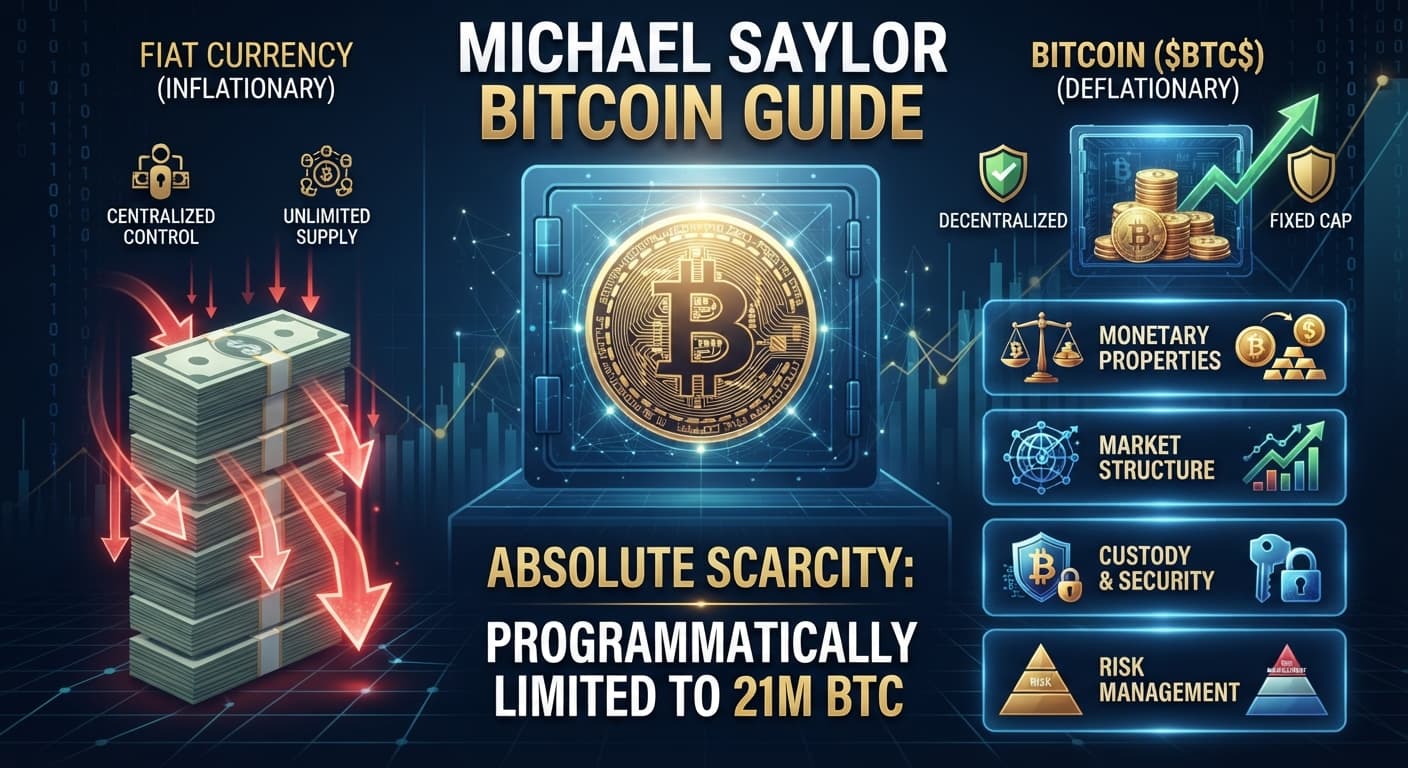
The global monetary landscape is undergoing a profound structural shift, driven by growing questions regarding the long-term stability of fiat currencies. Amidst this macroeconomic evolution, market participants continually seek resilient stores of value that can withstand inflationary pressures and currency debasement. Michael Saylor, Executive Chairman of Strategy, recently emphasized this core economic thesis through a widely shared investor resource, describing Bitcoin as an open, global reserve asset characterized by absolute scarcity.
The newly published Investor Guide details the fundamental monetary properties, investment cases, market structures, portfolio integration roles, custody best practices, and inherent risk factors associated with the digital asset. As institutional adoption deepens and corporate balance sheets increasingly incorporate digital property, comprehensive educational frameworks serve as vital tools for navigating this emerging financial paradigm.
BINANCE:BTCUSDT
| Structural Dimension | Core Focus Area | Strategic Implications |
| Monetary Properties | Absolute scarcity & decentralization | Hedging against long-term fiat inflation |
| Market Structure | Institutional integration & liquidity | Streamlined capital allocation and deep order books |
| Portfolio Role | Treasury reserve asset | Maximizing long-term shareholder and institutional value |
| Custody & Security | Multi-signature and cold storage | Mitigating counterparty risk and protecting digital capital |
The Economics of Absolute Scarcity: Why Bitcoin Stands Apart
Traditional fiat monetary systems are subject to continuous expansion managed by central authorities, frequently resulting in purchasing power erosion over extended periods. In contrast, Bitcoin operates under a mathematically enforced supply cap of 21 million coins. This programmatic limitation establishes absolute scarcity, differentiating digital assets from legacy commodities like gold, whose production can theoretically scale in response to higher market prices.
According to financial analysts, recognizing Bitcoin as a superior monetary good requires understanding its thermodynamic and cryptographic foundations. Because issuance cannot be artificially inflated by political decree, it provides a reliable, decentralized settlement layer for international commerce.
 Bitcoin Market Structure: Glassnode Signals→
 How Conflict Is Reshaping Digital Assets in the Middle East→
 Cathie Wood Remains Bullish on Bitcoin as BTC-Gold Ratio Signals a Potential Shift→
 Bitfinex Tokenizes Bitcoin Treasury Stocks for Secondary Trading→
“Bitcoin is an open, global reserve asset with absolute scarcity. The Investor Guide explores Bitcoin’s monetary properties, investment case, market structure, portfolio role, custody and risks.” — Michael Saylor
Corporate Treasury Adoption and Market Dynamics
Over the past several years, corporate adoption of digital assets has shifted from a speculative novelty to a formalized treasury strategy. Companies like Strategy have pioneered balance sheet transformations, utilizing innovative financial instruments such as convertible senior notes and equity programs to accumulate digital capital efficiently.
This institutional accumulation model reduces liquid market supply, reinforcing price stability and reinforcing the asset’s role as digital gold. Market observers note that as regulatory clarity improves globally, additional publicly traded entities and pension funds are expected to evaluate similar allocation frameworks.
| Asset Class | Supply Elasticity | Primary Economic Function | Counterparty Risk |
| Fiat Currency | Elastic (Politically managed) | Medium of exchange & unit of account | High (Inflation & policy shifts) |
| Physical Gold | Semi-Elastic (Mining output scales) | Store of value | Medium (Custody & confiscation) |
| Bitcoin ($BTC$) | Inelastic (Fixed 21M cap) | Global reserve asset & digital property | Low (When properly self-custed) |
Expert Perspectives on Portfolio Construction and Risk Management
Navigating the digital asset class requires disciplined risk management and a clear understanding of market cycles. Financial strategists emphasize that incorporating a non-correlated, scarce asset into a diversified portfolio can significantly enhance long-term risk-adjusted returns. However, professional advisors consistently stress the importance of robust operational security.
Proper custody solutions—ranging from institutional multi-signature custody providers to hardware-based self-custody—remain essential for eliminating single points of failure. The Investor Guide emphasizes that safeguarding digital property requires matching the sophistication of the storage mechanism with the scale of the holding.
Conclusion
As digital assets mature into recognized pillars of modern finance, comprehensive educational resources and institutional frameworks play an indispensable role in shaping market maturity. By highlighting absolute scarcity, robust custody, and disciplined portfolio integration, guidance from industry leaders continues to demystify the transition toward decentralized monetary networks.
Disclaimer
Disclaimer: The information provided in this article is for educational and informational purposes only and does not constitute financial, investment, or legal advice. Digital asset investments carry inherent volatility and risk. Always conduct your own research and consult with a licensed financial professional before making any financial decisions.