

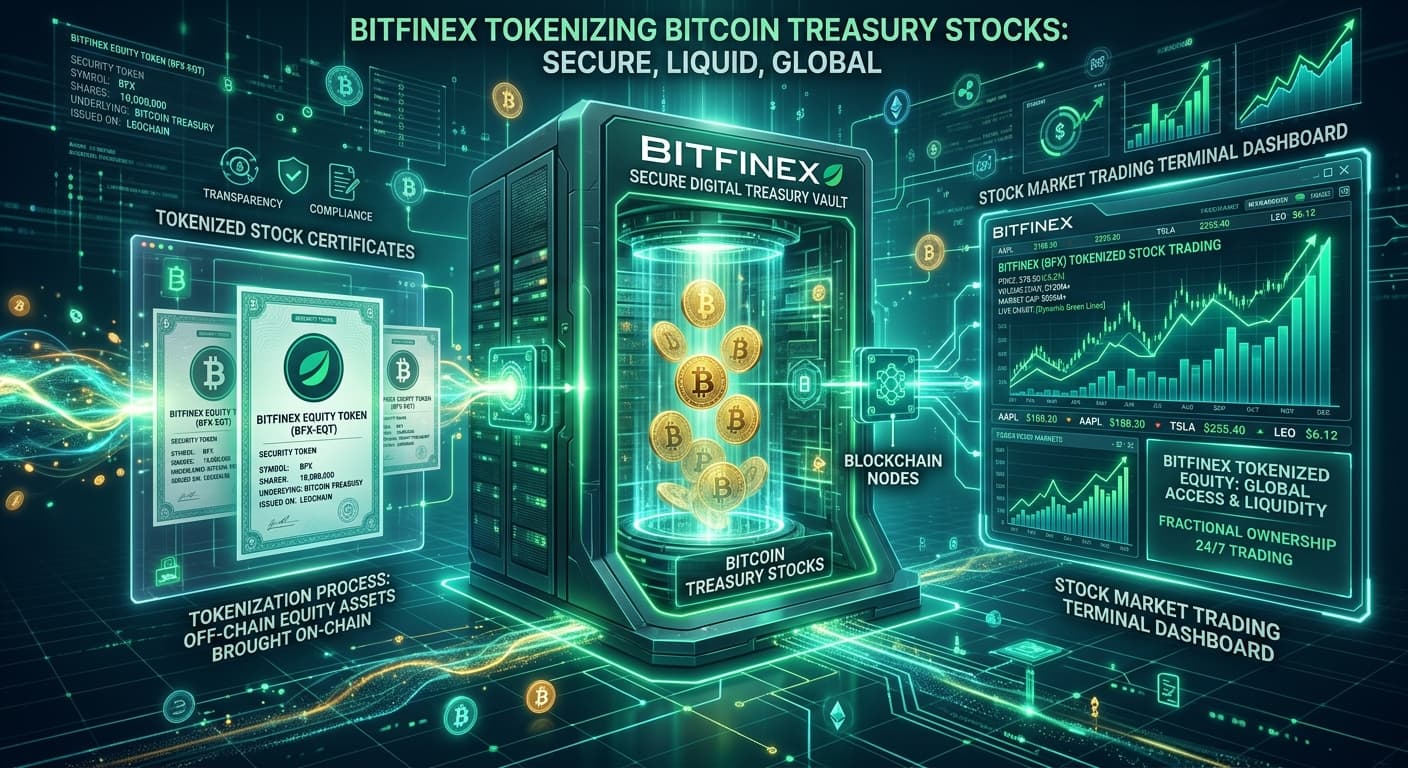
Bitfinex Securities has listed five tokenized Bitcoin treasury notes linked to publicly traded companies that have made Bitcoin a significant part of their corporate strategies.
The new products provide eligible investors with economic exposure to Strategy, Metaplanet, H100 Group and Capital B, as well as Strategy’s variable-rate perpetual preferred stock, STRC. The securities began trading on September 1 through Bitfinex Securities, the regulated tokenized-securities platform associated with Bitfinex.
Bitfinex Securities says the launch represents the first time tokenized securities issued by Bitcoin treasury companies have been admitted for secondary trading on a regulated tokenized securities exchange.
The development is significant because it moves Bitcoin treasury strategies another step into blockchain-based capital markets. Instead of simply buying shares in a company that holds Bitcoin, eligible investors can now obtain fractional economic exposure through blockchain-issued securities.
 Solana Tokenized Equities Smash Records with 850K Unique Holders and Institutional Adoption→
 VanEck: Bitcoin Could Hit $100,000 by Next Year as Fiscal Pressure and Liquidity Shape the Market→
 Fed Rate Hike May Not Rattle Crypto Markets, Grayscale Says→
 How CFOs Are Transforming Corporate Treasury With Digital Assets, XRP, and RLUSD→
Five New Products Bring Bitcoin Treasury Companies On-Chain
The five products are structured as securities-backed notes rather than direct blockchain representations of company shares.
The lineup includes CMSTR, which tracks Strategy’s Class A common stock; CMTPL, linked to Metaplanet; CH100, linked to H100 Group; CALCPB, linked to Capital B; and STRCst, which tracks Strategy’s Variable Rate Series A Perpetual Preferred Stock.
According to available product information, CMSTR, CMTPL, CH100 and CALCPB are each backed by 100 shares of the respective underlying company. STRCst is backed one-to-one by a share of Strategy’s STRC preferred stock.
The products are issued through separate compartments of ORO (II), a Luxembourg umbrella securitization fund managed by SICOS Securities. STOKR provides the technology infrastructure, while the underlying securities are held with regulated financial institutions.
That structure is important.
Buying one of the blockchain-based notes does not mean that an investor becomes a direct shareholder of Strategy, Metaplanet, H100 Group or Capital B. Instead, the investor holds a security that provides economic exposure to the underlying asset according to the terms of that particular note.
How the Tokenized Securities Trade
The five products are issued on the Liquid Network, a Bitcoin sidechain designed to support asset issuance and settlement.
Eligible investors can trade the securities against three quote assets:
| Trading asset | Role |
|---|---|
| USD | Traditional fiat-denominated trading |
| USDT | Stablecoin-based settlement and trading |
| Bitcoin | BTC-denominated exposure and settlement |
The products can be divided into fractional units, allowing investors to obtain exposure without purchasing the full underlying share package.
Bitfinex Securities says the notes can be traded in fractional units of up to four decimal places. Eligibility requirements and minimum investment levels can differ between individual securities.
The platform also requires approved wallets and compliance with its know-your-customer and anti-money-laundering procedures before users can transfer the securities.
U.S. persons are excluded from the offering. Bitfinex Securities also states that its services are unavailable to prohibited persons and jurisdictions where the offering or sale would be unlawful.
Strategy Takes Center Stage
Strategy is represented by two of the five products.
The first, CMSTR, provides economic exposure to Strategy’s Class A common stock. The second, STRCst, tracks Strategy’s variable-rate perpetual preferred stock.
The STRC structure is particularly notable because the underlying preferred security currently carries a variable annual dividend. Bitfinex’s product documentation states that the annual dividend rate has been 12% since July 15, with payments made twice per month.
However, STRCst holders should not interpret the product as identical to directly holding STRC shares.
According to the available documentation, Strategy pays the dividend associated with the underlying STRC shares to the issuer. After applicable fees and the structure’s mechanics, the economic benefit is passed through to noteholders in the form of additional notes rather than simply being delivered as the same cash dividend received by a direct shareholder.
This distinction illustrates why investors need to examine the legal documentation of tokenized securities rather than relying solely on the name or ticker.
Metaplanet, H100 and Capital B Join the Platform
The other three products extend the model to additional Bitcoin treasury companies.
CMTPL tracks Metaplanet, the Tokyo-listed company that has increasingly positioned Bitcoin as a central component of its corporate treasury strategy.
CH100 tracks H100 Group, a Swedish-listed company with Bitcoin treasury exposure.
CALCPB tracks Capital B, a French-listed company that has also adopted a Bitcoin treasury strategy.
The common feature is that investors gain exposure to the economic performance of the underlying securities through a blockchain-based note rather than purchasing the original exchange-listed shares directly.
This model could be particularly relevant for investors interested in Bitcoin treasury companies but seeking a digital-asset-native trading environment.
It also creates a bridge between two markets that historically operated separately: public equities and blockchain-based securities.
Expert Opinion: Secondary Liquidity Is the Bigger Story
Bitfinex Securities has emphasized that tokenization has historically been dominated by fixed-income and buy-and-hold products.
The company argues that adding equity-linked products can help develop deeper secondary-market liquidity for tokenized securities.
That argument is consistent with Jesse Knutson, Head of Operations at Bitfinex Securities, who has repeatedly focused on the ability of tokenization to modernize capital-market infrastructure.
In an April 2026 analysis, Knutson argued that tokenization can make real-world assets more mobile and flexible while reducing some of the friction associated with traditional collateral and settlement processes.
Bitfinex Securities has also previously described secondary-market liquidity as an important part of the next phase of tokenization.
This is an important distinction.
Creating a tokenized security is relatively easy compared with establishing a liquid market in which investors can continuously buy and sell that security.
The success of the new products will therefore depend not only on issuance but also on actual trading activity, spreads, liquidity and investor participation.
Bitfinex Securities Passes $500 Million in Listed Assets
The five new products arrive during a broader expansion of the Bitfinex Securities marketplace.
Following the listings, the platform said it had reached 12 tokenized investment products across 27 trading pairs, with total listed assets exceeding $500 million.
That portfolio extends beyond Bitcoin treasury companies.
Bitfinex Securities has offered tokenized exposure to areas including U.S. Treasury instruments, bonds, Bitcoin mining-related products and other alternative assets.
The platform also recently completed a $50 million tokenized capital raise for metals company Alkemya, further expanding its role as a marketplace for blockchain-based securities.
Bitfinex’s product roadmap reportedly includes additional tokenized assets such as a gold fund, private-credit products linked to Bitcoin mining and a tokenized U.S. money-market fund.
The direction suggests that Bitfinex Securities is attempting to build a broader tokenized capital-markets platform rather than focusing exclusively on cryptocurrencies.
Why the Liquid Network Matters
Using Liquid Network gives the new securities a direct connection to Bitcoin-oriented infrastructure.
Liquid is a Bitcoin sidechain designed for faster and more private asset transfers and has been used for the issuance and settlement of tokenized financial products.
For Bitfinex Securities, this provides an alternative to issuing tokenized securities exclusively on general-purpose smart-contract platforms.
The choice is also strategically consistent with the platform’s existing products, including tokenized bonds and Bitcoin mining-related securities that use Liquid-based infrastructure.
CryptoQuorum has previously examined the broader evolution of Bitcoin as financial-market infrastructure, including the growing intersection between Bitcoin, corporate treasuries, credit products and tokenized securities.
The emergence of Bitcoin treasury companies adds another layer to that trend.
Bitcoin is no longer appearing only as an asset held by investors. It is increasingly becoming an underlying economic component of corporate securities, preferred shares, debt structures and now tokenized investment products.
Tokenization Does Not Eliminate Investment Risk
The new products may make access and settlement more flexible, but tokenization does not remove the risks associated with the underlying investments.
An investor in CMSTR remains exposed to the economic performance of Strategy’s equity. That performance can be affected by Bitcoin prices, Strategy’s capital structure, financing costs, dilution, corporate decisions and broader equity-market conditions.
The same principle applies to Metaplanet, H100 Group and Capital B.
There is also an additional layer of structural risk.
Because investors hold notes rather than the underlying shares directly, they must consider issuer, custody, legal-structure, liquidity and counterparty risks.
The STRCst product introduces additional considerations related to Strategy’s variable dividend policy and the mechanism through which economic benefits are passed to noteholders.
Fractional trading may lower the nominal entry point, but it does not make the underlying asset less volatile.
A New Model for Bitcoin Treasury Exposure
The significance of the launch extends beyond five new securities.
Bitcoin treasury companies have already created a new way for public-market investors to obtain indirect Bitcoin exposure.
Traditional shares provide one route.
Exchange-traded products provide another.
Corporate preferred securities and debt add additional layers.
The Bitfinex Securities products introduce another model: blockchain-based notes backed by traditional securities.
That creates a financial stack in which the underlying corporate security remains connected to conventional capital markets while the trading and settlement layer moves onto blockchain infrastructure.
CryptoQuorum has also covered the broader tokenization trend, including the expansion of tokenized stocks and institutional real-world assets.
The Bitfinex launch suggests that tokenization is increasingly moving from government bonds and fixed-income instruments toward more complex equity-linked products.
What Comes Next?
The next test is secondary-market activity.
If the five new notes attract sustained trading, Bitfinex Securities could demonstrate that tokenized equity products can move beyond the traditional buy-and-hold model.
The company has already signaled plans to expand its product range, while the platform’s total listed assets have crossed the $500 million threshold.
For investors, the key questions will be practical:
- How deep will liquidity become?
- How closely will note prices track their underlying securities?
- How will spreads behave during periods of market stress?
- How efficiently will corporate actions and distributions be handled?
- Can tokenized equity products achieve meaningful institutional adoption?
These questions are more important than the novelty of putting a security on a blockchain.
Bottom Line
Bitfinex Securities’ launch of five tokenized Bitcoin treasury notes marks another step in the convergence of public equities and blockchain-based capital markets.
Strategy, Metaplanet, H100 Group and Capital B are now represented through securities that combine traditional underlying assets with blockchain-based issuance and secondary trading.
The structure does not give investors direct ownership of the underlying shares. Instead, it provides economic exposure through securities issued by a Luxembourg securitization structure, with regulated custody and trading on Liquid Network.
The broader significance is the move toward secondary-market tokenization.
If liquidity develops, these products could help demonstrate how blockchain infrastructure can be used not only to issue financial assets but also to create continuously tradable markets around them.
For now, the launch represents an important experiment in bringing Bitcoin treasury companies into the emerging on-chain capital-markets ecosystem.
BINANCE:BTCUSDT
Disclaimer
This article is provided for informational and educational purposes only and does not constitute financial, investment, legal, tax or regulatory advice. Tokenized securities and the underlying assets may involve substantial market, liquidity, issuer, custody, regulatory and counterparty risks. The availability of individual products depends on jurisdiction, investor eligibility and applicable restrictions. Readers should review the official offering documentation and conduct their own research before making any investment decision.