

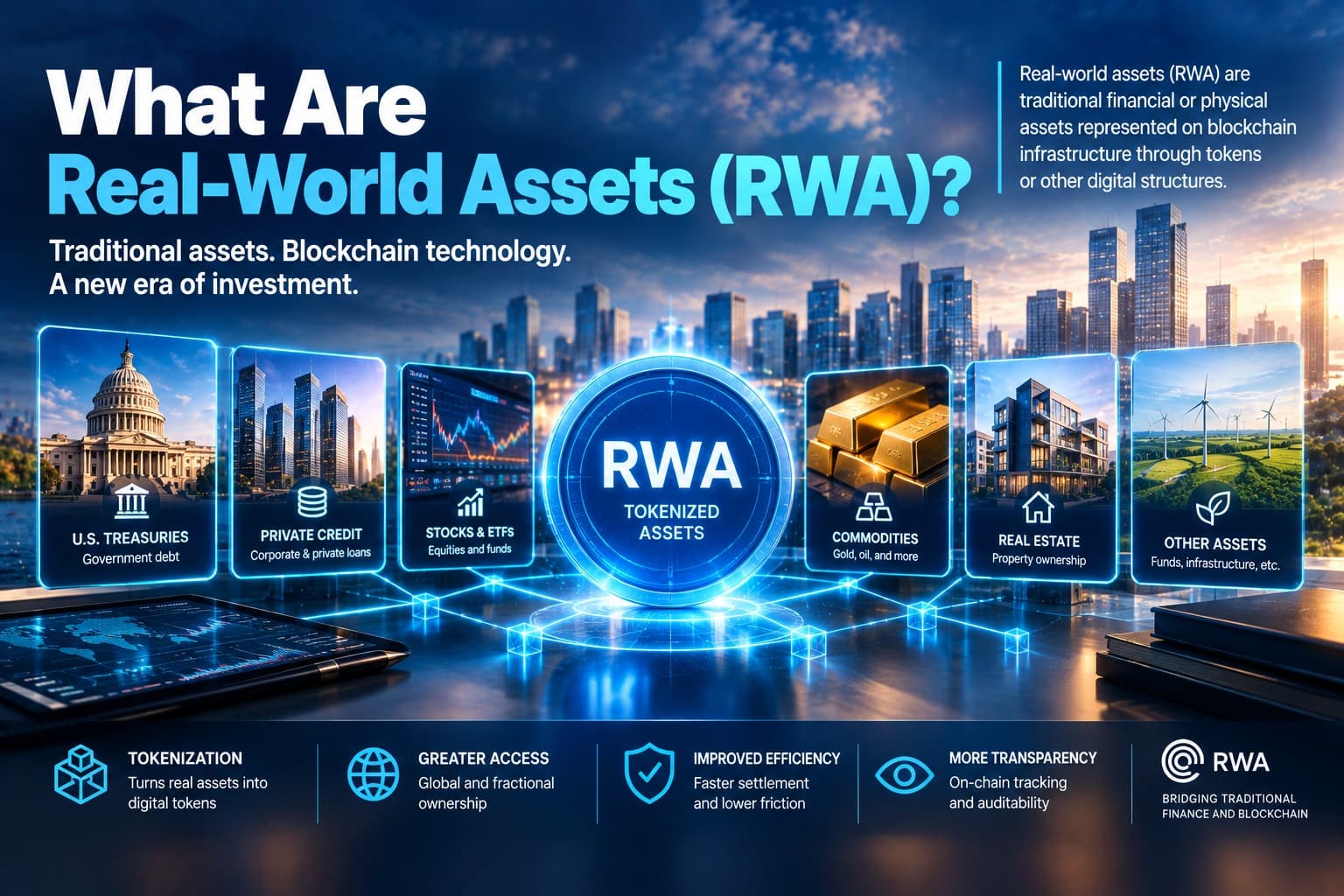
Real-world assets, commonly abbreviated as RWAs, are traditional financial or physical assets represented on blockchain infrastructure. The category includes assets such as U.S. Treasuries, corporate and private credit, investment funds, stocks, commodities and real estate. RWA tokenization connects those assets with programmable digital ledgers, creating new ways to record ownership, transfer value and automate financial transactions.
The concept has moved well beyond an experimental crypto niche. RWA.xyz, a data platform focused specifically on tokenized real-world assets, tracks institutional and startup activity across asset classes, issuers, platforms and public blockchain networks. Its dataset is used by institutions, regulators, investors and asset issuers to analyze the tokenization market.
The shift is also receiving attention from major financial institutions and policymakers. The International Monetary Fund describes tokenization as a potentially structural change in financial architecture, while the Bank for International Settlements has highlighted the ability of tokenized assets to combine asset information with rules governing transfers and settlement.
What does RWA actually mean?
In simple terms, an RWA is a blockchain-based representation of an asset or financial claim that originates in the traditional economy.
 VersaBank Brings Tokenized Deposits to the U.S.→
 Ripple, Meritz Bring Tokenization to Korea→
 Morgan Stanley Sees $10T Tokenized Asset Market→
 Nasdaq CEO: Tokenization Could Unlock Billions→
A token could represent exposure to:
- a U.S. Treasury security;
- a money-market fund;
- a corporate bond;
- private credit;
- an investment fund;
- a publicly traded stock;
- gold or another commodity;
- real estate;
- other financial or physical assets.
The important point is that the blockchain token is not automatically the same thing as the underlying asset.
The legal structure determines what the token holder actually owns or has a claim to.
The IMF notes that a tokenized security can either be issued directly on a digital ledger or represent an asset that exists outside the ledger. In the latter case, an intermediary may still need to hold the underlying asset safely in traditional custody.
That distinction is critical.
A tokenized Treasury fund, for example, may represent a legal claim backed by Treasury securities held by a custodian. The blockchain provides the digital record and transfer mechanism, while the underlying securities remain part of the conventional financial system.
How RWA tokenization works
The tokenization process generally involves several layers.
1. The underlying asset
This is the economic asset being represented: a Treasury, bond, fund interest, stock, commodity or property interest.
2. Legal and custody structure
An issuer or intermediary establishes who owns the asset, who holds it in custody and what rights the token represents.
3. Token issuance
A digital token is created on a blockchain or other programmable ledger.
4. Compliance and access controls
Depending on the product and jurisdiction, investors may need to satisfy eligibility, KYC, AML or other regulatory requirements.
5. Transfer and settlement
The token can then be transferred through the permitted blockchain infrastructure, potentially allowing automated settlement or interaction with other digital assets.
This is where tokenization differs from simply putting a PDF or database entry online.
The objective is to make the financial claim itself machine-readable and programmable.
The BIS describes tokenization as recording claims on real or financial assets on a programmable platform, with the potential to integrate messaging, reconciliation and asset transfer into a single process.
RWA.xyz shows how quickly the market has expanded
RWA.xyz provides a useful live view of the sector.
As of September 28, 2026, its global dashboard showed approximately $38.55 billion in Distributed Asset Value and $357.99 billion in Represented Asset Value. It also displayed about 4.85 million RWA asset holders, 39 networks, and approximately $306.33 billion in stablecoin value.
These numbers need to be interpreted correctly.
RWA.xyz distinguishes between Distributed and Represented assets. That distinction matters because not every blockchain-based representation is necessarily something investors can freely buy, hold or transfer onchain.
The platform also tracks stablecoins separately, even though stablecoins are often discussed alongside the broader tokenization market.
This prevents a common analytical mistake: assuming that every dollar represented somewhere on a blockchain is necessarily the same type of RWA exposure.
What are the main categories?
The market has developed across several distinct asset classes.
U.S. Treasuries and government debt
Government securities are among the most established tokenization use cases.
Tokenized Treasury products can provide onchain access to instruments traditionally held through brokers, custodians or funds. RWA.xyz tracks numerous Treasury-related products across multiple networks, including funds and other vehicles linked to U.S. government securities.
The attraction is relatively straightforward: investors can combine a conventional low-risk asset with blockchain-based transfer and settlement infrastructure.
Credit and private credit
Private credit has also become an important category.
Tokenization can create standardized digital representations of credit exposures, potentially making these products easier to distribute, track and integrate into programmable financial systems.
CryptoQuorum recently examined the growth of tokenized credit funds, including the increasing role of institutional capital in onchain debt markets.
Stocks and ETFs
Tokenized equities represent another fast-developing segment.
Products can provide blockchain-based exposure to publicly traded companies or exchange-traded funds, although the legal structure varies considerably by issuer.
Recent developments involving the SEC, DTCC, Ondo and other market participants show that tokenized securities are increasingly moving into regulated market infrastructure rather than remaining solely within crypto-native platforms.
CryptoQuorum’s recent coverage of SEC’s Innovation Exemption for tokenized NMS stock examines how U.S. regulators are beginning to define rules for onchain equity trading.
Commodities
Gold is one of the clearest examples of a physical commodity represented digitally.
Tokenized gold products allow blockchain users to hold a token linked to gold reserves rather than storing the physical metal themselves.
RWA.xyz currently tracks products including tokenized gold from Tether and Paxos.
Real estate
Real estate tokenization attempts to represent ownership interests or financial claims linked to property on a digital ledger.
This area remains more complicated because the legal ownership of physical property still depends on local property law, registries and contractual structures.
The blockchain can digitize the financial claim without eliminating the legal and administrative systems surrounding the underlying building or land.
RWA is not the same as DeFi
The two concepts are related but different.
DeFi describes financial applications that operate using blockchain-based infrastructure, usually through smart contracts.
RWA describes the underlying asset or financial claim being represented.
A tokenized Treasury can become part of a DeFi protocol.
A tokenized private-credit fund can be used as collateral.
A tokenized stock could eventually interact with onchain trading infrastructure.
The same asset can therefore be categorized as an RWA while simultaneously being used inside DeFi.
That combination is one reason the sector has attracted institutional attention.
RWA versus traditional digitization
It is easy to assume that tokenization is simply another name for digitization.
It is not.
Traditional securities have already been recorded electronically for decades.
The difference is that tokenization can combine ownership data, transfer rules and transaction logic on a programmable ledger.
The IMF argues that this changes how financial claims interact with settlement infrastructure, potentially enabling atomic settlement and programmable transactions.
The BIS similarly emphasizes that tokenized assets can embed the rules governing their transfer directly into the digital representation.
For example, a smart contract could potentially execute delivery-versus-payment, where an asset changes hands only when the corresponding payment is received.
That can reduce some reconciliation steps and settlement dependencies.
Expert opinions: tokenization could change financial architecture
The IMF’s 2026 research takes a particularly important position on the subject.
Tobias Adrian’s Tokenized Finance argues that tokenization is increasingly affecting the regulated financial system, including banks, asset managers and market infrastructures. The paper identifies potential benefits such as atomic settlement, continuous liquidity management and embedded compliance.
But the IMF also highlights the risks.
Tokenization can make markets faster and more programmable, but it can also move risk into new areas such as smart-contract governance, operational infrastructure and highly interconnected platforms.
The BIS takes a similar balanced view.
Its research identifies potential gains from tokenization while emphasizing legal, governance and technical obstacles. Some assets are relatively straightforward to tokenize; others become much more difficult because rights, custody and legal ownership are more complex.
This is important because the size of the market should not be confused with the maturity of its infrastructure.
Why institutions are interested
Traditional financial institutions can potentially use tokenization to address several existing problems.
Faster settlement
A shared programmable ledger can reduce the number of separate reconciliation steps required between counterparties.
Greater transparency
Asset balances, transfers and selected transaction data can become easier to audit.
Programmability
Financial rules can be encoded into smart contracts.
Broader distribution
Some products may become easier to distribute across digital platforms and jurisdictions, subject to regulation.
Collateral mobility
Tokenized assets can potentially be transferred or pledged more efficiently in collateral workflows.
CryptoQuorum recently covered the CFTC’s latest guidance on tokenized collateral and blockchain recordkeeping, which illustrates how U.S. regulators are increasingly considering blockchain as a technology layer inside existing derivatives infrastructure.
What are the risks?
RWA tokenization does not remove traditional investment risk.
A tokenized bond can still lose value.
A tokenized property interest can still face legal or market problems.
A tokenized credit instrument can still default.
In addition, investors may face new technology-specific risks.
Smart-contract risk
Code can contain vulnerabilities or unexpected behavior.
Custody risk
The underlying asset may still depend on a traditional custodian or other intermediary.
Legal risk
The rights attached to a token depend on contracts, securities law, property law and jurisdiction.
Liquidity risk
A token can be transferable on blockchain infrastructure without having a deep secondary market.
Oracle and data risk
Onchain applications may depend on external data to value or control the asset.
Platform concentration
Large amounts of tokenized value can become dependent on a relatively small number of issuers, custodians or infrastructure providers.
The IMF’s latest work stresses that tokenization can change where risk sits within the financial system rather than eliminating it.
Why stablecoins are often mentioned alongside RWAs
Stablecoins occupy a special position in discussions about tokenization.
A stablecoin generally represents a claim intended to maintain a stable value against a reference asset such as the U.S. dollar.
Because it is programmable and blockchain-based, it can serve as the payment leg of an RWA transaction.
For example:
Tokenized Treasury + stablecoin = asset + programmable payment
That combination can potentially support atomic settlement, collateral transfers and automated financial workflows.
However, RWA.xyz treats stablecoins as a distinct category in its analytics interface, which is a useful reminder that stablecoin market capitalization should not automatically be added to every RWA market-size calculation.
Which blockchains support RWA markets?
RWA markets are no longer concentrated on one blockchain.
RWA.xyz’s September 28 network data show substantial activity across Ethereum, BNB Chain, Solana, Stellar, Avalanche, Liquid Network, Arbitrum, ZKsync Era, Polygon and XRP Ledger, among others.
Ethereum remains the largest network in the RWA.xyz league table by tracked RWA value, while other networks are developing specialized institutional and tokenization ecosystems.
CryptoQuorum’s analysis of Solana’s RWA ecosystem and Ondo’s BlackRock-backed Intelligent Portfolios illustrates how different blockchain ecosystems are competing for institutional tokenization activity.
The competition is increasingly about more than transaction speed.
Custody, compliance, interoperability, developer tooling and connections to traditional financial institutions are becoming equally important.
Where RWA markets could go next
The next phase of development is likely to focus less on proving that assets can be tokenized and more on whether tokenized assets can operate at institutional scale.
Several areas deserve attention.
Tokenized funds could become distribution and settlement products for asset managers.
Tokenized collateral could improve capital mobility in derivatives and securities markets.
Tokenized equities could connect blockchain trading venues with regulated exchanges.
Private credit could gain more standardized digital distribution.
Real estate could benefit from fractionalized structures where local law permits them.
AI agents could eventually interact with tokenized financial assets programmatically, using stablecoins for settlement and blockchain infrastructure for execution.
BlackRock’s recent Machine-Native Economy research provides one example of this broader thesis, arguing that autonomous software could eventually create demand for programmable money, tokenized assets and computing markets.
What to check before calling an asset an RWA
For investors, the phrase “tokenized RWA” is not enough.
The important questions are:
What exactly does the token represent?
Who owns the underlying asset?
Who holds it in custody?
What legal rights does the token holder have?
Can the token be redeemed for the underlying asset?
Who verifies reserves or asset existence?
Where can the token legally be offered and transferred?
How liquid is the secondary market?
What happens if the issuer fails?
These questions are more important than the blockchain logo displayed on a product page.
The economic value of an RWA ultimately depends on the legal and financial claim behind the token, not simply on the fact that a token exists.
What RWA.xyz is useful for
RWA.xyz is particularly valuable because it provides a structured way to compare issuers, assets and networks rather than relying on isolated project announcements.
The platform describes itself as a dedicated analytics layer for tokenized real-world assets and provides classification frameworks, methodology documentation, data downloads and API access. It is also used by institutions, regulators, investors and issuers.
That makes it useful for tracking:
- asset values;
- holders;
- networks;
- platforms;
- issuance;
- transfer activity;
- asset classes.
For CryptoQuorum readers, it can also serve as a primary research starting point when checking whether claims about RWA growth are supported by measurable market activity.
Bottom line
Real-world assets are traditional financial or physical assets represented through blockchain-based digital tokens or related ledger structures.
The category now includes government securities, credit, funds, stocks, commodities and real estate, while stablecoins operate alongside the broader tokenization market as an important settlement layer.
RWA.xyz provides one of the clearest ways to monitor this market. As of September 28, 2026, its dashboard showed approximately $38.55 billion of Distributed Asset Value, $357.99 billion of Represented Asset Value, about 4.85 million RWA asset holders, and activity across 39 networks.
The distinction between distributed and represented value is particularly important because blockchain-based representation does not always mean that an asset is freely transferable or available for investors to hold directly onchain.
The broader financial system is increasingly paying attention.
The IMF describes tokenization as a potential structural change to financial architecture, while the BIS highlights the potential to combine ownership records, transfer rules and settlement logic on programmable infrastructure.
At the same time, both institutions emphasize that legal certainty, governance, technology and financial-stability risks remain important.
The next phase of RWA adoption will therefore not be determined simply by how many assets receive blockchain tokens.
The more meaningful test is whether tokenized assets can deliver legally enforceable ownership, reliable custody, efficient settlement, sufficient liquidity and integration with the existing financial system.
That is what could turn RWA tokenization from a growing crypto sector into a lasting component of global financial infrastructure.
Disclaimer
This article is provided for informational and educational purposes only and does not constitute financial, investment, legal, tax or other professional advice. Tokenized assets involve market, liquidity, custody, legal, regulatory, operational and technology risks. RWA.xyz data can change as its dataset is updated, and distributed and represented asset values are distinct measures that should not be treated as interchangeable. Readers should conduct independent research, review official product documentation and consult qualified professionals before making financial decisions.