

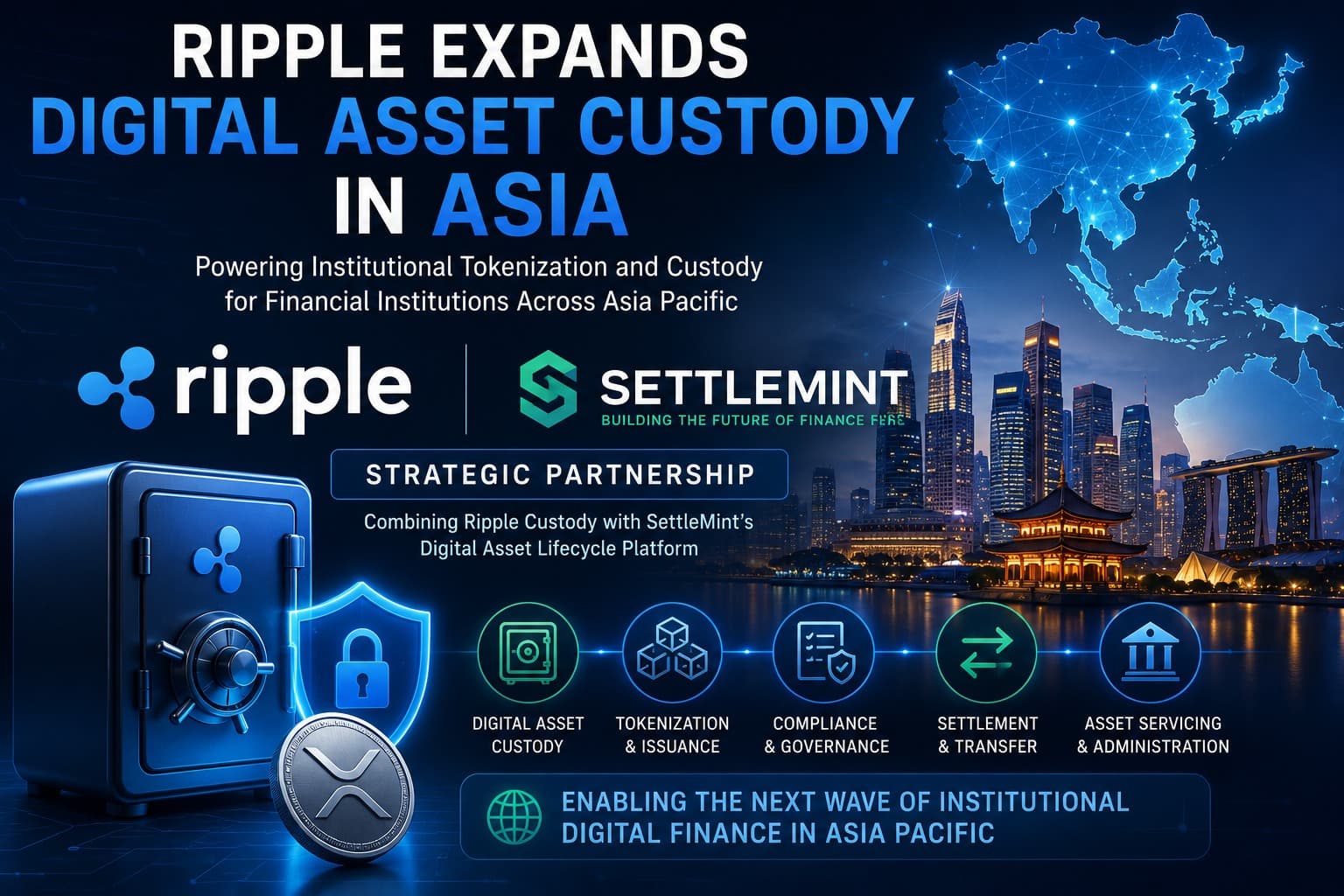
Ripple and SettleMint have announced a strategic partnership aimed at helping financial institutions across Asia Pacific issue, custody, manage and service tokenized assets through a more integrated digital infrastructure stack.
The partnership combines Ripple Custody, Ripple’s institutional custody infrastructure, with SettleMint’s Digital Asset Lifecycle Platform (DALP). The companies say the integration is designed to reduce the complexity created when banks and other regulated institutions have to assemble separate systems for custody, tokenization, compliance, settlement and asset servicing.
BINANCE:XRPUSDT
The announcement comes as banks and financial-market infrastructure providers increasingly move from blockchain experimentation toward production-level applications involving tokenized securities, stablecoins and real-world assets.
Ripple and SettleMint Target the Institutional Infrastructure Gap
Tokenization is often discussed in terms of creating digital representations of bonds, funds, real estate or other real-world assets. For financial institutions, however, issuing a token is only one part of the process.
 Solana Tokenized Equities Smash Records with 850K Unique Holders and Institutional Adoption→
 XRP Holders Close to Unlocking On-Chain RLUSD Borrowing as Validator Vote Nears Threshold→
 How CFOs Are Transforming Corporate Treasury With Digital Assets, XRP, and RLUSD→
 SEC Proposes to Rescind Rule 14a-8 and Modernize Proxy Rules→
Once an asset has been issued, institutions still need to determine who can hold it, how transfers are authorized, how compliance rules are enforced, where the asset is stored, how settlement occurs and how events such as redemptions or distributions are managed.
The Ripple-SettleMint integration is designed to address that broader lifecycle.
SettleMint’s DALP provides tools for designing, issuing and managing digital assets, while Ripple Custody provides infrastructure for institutional asset storage, governance and transaction management. The combined approach is intended to give institutions a single operational foundation rather than requiring multiple disconnected vendors.
This distinction is important because institutional adoption depends not only on blockchain performance but also on operational controls, governance and regulatory compliance.
Ripple describes custody as a foundational layer for institutional digital asset strategies, including tokenization, trading, staking and stablecoin operations. Its custody platform is also designed to connect with existing banking infrastructure through an API-centric architecture.
What the Integrated Platform Covers
The partnership brings several functions into a connected workflow.
| Function | Role in the Digital Asset Lifecycle |
|---|---|
| Asset issuance | Creation and deployment of tokenized financial assets |
| Custody | Secure institutional holding and governance of digital assets |
| Compliance | Permissioning and controls for regulated transactions |
| Settlement | Processing transactions between eligible counterparties |
| Asset servicing | Management of ongoing lifecycle events |
| Administration | Operational management after an asset is launched |
For banks, this architecture can be particularly important when tokenized assets must coexist with existing financial systems.
A tokenized bond, for example, still needs investors to be identified, transfers to comply with applicable restrictions, coupon payments to be processed and ownership records to remain accurate. Tokenization changes the underlying technology, but it does not remove the operational obligations associated with the financial instrument.
That is where lifecycle infrastructure becomes increasingly important.
Asia Pacific Becomes a Key Institutional Market
Ripple and SettleMint said the partnership has already commenced in Asia, with plans to extend the offering to other markets based on institutional demand.
Asia Pacific has become an important market for digital-asset infrastructure because financial institutions in the region are developing regulated use cases involving tokenization, stablecoins, custody and cross-border settlement.
Ripple has previously highlighted growing digital-asset activity across the region, including institutional adoption and the development of regulatory frameworks.
The new partnership therefore fits into a wider institutional trend rather than representing an isolated blockchain deployment.
CryptoQuorum has also covered the growth of institutional XRP infrastructure in Asia, including the integration of XRP with South Korean institutional custodian BDACS. That development illustrates the growing importance of regulated custody as financial institutions move toward digital assets.
Expert Opinions: Why Infrastructure Matters
Fiona Murray, Ripple’s Managing Director for Asia Pacific, said financial institutions in the region are increasingly looking for ways to expand their digital-asset activities without having to connect multiple independent solutions for custody, issuance and governance.
Her assessment highlights an important institutional requirement: simplicity does not mean fewer controls. Instead, banks need infrastructure that integrates those controls into a unified operating environment.
Adam Popat, CEO of SettleMint, similarly argued that capital markets are moving toward on-chain infrastructure and that custody and lifecycle management need to operate together rather than as disconnected systems.
These statements come from executives at the companies involved in the partnership and should therefore be viewed as strategic perspectives rather than independent assessments of the commercial success of the integration.
A broader industry perspective comes from Boston Consulting Group. Its 2026 The Future of Digital Assets report argues that tokenized real-world assets could become one of the most consequential areas of digital finance because tokenization can affect issuance, settlement, custody, servicing and collateral management.
BCG estimates in its progressive scenario that tokenized real-world assets could represent approximately 16% of global investable assets by 2035, equivalent to around $88 trillion. The figure is a forecast rather than a guaranteed outcome, but it illustrates the scale of the institutional market that infrastructure providers are targeting.
Ripple’s Institutional Strategy Extends Beyond Custody
The SettleMint partnership is also consistent with Ripple’s broader effort to build infrastructure around institutional digital finance.
Ripple has been expanding its product portfolio across custody, payments, stablecoins and institutional markets. Its RLUSD stablecoin is another important component of that strategy.
CryptoQuorum recently reported that RLUSD surpassed a $2 billion market-cap milestone according to Ripple, with close to $1 billion issued on the XRP Ledger. The development illustrates Ripple’s attempt to position stablecoins as infrastructure for payments, settlement and institutional financial applications rather than solely as trading instruments.
Ripple has also increasingly connected custody with tokenization and on-chain finance. The company argues that institutional custody must support not only long-term asset storage but also high-frequency transactions, governance and integration with existing financial systems.
This creates a broader infrastructure model:
Issuance → Compliance → Custody → Settlement → Servicing
The closer these functions become, the less institutions may need to rely on fragmented technology stacks.
Tokenization Is Moving Toward the Post-Issuance Stage
One of the most important implications of the partnership is that the institutional tokenization market is beginning to focus on what happens after an asset is created.
Early blockchain projects often emphasized token issuance itself. But institutional markets require much more: controlled ownership, permissioning, settlement, corporate actions, reporting and regulatory oversight.
BCG’s research similarly identifies settlement, clearing, custody and asset servicing as areas where tokenization could produce significant structural changes. The consultancy notes that programmable assets could support faster settlement, automated compliance and more efficient collateral management.
That makes the Ripple-SettleMint model relevant beyond cryptocurrencies.
The same infrastructure could potentially support tokenized bonds, funds, private-market assets, commodities and other financial instruments, subject to applicable regulations and market adoption.
CryptoQuorum has previously examined the wider tokenization trend through developments involving the XRP Ledger and institutional real-world assets.
What the Partnership Does Not Prove
The announcement should not be interpreted as evidence that tokenized assets have already reached mass institutional adoption.
The companies have not disclosed a complete list of participating financial institutions, transaction volumes or the amount of assets expected to be tokenized through the partnership.
Similarly, BCG’s $88 trillion projection is a scenario-based forecast, not a prediction that the market will necessarily reach that level.
The more measurable development is the infrastructure investment itself. Financial technology providers are increasingly building systems designed to connect traditional finance with blockchain-based asset management.
That suggests the competitive question is shifting from whether tokenization is technically possible to which companies can provide compliant, scalable and operationally efficient infrastructure for institutions.
What Comes Next
Ripple and SettleMint said their joint offering is already available in Asia and that expansion into additional markets will depend on institutional demand.
For the partnership to become commercially significant, several factors will matter:
- Institutional adoption: Banks and asset managers must move beyond pilots into recurring production activity.
- Regulatory clarity: Tokenized securities and digital assets remain subject to different rules across jurisdictions.
- Interoperability: Institutions will need digital assets to interact with existing financial infrastructure and multiple blockchain networks.
- Security and governance: Custody and permissioning remain critical requirements for regulated institutions.
- Economic value: Tokenization must produce measurable benefits in settlement, liquidity, collateral management or asset servicing.
The Asia Pacific launch gives Ripple and SettleMint an opportunity to compete in a market where institutional digital-asset infrastructure is developing rapidly.
Bottom Line
The Ripple-SettleMint partnership represents a shift toward integrated institutional infrastructure rather than standalone blockchain products.
By combining Ripple Custody with SettleMint’s lifecycle platform, the companies are targeting the operational layer that sits between token issuance and long-term financial-market use.
The significance of the deal will ultimately depend on adoption, regulatory approval and measurable institutional activity. But the strategic direction is clear: as tokenization develops, financial institutions will need infrastructure capable of managing digital assets throughout their entire lifecycle—not simply creating them.
The partnership therefore adds another piece to the emerging institutional digital-finance stack, particularly across Asia Pacific.
Disclaimer
This article is provided for informational and educational purposes only and does not constitute financial, investment, legal or regulatory advice. Statements regarding Ripple, SettleMint, tokenization, XRP, RLUSD or the future growth of digital assets reflect publicly available information and company statements where indicated. Forecasts and projections are inherently uncertain and should not be treated as guarantees of future performance. Readers should conduct their own research and consult qualified professionals before making investment decisions.