

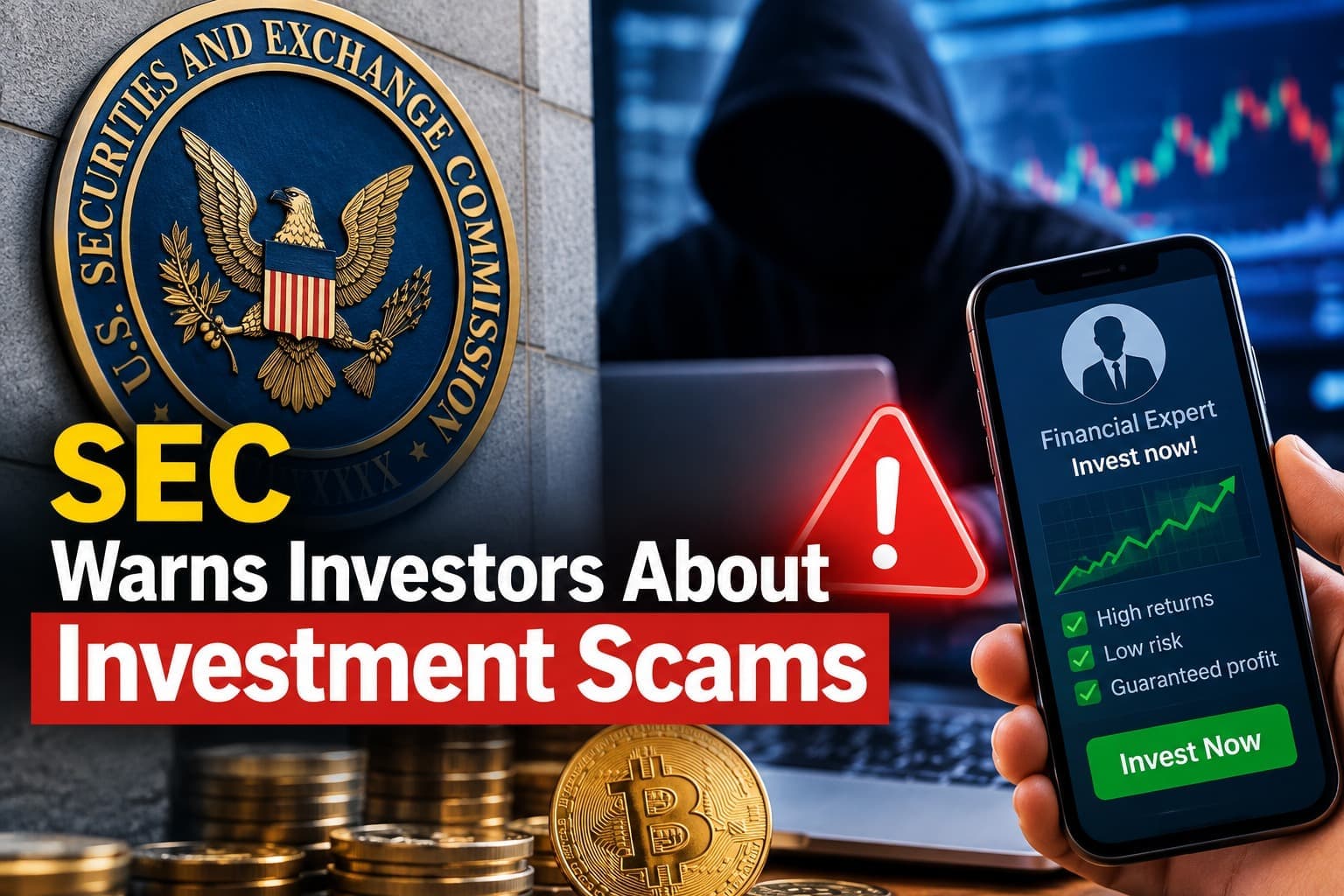
The U.S. Securities and Exchange Commission (SEC) is joining financial regulators around the world in a new campaign warning investors about increasingly sophisticated fraud, including relationship investment schemes and impersonation attacks powered by modern technology.
The warning was issued on October 5 as part of World Investor Week 2026, a global investor-education campaign coordinated by the International Organization of Securities Commissions (IOSCO). The SEC said regulators are focusing on investor resilience, digital deception and scam awareness as financial fraud becomes harder to distinguish from legitimate investment activity.
The campaign is particularly relevant to cryptocurrency and digital-asset investors, who increasingly encounter investment offers through social media, messaging applications and online communities.
SEC Coordinates Global Investor Protection Campaign
The SEC coordinated its U.S. World Investor Week effort with the Commodity Futures Trading Commission (CFTC), Financial Industry Regulatory Authority (FINRA), Securities Investor Protection Corporation (SIPC), National Futures Association (NFA) and North American Securities Administrators Association (NASAA).
 Coinbase and Citi Expand Stablecoin Payments for Businesses→
 Michael Saylor Proposes a Bill of Digital Rights to Fuel a $100 Trillion Digital Economy→
 BlackRock: AI Will Drive a New Machine-Native Economy→
 Solana Tokenized Stocks Smash Records with 850K Unique Holders and Institutional Adoption→
The 2026 campaign marks the 10th anniversary of World Investor Week, which brings regulators and investor-protection organizations together across six continents. The international campaign runs from October 5 to October 11.
SEC Chairman Paul S. Atkins said investor protection remains a core part of the agency’s mission and urged investors to use the resources available through Investor.gov while remaining alert to potential scams.
John Moses, director of the SEC’s Office of Investor Education and Assistance, similarly emphasized investor resilience and the importance of using independent information before making financial decisions.
These comments are significant because the regulators’ message extends beyond traditional securities fraud. The warning describes an environment in which criminals can combine social engineering, fake investment platforms, stolen identities and artificial intelligence to make fraudulent opportunities appear credible.
Relationship Investment Scams Start With Trust
One of the central threats identified by regulators is the relationship investment scam.
These schemes typically begin with an unsolicited message through social media, text or a messaging application. Rather than immediately asking for money, the fraudster may spend weeks or months establishing a relationship with the victim.
The relationship can appear to be a friendship, professional connection or romantic interaction.
Once trust has been established, the scammer introduces an investment opportunity and may offer to help the victim make money. The victim can then be directed to a professional-looking website or mobile application that displays fabricated account balances and trading profits.
The apparent profits are designed to encourage additional deposits.
In some cases, a victim may initially be allowed to withdraw a small amount of money. This can reinforce the belief that the platform is legitimate. Problems typically arise when the victim attempts to withdraw a larger amount.
The fraudulent platform may then demand additional payments for supposed taxes, fees or account requirements. Eventually, the operators may disappear, block the victim or remove access to the platform altogether.
The SEC says these types of schemes have resulted in investors worldwide losing billions of dollars each year.
AI Is Making Impersonation Fraud More Convincing
Artificial intelligence is adding another layer to the problem.
According to the SEC and its regulatory partners, fraudsters can use advanced technology to make impersonation attempts more convincing. Fake communications may appear to come from government agencies, financial professionals, companies or other trusted organizations.
The danger is not limited to fake social-media profiles.
Fraudsters can also create websites, documents and communications that resemble legitimate financial infrastructure. Regulators specifically warn that criminals may misuse genuine SEC filings or misrepresent what those filings mean.
For example, a fraudulent investment operation may point to an SEC filing as supposed evidence that a company or adviser is registered with the agency. But the existence of a filing does not automatically mean that the individual or business is registered or authorized to provide investment services.
This distinction is particularly important for digital-asset investors, where projects and platforms frequently use regulatory terminology to establish credibility.
Investors should therefore verify regulatory status independently rather than relying on screenshots, certificates, social-media claims or documents supplied by an investment promoter.
Crypto Investors Face Additional Risks
The SEC’s warning has a direct connection to the digital-asset sector.
Cryptocurrency transactions can be fast, difficult to reverse and, depending on the blockchain and transaction structure, challenging to attribute to a real-world identity. Investor.gov specifically warns that these characteristics can make crypto assets attractive to scammers.
Social media and investment-focused group chats are another major vulnerability.
A fraudulent account can impersonate a well-known analyst, exchange, financial professional or even a regulator. The scammer may then distribute a token recommendation, private investment opportunity or supposed account-recovery service.
This makes independent verification especially important.
CryptoQuorum has previously covered the problem of fraudulent entities using regulatory filings to create an appearance of legitimacy. In August, the SEC charged 38 entities that allegedly misrepresented information in adviser filings to appear legitimate to investors.
That case illustrates why investors should not treat a regulatory document as proof of legitimacy without examining what the document actually establishes.
Five Red Flags Investors Should Watch
The SEC and Investor.gov identify several recurring warning signs.
1. An unsolicited investment approach
Be cautious when an unknown person initiates contact through a messaging application, social network or investment group and gradually introduces an investment opportunity.
2. Guaranteed or unusually high returns
Claims of guaranteed profits, enormous returns or extremely low risk should be treated with skepticism. Investor.gov notes that legitimate investments carry risk and that promises of exceptional returns can be a hallmark of fraud.
3. Pressure to send money immediately
Scammers frequently create artificial urgency. Investors may be told that an opportunity will disappear unless they transfer funds immediately.
Independent research should come before payment.
4. Requests for additional money to unlock withdrawals
A demand for additional taxes, fees or deposits before an investor can access supposedly existing profits is a major warning sign.
5. Requests for sensitive credentials
Investors should never provide passwords, PINs, wallet seed phrases or private keys to someone claiming to represent a regulator, exchange or investment professional.
The SEC specifically warns that impersonators may ask for account information, digital addresses, passwords or private keys.
How Investors Can Verify an Investment
The SEC recommends checking the credentials and disciplinary history of investment professionals before committing funds.
For U.S. investors, Investor.gov provides tools for checking investment professionals. FINRA’s BrokerCheck and the NFA’s BASIC system can also provide information about regulated professionals and their histories.
Investors should also conduct independent research rather than relying exclusively on information supplied by a promoter.
Investor.gov recommends examining company information, checking SEC filings through EDGAR and investigating the person or organization making the investment recommendation.
For crypto investors, the same principle applies: verify the identity of the platform, examine the project’s official documentation, check regulatory claims against primary sources and avoid sending assets based solely on a social-media message.
Our own CryptoQuorum Fact-Checking Policy explains why primary regulatory sources and independent verification are central to our reporting.
Regulators Are Increasing Their Focus on Retail Fraud
The World Investor Week warning comes shortly after the SEC established a Retail Fraud Working Group designed to identify misconduct targeting everyday investors.
The group focuses on areas including false and fraudulent regulatory filings and misconduct by financial professionals. The SEC says retail investors can be particularly vulnerable because they may have less experience with complex financial products and may be less able to absorb significant losses.
The development indicates that investor protection is becoming a more visible regulatory priority even as the broader U.S. financial system moves toward greater integration of digital assets.
That creates an important distinction for the crypto market: regulatory clarity and technological innovation do not eliminate the need for basic investor due diligence.
CryptoQuorum‘s recent coverage of SEC crypto custody proposals and SEC-CFTC digital-asset regulation provides additional context on the evolving regulatory framework surrounding digital assets.
Investor Resilience Is Becoming a Core Skill
The SEC’s World Investor Week message is broader than simply telling investors to avoid scams.
Regulators are also encouraging people to build financial resilience through planning, diversification, appropriate risk management and adequate savings. The Investor Bulletin argues that investors who prepare for economic uncertainty are better positioned to avoid making emotional decisions during periods of market volatility.
For cryptocurrency investors, that principle is especially relevant.
Volatile markets can create pressure to act quickly, while social-media communities can amplify fear of missing out. Combining those conditions with increasingly sophisticated impersonation technology can make fraudulent opportunities difficult to recognize.
The most effective defense remains relatively simple: slow down, verify the source, investigate the person or platform independently and never provide credentials or send money solely because someone claims to represent a trusted institution.
World Investor Week 2026 ultimately reinforces a principle that applies across traditional finance and digital assets alike: investor protection begins with independent verification.
For additional context on CryptoQuorum’s approach to accuracy and transparency, readers can review our Our Principles.
Disclaimer
This article is for informational and educational purposes only and does not constitute financial, investment, legal or tax advice. Investors should conduct independent research and consult qualified professionals before making financial decisions.