

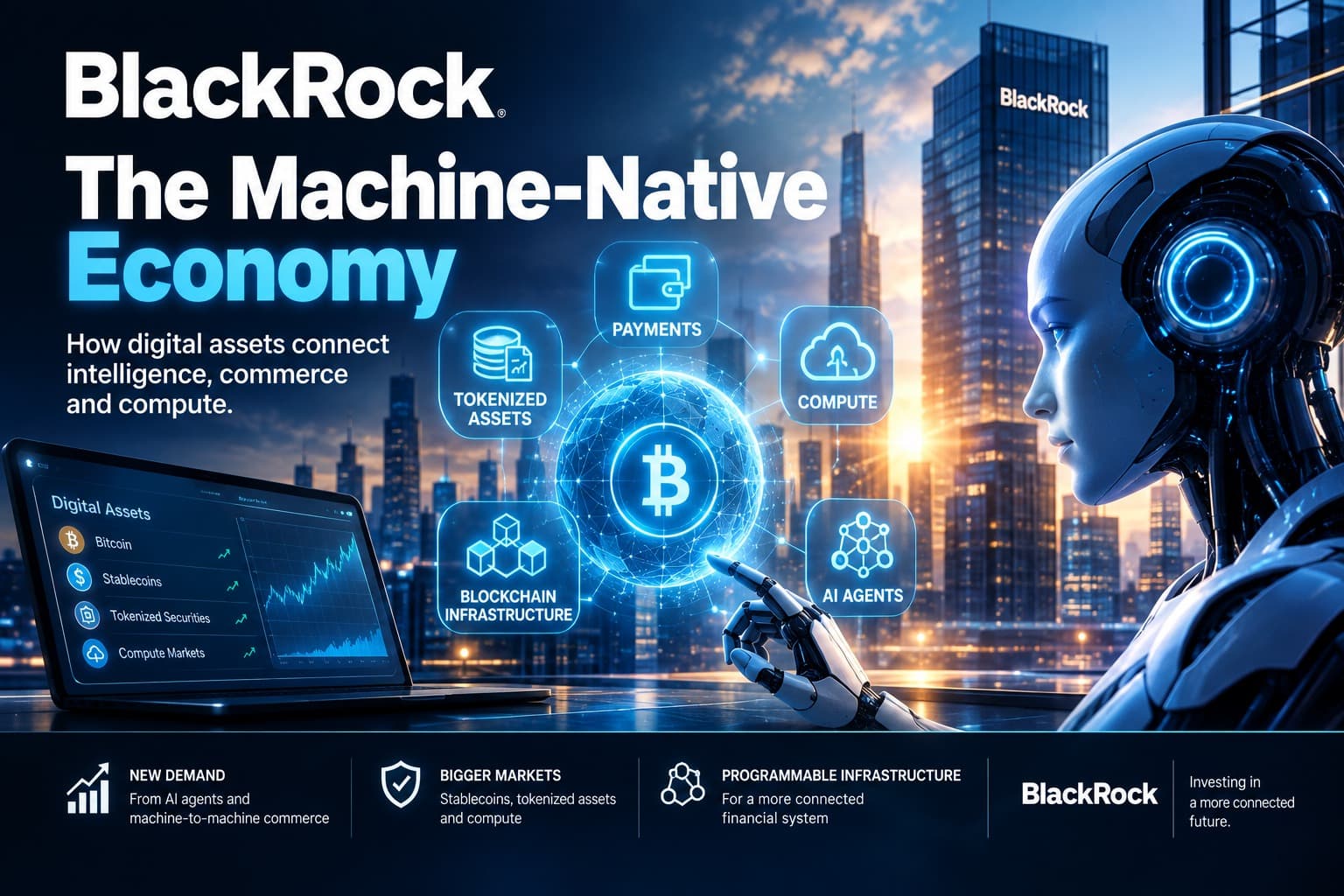
BlackRock is arguing that the next major source of digital-asset adoption may come not from people, but from software. In its new research paper, The Machine-Native Economy: How digital assets connect intelligence, commerce, and compute, the asset manager examines how increasingly autonomous AI agents could use stablecoins, tokenized assets and programmable blockchains to make payments, access financial products and procure computing resources.
The thesis marks a notable shift in how the relationship between artificial intelligence and crypto is being framed. Rather than treating blockchain as simply another investment technology, BlackRock’s Digital Assets Research team views it as potential economic infrastructure for systems that can increasingly plan and execute tasks with limited human intervention.
The paper was written by Will Su, Head of Digital Assets Research; Robert Mitchnick, Head of Digital Assets; Jay Jacobs, U.S. Head of Equity ETFs; and William Helm, Head of U.S. iShares Product Innovation.
BlackRock also makes an important qualification: much of the agentic-payment and compute-market ecosystem described in the report is still nascent, with limited real-world activity and liquidity today.
 Solana Tokenized Equities Smash Records with 850K Unique Holders and Institutional Adoption→
 How CFOs Are Transforming Corporate Treasury With Digital Assets, XRP, and RLUSD→
 SEC Proposes to Rescind Rule 14a-8 and Modernize Proxy Rules→
 DTCC Tokenization Service Nears October 2026 Launch as Edel Joins Industry Working Group→
From human-centered software to agentic commerce
The central concept in BlackRock’s paper is the emergence of agentic AI.
Traditional software generally waits for a user to issue an instruction and then executes a predefined operation. Agentic systems are designed to plan multi-step tasks, use external tools and act with less human intervention.
That creates a financial problem.
An autonomous agent may need to pay for an API, purchase data, access a cloud service or obtain computing capacity. If each transaction requires a person to log into a bank account, enter credentials and approve a payment manually, the economics of full automation become more difficult.
BlackRock argues that blockchains and programmable digital assets could provide a more natural settlement layer for those transactions because they are already machine-readable and can operate continuously. The report identifies stablecoins, native cryptoassets and tokenized real-world assets as potential instruments for such activity.
This is the foundation of the machine-native economy concept.
Why stablecoins are central to the thesis
BlackRock does not argue that Bitcoin necessarily becomes the default currency for every AI transaction.
Instead, the paper says stablecoins are likely to lead transactional use because their relatively stable value makes them easier to use for pricing and settlement.
That distinction is economically significant.
An AI agent purchasing an API call or a few seconds of computing power needs a predictable unit of account. A highly volatile cryptocurrency can introduce unnecessary pricing risk.
A stablecoin can potentially provide:
Agent → payment → service → settlement
without requiring a bank-based workflow for every transaction.
BlackRock points to emerging protocols that could support this model, including x402, Stripe and Tempo’s Machine Payments Protocol, Stripe and OpenAI’s Agentic Commerce Protocol, Google’s Agent Payments Protocol, and Visa’s Trusted Agent Protocol.
These initiatives do not all use the same technical architecture, and BlackRock does not suggest that one protocol has already won. The broader point is that standards for agent-to-agent and agent-to-business payments are beginning to emerge.
$11 trillion in stablecoin volume — with an important caveat
One of the paper’s most attention-grabbing figures is its estimate that adjusted stablecoin transaction volume exceeded $11 trillion during 2025.
BlackRock compares the figure broadly with annual Visa and Mastercard volumes, while noting that it remains well below the roughly $93 trillion transferred through ACH in 2025. More importantly, the company states explicitly that these figures are not directly comparable because the underlying methodologies differ.
BlackRock’s adjusted stablecoin measure applies filters intended to remove internal transfers, intra-exchange activity, bots and other high-frequency or high-volume transactions.
That methodological warning should remain attached to the headline number.
The figure is useful as an indicator of the scale of on-chain dollar activity, but it should not be interpreted as equivalent to $11 trillion of ordinary consumer payments.
For the machine-economy thesis, the more important point is that stablecoin infrastructure already exists at substantial scale.
BlackRock connects AI tokens with blockchain tokens
Another section of the paper looks at an architectural similarity between AI and digital assets.
Large language models break human language into tokens that can be processed numerically. Blockchain systems represent assets, ownership and economic claims as standardized digital tokens.
The functions are obviously different, but both systems transform information into machine-readable structures.
BlackRock argues that this common structure could make it easier for AI agents to interact with tokenized assets than with fragmented legacy financial databases.
For example, a tokenized fund interest can contain standardized information about the asset, ownership and transfer rules. An agent could potentially evaluate that information, verify eligibility and initiate a transaction through programmable infrastructure.
The financial controls do not disappear.
BlackRock notes that AML, KYC and KYA checks generally remain off-chain, where identity and compliance information can be evaluated before verified results are passed to the blockchain to determine transaction eligibility.
That is an important E-E-A-T point for the article: tokenization does not eliminate regulation. It changes how financial claims and transaction instructions can be represented and executed.
Tokenization could become an interface for AI agents
The implication goes beyond payments.
Suppose an autonomous software system needs to manage a portfolio, hedge an exposure or deploy working capital. A financial market built around standardized tokenized assets could potentially make those tasks more programmable.
BlackRock argues that tokenization can reduce the number of bespoke integrations needed across financial infrastructure and allow agents to orchestrate more complex, multi-asset workflows.
A tokenized money-market fund, for example, could represent a standardized financial claim in a digital wallet.
An agent could theoretically:
- identify the asset;
- check eligibility rules;
- determine available liquidity;
- execute an authorized transfer;
- verify settlement.
The crucial word is theoretically.
The paper describes an emerging architecture rather than a mature autonomous financial market.
Compute could become a new digital asset market
The most interesting part of BlackRock’s thesis may be its discussion of compute.
AI systems require GPUs, CPUs, electricity and data-center capacity. Today that infrastructure is generally bought through cloud contracts or direct hardware financing.
BlackRock argues that compute is becoming a distinct economic resource that could eventually support financial products and digital assets.
The research cites consensus estimates for combined revenue from AWS, Microsoft’s Intelligent Cloud segment and Google Cloud of approximately $1.1 trillion by 2030, representing a 29% compound annual growth rate from 2025 levels.
BlackRock’s proposed model is not a simple “GPU token.”
Instead, it envisions standardized claims on computing capacity that could potentially be represented, transferred, financed, pledged as collateral and settled through programmable infrastructure.
That would create a market somewhat analogous to established commodity markets, where standardized contracts allow participants to price, hedge and finance physical resources.
The challenge: compute is not a standardized commodity yet
BlackRock itself acknowledges significant obstacles.
Different generations of chips have different performance characteristics. Regional electricity costs vary. Latency, location and hardware specialization also affect the economic value of computing capacity.
A contract for one hour of compute on one GPU therefore cannot automatically be treated as equivalent to an hour on another device.
The paper says these differences create contract-design and market-structure challenges before standardized compute products can scale.
BlackRock nevertheless points to familiar financial-market mechanisms — including basis markets and contracts for difference — as potential precedents for dealing with heterogeneous underlying resources.
This is an important distinction: the firm is describing a possible future financial market around compute, not reporting that such a liquid standardized market already exists.
AI agents could eventually shop for compute
The paper takes the compute thesis one step further.
An autonomous agent could theoretically query marketplaces for available capacity, comparing price, performance, latency, location and hardware specialization before selecting the most appropriate resource.
Protocols such as MCP and A2A could handle information access and communication between agents, while x402 could provide on-demand settlement.
The result would be a workflow in which the AI system does not simply request compute.
It discovers, evaluates, purchases and pays for compute automatically.
BlackRock acknowledges that agentic-payment activity remains early today, but argues that the structural relationship between autonomous agents and programmable payments makes the model worth monitoring.
Expert opinions: the convergence is still early
BlackRock’s view is not isolated within the firm’s research.
In another BlackRock discussion, Robert Mitchnick described the convergence between AI and digital assets as particularly important and argued that AI-agent economics could create demand for blockchain-based monetary instruments. BlackRock’s broader thematic research has also described AI and digital assets as potentially reinforcing technologies.
At the same time, BlackRock’s paper itself explicitly says the ecosystem is still nascent, with limited agentic-payment activity and compute-market liquidity.
That makes the current thesis more useful as a framework for identifying emerging infrastructure than as evidence of an already-established machine economy.
The practical question is whether autonomous systems will actually generate enough transactions to justify new financial rails.
Stripe, x402 and the emerging payment stack
The report highlights several early standards that illustrate how this infrastructure is developing.
x402, associated with Coinbase, uses the HTTP 402 “Payment Required” mechanism to facilitate machine-initiated payments. BlackRock notes that the protocol is blockchain-agnostic and identifies stablecoins such as USDC as an early use case.
The Machine Payments Protocol, developed by Stripe and Tempo, is aimed at payments for APIs and HTTP resources.
The Agentic Commerce Protocol, developed by Stripe and OpenAI, focuses on programmatic checkout between agents and businesses.
Google’s AP2 and Visa’s Trusted Agent Protocol address other aspects of authorization, agent communication and payment credentials.
The emerging stack is therefore broader than blockchain alone.
Identity, authorization, payment messaging, settlement and compliance all have to work together.
What this means for crypto infrastructure
BlackRock’s thesis potentially changes the investment narrative around several crypto categories.
Stablecoins
Stablecoins could become machine-to-machine settlement instruments rather than simply trading collateral.
Layer-1 blockchains
Networks may compete on fees, throughput, settlement guarantees and programmability as agentic transaction volumes grow.
Tokenized RWAs
Standardized financial claims could give autonomous software a structured interface with traditional financial assets.
Oracles and data infrastructure
Agents need trusted information about prices, balances, eligibility and market conditions before transactions can execute.
Compute markets
Digital assets could eventually become a way to finance or trade standardized claims on computing capacity.
This convergence is already relevant to CryptoQuorum’s coverage of AI inference and on-chain settlement on Solana and stablecoin payroll infrastructure on Stellar.
Those applications address different use cases, but they share the same basic idea: blockchain settlement becomes more useful when digital activity itself becomes more automated.
A new demand source for digital assets?
This is ultimately the most important question raised by BlackRock’s report.
Crypto adoption has historically been driven by human users: traders, investors, businesses and institutions.
An economy increasingly populated by autonomous software could add another category of economic actor.
Machines could potentially hold working balances, purchase services, pay for information, acquire computing resources and interact with tokenized financial assets.
That would create transaction demand that is not directly dependent on humans buying crypto because they expect its price to rise.
BlackRock calls AI a potential structural catalyst for digital-asset adoption and digital assets a potential facilitator of the AI economy.
But the paper also makes clear that this remains a forward-looking thesis.
What could prevent the machine-native economy from scaling?
Several obstacles remain.
Identity and authorization: Autonomous agents need clear rules defining what they are allowed to purchase and how much they can spend.
Compliance: KYC, AML, sanctions and eligibility requirements cannot simply be removed because a transaction is machine-generated.
Security: A compromised agent wallet could potentially create automated financial losses at machine speed.
Interoperability: Multiple payment and blockchain standards will need to communicate reliably.
Liquidity: A theoretical tokenized market has limited value if buyers and sellers cannot transact efficiently.
Economic incentives: Developers must determine whether blockchain settlement is actually cheaper and more useful than existing payment infrastructure.
BlackRock recognizes several of these constraints, particularly around identity, compliance, market structure and compute standardization.
Why this matters for Bitcoin and other cryptoassets
The report does not provide a new Bitcoin price target or argue that one cryptocurrency will capture all of the potential economic value.
Its thesis is broader.
Stablecoins may handle transaction settlement. Tokenized assets may represent financial claims. Native cryptoassets can provide blockchain-native economic incentives and settlement. Compute-related instruments could represent access to scarce digital resources.
BlackRock’s research therefore presents a multi-layer digital-asset economy, rather than a single-asset investment thesis.
For Bitcoin specifically, the potential implication is indirect. If machine-driven economic activity causes more value to move through blockchain networks, demand for the broader digital-asset infrastructure could increase. But the report does not establish how that demand would be distributed among individual assets.
Bottom line
BlackRock’s machine-native economy thesis places AI agents at the center of a potential new wave of digital-asset adoption.
The asset manager’s research argues that autonomous software could create demand for programmable payments, tokenized financial assets and markets for computing capacity. Stablecoins could provide predictable settlement, tokenization could standardize financial claims, and blockchain networks could provide always-on infrastructure for machine-to-machine transactions.
The numbers surrounding the thesis are substantial. BlackRock cites more than $300 billion in stablecoin market capitalization as of September 2026, more than $11 trillion in adjusted stablecoin transaction volume during 2025, and potential combined cloud revenues of approximately $1.1 trillion by 2030 across selected hyperscaler businesses.
But the report does not claim that an autonomous machine economy already exists at scale.
Agentic payments remain early, compute markets are not yet standardized and questions around identity, compliance, security, interoperability and liquidity remain unresolved.
The significance of the paper is therefore its proposed direction of travel.
If AI systems increasingly become economic participants, they will need money, assets, data and computing resources that machines can access and settle programmatically.
That could give stablecoins, tokenized assets and blockchain infrastructure a role well beyond today’s human-directed crypto market.
For CryptoQuorum readers, the most important metric to watch may ultimately be neither token prices nor AI model benchmarks.
It may be how much real economic activity autonomous software begins to conduct through programmable financial rails.
Disclaimer
This article is provided for informational and educational purposes only and does not constitute financial, investment, trading, legal, tax or other professional advice. BlackRock’s research contains forward-looking views, estimates and illustrative scenarios that may not materialize. The paper itself states that it is not investment advice and that its views may change as conditions evolve. AI-agent payments, tokenization, stablecoins and digital assets remain developing markets with technological, regulatory, liquidity, cybersecurity and counterparty risks. Readers should conduct independent research and consult qualified professionals before making financial decisions.