

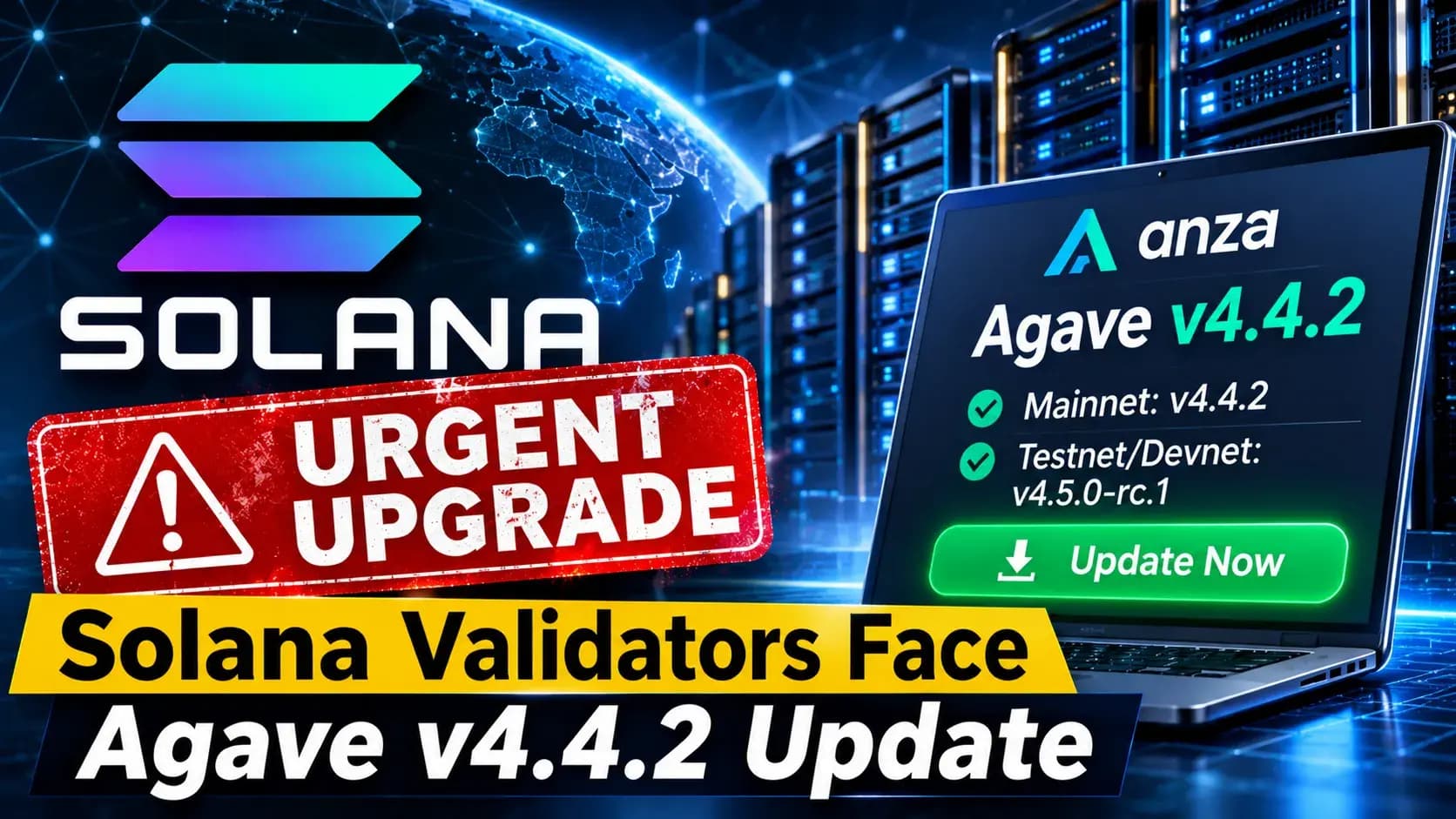
Solana developers have issued an urgent software update notice to operators running the network’s Agave validator client, instructing them to install version 4.4.2 without delay.
The warning, issued by Anza, the engineering organization responsible for the Agave client, applies to both staked and unstaked mainnet nodes. Operators running Testnet and Devnet have been directed to install a separate release candidate, Agave v4.5.0-rc.1.
BINANCE:SOLUSDT
The notice was amplified by the official Solana account on November 28. Anza’s message, published late on November 27, used unusually direct language: “Don’t wait, upgrade now.”
Despite the urgency, Anza also said that Solana clusters were safe and operating normally. The team has not publicly identified the specific technical reason for the immediate upgrade request. There is currently no confirmed evidence that the announcement was prompted by an active attack, a successful exploit or a network outage.
 Brad Garlinghouse Says XRP Remains Its North Star as RLUSD Expands→
 JPMorgan Brings Tokenized Money Market Funds to Solana→
 MoneyGram Joins XDC Network as Institutional Validator→
 XRP Asia Officially Launches in Seoul to Accelerate XRP Ledger Adoption Across the Asia-Pacific Region→
The distinction is important: the instruction signals that developers want operators to deploy the update quickly, but it does not establish that the blockchain itself has been compromised.
What Anza Told Solana Validators
Anza’s notice covers operators running the Agave validator client on Solana’s mainnet.
The instruction is not limited to validators that stake SOL or participate directly in block voting. It also includes unstaked nodes running the affected software.
This broader scope matters because validator infrastructure includes more than machines responsible for voting on blocks. Non-voting nodes can provide RPC services and process network data. They still run software that may need to be updated.
Anza specified two different software targets:
- Mainnet: Agave v4.4.2.
- Testnet and Devnet: Agave v4.5.0-rc.1.
The distinction reflects the separate release tracks used for production software and testing. Operators should follow the version appropriate to the cluster they maintain rather than treating the two releases as interchangeable.
The announcement also demonstrates the importance of coordination across an independent validator network. Developers can publish a release, but individual operators must deploy it on their own infrastructure.
Anza’s direct instruction is intended to accelerate that process.
What Is Included in Agave v4.4.2?
The release is documented in the official Agave GitHub repository, where version 4.4.2 is described as a stable release recommended for general adoption.
Its published changes include several updates involving network communication, dependencies and RPC functionality.
One change disables unused TLS early data in the tpu-client-next transaction-forwarding component. The release also updates vendored Quinn networking crates to the Agave 4.4.2 version.
Other changes address three RustSec dependency advisories involving Quinn, libz-sys and url.
The update also changes access to the /v0/circulating-supply RPC endpoint. According to the release notes, this endpoint now requires the --full-rpc-api configuration flag.
These changes are documented in the software release, but the release notes do not explicitly identify which individual change prompted Anza to issue its urgent upgrade instruction.
That limitation should not be overlooked. It would be premature to describe the update as a confirmed emergency security patch for a specific vulnerability when the engineering team has not publicly connected the notice to an identified exploit or incident.
Why the Upgrade Applies to Unstaked Nodes Too
The inclusion of unstaked nodes is one of the more notable aspects of the announcement.
Solana relies on validator software to process transactions, maintain the ledger and participate in the network’s consensus process. Staked validators have voting weight associated with delegated SOL, while unstaked nodes can perform other network functions without contributing voting weight.
Both types of nodes still execute software.
Consequently, a software update can be relevant to an unstaked node even if that machine does not participate in consensus voting. The node may still process network traffic or provide services that depend on the affected components.
Anza’s instruction therefore focuses on the software being operated, not simply on whether a machine has SOL delegated to it.
For infrastructure providers, this means checking the client implementation and version running on each relevant machine.
It also illustrates why blockchain maintenance requires coordination across different types of operators, including validators, RPC providers and other infrastructure services.
Agave v4.4.2 Is Not the Same as the v4.5 Test Release
The simultaneous publication of v4.4.2 and v4.5.0-rc.1 can create confusion.
The Agave GitHub release page identifies v4.4.2 as a stable release recommended for general adoption. By contrast, v4.5.0-rc.1 is marked as a mainnet-beta upgrade candidate recommended for Testnet and Devnet.
These releases belong to different stages of the software development process.
A stable release is intended for broader deployment in the environment for which it is recommended. A release candidate is a version being evaluated ahead of a wider production rollout.
The distinction is particularly important for operators who manage multiple Solana clusters. Installing a version intended for testing on a production node without checking the official guidance could introduce unnecessary operational risk.
Anza’s notice provides the relevant targets: v4.4.2 for mainnet and v4.5.0-rc.1 for Testnet and Devnet.
The official Agave release history provides the corresponding release information and change logs.
Does the Urgent Notice Mean Solana Was Hacked?
There is no public confirmation of that.
Anza’s message called for an immediate upgrade but also stated that clusters were safe and running normally. The public release notes describe software changes, but they do not disclose an active exploit or identify an attacker.
An urgent software instruction should not automatically be interpreted as evidence of a successful attack.
Development teams may request rapid deployment for several reasons, including changes to network-facing components, dependency updates, reliability improvements or risk mitigation. Without a specific explanation from the engineering team, the exact motivation remains unconfirmed.
The available information supports three conclusions:
- Anza wants Agave-based mainnet operators to install v4.4.2 immediately.
- The instruction applies to staked and unstaked nodes.
- The engineering team has not publicly confirmed an active network attack or outage.
This is the most accurate way to characterize the announcement until Anza provides further technical details.
What the Upgrade Means for SOL Holders
For ordinary SOL holders, the notice does not introduce a new token or require a change to wallet balances.
The instruction is directed at infrastructure operators, not at users holding SOL in personal wallets or using applications on the network.
There is no indication in the announcement that users must transfer their tokens, create new wallets or perform a manual migration.
However, validator software maintenance is relevant to the broader reliability of the blockchain. Network performance depends on the software operated by independent infrastructure participants, and timely deployment of important updates can help maintain consistent operation.
The immediate question is therefore not whether SOL holders need to take action, but how quickly the relevant node operators respond.
The available public information does not provide a complete, independently verified breakdown of how many mainnet nodes have already installed v4.4.2. Release availability should not be confused with completed deployment across the validator network.
Anza’s Upgrade Notice Puts Validator Coordination in Focus
The announcement also highlights a broader technical challenge for proof-of-stake networks: maintaining software consistency across infrastructure operated by independent participants.
A development team can identify a change and publish an updated client, but deployment depends on operators managing their own machines, testing configurations and coordinating maintenance.
This is particularly relevant when an update is described as urgent.
Anza’s instruction covers both staked and unstaked Agave nodes, making the response dependent on a broad group of infrastructure operators rather than only the validators with the largest stake.
The engineering team’s public statement is the primary technical assessment currently available. No independently attributed security expert has publicly established the cause of the urgent notice in the sources reviewed for this article. Any stronger explanation would therefore be speculation.
The next useful indicators will be further communication from Anza, updates to the official release documentation and evidence of deployment across the relevant validator infrastructure.
What Happens Next?
The immediate priority is for operators running Agave on Solana mainnet to follow Anza’s v4.4.2 instruction. Testnet and Devnet operators have a separate target in v4.5.0-rc.1.
Several developments will help clarify the significance of the update:
- Whether Anza publishes a more detailed explanation of the reason for the urgent instruction.
- How quickly mainnet operators deploy v4.4.2.
- Whether additional technical guidance or follow-up releases are published.
- Whether the network continues operating normally during the rollout.
- Whether the issue affects only Agave-based clients or requires further action from other validator implementations.
For now, the announcement should be viewed as an urgent validator-software update rather than confirmation of a Solana security breach.
The network’s ability to coordinate a timely response across independent operators will be an important part of the story as the rollout progresses.
Disclaimer: This article is for informational and educational purposes only and does not constitute financial, investment or technical advice. The information is based on public statements from Solana and Anza, official software release documentation and independent reporting available at the time of publication. The precise reason for the urgent upgrade notice has not been publicly confirmed. CryptoQuorum does not provide investment recommendations. SOL and other digital assets are volatile and involve significant risk.