English
  Español

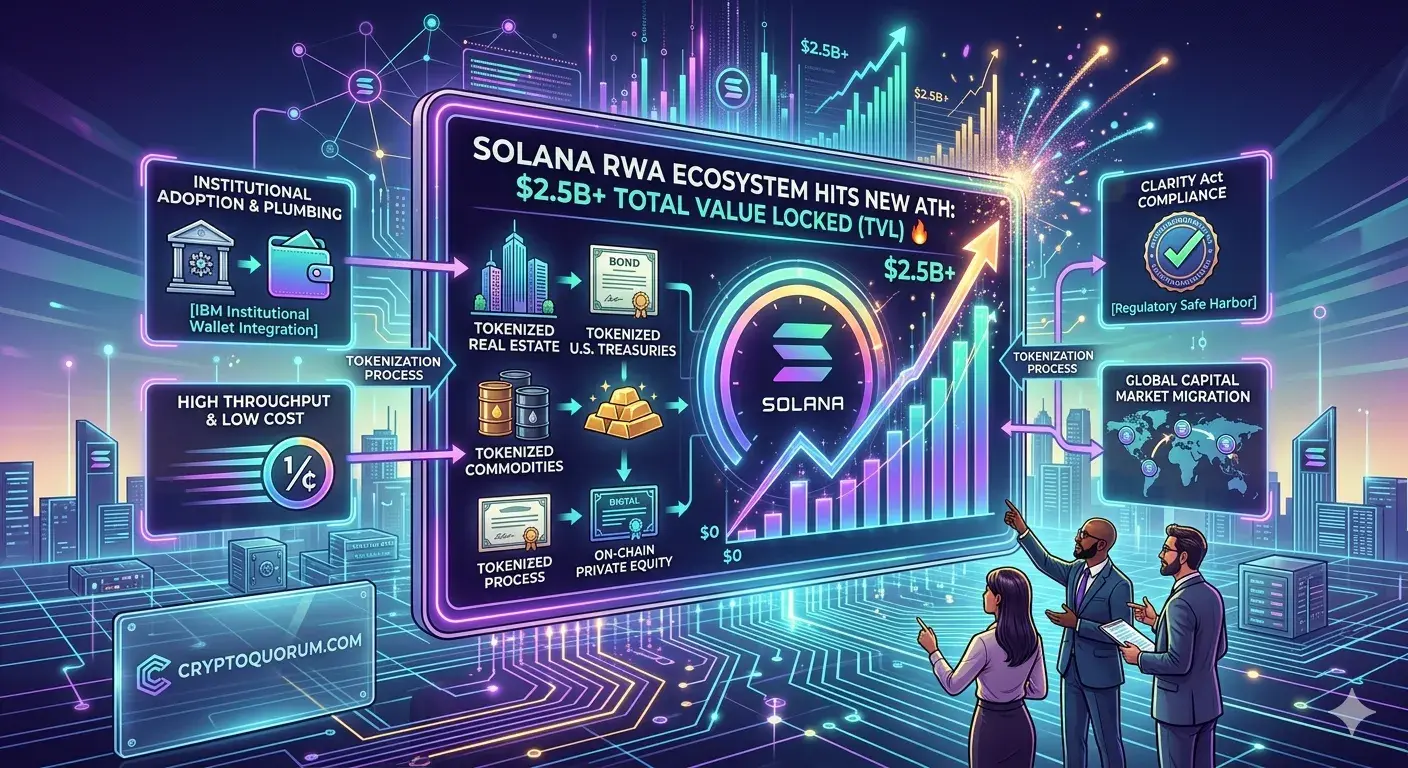
The integration of traditional finance with decentralized infrastructure has reached a pivotal milestone this April 2026. According to the latest on-chain data, the Solana RWA ecosystem has officially surpassed $2.5 billion in Total Value Locked (TVL), marking a new all-time high (ATH). This surge represents more than just a numerical increase; it signals a fundamental shift in how institutional-grade assets are issued, managed, and traded in a digital-first economy.
Real-World Assets (RWAs) — which include tokenized versions of U.S. Treasuries, real estate, private equity, and commodities — have found a high-performance home on Solana. The network’s ability to handle high throughput with sub-second finality has made it the preferred choice for major financial institutions looking to move away from the high-latency environments of legacy finance.
The Catalyst: Why Solana for Real-World Assets?
The recent growth in the Solana RWA ecosystem is driven by the demand for “programmable money.” Unlike the “experiment” phase of early DeFi, the current wave of adoption is characterized by “capital efficiency.” Institutions are no longer satisfied with simply holding an asset; they want that asset to be liquid, composable, and instantly transferable.
Read Also
Key drivers of this $2.5B milestone include:
- Tokenized Treasuries: Short-term government debt is being brought on-chain to provide “risk-free” yield to DeFi protocols.
- Real Estate Fractionalization: High-value properties are being split into digital tokens, allowing for global liquidity in previously illiquid markets.
- Low Transaction Costs: Solana’s negligible gas fees allow for the high-frequency rebalancing of portfolios that would be cost-prohibitive on other Layer-1 networks.
Expert Insights: The Shift to “On-Chain Finance”
The professional analyst community is closely monitoring this breakout, noting that the $2.5B figure is likely the floor, not the ceiling, for the 2026-2027 cycle.
ETH / USD Real-Time Chart
The Strategic Analyst: David Redin
“The growth of the Solana RWA ecosystem is a direct byproduct of the structural changes we’ve seen in global regulation,” explains David Redin, financial crypto analyst and reviewer for CryptoQuorum. “With the CLARITY Act Implementation providing the necessary legal safe harbor, the friction for banks to move their balance sheets onto a public ledger has disappeared. Solana’s architecture is uniquely suited to handle the ‘Institutional Floodgates’ we’ve been predicting.”
The Macro Perspective: Sarah Thompson
“We are moving from speculative assets to productive assets,” notes researcher Sarah Thompson. “When you look at the Solana RWA ecosystem, you aren’t just seeing ‘crypto’ wealth; you are seeing the migration of the global capital market. The fact that this ecosystem is scaling so rapidly during a period of high interest rates proves that the utility of the blockchain is decoupled from mere retail hype.”
Stay Ahead of the Curve
Join our weekly newsletter for exclusive insights.
The “Wildcard” Perspective: Diversification and Risk
While Solana’s growth is impressive, it is essential to maintain a broader market perspective. The RWA narrative is not exclusive to one chain. Ethereum remains a powerhouse for large-scale enterprise issuance, and emerging networks like Sui are beginning to capture market share in specialized niches like tokenized commodities.
Investors should also be aware of the “Oracle Risk” associated with RWAs. Because these tokens represent assets in the physical world, the accuracy of the data feed (the bridge between the bank and the blockchain) is critical. A failure in the reporting of a property’s value or a treasury’s yield could lead to significant slippage in decentralized markets.
Alignment with the “Big Blue” Infrastructure
The expansion of the Solana RWA ecosystem coincides with the broader trend of “Institutional Mainstream” adoption. The launch of the IBM Institutional Crypto Wallet, which now serves 97 of the top 100 banks, has provided the physical plumbing for these $2.5 billion in assets to move safely.
As banks like JPMorgan continue their transformation into blockchain-integrated lenders, the demand for high-speed settlement layers like Solana will only intensify. The $2.5B ATH is a signal to the market that the infrastructure is ready to handle trillions in institutional flow, as Tim Draper recently predicted.
Future Outlook: The Road to $10 Billion
The current trajectory suggests that the Solana RWA ecosystem could reach the $10 billion mark before the end of the 2026 fiscal year. This growth will likely be fueled by:
- Sovereign Debt Issuance: Emerging markets exploring the issuance of bonds directly on the Solana network to bypass traditional Western intermediaries.
- Institutional Credit Pools: The rise of uncollateralized lending platforms for verified corporate borrowers.
- Expanded Stablecoin Utility: The use of RWA-backed stablecoins as a more stable alternative to purely algorithmic or fiat-collateralized assets.
Conclusion: The New Standard for Institutional Liquidity
The achievement of a $2.5B ATH within the Solana RWA ecosystem marks the end of the “Proof of Concept” era. Digital assets are no longer just about decentralization; they are about modernization. By providing a platform that is faster, cheaper, and more transparent than the current financial system, Solana has positioned itself as the premier destination for the tokenized world.
As we look forward, the integration of real-world value into the digital ledger will be the primary driver of the next decade of wealth creation. The Solana RWA ecosystem is just getting started.
Is your investment strategy accounting for the tokenization of everything? Subscribe to the CryptoQuorum RWA Insider for exclusive deep-dives into the protocols leading the Solana charge.