

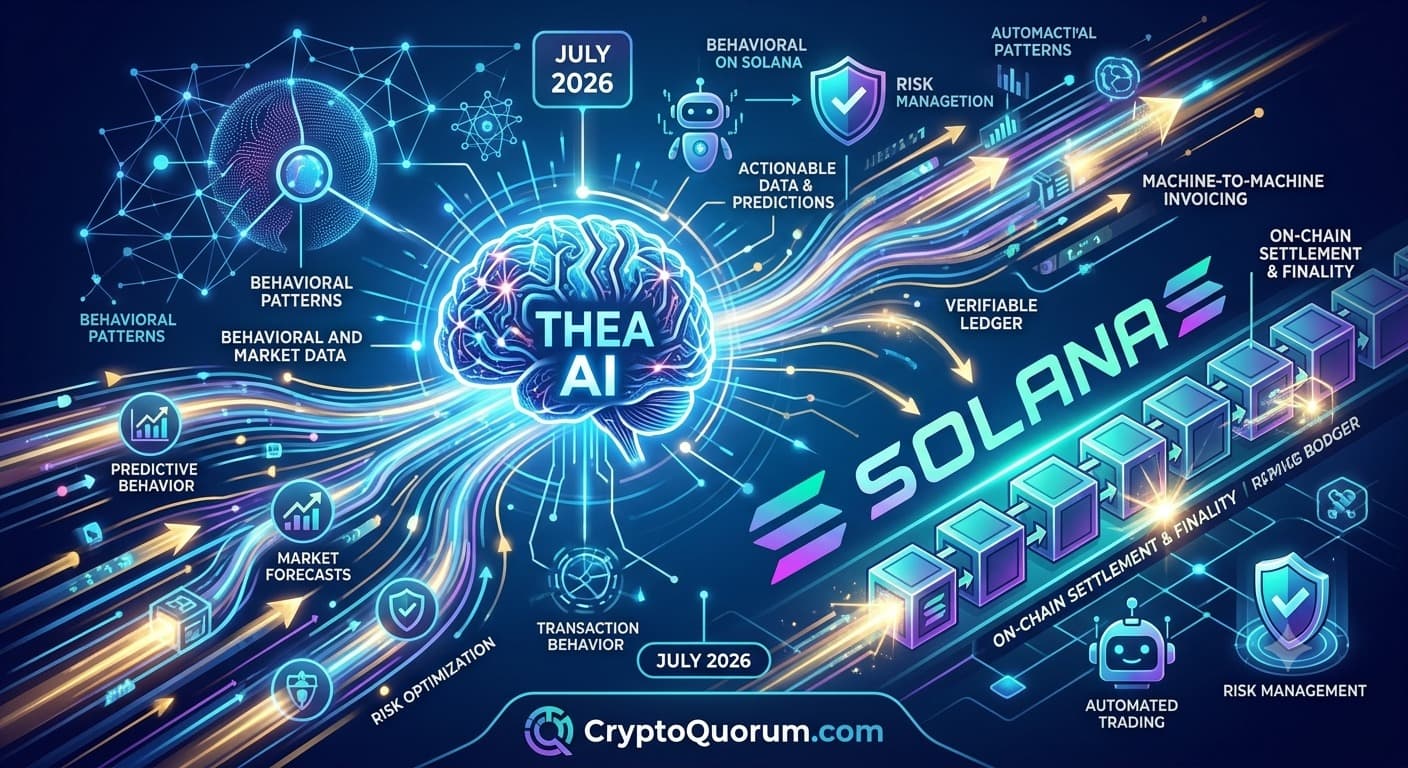
What happens when a predictive AI network processing 400 million monthly queries needs a settlement layer that can keep pace? For Thea AI, the answer is Solana – and the Solana Foundation just told the world about it.
On July 24, 2026, the official Solana X account featured Thea AI with a description that cuts through the complexity of the project in a single sentence: “@Thea_AI is a distribution and settlement layer that routes AI inference to the right purpose-built model and settles usage on Solana.” The feature arrived three weeks after Thea closed an $8 million funding round and confirmed the launch of the THEA Network – a federated coordination layer that places Solana at the centre of an emerging AI inference economy that most mainstream crypto investors have not yet fully absorbed.
CRYPTOCAP:TOTAL3 Real-Time Chart
The architecture Thea is building – routing AI inference requests on-chain, settling usage transparently via Solana, while keeping the heavy computational work off-chain – represents a design philosophy that is quietly becoming the dominant template for bringing AI and blockchain into productive, scalable coexistence.
What Thea AI Actually Does: Distribution, Routing, and Settlement
The Problem With AI Inference at Scale
To understand what Thea is building, it helps to understand the problem it is solving. Modern AI applications do not run on a single model. They route requests – inference queries – to whichever model is best suited to the task: a language model for text, a computer vision model for images, a behavioural risk model for financial decisions. At enterprise scale, this routing happens millions of times per day. Each inference costs something. Someone needs to pay. That payment needs to be tracked, audited, and settled – ideally in a way that is transparent, verifiable, and fast.
 TRON Ecosystem Expands in Q2 2026 Across AI, Payments and Tokenization→
 Chainlink: AI systems are becoming financial participants, .→
 XDC Network Hits Record 27.7M Transactions in August→
 The Era of Conversational Crypto: How PayBox Enables ChatGPT and Claude Users to Trade Anything on Solana→
Traditional cloud infrastructure handles this through centralised billing dashboards and monthly invoices. The problem is that centralised billing is opaque, subject to vendor lock-in, and practically incompatible with the multi-provider, multi-model AI infrastructure that sophisticated enterprises are now building. There is no shared ledger. There is no programmable settlement. There is no way for two parties to establish trustless payment for AI inference without routing everything through a centralised intermediary.
THEA’s hybrid model routes inference coordination on-chain while keeping data processing off-chain, providing verifiable, real-time settlement without running compute inside smart contracts.
That design decision – on-chain coordination and settlement, off-chain computation – is the technical foundation of the entire project. It means Solana handles the accounting and the money movement, while THEA’s own infrastructure handles the actual AI work. The result is cloud-grade performance paired with blockchain-grade transparency.
Why Purpose-Built Models Matter
The Solana description of Thea as a layer that routes inference “to the right purpose-built model” points to something important about how enterprise AI is evolving. General-purpose large language models are impressive. But for domain-specific tasks – predicting customer churn under economic stress, identifying fraud patterns in high-frequency transaction data, estimating credit risk for underserved populations – purpose-built models trained on domain-specific data consistently outperform general-purpose alternatives.
THEA’s core product is predictive behavioral AI for risk markets. Its models analyse patterns in how people and markets behave under stress, then generate real-time predictions that clients use to make faster, better-informed decisions. The company’s models were trained on more than 35 billion real-world decisions made under economic pressure.
The routing layer Thea is building is designed to match each inference request to the model best equipped to answer it – and then settle that usage on Solana with full auditability. For an enterprise managing risk across 30 jurisdictions, the ability to prove which AI model made which prediction, when, and at what cost, is not a luxury. It is a compliance requirement.
The $8 Million Round: Who Backed THEA and Why
A Roster of Crypto-Native Institutional Investors
THEA closed an $8 million funding round led by Maven11 Capital, Spartan Group, ManifoldTrading, HackVC, and Fisher8 Capital. The investor list is notable for its crypto-native concentration. Maven11 Capital is one of the most active institutional investors in the Solana and DeFi ecosystem. Spartan Group has backed some of the most consequential infrastructure projects in the last two crypto cycles. HackVC focuses specifically on foundational protocol infrastructure. The group’s collective decision to back THEA signals a shared thesis: that AI inference routing and on-chain settlement is foundational infrastructure for the next phase of blockchain adoption – not a feature, but a layer. –
The Deployment Plan: Two Priorities
Capital from the round will be directed toward two priorities: enhancing THEA’s operational AI stack and further developing the Solana-based coordination layer. THEA has also indicated plans for a utility token to tokenise access to its autonomous systems, enabling payments and global scalability across its network.
The utility token dimension is significant. The structure of on-chain settlement for AI inference could unlock a market where AI services are paid for on a per-inference basis, with settlement flowing through SOL or SPL tokens. The implications for how AI services are priced, purchased, and audited at enterprise scale are substantial – and the on-chain settlement model Thea is building creates the rails for that market to exist.
The Scale Already in Place: 400 Million Monthly Queries
Not a Proof of Concept – a Live Network
One of the most striking facts about Thea’s announcement is that the THEA Network is not a whitepaper aspiration. It is a live operational reality. The network already processes over 400 million queries per month, serving more than 3,000 enterprise customers across more than 30 jurisdictions.
That number – 400 million AI inference queries monthly – contextualises the choice of Solana as the settlement layer. Most blockchains could not handle the settlement throughput that 400 million monthly queries would eventually require if every inference is paired with an on-chain settlement event. Ethereum mainnet, with its gas cost structure, would make per-inference settlement economically prohibitive. THEA’s choice of Solana as the settlement layer is driven by performance requirements for handling hundreds of millions of monthly queries. The network’s low-latency architecture makes it an attractive settlement layer for AI coordination.
Solana’s sub-second finality and transaction fees measured in fractions of a cent make it the only current public blockchain where per-inference settlement is economically viable at this volume – which is precisely why it was chosen.
Expert Opinions: The Convergence of AI and Blockchain
Valentin Batura, THEA CEO: Operational Intelligence Is the Next Phase
The clearest articulation of THEA’s thesis came from CEO Valentin Batura, whose framing of the AI transition provides crucial context for why on-chain settlement matters now rather than later.
“The first wave of AI changed how humans interact with software,” Batura said. “The next phase is operational intelligence: AI systems making decisions inside environments where outcomes are measurable and economically consequential.”
That phrase – “economically consequential” – is the key to the entire design. When AI systems make decisions that have real financial outcomes – approving a loan, routing a payment, adjusting a trading position, pricing insurance risk – those decisions need to be accountable in a way that pure software architectures cannot easily provide. A blockchain settlement layer is, at its core, an accountability layer: an immutable, auditable record of what happened, when, and who paid for it.
“Up until now, we’ve been building AI systems trained on real economic behaviour rather than synthetic simulations,” Batura said, describing THEA’s approach to model training. “THEA’s vision is that economies of the near future will require sophisticated AI risk intelligence, accessible to all, creating more efficient and equitable markets through transparent, autonomous systems at a global scale.”
Solana Foundation: THEA Joins a Growing AI Ecosystem
The Solana Foundation’s decision to feature Thea on its official X account on July 24 is not a casual endorsement. It places THEA within a deliberate strategy to position Solana as the settlement layer of choice for AI-native applications -a strategy that also includes the x402 protocol for AI-to-AI payments, the Solana Developer Platform’s AI tooling integrations, and the network’s growing roster of institutional AI partnerships.
THEA is not alone in building Solana into AI infrastructure. Arcium launched Blackthorn for encrypted AI inference on NVIDIA GPUs using multi-party computation – a different technical route to the same general category of AI infrastructure on Solana. The diversity of approaches – THEA handling routing and settlement, Arcium handling encrypted inference – suggests an ecosystem that is building complementary infrastructure rather than competing on identical ground.
BlockchainReporter: Mirrors High-Frequency Trading Architecture
Independent analysis from BlockchainReporter offered a useful analogy for understanding THEA’s technical architecture that goes beyond the crypto native frame of reference. The division of labor in THEA’s design mirrors how certain high-frequency trading systems operate: speed-sensitive logic stays close to the hardware, while finality and dispute resolution happen on-chain. On-chain inference remains a bottleneck – running neural networks directly on Solana is not only cost-prohibitive but also introduces latency that breaks real-time use cases. THEA’s coordination layer sidesteps this by only settling the accounting on-chain.
The HFT analogy is precise and instructive. The most sophisticated trading systems in the world do not process their core logic on centralised exchanges’ matching engines. They run their strategies on their own hardware and use exchanges only for execution and settlement. THEA is applying the same division of labour to AI inference: keep the compute close to the intelligence, use the blockchain for the trust and the settlement.
Dealroom: Part of a Broader AI-Native Financial Infrastructure Wave
THEA’s raise sits within a broader wave of AI-native financial infrastructure funding, where startups are trying to rewire how markets classify, price, and manage risk. A close analogue is Theia Insights, which also raised $8 million in 2026 to replace static sector classifications with a dynamic economic map – suggesting that behavioural AI for financial applications is attracting serious institutional attention beyond any single company.
The pattern across multiple funded companies building in the same space is itself a market signal: institutional investors are making concentrated bets that the infrastructure for AI-native finance – routing, settlement, behavioural prediction, risk analytics – will be built on blockchain rails, and that the window for establishing foundational positions in that infrastructure is open right now.
The Risks the Industry Is Watching
Will Centralised AI Providers Accept On-Chain Payment Rails?
Not every observer of THEA’s model is uncritically bullish. The most pointed risk analysis comes from infrastructure analysts who note a structural dependency that Thea cannot control on its own. THEA’s coordination layer only works if there is enough supply of predictive behavioral models willing to accept payment through on-chain rails. For now, the networks that dominate AI inference – mostly centralised providers – have shown little interest in crypto settlement. If THEA cannot bridge that gap, the network may struggle to attract volume from serious machine learning teams.
This is the adoption flywheel problem that every infrastructure layer faces: supply needs demand to justify participation, and demand needs supply to make the platform worth using. THEA’s 400 million monthly query baseline provides initial proof of demand. Whether AI model providers outside THEA’s own ecosystem will connect to its settlement rails is the open question that the $8 million deployment will need to begin answering.
Self-Reported Metrics and Independent Verification
A note of analytical rigour is warranted. The headline metrics – 400 million monthly inferences, 3,000 customers, 35 billion training decisions – are self-reported and have not been independently verified by third parties. Investors conducting due diligence should seek independent confirmation of THEA’s claimed operational scale before treating these figures as established fact.
The disclosure is important, not because it disqualifies the project, but because it is the standard of intellectual honesty that serious crypto market coverage requires – particularly for a company that is simultaneously running an AI business, raising institutional capital, and planning a utility token.
Why This Moment for AI Inference on Solana
The Solana Foundation’s July 24 feature of Thea AI arrived three weeks after the company’s funding announcement, at a moment when Solana is simultaneously breaking records in tokenised asset volume, running the settlement rails for MoneyGram and Toss Bank’s remittance pilots, processing more daily transaction volume than any blockchain in history, and now entering a new frontier: becoming the settlement layer of choice for AI inference at enterprise scale.
THEA is among the first AI networks to tokenise the settlement layer of its infrastructure while its compute remains operating off-chain – combining cloud-grade performance with blockchain integrity. That combination is exactly what enterprise AI deployment requires: the speed and reliability of cloud computing, paired with the auditability and programmability of a public blockchain.
The AI inference economy is not a future concept. THEA is processing 400 million monthly queries today. Solana is the settlement layer it chose. The architecture is live. The institutional backing is secured. The next chapter of AI-native finance is being written – and Solana is providing the ledger.
CRYPTOCAP:TOTAL3 Real-Time Chart
Disclaimer: This article is for informational purposes only and does not constitute financial or investment advice. Always conduct your own research before making investment decisions.