

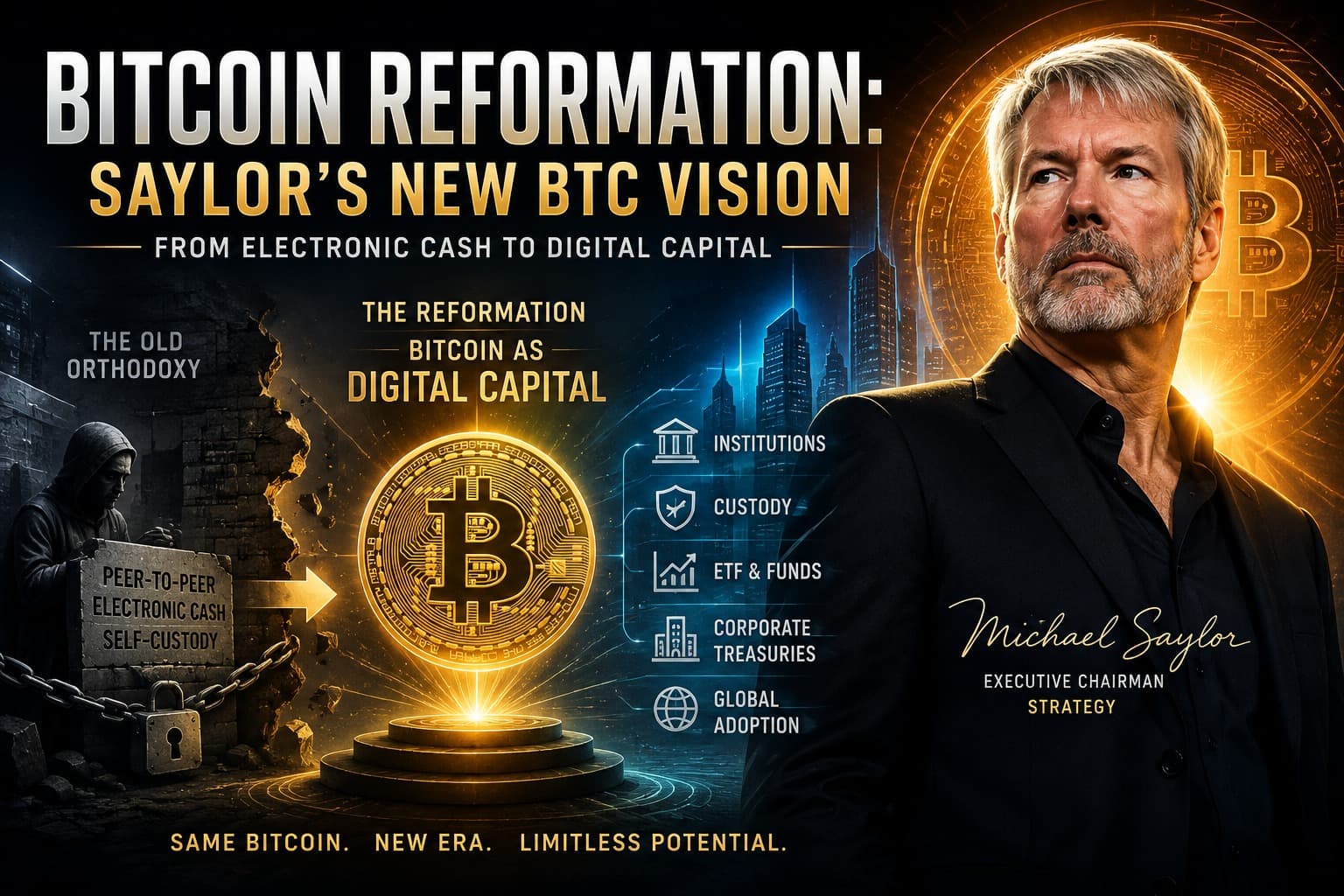
Michael Saylor has reignited one of Bitcoin’s oldest debates: what is Bitcoin ultimately becoming?
In a new essay titled “The Bitcoin Reformation: The Decline of Bitcoin Orthodoxy and the Rise of Digital Capital,” Strategy Executive Chairman Michael Saylor argues that Bitcoin is moving beyond the ideological framework that dominated its early years.
His thesis is straightforward but consequential. Bitcoin, he argues, should not be defined exclusively as peer-to-peer electronic cash or as an asset that must always be held through self-custody. Instead, BTC is increasingly becoming a form of digital capital that can interact with banks, custodians, exchanges, investment funds, public companies and governments.
The full essay is available through Michael Saylor’s original publication.
 Michael Saylor Proposes a Bill of Digital Rights to Fuel a $100 Trillion Digital Economy→
 VanEck: Bitcoin Could Hit $100,000 by Next Year as Fiscal Pressure and Liquidity Shape the Market→
 Fed Rate Hike May Not Rattle Crypto Markets, Grayscale Says→
 Deutsche Bank Announces Institutional Bitcoin Custody for Corporate and Hedge Fund Clients→
From electronic cash to digital capital
Bitcoin’s original design emphasized peer-to-peer electronic payments without relying on financial intermediaries. That remains an important part of its history and technical identity.
However, the market surrounding Bitcoin has changed dramatically.
Spot exchange-traded funds, institutional custody, corporate treasury strategies, derivatives and regulated financial products have created additional ways for investors and institutions to gain exposure to BTC.
Saylor believes this development should not automatically be viewed as a departure from Bitcoin’s principles.
Instead, he sees it as evidence that the asset is entering a new stage of adoption.
The distinction matters because Bitcoin’s monetary properties remain tied to its protocol. Its supply is capped at 21 million coins, while new issuance declines through programmed halvings.
The surrounding financial infrastructure, however, can evolve.
That creates a potential division between Bitcoin the protocol and Bitcoin the financial asset.
Saylor challenges Bitcoin orthodoxy
One of the more controversial arguments in Saylor’s essay concerns self-custody.
For years, the phrase “not your keys, not your coins” has been central to Bitcoin culture. The principle highlights an important advantage of holding private keys directly: the owner does not have to depend on a bank, exchange or custodian.
Saylor does not reject self-custody. Instead, he frames it as a right rather than an obligation.
For individual users, direct custody can provide sovereignty and independence. For institutions, however, professional custody can introduce different forms of security, governance, compliance and operational controls.
That distinction is particularly relevant as Bitcoin ownership expands from individual investors to corporations, funds and financial institutions.
The question is therefore no longer simply whether self-custody is good.
It is whether different forms of custody can coexist without changing Bitcoin’s underlying monetary properties.
The institutionalization of Bitcoin is already underway
Saylor’s argument is supported by developments across the market.
Strategy has become the most prominent example of a corporate Bitcoin treasury model. As of May 25, 2026, the company reported holding 843,738 BTC, alongside a complex capital structure involving convertible debt and preferred securities.
Strategy’s model has also evolved beyond simply purchasing BTC.
The company has developed preferred-stock products and a broader financing structure designed around its Bitcoin holdings. Its management describes this framework through metrics such as Bitcoin Per Share, BTC Yield and BTC Gain.
That evolution provides important context for Saylor’s argument.
Bitcoin is increasingly being connected to traditional concepts of equity, credit, collateral and capital markets.
CryptoQuorum previously examined this development in [Strategy’s Bitcoin credit and institutional analytics] and in its analysis of Strategy’s Bitcoin holdings and SEC disclosures.
A changing definition of “Bitcoin exposure”
The traditional Bitcoin investor owns BTC directly.
The institutional market now offers several additional forms of exposure.
| Bitcoin exposure | Typical structure | Main characteristic |
|---|---|---|
| Spot BTC | Direct ownership | Highest direct exposure to Bitcoin |
| Bitcoin ETF | Regulated investment vehicle | Simplifies institutional access |
| Corporate treasury | Company balance sheet | Combines BTC exposure with corporate risk |
| Preferred securities | Capital-market instrument | Adds yield and credit characteristics |
| Derivatives | Futures/options | Enables hedging and leveraged exposure |
| Custodial accounts | Third-party custody | Adds institutional operational infrastructure |
These instruments are not interchangeable.
Owning BTC directly is fundamentally different from owning shares in a company that holds BTC. A preferred security issued by a Bitcoin treasury company introduces additional issuer, liquidity and capital-structure risks.
That distinction is critical for investors.
Saylor’s broader argument is not that all these instruments are equivalent to Bitcoin. Rather, they can form layers around the underlying asset.
Expert opinions reveal the central disagreement
Saylor’s vision is not universally accepted.
In June, blockchain analytics firm CryptoQuant argued that Strategy should temporarily slow its Bitcoin accumulation and rebuild its cash reserves. The firm pointed to pressure on Strategy’s preferred-stock market and shrinking dividend coverage as reasons for greater financial discipline.
That criticism highlights the key risk in the digital-capital model.
The more financial products are built around Bitcoin, the more important liquidity, collateral management and capital structure become.
Strategy itself has already demonstrated that its approach is capable of changing.
In August, the company sold Bitcoin while repurchasing preferred stock and raising additional capital. CoinDesk reported that Strategy executives said the experience reinforced the need to maintain sufficient dollar liquidity and remain capable of both buying and selling BTC when managing its capital structure.
This is an important development because it represents a more flexible version of the corporate Bitcoin strategy than the simple “buy and never sell” narrative associated with Saylor in earlier years.
The BIP-110 debate provides important context
Saylor’s essay also arrives during a broader debate over Bitcoin’s future direction.
In July, he published “110 Reasons BIP 110 Is a Bad Idea,” arguing for neutral consensus rules, open markets and permissionless innovation.
The dispute surrounding BIP-110 concerns how Bitcoin should handle non-monetary data and certain transaction structures.
At a deeper level, however, the disagreement is philosophical.
Should Bitcoin deliberately restrict its functionality to preserve a narrow monetary identity?
Or should the base layer remain conservative while allowing markets, applications and financial infrastructure to determine which uses succeed?
Saylor clearly favors the second approach.
His latest essay extends that argument from protocol design into the financial system itself.
Bitcoin may coexist with fiat rather than replace it
Another important element of Saylor’s thesis is his apparent shift away from the idea that Bitcoin must completely replace traditional money.
Bitcoin can function as a scarce, globally transferable digital asset while fiat currencies continue to be used for taxes, wages and everyday transactions.
This is not necessarily a contradiction.
Gold provides a useful historical analogy. Gold remains an important monetary and financial asset even though consumers rarely use physical gold to purchase groceries.
Saylor’s framework places Bitcoin in a similar long-duration capital category.
The result would be a financial architecture in which fiat remains important for transactional purposes while Bitcoin increasingly functions as a scarce digital reserve asset and collateral layer.
Why the thesis matters for investors
The Bitcoin Reformation argument matters because it changes the question investors ask.
The debate is no longer simply:
“Will Bitcoin become digital gold?”
A broader question is emerging:
“What financial system can be built around Bitcoin?”
That system could include ETFs, custody services, lending markets, corporate treasuries, tokenized securities, derivatives and Bitcoin-linked credit instruments.
CryptoQuorum has previously examined Saylor’s evolving monetary framework in Michael Saylor’s digital asset spectrum, where Bitcoin, digital credit and stablecoins are presented as different layers within a broader financial structure.
For investors, however, the expansion of this ecosystem introduces additional risk.
Bitcoin exposure through a financial product carries risks that direct ownership does not. These may include issuer risk, counterparty risk, leverage, liquidity risk, regulatory risk and capital-structure risk.
That makes due diligence increasingly important as institutional Bitcoin products become more sophisticated.
A new phase for Bitcoin?
Saylor’s argument should not be interpreted as proof that Bitcoin’s original philosophy has been invalidated.
The network still operates according to its consensus rules, and its fixed supply remains one of its defining monetary properties.
Instead, the more interesting interpretation is that Bitcoin’s economic perimeter is expanding.
The protocol can remain conservative while the ecosystem around it becomes increasingly sophisticated.
That may ultimately be Saylor’s central point: Bitcoin does not need to abandon its monetary characteristics to become infrastructure for a much larger financial market.
Whether that vision succeeds will depend on factors far beyond Saylor himself — including institutional adoption, regulation, custody standards, liquidity, technological development and the willingness of investors to accept Bitcoin-related financial products.
For now, the Bitcoin Reformation represents a significant statement about where one of Bitcoin’s most influential corporate advocates believes the market is heading.
The next chapter may be less about convincing the world that Bitcoin can survive.
It may be about determining how much of global capital can eventually be built around it.
Sources and further reading
Disclaimer: This article is for informational and educational purposes only and does not constitute investment, financial, legal or tax advice. Bitcoin and crypto-related securities are highly volatile and may result in substantial losses. Readers should conduct their own research and consult a qualified financial professional before making investment decisions.