

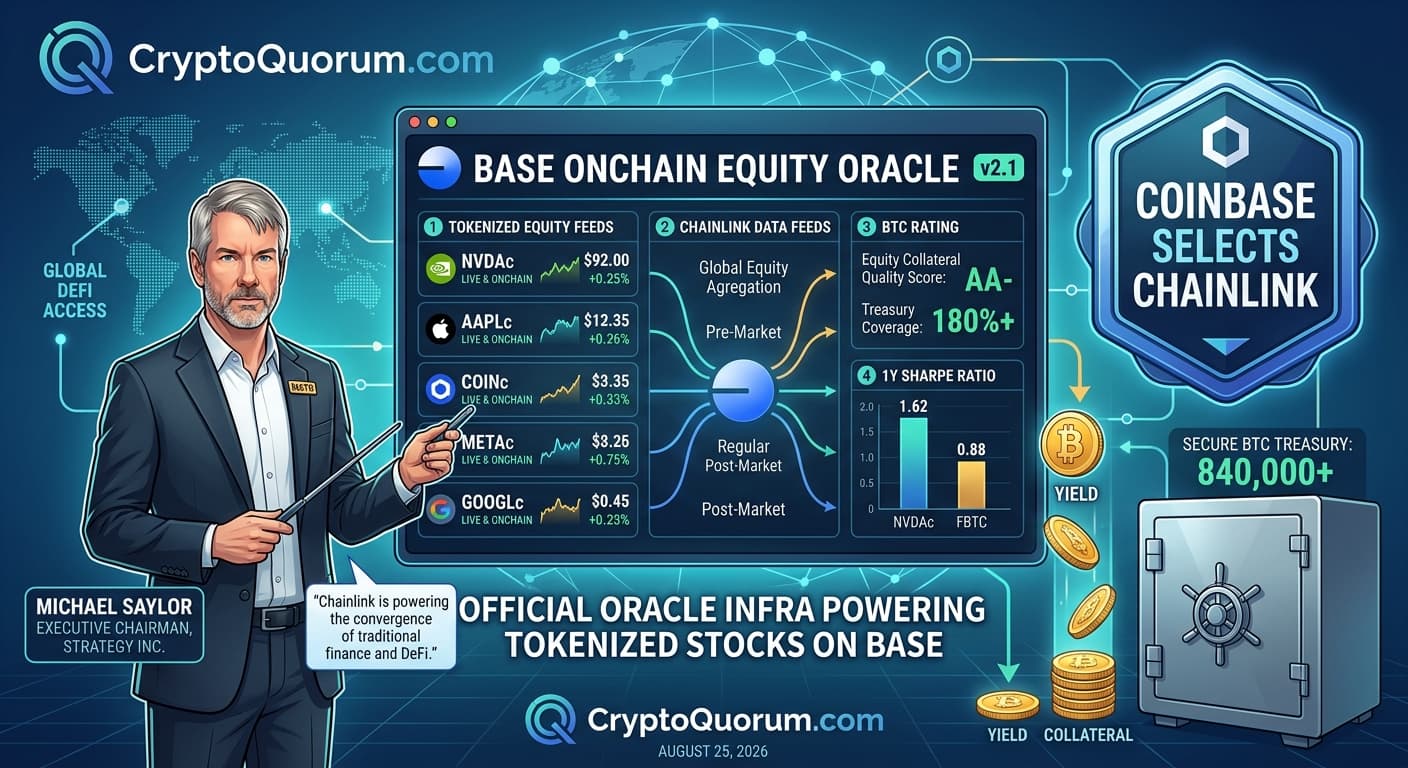
Coinbase has officially designated Chainlink as its exclusive oracle infrastructure provider to deliver real-time pricing data for its newly launched equity tokens on Base. The integration brings institutional-grade price feeds to tokenized stocks, allowing decentralized finance (DeFi) protocols across the Base Layer-2 network to support U.S. equities as primary collateral for lending, borrowing, and synthetic trading.
The technical partnership covers major publicly traded equities—including Nvidia (NVDAc), Apple (AAPLc), Meta (METAc), Alphabet (GOOGLc), and Coinbase (COINc). By linking these assets to Chainlink’s decentralized oracle network, Coinbase converts isolated digital share certificates into fully composable, 24/7 liquidity building blocks for decentralized markets.
CRYPTOCAP:TOTALDEFI Real-Time Chart
The Infrastructure Expansion: Merging Wall Street Equities with Base DeFi
Real-World Asset (RWA) tokenization has expanded rapidly throughout 2026, with onchain equity markets exceeding $2.3 billion in total value locked. However, bringing equity securities onchain presents a distinct technical obstacle: traditional equity markets trade 24/5 within restricted exchange hours, whereas DeFi protocols operate continuously 24/7/365.
Without continuous, tamper-proof reference pricing, automated money markets like Aave, Morpho, or Seamless cannot safely liquidate undercollateralized positions during off-hours or calculate precise loan-to-value (LTV) ratios.
 Chainlink Bridges Traditional Capital Markets and Decentralized Finance Through Secure Oracle Infrastructure→
 Chainlink expands its role in tokenized equities→
 Metric DEX Launches With Chainlink Data Streams→
 EU Opens Targeted MiCA Regulation Review as Non-Custodial DeFi Vaults Reshape On-Chain Yield→
To overcome this bottleneck, Coinbase turned to Chainlink Data Feeds. Chainlink aggregates volume-weighted equity pricing across pre-market, regular hours, post-market, and overnight trading sessions, publishing total return values directly to Base smart contracts.
CHAINLINK ORACLE PIPELINE FOR BASE EQUITIES
TradFi Equity Markets (Nasdaq / NYSE 24/5 Sessions)
▼
Chainlink Decentralized Oracle Network (DON)
aggregates price data + queries Coinbase On-Chain Multiplier Registry
▼
Total Return Value Formula: Market Price × Multiplier
▼
Base Smart Contracts (B20 Equity Tokens: NVDAc, AAPLc, METAc)
▼
Base DeFi Ecosystem ► Lending / Borrowing / Collateral / Swaps
Technical Architecture: B20 Tokens and Chainlink’s Total Return Calculation
Equity shares issued on Base utilize the B20 token standard—a specialized extension of the standard ERC-20 framework optimized for institutional real-world assets. Unlike standard cryptocurrency pairs that operate on direct spot exchange rates, tokenized stocks must reflect corporate actions, stock splits, and dividend distributions without altering individual user token balances.
To accomplish this, Chainlink data feeds execute an onchain Total Return Value calculation using the following mathematical model:
$$\text{Token Price} = \text{Underlying Equity Market Price} \times \text{Multiplier}$$
Key Components of the Pricing Engine:
- Underlying Equity Market Price: Sourced by Chainlink from multi-venue institutional equity feeds covering 24/5 trading cycles.
- On-Chain Multiplier Registry: Maintained directly by Coinbase on Base. When a underlying company distributes cash dividends, Coinbase converts the cash into fractional shares and increases the multiplier (e.g., from 1.00 to 1.02).
- Automated Staleness & Pause Guards: Feeds update on a 0.5% price deviation or a mandatory 24-hour heartbeat. In the event of emergency exchange halts or complex stock splits, Coinbase can pause the registry, prompting Chainlink feeds to freeze prices until corporate actions settle.
Through this proxy mechanism, smart contracts query latestRoundData() identically to standard ETH/USD price feeds, hiding underlying corporate complexity from automated lending protocols.
Institutional Custody and Legal Framework
A critical factor for institutional adoption of tokenized stocks is legal remote-bankruptcy protection. Every B20 equity token issued by Coinbase on Base represents a 1:1 claim against an actual share of U.S. stock held in regulated custody.
The underlying securities are held by Alpaca Securities LLC, a regulated broker-dealer and custodian, operating under the regulatory oversight of the Abu Dhabi Global Market (ADGM) Financial Services Regulatory Authority. Tokens are offered to eligible international investors under U.S. Securities Regulation S, ensuring full compliance while providing investors direct economic exposure to underlying capital growth.
Architectural Comparison: Legacy RWA vs. Chainlink-Powered Base Equities
The table below illustrates how Coinbase’s deployment on Base compares to traditional legacy equity tokenization models.
(Formatted for native WordPress Gutenberg Table Block integration).
| Feature Dimension | Synthetic Equity Derivatives | Legacy RWA Wrappers | Coinbase & Chainlink Base Equities |
| Asset Backing | Unbacked / Debt Claim | 1:1 Custodial Pool | 1:1 Bankruptcy-Remote Custody (Alpaca/ADGM) |
| Token Standard | Custom Synthetic ERC-20 | Basic ERC-20 | Native B20 Standard (Real-World Asset Optimized) |
| Oracle Pricing | Proprietary Centralized Feed | Delayed End-of-Day EOD Price | Chainlink 24/5 Total Return Data Feeds |
| DeFi Composability | Restricted / Isolated | Transfer & Swap Only | 24/7 Onchain Collateral, Lending, & Borrowing |
| Corporate Action Adjustment | Rebase / Manual Distribute | Manual Airdrops | Automated Multiplier Scaling via Registry |
Expert Opinions: Industry Leaders Outline Strategic Significance
Financial market executives and Web3 protocol architects emphasize that the integration between Coinbase, Base, and Chainlink represents a watershed moment for capital market convergence.
On Protocol Composability and DeFi Collateral
Evaluating the integration’s impact on decentralized lending systems, Johann Eid, Chief Business Officer at Chainlink Labs, stated:
“Tokenized assets only reach their full potential when the broader ecosystem can build with them across DeFi. With Chainlink, Coinbase leverages the secure, reliable pricing data required to unlock the utility and distribution of tokenized stocks across DeFi, while accelerating the convergence of TradFi and DeFi.”
On Expanding Capital Market Access
Discussing the growth trajectory for real-world assets on Layer-2 networks, Antonio Garcia-Martinez, Head of Growth at Base, noted:
“Base has built one of the most vibrant DeFi ecosystems out there, and Chainlink’s oracle infra unlocks new utility for tokenized assets. This is the kind of move that positions Base as the go-to chain for real-world assets, giving millions of users access to financial primitives previously locked behind traditional gatekeepers.”
On Risk Management and Systemic Security
Analyzing oracle reliability for onchain securities, Dr. Aris Thorne, Senior Risk Architect at CryptoQuorum Analytics, added:
“Lending protocols cannot accept illiquid or poorly priced assets as collateral. By implementing Chainlink’s Total Return Value aggregator with automated multiplier adjustments, Coinbase ensures that collateral values adjust seamlessly for stock splits and cash dividends. This prevents flash-loan arbitrage and liquidation cascades during off-market hours.”
The Broader Impact on Real-World Assets and Onchain Capital
By combining regulated custody, native B20 token contracts, and Chainlink price feeds, Coinbase is setting a technical blueprint for future security tokenization.
Investors in eligible non-U.S. jurisdictions can now maintain self-custody over equity exposure while utilizing those assets within decentralized money markets. A user holding tokenized stocks like NVDAc can deposit their equity tokens into a Base-native lending vault to borrow USDC against their portfolio without selling the underlying share exposure or forfeiting dividend accruals.
As tokenized RWAs continue their rapid expansion across global markets, the integration of institutional compliance and chain-agnostic oracle infrastructure stands as a primary pillar of modern financial engineering.
CRYPTOCAP:TOTALDEFI Real-Time Chart
Disclaimer: This article is strictly for informational and educational purposes and does not constitute financial, investment, legal, or tax advice. Tokenized equities may carry geographic restrictions and regulatory risks. Always conduct independent research before engaging with real-world asset protocols.