
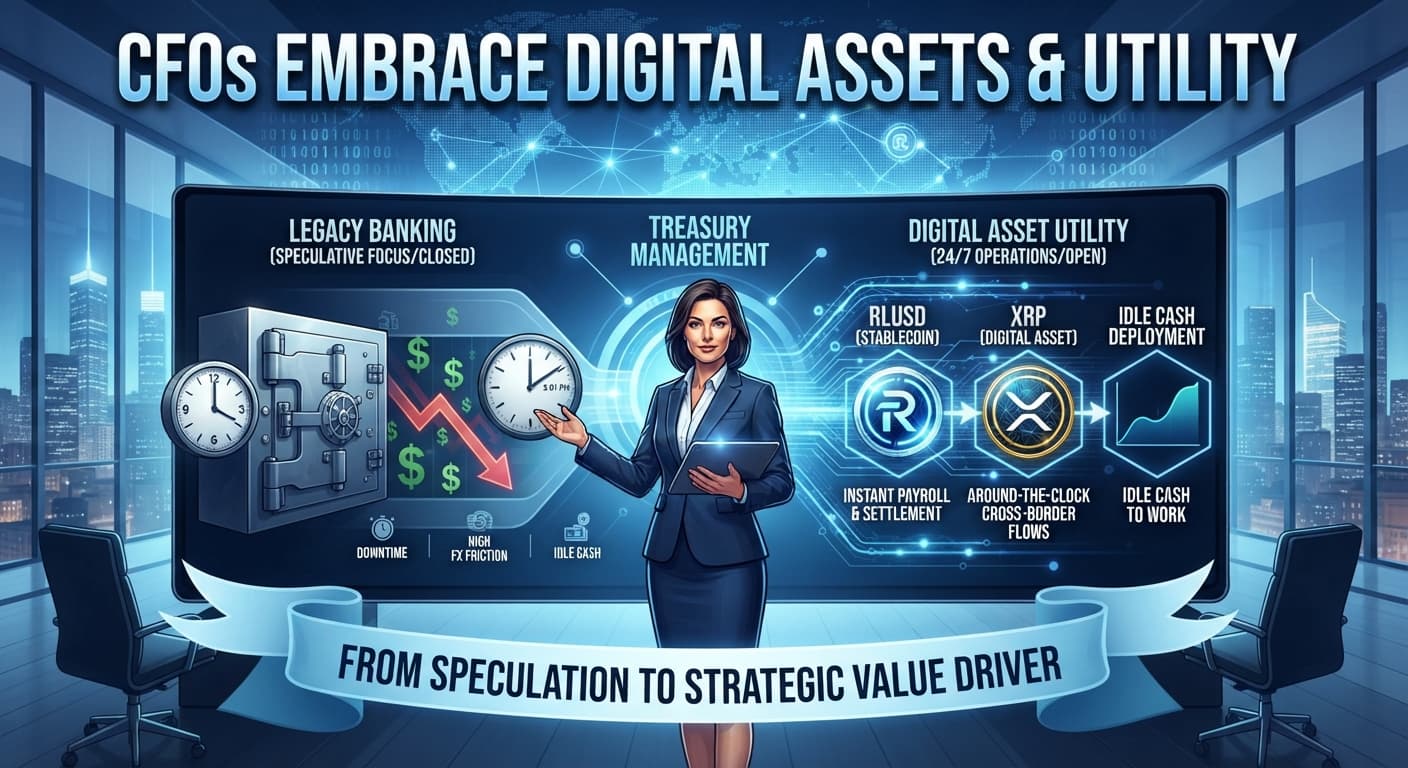
The modern office of the chief financial officer is undergoing a profound structural evolution. For years, corporate leadership viewed digital assets primarily through the lens of speculation and high market volatility. However, that perception has shifted dramatically toward tangible utility. As corporate finance departments face the constraints of legacy banking hours and sluggish cross-border settlement times, institutional leaders are turning to blockchain infrastructure to optimize capital efficiency.
According to recent insights shared by the Ripple leadership team, the conversation surrounding enterprise blockchain has pivoted from theoretical experimentation to practical implementation. Specifically, executives are evaluating what digital assets and stablecoins—such as XRP and RLUSD—can achieve for daily treasury operations, payroll processing, and complex cross-border payment flows.
BINANCE:XRPUSDT
| Traditional Treasury Infrastructure | On-Chain Digital Asset Treasury |
| Operating Hours: Limited to 5 PM cutoffs and banking days | Operating Hours: 24/7/365 continuous execution |
| Settlement Velocity: Multi-day clearing via legacy rails | Settlement Velocity: Instantaneous blockchain finality |
| Idle Cash Management: Trapped over weekends and holidays | Idle Cash Management: Continuous yield generation around the clock |
Overcoming Legacy Limitations With Around-the-Clock Liquidity
One of the most persistent bottlenecks in traditional corporate finance is the rigid schedule of legacy banking networks. Conventional wire transfers and SWIFT transactions generally halt at 5 PM and remain offline over weekends and public holidays. During these dormant windows, corporate capital remains entirely idle, missing out on potential yield generation and leaving businesses vulnerable to sudden liquidity crunches.
On-chain markets, by contrast, do not stop. Blockchain rails operate continuously, enabling modern treasury departments to manage liquidity in real time. As noted by Ronan Vereecke, SVP of Ripple Treasury, in a recent edition of Crypto In One Minute, this continuous operational cycle opens up entirely new pathways to put idle cash to work around the clock, turning corporate treasury into a strategic value driver rather than a back-office administrative cost center.
 SEC Proposes to Rescind Rule 14a-8 and Modernize Proxy Rules→
 DTCC Tokenization Service Nears October 2026 Launch as Edel Joins Industry Working Group→
 Coinbase Sets New Industry Benchmark with Fully-Backed Tokenized Stocks for Global Investors→
 RLUSD stablecoin and the New Standard for Regulation→
“CFOs have moved from viewing digital assets as purely speculative to having utility. The opportunity now is what crypto and stablecoins, like XRP and RLUSD, can do for treasury, payroll, and cross-border flows.” — Ripple Treasury
Enhancing Payroll and Global Cross-Border Flows
Cross-border payroll distribution and international vendor settlements have historically suffered from high intermediary fees, currency conversion delays, and lack of transparency. By integrating digital assets into treasury workflows, enterprises can bypass multi-layered correspondent banking networks.
Using native digital assets and compliant stablecoins allows firms to execute instant cross-border payments with predictable liquidity. This drastically reduces working capital requirements, eliminating the need to pre-fund accounts in multiple foreign jurisdictions just to cover anticipated international expenses.
| Operational Area | Legacy Process Challenge | On-Chain Solution via Ripple |
| Cross-Border Payments | Delayed settlement (T+1 to T+3) and high FX friction | Instant settlement with transparent, real-time routing |
| Payroll Management | Complex international multi-bank disbursement | Streamlined global distribution using stablecoins |
| Cash Optimization | Capital trapped during weekends and bank holidays | 24/7 liquidity deployment and yield generation |
Expert Perspectives on Enterprise Blockchain Adoption
Financial analysts and treasury consultants emphasize that corporate adoption of digital assets depends heavily on regulatory clarity and operational familiarity. As major jurisdictions establish clear legal frameworks for digital commodities and regulated stablecoins, enterprise risk committees are becoming increasingly comfortable approving blockchain integration.
Industry experts point out that successful corporate software solutions must bridge the gap between traditional enterprise resource planning (ERP) systems and decentralized networks. By embedding digital asset rails directly into existing treasury management platforms, organizations can adopt blockchain capabilities without disrupting established internal controls, compliance protocols, or audit trails.
Conclusion
The transition of corporate finance from speculative curiosity to practical utility marks a defining milestone for the digital asset industry. By leveraging continuous on-chain markets, enterprise-grade stablecoins like RLUSD, and digital assets like XRP, CFOs are unlocking unprecedented operational agility. As more institutions embrace these tools, 24/7 treasury management will quickly shift from an innovative edge to an essential industry standard.
Disclaimer
Disclaimer: The information provided in this article is for educational and informational purposes only and does not constitute financial, investment, or legal advice. Digital asset transactions and corporate treasury strategies involve inherent risks. Always conduct your own thorough research and consult with qualified financial and legal professionals before implementing new financial technologies.