

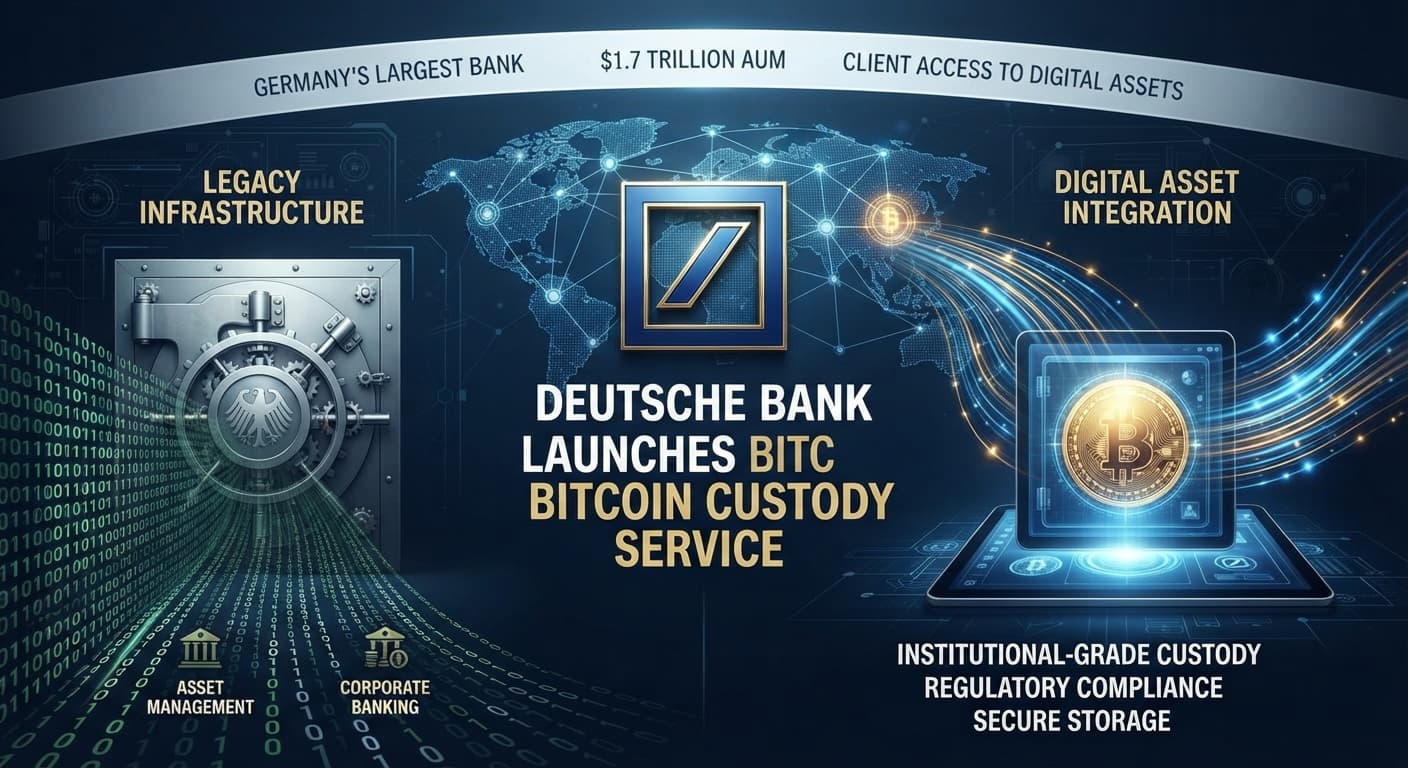
The integration of digital assets into legacy traditional banking infrastructure is reaching an unprecedented milestone. Deutsche Bank, Germany’s largest financial institution managing over $1.7 trillion in assets, has officially announced plans to launch dedicated digital asset custody services for corporate and institutional clients. This monumental development marks one of the most significant entries by a major European lender into direct cryptocurrency safekeeping and transfer operations.
As regulatory frameworks across the European Union mature—bolstered by the implementation of the Markets in Crypto-Assets (MiCA) regulation and supervision by BaFin—traditional financial institutions are actively constructing compliant bridges for institutional capital. By offering secure storage and transfer capabilities for Bitcoin and select digital assets, the Frankfurt-based bank is eliminating the barriers that previously prevented risk-averse institutional investors from entering the asset class.
BINANCE:BTCUSDT
| Operational Feature | Implementation Details | Strategic Impact |
| Institution | Deutsche Bank ($1.7 Trillion AUM) | Validates institutional adoption at scale |
| Initial Asset Scope | Bitcoin, Ethereum, and select stablecoins | Broadens multi-asset institutional exposure |
| Target Audience | Corporate banks, hedge funds, and asset managers | Streamlines capital inflow from legacy finance |
| Regulatory Oversight | Compliant with EU MiCA & BaFin frameworks | Ensures legal certainty and secure operations |
The Mechanics of Bank-Grade Digital Asset Custody
For institutional investors, hedge funds, and asset managers, managing private keys and securing cryptographic infrastructure internally presents severe operational and regulatory challenges. By utilizing Deutsche Bank’s upcoming custody platform, corporate clients can delegate wallet management and private key security directly to a trusted, regulated counterparty.
The initial rollout will target clients across the bank’s Corporate Bank and Investment Bank divisions, enabling secure storage and third-party transfer capabilities. While Bitcoin serves as the premier asset in this deployment, the platform will also support Ethereum and select regulated stablecoins (such as USDC, EURC, and EURAU), positioning the bank as a comprehensive digital asset service provider.
 Michael Saylor Releases Comprehensive Bitcoin Investor Guide Highlighting Absolute Scarcity and Reserve Asset Status→
 Bitcoin Market Structure: Glassnode Signals→
 How Conflict Is Reshaping Digital Assets in the Middle East→
 Cathie Wood Remains Bullish on Bitcoin as BTC-Gold Ratio Signals a Potential Shift→
“JUST IN: 🇩🇪 $1.7 TRILLION DEUTSCHE BANK JUST ANNOUNCED THEY ARE LAUNCHING #BITCOIN CUSTODY FOR THEIR CLIENTS. THE LARGEST BANK IN GERMANY” — Pete Rizzo, The Bitcoin Historian*
Regulatory Compliance and the European Market Landscape
Operating a digital asset custody service within the European Union requires strict adherence to regulatory standards. Deutsche Bank’s initiative aligns with the phased implementation of MiCA and coordinates closely with Germany’s Federal Financial Supervisory Authority (BaFin). By leveraging its established banking license and adhering to strict compliance protocols, the institution provides clients with legal certainty that crypto-native startups often struggle to match.
| Rollout Phase | Target Milestone | Expected Timeline |
| Phase 1 | Regulatory alignment & notification workflows | Ongoing under MiCA guidelines |
| Phase 2 | Institutional Bitcoin and Ether custody launch | Scheduled for later this year |
| Phase 3 | Expansion based on client demand and risk assessment | 2027 and beyond |
Expert Perspectives on Institutional Banking Adoption
Financial strategists and macro analysts view the entry of systemically important banks into digital asset custody as a watershed moment. When lenders managing trillions of dollars build native infrastructure for Bitcoin, it signals that digital property has transitioned from an alternative asset class into an essential component of modern balance sheet management.
Industry experts emphasize that trusted custody solutions reduce counterparty risk and encourage broader corporate participation. As sovereign institutions and large asset managers seek compliant avenues for digital asset exposure, bank-grade infrastructure will continue to drive market maturation.
Conclusion
Deutsche Bank’s decision to offer institutional Bitcoin custody highlights the unstoppable convergence of traditional finance and blockchain technology. By combining rigorous regulatory compliance with secure, scalable key management, the $1.7 trillion German banking giant is paving the way for widespread corporate adoption. As traditional financial rails open up to decentralized assets, the global monetary landscape enters a new era of legitimacy and growth.
Disclaimer
Disclaimer: The information provided in this article is for informational and educational purposes only and does not constitute financial, investment, or legal advice. Digital asset investments and custody solutions carry inherent risks. Always conduct thorough research and consult with a qualified professional before making financial decisions.