

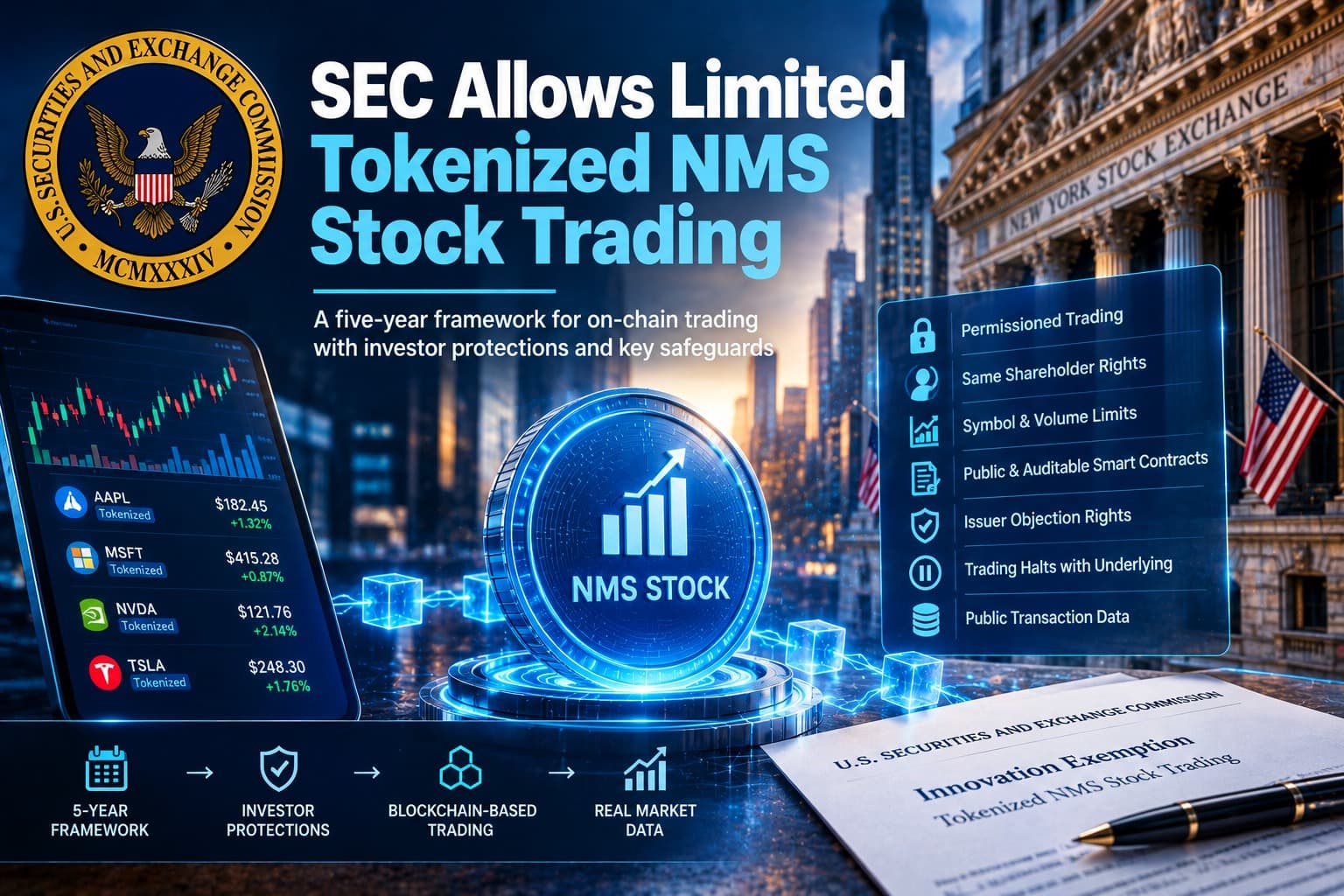
The U.S. Securities and Exchange Commission has granted temporary, conditional regulatory relief allowing certain on-chain venues to trade tokenized NMS stocks through permissioned automated market makers and liquidity pools. The new “Innovation Exemption” creates a five-year framework for testing blockchain-based secondary trading while the SEC gathers data and considers longer-term rules.
The order, issued on September 17, 2026, is one of the most significant U.S. regulatory steps yet toward integrating tokenized securities with conventional capital markets.
The SEC is not creating a general exemption for every crypto platform or every digital representation of a stock. Instead, the order establishes a defined regime for Tokenized Securities Venues, or TSVs, and for certain liquidity providers operating in their automated market-making pools.
The framework is deliberately limited.
 Coinbase Sets New Industry Benchmark with Fully-Backed Tokenized Stocks for Global Investors→
 Metric DEX Launches With Chainlink Data Streams→
 Solana’s RWA Ecosystem Surpasses $4 Billion in Total Value, Setting New Milestone for Tokenized Finance→
 Solana Breaks Records Across Trading, Revenue, and Transactions in Q2 2026→
Trading must take place in a permissioned environment, eligible securities are subject to symbol and volume limits, and the tokenized asset must provide holders with the same rights and privileges as the equivalent traditional NMS stock.
That combination of experimentation and restrictions is at the center of the SEC’s approach.
What the Innovation Exemption actually does
The SEC’s order provides two distinct forms of temporary relief under Section 36(a)(1) of the Securities Exchange Act.
The first exempts qualifying Tokenized Securities Venues from being treated as an “exchange” under Section 3(a)(1) when they conduct the defined on-chain trading activity.
The second provides conditional relief from the statutory “dealer” definition for certain liquidity providers that contribute proprietary capital to the automated market-making pools and may engage in activities associated with dealing, such as quoting prices to customers.
The distinction is important because the order is addressing the regulatory status of the venue and liquidity infrastructure, not declaring that blockchain-based trading falls outside federal securities law.
SEC Chairman Paul S. Atkins said the exemption is intended to facilitate on-chain trading of certain tokenized stocks while the Commission considers additional measures for a longer-term framework.
What is a Tokenized Securities Venue?
A TSV is designed to bring together buyers and sellers of tokenized NMS stock through one or more automated market-maker liquidity pools.
The SEC describes the model as a permissioned environment in which eligible participants interact with liquidity pools and agree to the terms of trades.
This is materially different from an unrestricted decentralized exchange.
A TSV must establish standards governing access to the trading pools, and the SEC’s conditions impose requirements around public disclosures, transaction transparency, records, technology safeguards and coordination with the underlying stock market.
The result is a hybrid structure:
Blockchain infrastructure + automated liquidity + permissioned access + securities-market protections.
That approach allows the SEC to observe how on-chain equity trading actually works without immediately rewriting the entire U.S. exchange framework.
Tokenized shares must preserve shareholder rights
One of the most important conditions concerns the legal relationship between a tokenized security and its underlying stock.
A TSV must verify that the tokenized NMS stock provides holders with the same rights and privileges as the equivalent class of traditional NMS stock. The SEC specifically identifies rights such as receiving dividends and exercising voting rights.
That requirement sharply distinguishes the new framework from some synthetic or derivative-based products marketed as tokenized stocks outside the United States.
The SEC says TSVs may not use the exemption for synthetic representations that simply track a stock’s price without providing the underlying security rights required by the order.
This is a fundamental point for investors.
A token with exposure to Apple, Nvidia or another listed company is not automatically equivalent to ownership of the underlying stock.
Under this exemption, the regulatory framework is explicitly tied to preserving the rights associated with the traditional security.
Issuers can object to third-party tokenization
The order also addresses an issue that has been central to debates over tokenized equities: who is allowed to create the token.
Where a tokenized NMS stock is created by an unaffiliated third party rather than by or on behalf of the underlying issuer, the TSV must provide written notice to the issuer and an opportunity to object before the security is made available for trading.
That gives public companies a formal role in the process.
The structure is therefore not completely permissionless, even though the smart contracts used by the venue must be public, auditable and deployed on a public, permissionless distributed ledger.
This combination is noteworthy: the infrastructure can use a public blockchain while access to the actual trading venue remains controlled.
The market will have symbol and volume limits
The SEC is also limiting the scale of the experiment.
Tokenized NMS stocks traded under the exemption will be subject to limits on the number of symbols and trading volume. Commissioner Mark T. Uyeda said the volume caps are calibrated according to limit-up/limit-down tiers, creating a controlled environment in which the Commission can gather market data before deciding on longer-term policy.
This means the exemption is not intended to immediately create a parallel multi-trillion-dollar equity market.
It is closer to a regulatory test environment for real trading activity.
The data generated by that environment could eventually inform permanent rules.
Transaction data will become part of the experiment
One of the most significant features for market observers is the transparency requirement.
Commissioner Uyeda said U.S.-dollar-denominated data including price, trade size, time, pool address, end-of-day pool size and daily volume will be made publicly available at regular intervals.
That creates a potentially valuable data set.
Regulators will be able to study how tokenized securities trade compared with their traditional equivalents. Researchers and market participants may also gain visibility into liquidity, spreads, trading behavior and the interaction between automated liquidity pools and conventional equity markets.
For a technology that has often been evaluated through isolated pilots, real market data could materially improve the regulatory discussion.
Tokenized NMS stock trading will still follow the underlying market
The exemption does not automatically create a 24-hour U.S. stock market.
One of the SEC’s conditions requires a TSV to stop trading a tokenized NMS stock at the same time that trading in the underlying stock stops on its primary listing exchange.
This requirement is significant because blockchain infrastructure can technically operate continuously.
The SEC is choosing not to allow the tokenized version to become detached from the trading status of the underlying security.
That helps maintain a closer relationship between the tokenized market and the conventional market.
It also means that one of the frequently cited advantages of blockchain — continuous market availability — remains constrained by the rules governing the underlying security.
Expert opinions: the SEC is treating tokenization as a market-structure experiment
Commissioner Mark T. Uyeda described the exemption as a way to let the Commission develop a better understanding of on-chain venues while informing future policymaking. He argued that technology-neutral regulation should focus on outcomes such as investor protection and market integrity rather than forcing new technologies into legacy structures.
SEC Chairman Atkins similarly described the action as a temporary step toward bringing U.S. capital markets onto blockchain infrastructure. He emphasized that federal anti-fraud and anti-manipulation rules continue to apply to securities activity conducted under the exemption.
The significance of those statements is that the SEC is not presenting tokenization as a separate financial system.
Instead, the agency is testing whether existing market protections can be adapted to a blockchain-based trading environment.
That is a more consequential question than whether investors can simply buy a digital token representing a familiar stock.
Why this matters for Wall Street
Tokenization could affect several layers of market infrastructure.
Settlement
Blockchain-based settlement can potentially reduce the number of intermediaries involved in transferring an asset and shorten the time needed to finalize transactions.
Liquidity
Automated market-making pools create a different mechanism for matching buyers and sellers from a traditional centralized order book.
Collateral
Tokenized securities could eventually be incorporated into programmable collateral and margin workflows.
Transfer
Digital assets can be moved between compatible wallets and financial systems without using the same operational processes as conventional securities transfers.
Programmability
Smart contracts can encode rules governing transfers, eligibility and other transaction conditions.
Commissioner Uyeda specifically identified issuance, trading, transfer, settlement and ownership records as parts of market infrastructure that tokenization could potentially modernize.
The economic impact, however, remains an empirical question.
The exemption is designed to generate the evidence needed to evaluate those potential benefits.
The five-year window is important
The relief is scheduled to expire five years after publication.
That gives the SEC a defined period to observe the market rather than committing immediately to permanent regulations.
This creates a potential pathway:
Temporary exemption → live market data → public comment → evaluation → permanent rulemaking.
The Commission is explicitly requesting comment on the framework and possible modifications.
Uyeda called for detailed information from market participants, including metrics, case studies, incident analyses and operational experience from live or test environments.
That makes the next five years potentially important for the future of tokenized securities regulation in the United States.
How this connects with DTCC’s tokenization program
The SEC action arrives at the same time that traditional securities infrastructure is moving toward blockchain-based assets.
DTCC is preparing to launch its Tokenization Service in October 2026 after conducting production tests involving DTC-custodied securities.
CryptoQuorum recently examined that initiative in DTCC Tokenization Service Nears October 2026 Launch as Edel Joins Industry Working Group.
The two developments address different layers of the market.
DTCC is focused on the infrastructure connecting tokenized assets to traditional custody and post-trade systems.
The SEC’s Innovation Exemption addresses secondary trading venues and liquidity mechanisms.
Together, they illustrate how tokenization is moving through several stages of the financial-market stack rather than remaining a single blockchain project.
Chainlink and the data layer
Tokenized equities also require reliable market data.
CryptoQuorum recently analyzed Chainlink’s expansion into tokenized equities, including data feeds, data streams and interoperability infrastructure for blockchain-based stocks and ETFs.
The SEC’s requirement for public transaction information under the Innovation Exemption adds another dimension to that infrastructure.
A tokenized-equity market needs not only a blockchain and trading venue, but also accurate pricing, market-status information, corporate actions, ownership records and compliance systems.
This is why the broader tokenization market is increasingly becoming an infrastructure story rather than simply a token-issuance story.
What investors should watch
Several questions will determine whether the exemption develops into a meaningful part of the U.S. equity market.
First, participation. Which firms actually launch TSVs, and how many issuers allow their securities to be tokenized?
Second, liquidity. Can permissioned AMM pools generate competitive execution compared with established equity venues?
Third, spreads and costs. Will tokenized trading reduce friction or simply shift costs to new infrastructure?
Fourth, investor rights. How effectively will dividends, voting and other corporate actions be reflected in tokenized securities?
Fifth, interoperability. Can tokenized shares move between approved networks without compromising ownership records or regulatory controls?
Sixth, market integrity. Will regulators observe meaningful differences in manipulation, volatility, information quality or liquidity compared with conventional markets?
The answers will matter more than the headline announcement itself.
Risks remain
The exemption does not eliminate the technological and market risks associated with tokenization.
Smart contracts can contain vulnerabilities. Blockchain networks can experience outages or congestion. Automated liquidity pools may behave differently during periods of extreme volatility. Permissioned systems can also create new operational dependencies.
There is also a risk of fragmentation.
If tokenized securities become distributed across multiple networks with different standards, investors could face separate pools of liquidity rather than a single integrated market.
Finally, legal equivalence is essential.
A tokenized security is only useful to institutional investors if its ownership rights, redemption processes, corporate actions and settlement mechanics remain enforceable.
The SEC’s conditions attempt to address these issues, but real-world operation will provide a much stronger test than regulatory text alone.
The bigger picture
The Innovation Exemption arrives as U.S. financial infrastructure increasingly moves toward tokenization.
Earlier proposals and industry initiatives focused on whether stocks, Treasuries and funds could technically be represented on blockchains.
The next question is whether those representations can participate in regulated secondary markets.
That is what the SEC’s new framework begins to test.
The significance extends beyond crypto exchanges.
If tokenized securities become viable within regulated U.S. markets, brokerages, asset managers, custodians, market makers and financial technology companies could eventually incorporate blockchain-based assets into existing trading and settlement workflows.
For the digital-asset industry, this would represent a major shift in the relationship between crypto infrastructure and traditional finance.
Bottom line
The SEC’s Innovation Exemption creates a controlled path for tokenized NMS stock to be traded on certain permissioned blockchain-based venues.
The framework is temporary and conditional, not a blanket authorization for tokenized stock trading. TSVs must meet requirements concerning access, volume, shareholder rights, issuer notification, smart-contract transparency, market halts and public disclosures.
Certain liquidity providers also receive conditional relief from the federal dealer definition, allowing them to contribute proprietary capital to automated market-making pools under specified conditions.
The SEC’s stated goal is to learn from real market activity while maintaining investor protections and developing data that can support longer-term regulation.
The timing is especially significant because DTCC is simultaneously preparing tokenization infrastructure for DTC-custodied securities, while firms such as Chainlink are developing the data and interoperability layers required for on-chain equities.
The immediate market impact may be limited by the exemption’s symbol and volume caps.
Its longer-term significance could be much larger.
For the first time, U.S. regulators are allowing a defined class of blockchain-based equity trading to generate real market data under an explicit securities-law framework.
That makes the next five years less about whether tokenization is technically possible and more about whether on-chain markets can demonstrate better or more efficient ways to trade, settle and manage traditional securities without compromising investor protection.
Disclaimer
This article is provided for informational and educational purposes only and does not constitute financial, investment, legal, regulatory or other professional advice. The SEC’s Innovation Exemption is temporary and conditional, and its scope may change following public comment or subsequent regulatory action. Tokenized securities and blockchain-based trading involve technological, liquidity, operational, counterparty and regulatory risks. Readers should conduct independent research and consult qualified professionals before making investment or financial decisions.