

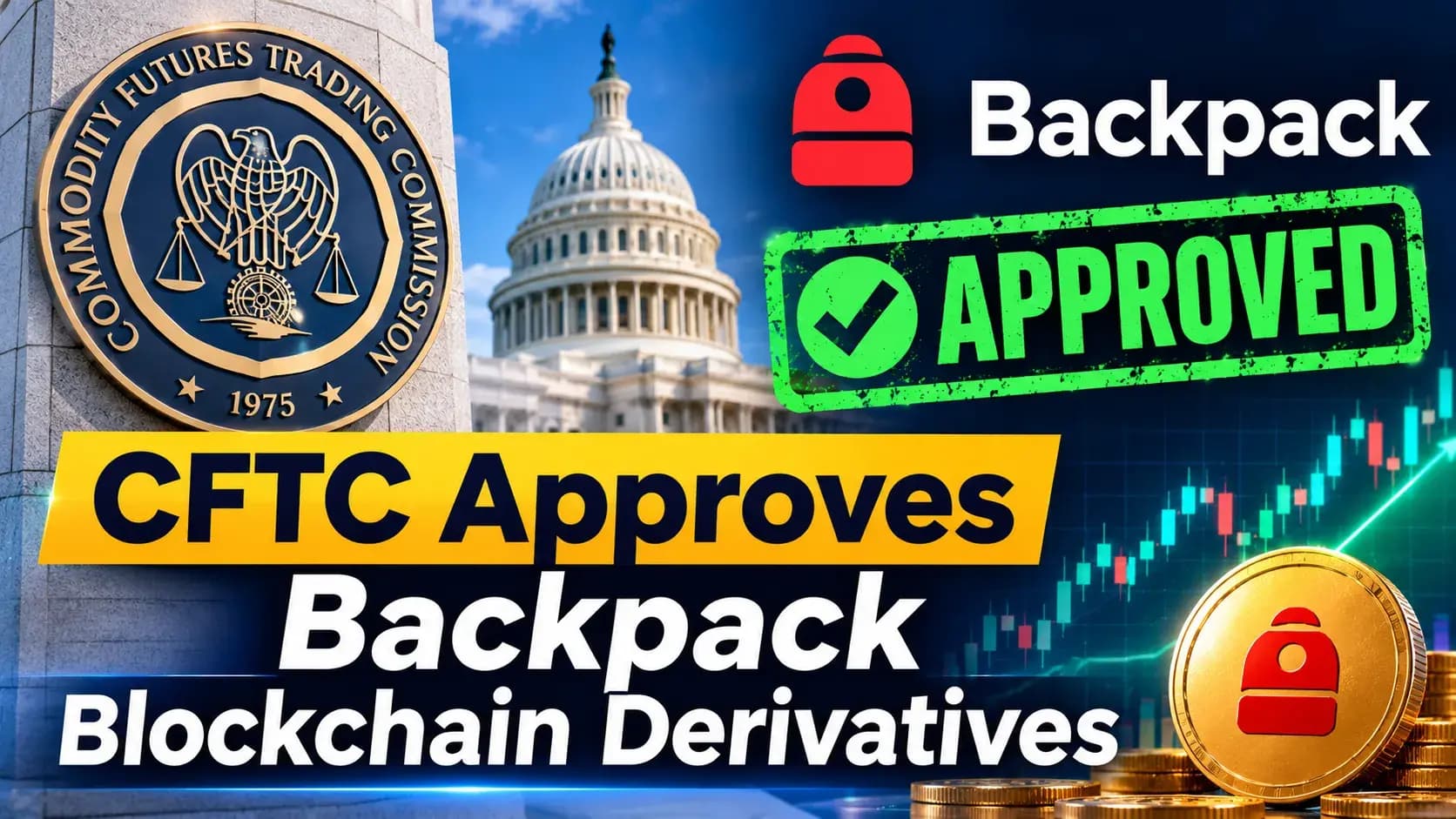
The U.S. Commodity Futures Trading Commission (CFTC) has approved a regulatory framework that allows Backpack to establish a blockchain-based derivatives exchange and clearing operation in the United States. The decision marks a significant step toward bringing crypto-native trading infrastructure under federal derivatives-market supervision.
Backpack announced the approvals on November 16, 2026, after CFTC Chairman Michael Selig published a statement describing the agency’s authorization of a firm using blockchain-based architecture to execute and settle derivatives contracts.
The approvals cover two separate entities within the Backpack group: TLD Markets, Inc., which received designation as a designated contract market (DCM), and TLD Clearing, Inc., doing business as Backpack Clearing, which was registered as a derivatives clearing organization (DCO).
The company says the regulatory framework will allow it to offer U.S. customers leveraged cryptocurrency perpetual futures, 24-hour trading, crypto collateral and cross-margin functionality through a unified global order book.
 Binance Blocks MEXC Transfers After FinCEN Order→
 SEC examination priorities put tokenization on 2027→
 Crypto.com Brings Prediction Markets to Institutions→
 IMF Sees Global Growth at 3.1% in 2026 as AI Boom Offsets Energy Shock→
However, regulatory approval does not mean the U.S. platform has already launched. Backpack has not announced a trading start date or published a final list of available contracts.
What the CFTC Approved
The regulatory development involves two distinct permissions.
On November 13, the CFTC registered TLD Clearing, Inc. as a derivatives clearing organization. Three days later, on November 16, the agency approved TLD Markets, Inc. as a designated contract market.
These registrations serve different functions within derivatives markets.
A designated contract market is a regulated exchange authorized to list and facilitate trading in futures and other derivatives. A derivatives clearing organization performs the clearing function, managing obligations between counterparties and overseeing margin and settlement processes.
In practical terms, the two approvals establish the regulatory foundation for Backpack to operate both sides of a U.S. derivatives trading structure.
The CFTC’s public records confirm the registration of TLD Clearing on November 13 and the designation of TLD Markets on November 16.
The distinction matters because approval of an exchange alone would not establish the complete clearing infrastructure required for the company’s proposed model.
The agency’s official documents are available through its TLD Clearing registration record and the TLD Markets designation order.
Why Blockchain-Based Market Infrastructure Matters
The CFTC’s announcement is significant because it recognizes that blockchain technology can be used within the operational architecture of a regulated derivatives exchange and clearinghouse.
In his November 16 statement, Chairman Michael Selig said the approvals demonstrated that a regulated pathway exists for a new generation of financial-market infrastructure built using blockchain technology.
He also emphasized that the Commodity Exchange Act establishes core principles for exchanges and clearinghouses without requiring them to use a particular technological architecture.
This means that a company does not automatically fall outside the regulatory framework simply because it uses distributed ledger technology.
However, the CFTC made clear that technological innovation does not reduce regulatory obligations.
Selig said firms using novel infrastructure must satisfy the same standards as traditional market operators. These include:
- Anti-money laundering programs.
- Customer protection and segregation requirements.
- Market surveillance and monitoring.
- Adequate financial resources.
- Risk-management policies.
- Operational and system safeguards.
The message from the regulator is therefore two-sided: blockchain-based infrastructure can be accommodated, but it must operate within the same core protections expected of conventional derivatives markets.
The full statement is available on the CFTC website.
What Backpack Plans to Offer U.S. Traders
Backpack says the approvals create the foundation for a U.S. derivatives platform offering several features commonly associated with offshore cryptocurrency exchanges.
The company’s announcement identifies crypto perpetual futures as a central product.
Perpetual futures are derivatives contracts that track the price of an underlying asset but do not have a fixed expiration date. Traders can maintain positions as long as they satisfy margin requirements and other applicable exchange rules.
Backpack says its planned U.S. offering will include leveraged trading, crypto and fiat collateral, cross-margin functionality and 24/7 market access.
One of the most important elements is the proposed unified global order book.
Rather than maintaining completely separate liquidity pools for U.S. and international users, Backpack says it intends to connect its global trading activity through one coordinated marketplace.
This could help concentrate liquidity and improve price discovery by allowing orders from different markets to interact within a common trading environment.
Mark Wetjen, president of Backpack US and a former CFTC commissioner, described the approval as an important step toward moving price discovery from offshore venues into the United States.
He argued that blockchain infrastructure can provide verifiability, auditability and asset mobility while operating under regulatory supervision.
These are company-side arguments, however, and the actual benefits will depend on implementation, liquidity, execution quality and the conditions imposed on the U.S. platform.
Approval Does Not Mean Trading Has Started
Despite the regulatory milestone, several important details remain outstanding.
Backpack has not announced when U.S. trading will begin. It has also not published a complete initial contract list, maximum leverage levels, trading fees or final collateral requirements for the American platform.
The distinction between approval and launch is important for potential customers.
A DCM designation and DCO registration establish regulatory permissions, but an exchange still needs to complete operational preparations, establish clearing-member relationships, onboard customers and satisfy applicable compliance requirements.
The CFTC’s public records also show that TLD Clearing’s registration permits it to clear margined futures, as well as fully collateralized futures, options on futures and swaps. This describes the scope of its clearing authorization; it does not mean every possible product is immediately available for trading.
Backpack CEO Armani Ferrante described the approvals as the culmination of almost four years of work. He said the company has consistently sought to enter new markets through regulated structures.
For now, traders should treat the announcement as a regulatory milestone rather than confirmation that all advertised features are already operational in the United States.
Backpack Is Not the First Company to Receive CFTC Derivatives Approvals
The development should also be understood in the context of a broader expansion of regulated digital-asset derivatives infrastructure.
Other cryptocurrency and financial technology companies have already received CFTC registrations for derivatives clearing and exchange operations.
The agency’s public records, for example, list Coinbase Clearing LLC and tZERO DCO, LLC among registered derivatives clearing organizations. tZERO also received its own designated contract market approval in November.
Consequently, Backpack should not be described as the first cryptocurrency-related company ever approved by the CFTC or the first firm to obtain DCM and DCO status.
The more specific distinction is the blockchain-based architecture for the execution and settlement of derivatives contracts highlighted by Chairman Selig.
That distinction is important for understanding the technological significance of the decision without overstating its regulatory novelty.
It also suggests that U.S. regulators are evaluating different approaches to integrating digital-asset infrastructure into established financial-market structures.
What It Means for U.S. Crypto Regulation
The approval fits into a wider shift in the CFTC’s approach to digital assets and market infrastructure.
The agency has increasingly addressed how blockchain technology can function within existing derivatives regulations, including the use of tokenized collateral and distributed ledgers for regulatory recordkeeping.
In September, CFTC staff updated its guidance on crypto assets and blockchain technologies, addressing investments of customer funds in tokenized forms of permitted investments and the use of blockchain systems to satisfy recordkeeping requirements.
That guidance and the Backpack approvals address different aspects of the same broader question: how can financial institutions use blockchain technology without weakening established protections?
For market participants, the distinction between technological innovation and regulatory compliance is central.
A blockchain-based exchange may offer faster settlement, greater transparency and new forms of asset mobility. But those characteristics do not eliminate counterparty risk, operational vulnerabilities or the need for market surveillance.
The regulatory framework will continue to determine which products can be offered, how customer assets are protected and which entities are responsible for clearing and settlement.
Read CryptoQuorum’s related coverage: CFTC Clarifies Tokenized Collateral Rules and On-Chain Recordkeeping.
Expert Perspective: Innovation Must Meet Traditional Standards
Selig’s statement provides the clearest regulatory perspective on the development.
The CFTC chairman welcomed blockchain-based market infrastructure but stressed that new technology must meet existing standards for customer protection, financial resources, risk management and anti-money laundering controls.
Wetjen’s comments represent the company’s perspective. He emphasized the potential benefits of combining blockchain’s auditability and asset mobility with federal oversight.
Taken together, these positions highlight the central challenge for blockchain-based derivatives platforms.
The technology may change how transactions are recorded, executed and settled, but the responsibilities of an exchange and clearinghouse remain substantial.
For institutional investors, the most important test will be whether the new infrastructure can demonstrate reliable operations, transparent risk controls and sufficient liquidity under real trading conditions.
What to Watch Next
Several developments will determine the practical significance of the approval:
- U.S. launch date: Backpack must clarify when American customers will be able to access the platform.
- Initial products: The first listed contracts and their trading conditions will show how broad the offering will be.
- Collateral rules: Details on eligible digital assets, margin requirements and risk limits will be important for institutional participation.
- Global liquidity: The proposed unified order book will need sufficient participation to deliver meaningful execution benefits.
- Regulatory implementation: The exchange and clearinghouse must demonstrate that blockchain-based operations can satisfy the CFTC’s ongoing requirements.
The answers will determine whether Backpack becomes a meaningful competitor in the U.S. derivatives market or remains primarily a regulatory and infrastructure milestone for now.
Conclusion
The CFTC’s approvals give Backpack a regulatory foundation to establish a blockchain-based derivatives exchange and clearinghouse in the United States.
The decision demonstrates that distributed ledger technology can be integrated into federally supervised market infrastructure, provided that operators meet the same core standards as traditional exchanges and clearing organizations.
For the crypto industry, the development could encourage more companies to pursue regulated U.S. derivatives operations rather than relying exclusively on offshore venues.
But the next stage will matter more than the announcement itself. Trading must launch, liquidity must develop and the platform must demonstrate that its blockchain architecture can deliver operational advantages without compromising customer protection.
Disclaimer: This article is for informational purposes only and does not constitute investment, legal or financial advice. Derivatives and leveraged cryptocurrency products involve substantial risk and may not be suitable for all investors.