

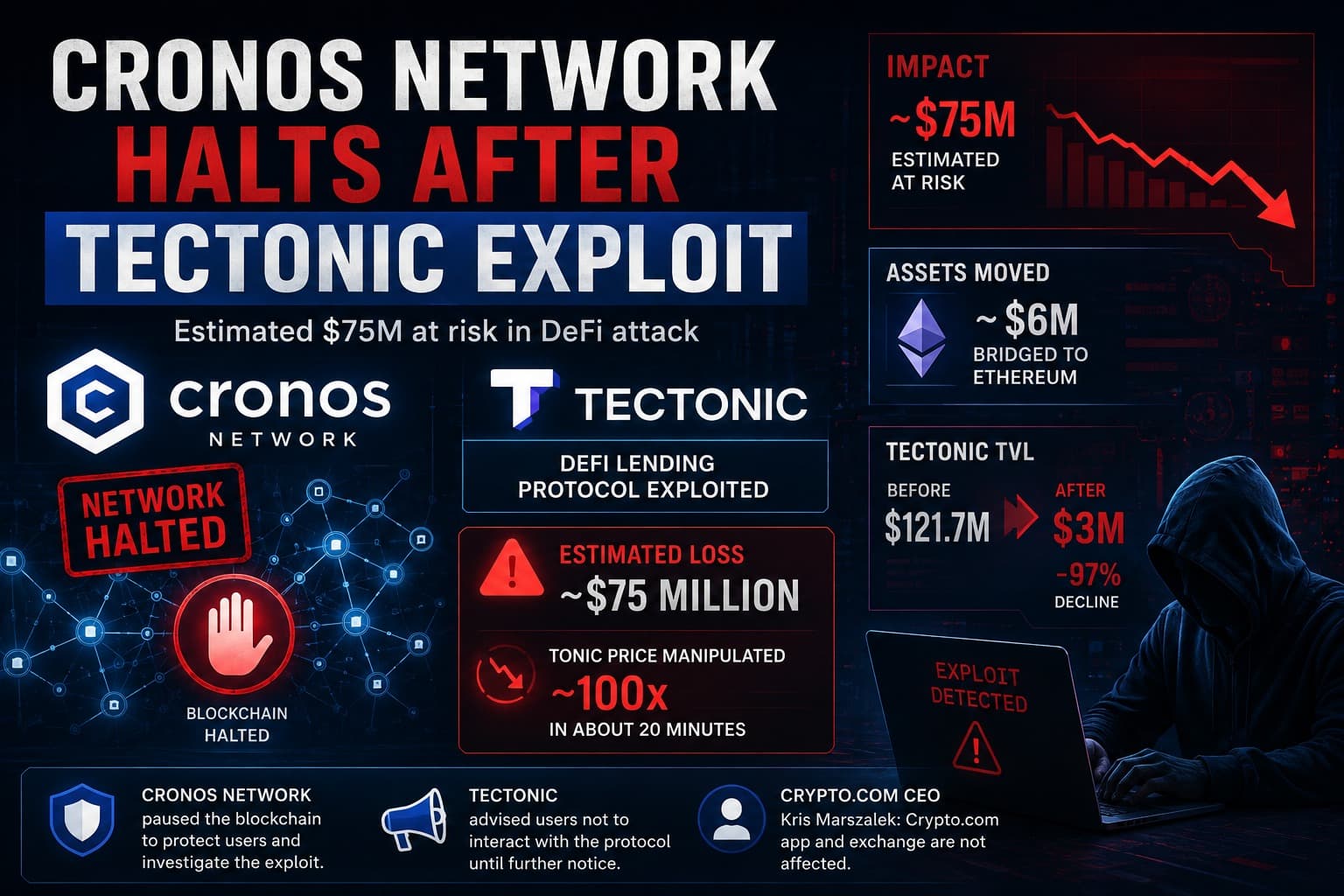
The Cronos Network halted block production after an exploit hit Tectonic, its largest DeFi lending protocol. On-chain researcher Weilin Li initially estimated that about $66 million in assets were affected and later raised the figure to roughly $75 million after identifying another attacker-controlled address. The attack appears to have involved a rapid manipulation of Tectonic’s low-liquidity TONIC token before the inflated token value was used as collateral.
What Happened to the Cronos Network?
The incident began with an attack on Tectonic, a decentralized lending protocol operating on Cronos.
On August 30, Cronos Network announced that it had identified an exploit affecting Tectonic and halted the blockchain while the investigation continued. Tectonic separately warned users not to interact with the protocol until its team could verify that it was safe.
The official announcements are available from the Cronos Network X account and Tectonic’s X account.
 Robinhood’s Evolving Wealth Management Strategy Targets the Future of Retail Investing→
 Fed Rate Hike May Not Rattle Crypto Markets, Grayscale Says→
 Solana Tokenized Equity Supply Surges to Record $684M Amid Multi-Platform Expansion→
 XRP Ledger Foundation Advances Ecosystem Resilience with Strategic Infrastructure Upgrades→
The decision to halt the entire network was significant because it did not affect only Tectonic. Normal transactions across Cronos were also interrupted.
The move was designed to prevent the attacker from moving additional assets away from the chain while the incident was being investigated.
According to reporting based on on-chain analysis, approximately $6 million had reached Ethereum before validators stopped the network. Most of the estimated affected value therefore remained on Cronos.
How the Tectonic Exploit Appears to Have Worked
The preliminary evidence points toward a price-manipulation and collateral attack, rather than a conventional exploit in which an attacker simply discovers a coding error and drains funds.
At the center of the incident was TONIC, Tectonic’s governance token.
Weilin Li, an on-chain researcher who tracked the attack, said TONIC had very limited liquidity while still carrying a 20% collateral factor within Tectonic.
That combination created a potential vulnerability.
The basic mechanism can be simplified into four stages:
- Manipulate the market price.
The attacker rapidly bought or otherwise manipulated TONIC in a thin market, causing its displayed market value to rise dramatically. - Create inflated collateral.
The attacker then used the artificially elevated TONIC valuation inside Tectonic. - Borrow more valuable assets.
Because lending protocols calculate borrowing capacity from collateral value, the inflated TONIC position could support substantially larger loans. - Move the borrowed assets.
The attacker reportedly transferred some of the resulting assets away from Cronos before validators halted the network.
Li described the technique as a “Mango-market style” pump-and-borrow attack, referring to the price-manipulation mechanism seen during the 2022 Mango Markets exploit.
The critical issue is therefore not simply whether TONIC’s price increased.
It is whether a lending protocol should have treated such a rapidly changing, thinly traded asset as reliable collateral at the price being displayed.
Why Low Liquidity Matters
Liquidity is one of the most important variables in decentralized lending.
Before the incident, DefiLlama showed Tectonic with roughly $121.7 million in total value locked, approximately $82.7 million in active loans, and only around $1.34 million of TONIC liquidity.
That imbalance illustrates the underlying risk.
A token can have a relatively small amount of liquidity while still receiving a market valuation that appears large enough to influence lending decisions.
If a protocol accepts that token as collateral, an attacker may attempt to manipulate the market price temporarily and then use the inflated valuation to borrow assets that are much more liquid.
This is why oracle design, collateral parameters and liquidity monitoring are fundamental to DeFi security.
CryptoQuorum recently examined this issue in its analysis of Chainlink Data Streams and oracle infrastructure, including the relationship between market liquidity and reliable on-chain pricing.
The Tectonic incident demonstrates why that infrastructure matters in practice.
A price feed can be technically functional while still producing a dangerous result if the underlying market is too shallow to support the valuation being reported.
The $75 Million Figure Is Not Yet a Confirmed Loss
The headline figure requires careful qualification.
Weilin Li initially estimated that approximately $66 million was affected. He later identified another attacker-controlled address containing roughly $8 million, raising his estimate toward $75 million.
However, neither Cronos nor Tectonic had confirmed that figure as the final loss at the time of writing.
Other on-chain analyses have produced substantially higher numbers for the amount of value that moved through affected pools. One analysis cited by CoinDesk estimated approximately $119.5 million in assets withdrawn or otherwise affected, while also identifying liquidations and bad debt. That figure should not automatically be described as a $119.5 million theft because asset movements, collateral repricing, liquidations and actual realized losses are different measurements.
For that reason, the most accurate description at this stage is:
A researcher estimates approximately $75 million in affected assets, while the final financial loss remains unconfirmed.
That distinction is important for responsible crypto reporting.
Expert Opinions: What Weilin Li and Kris Marszalek Said
Weilin Li’s analysis provides the clearest preliminary technical explanation of the incident.
Li identified the combination of TONIC’s low liquidity and its collateral factor as a key part of the attack. He compared the mechanism to the Mango Markets-style pump-and-borrow model, in which an attacker manipulates an asset’s market price and then uses the inflated valuation to obtain undercollateralized borrowing.
His analysis should still be treated as preliminary because the Tectonic team had not published a complete postmortem confirming the root cause.
Kris Marszalek, CEO of Crypto.com, provided a separate but important perspective focused on the company’s centralized services.
In his X post, Marszalek said there had been a security breach involving the Cronos lending protocol Tectonic, while the Crypto.com app and exchange were not affected and continued operating normally. He also said Crypto.com’s security team was assisting with the investigation.
That distinction matters because Tectonic is a DeFi protocol operating on Cronos; it is not the Crypto.com exchange itself.
Users should therefore avoid treating the Tectonic incident as evidence that the Crypto.com exchange was hacked.
Cronos Network’s Emergency Halt Creates a Decentralization Debate
The network shutdown also raises a broader question about blockchain governance.
Cronos was able to stop block production rapidly because its validator structure allows coordinated action during an emergency. Reporting indicates that the network has a maximum of 100 validators, making an emergency halt considerably more feasible than on a highly decentralized network with thousands of independent participants.
There are two ways to interpret that capability.
From a security perspective, the halt may have prevented the attacker from moving a much larger amount of assets outside Cronos.
From a decentralization perspective, however, the incident highlights the trade-off involved when a blockchain can be collectively stopped.
The same mechanism that can help contain an exploit can also stop legitimate users from transferring assets, interacting with smart contracts or managing positions.
This is not necessarily a simple “good versus bad” question.
It is a design trade-off between network neutrality, decentralization, operational control and emergency response.
CryptoQuorum has previously explored a similar question in its coverage of Litecoin’s response to a major security incident, where the focus was on how blockchain networks balance resilience with continuity during a crisis.
What Happened to Tectonic’s TVL?
The impact on Tectonic’s liquidity has been dramatic.
Before the attack, DefiLlama showed Tectonic with approximately $121.7 million in TVL. Current DefiLlama data show the protocol at only around $3 million, representing a decline of more than 97%.
That collapse demonstrates that the consequences extend beyond the amount potentially controlled by the attacker.
When users lose confidence in a lending protocol, they may withdraw assets, stop supplying liquidity or avoid borrowing until the security model has been independently reviewed.
For Tectonic, the next stage is therefore not simply recovering funds.
The protocol will need to establish exactly what happened, identify affected markets, quantify bad debt, explain how the pricing mechanism behaved and demonstrate what changes will prevent a similar event.
What Comes Next for Cronos and Tectonic?
Several questions remain unanswered.
1. When will Cronos restart?
At the time of writing, no definitive restart timetable had been announced.
2. How much was actually lost?
The $75 million estimate remains preliminary. A final accounting will need to distinguish stolen assets from liquidations, market losses and other affected balances.
3. Can the remaining assets be recovered?
If most of the suspected funds remain on Cronos, recovery may be technically easier than if they had already moved across multiple chains. But recovery is not guaranteed.
4. Will affected Tectonic users be compensated?
Neither the preliminary reporting nor the public statements available at publication established a confirmed reimbursement plan.
5. What changes will Tectonic make?
The most important technical questions concern collateral factors, price feeds, liquidity thresholds and safeguards against rapid market manipulation.
Why the Incident Matters for DeFi
The Tectonic attack is another reminder that DeFi security is not limited to smart-contract code.
A protocol can have audited contracts and still face serious risks if its economic assumptions are vulnerable.
Collateral valuation is particularly important.
If a lending protocol accepts an asset with shallow liquidity, it must assume that the market price can potentially be manipulated. The risk becomes greater when that asset is the protocol’s own governance token.
The incident also shows why users should examine more than headline APYs before depositing funds into DeFi protocols.
Questions about collateral composition, oracle architecture, liquidity depth, audits, emergency controls and historical incidents can be just as important as the advertised yield.
CryptoQuorum’s guide to using DeFi platforms safely covers these risks in greater detail, including smart-contract, liquidation, oracle and phishing risks.
Bottom Line
The Cronos Network halt following the Tectonic exploit is one of the most significant DeFi security incidents affecting the ecosystem in 2026.
The preliminary picture is clear: an attacker appears to have manipulated the price of low-liquidity TONIC, used the inflated valuation as collateral and borrowed substantially more valuable assets. The estimated impact reached approximately $75 million according to on-chain researcher Weilin Li, although the final loss remains unconfirmed.
The emergency network halt may have prevented more funds from leaving Cronos, but it also exposed the trade-offs inherent in a blockchain capable of coordinated intervention.
For DeFi developers, the central lesson is broader than Tectonic.
Liquidity, oracle design and collateral parameters are security infrastructure.
For users, the lesson is equally important: a decentralized lending protocol can inherit significant economic risk from the markets it uses to value collateral.
Until Cronos and Tectonic publish a verified postmortem, recovery plan and restart details, the incident should be considered an evolving security event rather than a closed case.
Disclaimer: This article is provided for informational and educational purposes only and does not constitute financial, investment, trading, legal or tax advice. Cryptocurrency and DeFi activities involve substantial risks, including smart-contract vulnerabilities, oracle manipulation, liquidity risk, market volatility, protocol insolvency and potential loss of funds. The $75 million figure cited in this article is a preliminary on-chain estimate and has not been confirmed as the final loss by Tectonic or Cronos. Readers should verify official announcements and conduct independent research before making financial decisions.