

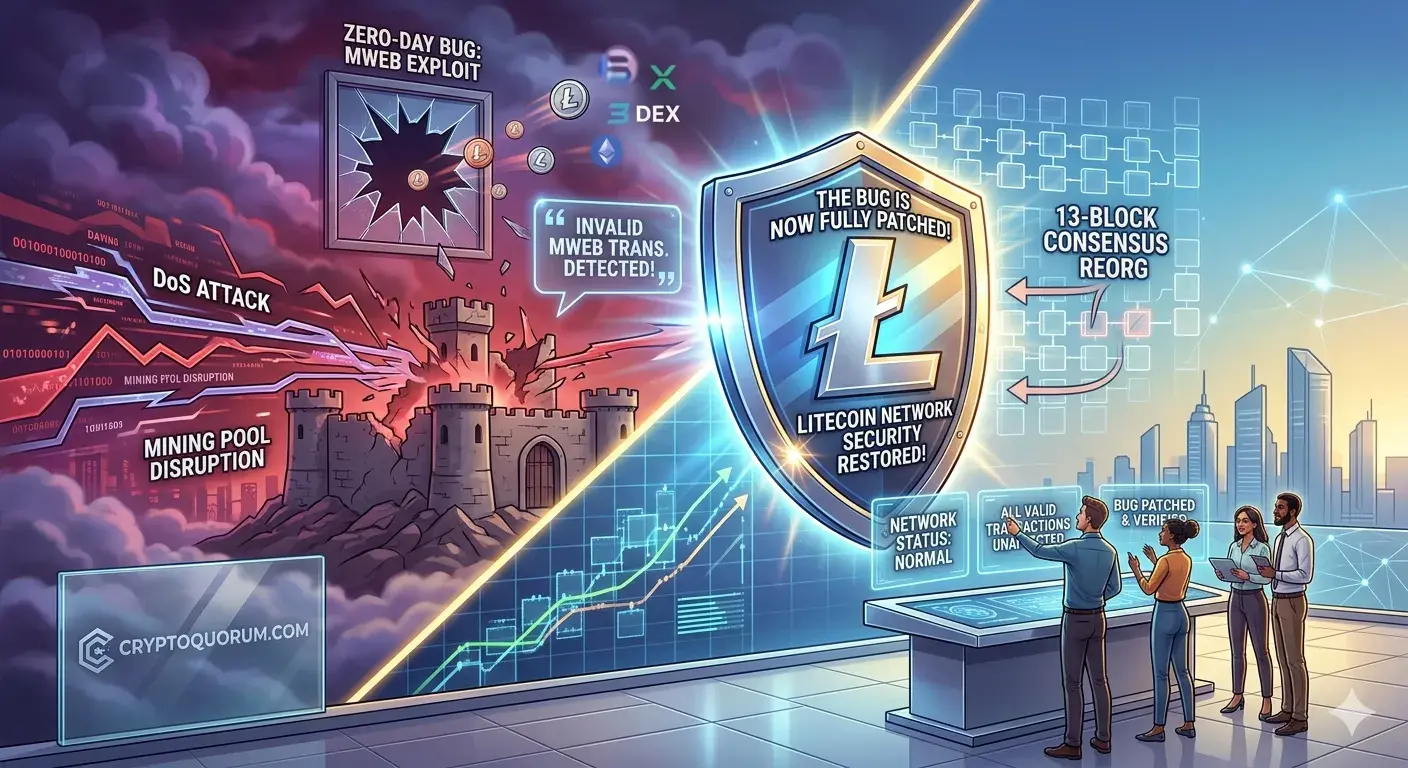
In the world of decentralized finance, the true measure of a blockchain is not how it performs during a bull run, but how it responds to a critical failure. In late April 2026, the Litecoin network security was put to its most rigorous test in years. A sophisticated zero-day bug triggered a chain of events that included a Denial of Service (DoS) attack on major mining pools and a specialized exploit of the MimbleWimble Extension Blocks (MWEB).
While the event caused temporary disruption, the swift response from the Litecoin Core developers and the global mining community has provided a masterclass in incident management. As of today, the network has successfully stabilized, and the official word from the foundation is that the bug is now fully patched.
CRYPTOCAP:TOTAL3 Real-Time Chart
The Technical Breakdown: DoS and the MWEB Vulnerability
The incident began when attackers exploited a zero-day vulnerability to flood mining pools with malicious traffic. This DoS attack was designed to desynchronize the network’s most powerful participants. Amidst this chaos, a secondary exploit targeted the MWEB protocol—Litecoin’s privacy-focused scaling solution.
Mining nodes that had not been updated to the latest security protocols failed to recognize a series of invalid MWEB transactions. These transactions were “peg-outs,” a process where coins move from the MWEB side-chain back to the main Litecoin chain. The attackers attempted to route these unauthorized funds to various third-party DEXs, hoping to liquidate the stolen LTC before the network could react.
 XRP Asia Officially Launches in Seoul to Accelerate XRP Ledger Adoption Across the Asia-Pacific Region→
 CFTC Clarifies Tokenized Collateral Rules and On-Chain Recordkeeping→
 Chainlink Bridges Traditional Capital Markets and Decentralized Finance Through Secure Oracle Infrastructure→
 XRP Holders Close to Unlocking On-Chain RLUSD Borrowing as Validator Vote Nears Threshold→
However, the decentralized nature of the network provided a natural defense. Updated nodes began rejecting these blocks, leading to a temporary fork in the chain. Because the core developers acted with lightning speed, they were able to verify that the bug is now fully patched across the majority of the hash rate within hours.
The 13-Block Reorg: A Necessary Surgery
One of the most discussed aspects of this event is the 13-block reorganization. In blockchain terms, a reorg of this size is significant. It essentially means the network “rewound” approximately 32 minutes of history (given Litecoin’s 2.5-minute block time) to follow a version of the chain that did not include the fraudulent MWEB transactions.
While reorgs can sometimes be seen as a sign of instability, in this context, it was a display of Litecoin network security in action. The majority of miners agreed to follow the “clean” chain, effectively vaporizing the attackers’ attempts to siphon funds. Valid transactions—those not involving the exploit—were simply re-included in the subsequent blocks.
This surgical intervention ensured that the main chain remained untainted. For the average user, the only noticeable effect was a brief delay in transaction confirmations. This was a small price to pay to ensure that the bug is now fully patched and the ledger remains immutable.
Expert Opinions: Analyzing the Fallout
The crypto community and security analysts have been quick to weigh in on the implications of this zero-day event.
The Strategic Analyst: David Redin
“What we saw here was a ‘stress test’ in a live environment,” says David Redin, financial crypto analyst and reviewer for CryptoQuorum. “The fact that the attackers tried to move funds to DEXs suggests they knew their window of opportunity was tiny. The 13-block reorg might look scary to outsiders, but it proves that LTC’s consensus mechanism is robust. It’s a win for Litecoin network security because it showed the devs can outpace zero-day exploits. They confirmed quickly that the bug is now fully patched, which restored market confidence almost instantly.”
The Security Researcher: Sarah Chen
“Privacy features like MWEB always introduce a larger attack surface,” notes researcher Sarah Chen. “This bug was a reminder that node maintenance is not optional. The vulnerability existed in the bridge between the main chain and the extension block. Fortunately, the fix was straightforward once identified. Since the bug is now fully patched, MWEB is actually stronger now than it was before the attack.”
The Institutional View: Mark Verhoeven
“Institutional investors look for how a network handles a crisis,” Verhoeven adds. “Litecoin’s transparency during the DoS attack was commendable. They didn’t hide the reorg; they explained it. For banks looking at IBM’s institutional wallets, this kind of battle-tested resilience is actually a selling point.”
Lessons for the Future of LTC
This event serves as a critical reminder for the “Silver to Bitcoin’s Gold.” As Litecoin continues to integrate more complex features like MWEB, the demand for high-level Litecoin network security will only increase.
Mining pools are now implementing more rigorous DoS mitigation strategies, and the foundation is pushing for mandatory “auto-update” prompts for node operators to prevent non-updated nodes from becoming a liability in the future. The community can rest easy knowing that the bug is now fully patched, but the vigilance must remain.
Furthermore, the integration of Litecoin into broader regulatory frameworks like the CLARITY Act means that network stability is no longer just a technical requirement—it is a legal and institutional one.
Conclusion: Business as Usual
Litecoin has emerged from this zero-day bug with its reputation intact. The attempted theft was thwarted, the invalid transactions were erased, and the network is running at full capacity. By taking the hard path of a 13-block reorg, the developers protected the long-term value of the asset over short-term optics.
The most important takeaway for holders is that your funds are safe, the network is secure, and the bug is now fully patched. Litecoin remains one of the most reliable and battle-hardened chains in existence, ready to handle the next generation of global transactions.
Stay ahead of network updates and security alerts. Subscribe to the CryptoQuorum Technical Bulletin for real-time analysis of blockchain vulnerabilities and fixes.
CRYPTOCAP:TOTAL3 Real-Time Chart
Disclaimer: The information provided in this article is for educational and informational purposes only and does not constitute financial, legal, or investment advice. While the Litecoin network is currently operating normally and the bug is patched, all blockchain interactions involve risk. Always conduct your own research and consult with a certified professional before making investment decisions. CryptoQuorum is not responsible for any financial losses.