

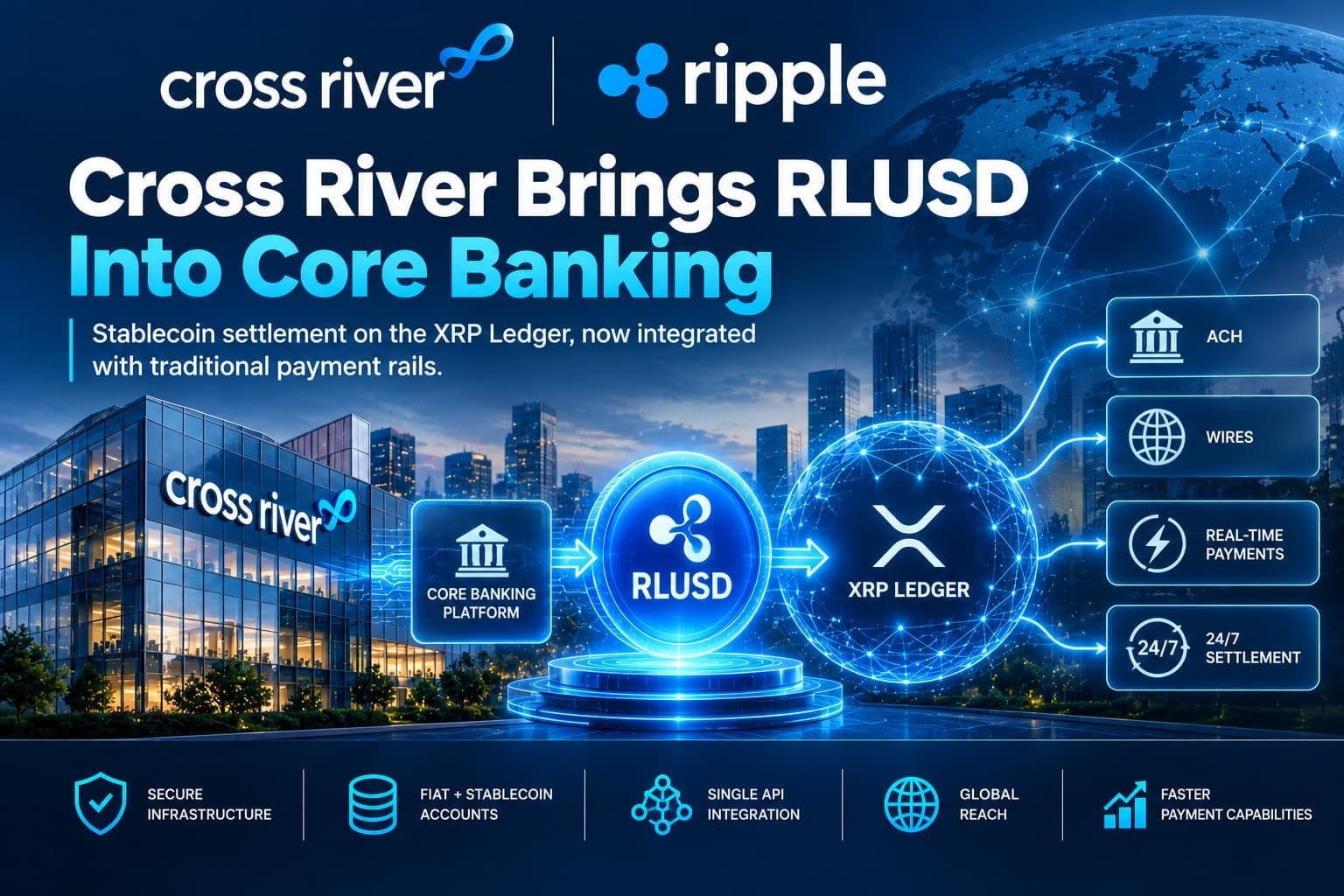
Cross River Bank is integrating Ripple USD into its core banking infrastructure, allowing fintech companies to access blockchain-based settlement on the XRP Ledger through the same platform they use for conventional U.S. payment rails.
Announced on October 15, the partnership integrates Ripple’s U.S. dollar-backed RLUSD stablecoin into Cross River’s proprietary Core Operating System, or COS, with support for transactions on the public XRP Ledger.
BINANCE:XRPUSDT
The significance is not simply that another financial institution supports a stablecoin. Cross River is embedding blockchain settlement directly into its banking technology rather than requiring customers to build and maintain separate blockchain infrastructure.
Fintech clients will be able to move between U.S. dollars and RLUSD, manage cross-border payments and treasury transfers around the clock, while retaining access to ACH, wires and real-time payments through a single banking platform and API.
 MoneyGram Joins XDC Network as Institutional Validator→
 Mastercard and BVNK have launched a new global payments platform→
 Fink: Data Center Moratorium Risks Recession→
 Ripple, Meritz Bring Tokenization to Korea→
The result brings stablecoin settlement closer to the infrastructure businesses already use for conventional payments.
RLUSD Becomes Another Payment Rail
Cross River describes the integration as adding RLUSD as an additional payment rail within its existing banking environment.
That distinction matters.
Instead of forcing a fintech to choose between a traditional bank connection and blockchain infrastructure, Cross River wants both to operate within the same system.
A business could use conventional payment rails when they are appropriate and use blockchain-based settlement when speed, availability or cross-border movement makes it advantageous.
“Businesses shouldn’t have to rely on several different providers to move money across the globe,” Adam Goller, Cross River’s Head of Fintech Banking, said in the announcement.
Goller said the Ripple partnership is intended to reduce that complexity by integrating the stablecoin with capabilities Cross River was already developing.
According to the bank, customers can access the new functionality through a single API connection without having to deploy their own blockchain infrastructure.
Cross River’s official announcement provides the full technical and commercial outline of the partnership.
Why the XRP Ledger Is Part of the Integration
The blockchain component of the partnership is the XRP Ledger, or XRPL.
Ripple says transactions on XRPL typically settle in three to five seconds and cost a fraction of a cent. Cross River says the network has settled more than $1.3 trillion in value to date.
Those characteristics are particularly relevant for payment-network settlement.
Traditional payment systems can involve different processing windows, intermediaries and reconciliation processes. Blockchain settlement can operate continuously, including outside normal banking hours.
Cross River says the new infrastructure will give payment-network issuers and acquirers greater flexibility to settle intraday and reduce settlement latency.
RLUSD itself uses the XRP Ledger’s native issued-token functionality. Ripple’s developer documentation confirms that the stablecoin operates on the XRPL mainnet and that users establish trust lines with its issuer to receive and hold the asset.
This does not mean every Cross River customer needs to interact directly with those technical components. A major purpose of the bank’s infrastructure is to abstract blockchain complexity behind its existing API.
Stablecoins Are Moving Into Existing Banking Infrastructure
Markus Infanger, Senior Vice President of RippleX at Ripple, framed the partnership as evidence that stablecoins will succeed through integration rather than through the creation of an entirely separate financial system.
“Stablecoins won’t transform payments through parallel financial systems,” Infanger said.
His argument is that blockchain-based dollars become more useful when businesses can access them through infrastructure they already understand.
That is exactly what Cross River is attempting.
The bank’s COS serves as an integration layer connecting regulated banking services with payment networks. Adding blockchain settlement gives fintechs another route for moving value without requiring them to create an independent technology stack for every network.
This is increasingly becoming the institutional stablecoin model.
Mastercard and BVNK recently unveiled a similar interoperability strategy that connects stablecoins, fiat balances, cards and local payouts rather than treating blockchain payments as a completely separate ecosystem.
The common theme is abstraction: businesses interact with a financial platform while the infrastructure determines whether value should move through a bank rail or blockchain network.
Cross River Had Already Built Stablecoin Infrastructure
The Ripple agreement is an expansion of an existing strategy rather than Cross River’s first move into blockchain payments.
In November 2025, the bank launched its Stablecoin Payments infrastructure.
The platform was designed to unify fiat and stablecoin flows through Cross River’s real-time core.
Cross River said the system could support network settlement, merchant payouts, on- and off-ramps and treasury management without forcing customers to maintain separate ledgers or pre-fund multiple accounts.
That architecture provides the foundation for the Ripple integration.
Adding RLUSD and XRPL extends the bank’s existing framework with another stablecoin and another public blockchain network.
Cross River says its objective is not to replace conventional rails. Instead, stablecoins become complementary settlement options alongside ACH, wires, real-time payments and other existing methods.
That is an important distinction for assessing institutional adoption.
24/7 Treasury Movement Is a Key Use Case
One of the strongest potential applications is corporate treasury.
Businesses operating across countries and time zones often need to move liquidity outside U.S. banking hours. Traditional correspondent-banking structures can also require companies to maintain pre-funded balances in different markets.
Stablecoins can potentially reduce some of those constraints by allowing dollar-denominated value to move continuously across blockchain networks.
Cross River says its infrastructure enables cross-border and treasury movement 24/7.
In a July analysis of stablecoin cross-border payments, the bank argued that blockchain settlement can reduce dependence on correspondent banking chains and batch-processing windows.
The benefit is not necessarily replacing every bank transfer with a blockchain transaction.
Rather, treasury teams gain another settlement option and can choose the rail appropriate for a particular transaction.
That could become increasingly important as stablecoins move from crypto trading into B2B payments, supplier settlement, treasury operations and institutional finance.
RLUSD Has Grown Beyond $2.5 Billion
The partnership also arrives as Ripple’s stablecoin continues to expand.
Cross River said RLUSD had grown to more than $2.5 billion in market capitalization at the time of the announcement, with more than $1 billion issued on XRPL.
That represents further growth from the milestone CryptoQuorum covered in August, when RLUSD crossed $2 billion.
Ripple has consistently positioned the asset around enterprise use cases rather than solely crypto-market liquidity.
Payments, treasury management, tokenization, collateral and institutional settlement are increasingly central to that strategy.
CryptoQuorum has also examined the regulatory framework surrounding RLUSD, including the importance of distinguishing between different forms of stablecoin oversight.
That regulatory dimension matters when a stablecoin moves into banking infrastructure because financial institutions need predictable rules around issuance, reserves, redemption and compliance.
What the Partnership Means for XRP — and What It Does Not
The Cross River announcement has obvious relevance to the XRP ecosystem because transactions will be supported on the XRP Ledger.
But RLUSD and XRP are different assets.
RLUSD is designed to track the U.S. dollar. XRP is the native digital asset of XRPL and performs network-level functions including transaction fees.
The Cross River announcement does not say that XRP will be used as the settlement asset for the bank’s customer payments.
It would therefore be inaccurate to present the partnership as evidence that Cross River has adopted XRP for payments.
The more defensible conclusion is that the partnership increases institutional use of infrastructure built on XRPL.
Greater network activity can strengthen the utility case for the blockchain itself, but it does not create a simple one-to-one relationship between stablecoin transaction volume and XRP’s market price.
This distinction is particularly important for Google News and E-E-A-T reporting because Ripple-related announcements are frequently reframed online as direct XRP adoption even when the original source does not make that claim.
One API Could Be the Most Important Feature
The most consequential part of the announcement may not be the blockchain.
It may be the API.
Enterprise adoption often depends on making new infrastructure less complicated rather than simply making it technically faster.
A fintech that wants to offer blockchain payments independently might need to integrate a wallet provider, stablecoin issuer, blockchain network, compliance system, banking partner and fiat payment rails.
Cross River is attempting to hide much of that fragmentation behind one connection.
A customer can access traditional dollars, RLUSD and multiple payment rails through the bank’s infrastructure.
That is the same architectural direction appearing across the payments industry: blockchain becomes an underlying settlement technology rather than a separate product users must consciously navigate.
For businesses, the question eventually becomes less “Should we use blockchain?” and more “Which payment rail provides the best combination of speed, cost, availability and compliance for this transaction?”
The Rollout Is Still Limited
Despite the significance of the integration, there are important limitations.
Cross River explicitly states that these services are currently available only in limited states.
The companies have not disclosed transaction-volume targets, named customers using the new RLUSD functionality or provided a complete nationwide rollout schedule.
That means the announcement establishes working infrastructure and availability, but not yet large-scale commercial adoption.
The next meaningful data points will be customer adoption, payment volumes and evidence that companies are using the system for real treasury and cross-border settlement.
Those metrics will provide a clearer picture of whether integrating a stablecoin directly into bank infrastructure produces meaningful operational advantages at scale.
Banking and Blockchain Are Beginning to Converge
The Cross River partnership illustrates a broader change in institutional crypto adoption.
The first phase of stablecoins developed largely outside traditional banking infrastructure.
The next phase increasingly involves banks, payment companies and fintech platforms incorporating blockchain settlement directly into their existing systems.
That model could be more consequential than creating separate crypto payment networks.
Businesses already have bank accounts, payment APIs, treasury systems and compliance procedures. Integrating blockchain settlement into those environments lowers the operational barrier to adoption.
Cross River’s approach turns RLUSD into another available payment rail rather than requiring customers to build an entirely new financial stack.
If that architecture scales, stablecoins may become increasingly invisible to end users.
A company may initiate a dollar-denominated payment through its existing financial software, while the underlying infrastructure determines whether the transaction moves through ACH, a real-time payment network or RLUSD on XRPL.
That is the real significance of this integration.
Blockchain is moving closer to becoming part of the banking stack itself.
Disclaimer: This article is for informational purposes only and does not constitute investment, financial or legal advice. Stablecoins and blockchain-based payment systems involve regulatory, liquidity, operational, counterparty and technology risks.