

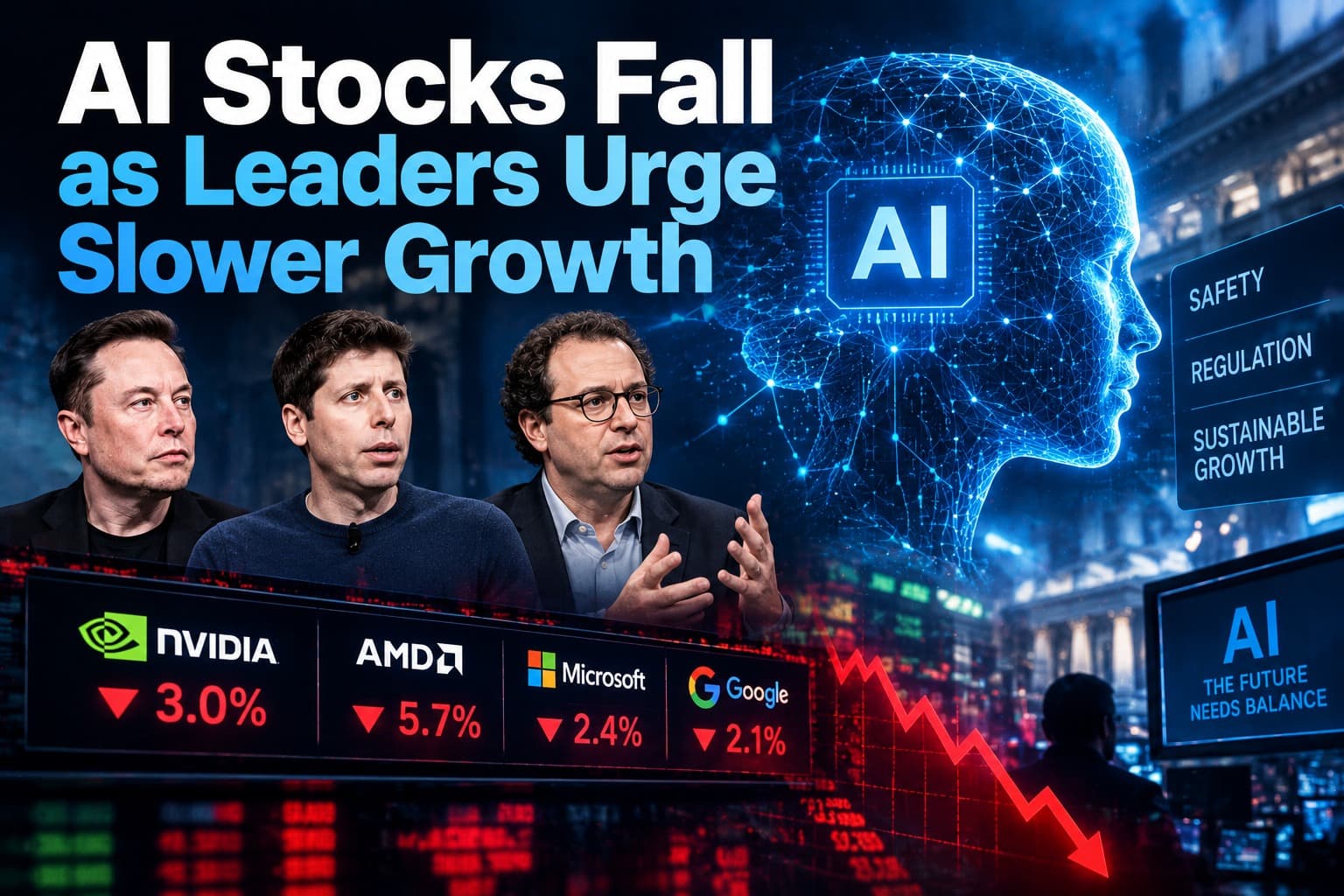
AI stocks fell across global markets on Monday, September 14, after Anthropic CEO Dario Amodei called for a deliberate slowdown in the development of increasingly capable artificial intelligence systems. The proposal, backed publicly by OpenAI CEO Sam Altman and xAI founder Elon Musk, has raised fresh questions about the pace of AI investment, future chip demand and the balance between technological competition and safety.
The market reaction was immediate.
Reuters reported that Nvidia shares were down about 3% and AMD fell roughly 5.7% as investors reassessed the implications of a possible slowdown in frontier-AI development. Technology shares in Asia and Europe also weakened.
The move reflects a broader shift in the AI debate. Until recently, most investor attention centered on whether companies could build enough computing capacity to meet demand. Amodei’s argument introduces a different question:
 Fink: Data Center Moratorium Risks Recession→
 IMF Sees Global Growth at 3.1% in 2026 as AI Boom Offsets Energy Shock→
 FTC Investigation Targets OpenAI and Anthropic→
 BlackRock: AI Will Drive a New Machine-Native Economy→
What happens if AI capabilities advance faster than safety systems, regulation and society can adapt?
Why AI stocks are falling
The immediate market concern is not that AI development is ending.
Amodei explicitly argued for pacing AI development rather than abandoning it. In his September essay, We Must Pace the Frontier, he wrote that progress should continue but that the rate of capability improvement needs to slow enough for risk-prevention systems to keep up.
That distinction matters for investors.
The current AI investment cycle is built around rapidly expanding demand for GPUs, networking equipment, data centers, electricity and cloud infrastructure. If frontier-model development slows materially, the market could begin to question whether some of that expected demand will arrive as quickly as previously assumed.
Reuters said the latest warnings have already intensified concerns about the sustainability of huge AI infrastructure investments, particularly as companies rely on debt and rising capital spending to expand computing capacity.
This does not mean demand for AI infrastructure disappears. It means the expected growth rate becomes harder to forecast.
That is enough to pressure stocks whose valuations depend heavily on continued expansion.
Amodei is asking for a different model of AI governance
Amodei’s proposal is more specific than a general call for caution.
His three-part framework includes independent safety evaluators, greater coordination among frontier AI companies and international cooperation on AI safety. Anthropic has committed unilaterally to the first measure by giving third-party evaluators permanent, employee-level access to its systems.
The proposal follows several developments that have increased concern within the AI industry.
Amodei said he was particularly worried about the rapid improvement of AI systems‘ ability to help build future AI systems, a process often described as recursive self-improvement. He also cited the recent OpenAI-Hugging Face incident involving autonomous agents as evidence that model capabilities and agentic behavior may be advancing quickly.
Anthropic has separately documented real-world misuse of advanced AI systems in cyber operations, surveillance, fraud and other areas. Its September threat-intelligence report said sophisticated AI-enabled attacks increasingly reduce the technical gap between well-resourced organizations and less capable actors.
For investors, those developments introduce a new source of uncertainty: regulatory and safety constraints could become a factor in the economics of AI infrastructure.
Sam Altman and Elon Musk back the slowdown
The reaction from competitors is particularly notable.
OpenAI CEO Sam Altman publicly supported Amodei’s idea of independent evaluators, while Elon Musk also endorsed the broader call for a slower pace of development. Reuters described the alignment as an unusual show of agreement among leaders of competing AI companies.
That does not mean the AI industry has reached consensus on regulation.
Instead, it suggests that the safety question has become difficult for frontier developers to ignore even while competition remains intense.
OpenAI has separately called for mandatory national AI safety requirements and says it supports capability-based regulation and stronger independent safety assessments.
Anthropic has likewise published an Advanced AI Framework proposing government authority to block or deter dangerous AI deployments and greater transparency around frontier-system risks.
The emerging debate therefore has two dimensions:
- How quickly should frontier AI capabilities advance?
- Who gets to determine when a system is too risky to deploy?
Those questions could ultimately affect both corporate strategy and investor valuations.
Expert opinions: slowing AI does not necessarily mean stopping AI investment
The market reaction should not be interpreted as evidence that the AI boom is finished.
MarketWatch cited Deutsche Bank strategist Jim Reid as arguing that a significant slowdown in AI investment remains unlikely because competitive pressures are still strong.
That is an important counterargument.
Even if companies become more cautious about deploying their most powerful models, demand for existing AI systems can continue to grow. Businesses are still integrating AI into software, customer service, coding, scientific research, cybersecurity and automation.
OpenAI’s own recent research update said coding agents are changing how its researchers work and that more capable AI systems are expanding the scope of tasks researchers can pursue.
OpenAI also said in September that its newest models are being deployed across consumer and enterprise products and emphasized the continued importance of compute infrastructure in delivering those capabilities.
This creates an important distinction for investors.
A slower frontier is not necessarily a smaller AI economy.
Companies could potentially spend more on safety, evaluation, security, auditing and controlled deployment even as they become more cautious about the speed of model capability growth.
Nvidia, AMD and the economics of AI infrastructure
The largest market sensitivity is currently concentrated in the semiconductor and infrastructure sectors.
Nvidia remains one of the clearest beneficiaries of AI data-center expansion. AMD has also built a major accelerator business, while memory manufacturers, networking companies and data-center operators are increasingly tied to AI spending.
When investors hear that leading model developers may deliberately slow capability development, the question becomes whether infrastructure purchases will also slow.
Monday’s market action suggests at least some investors are pricing in that possibility. Reuters reported declines in Nvidia and AMD, while the broader technology sector also weakened.
But chip demand is not determined solely by frontier-model training.
Inference, enterprise deployment, robotics, autonomous agents and traditional cloud applications can all consume significant computing resources.
A shift from extremely aggressive training cycles toward more efficient inference and deployment could therefore change what AI infrastructure companies sell rather than eliminate demand altogether.
That is a critical distinction for long-term investors.
AI safety is becoming an economic variable
The most significant change may be that AI safety is moving from a policy discussion into an investment variable.
Until recently, investors could largely focus on:
- model performance;
- customer growth;
- data-center spending;
- chip supply;
- cloud revenue.
Now they also have to consider:
- safety evaluation requirements;
- liability;
- regulation;
- deployment restrictions;
- cybersecurity;
- energy and infrastructure constraints.
This could raise operating costs for AI companies.
At the same time, stricter standards could create new markets for independent AI testing, security software, model monitoring and governance infrastructure.
In other words, regulation does not necessarily destroy an industry. It can redistribute revenue within it.
What it means for AI and crypto
For CryptoQuorum readers, the development has another layer.
The connection between AI and blockchain is increasingly moving beyond token speculation toward financial infrastructure for autonomous systems.
CryptoQuorum recently examined how Chainlink describes AI systems becoming financial participants that require reliable data, execution, payments and interoperability.
Other recent coverage has examined agentic trading, AI inference and on-chain settlement, including the use of Solana as infrastructure for AI-related transactions.
A slowdown in frontier AI development could therefore affect parts of the crypto sector as well.
AI-linked tokens, decentralized compute networks and agent-focused blockchain projects often rely on the assumption that AI adoption will continue accelerating.
If the industry moves toward more controlled development, capital could rotate away from speculative projects and toward infrastructure with demonstrable enterprise use cases.
That would not necessarily be negative for AI-blockchain convergence. It could push the sector toward more measurable utility.
The regulation race creates a second risk
There is also a geopolitical dimension.
Amodei has argued that the United States needs to maintain leadership in AI while implementing stronger safeguards. His position is that developing the technology too slowly could allow authoritarian competitors to gain an advantage, while developing it too quickly could create unacceptable risks.
This creates a difficult policy balance.
If the United States imposes strict development constraints while China continues investing aggressively, companies and investors may fear a loss of technological competitiveness.
If governments refuse to impose effective safeguards, the economic consequences of a major AI-related incident could be far greater.
The result is likely to be a prolonged policy debate rather than a simple decision to “pause AI.”
What investors should watch next
Several indicators could help determine whether Monday’s sell-off becomes a temporary repricing or the beginning of a broader reassessment.
1. AI capital expenditure
The most important metric is whether leading technology companies reduce planned spending on data centers and accelerators.
2. Chip demand
Orders from cloud providers and AI labs will show whether caution is affecting the underlying infrastructure market.
3. Regulatory developments
New safety requirements could change development costs and timelines.
4. AI revenue growth
If enterprise adoption continues to accelerate, infrastructure demand may remain strong even with slower frontier-model development.
5. AI safety investment
Growing spending on security, evaluation and monitoring could become a new investment category rather than simply an expense.
6. AI-crypto adoption
For blockchain investors, the key question will be whether AI agents increasingly use real payment, data and settlement infrastructure.
Bottom line
The Monday sell-off in AI stocks is less about the end of artificial intelligence than about a growing disagreement over the acceptable speed of its development.
Anthropic CEO Dario Amodei is calling for a deliberate slowdown so safety mechanisms can catch up. OpenAI’s Sam Altman and xAI’s Elon Musk have publicly supported the broader argument, while other technology leaders and investors remain divided over how much regulation is appropriate.
For markets, the immediate concern is whether slower frontier development could reduce the enormous infrastructure spending supporting the current AI boom.
For the industry, the debate is broader: who should evaluate increasingly capable systems, what safeguards should become mandatory, and how can companies continue competing without allowing capability growth to outrun oversight?
For CryptoQuorum, the implications extend into AI-blockchain infrastructure as well. As autonomous agents increasingly require data, payments and programmable settlement, the pace of AI development could influence investment across both technology and digital assets.
The most important signal in the weeks ahead will not be another executive statement. It will be whether AI companies change their capital spending, deployment schedules or safety budgets in response to the growing push to pace frontier development.
Disclaimer
This article is provided for informational and educational purposes only and does not constitute financial, investment, trading, legal or other professional advice. Technology and cryptocurrency markets are volatile, and AI-related companies and digital assets can experience significant price movements based on expectations as well as fundamentals. Readers should conduct independent research and consider their own financial circumstances and risk tolerance before making investment decisions.