

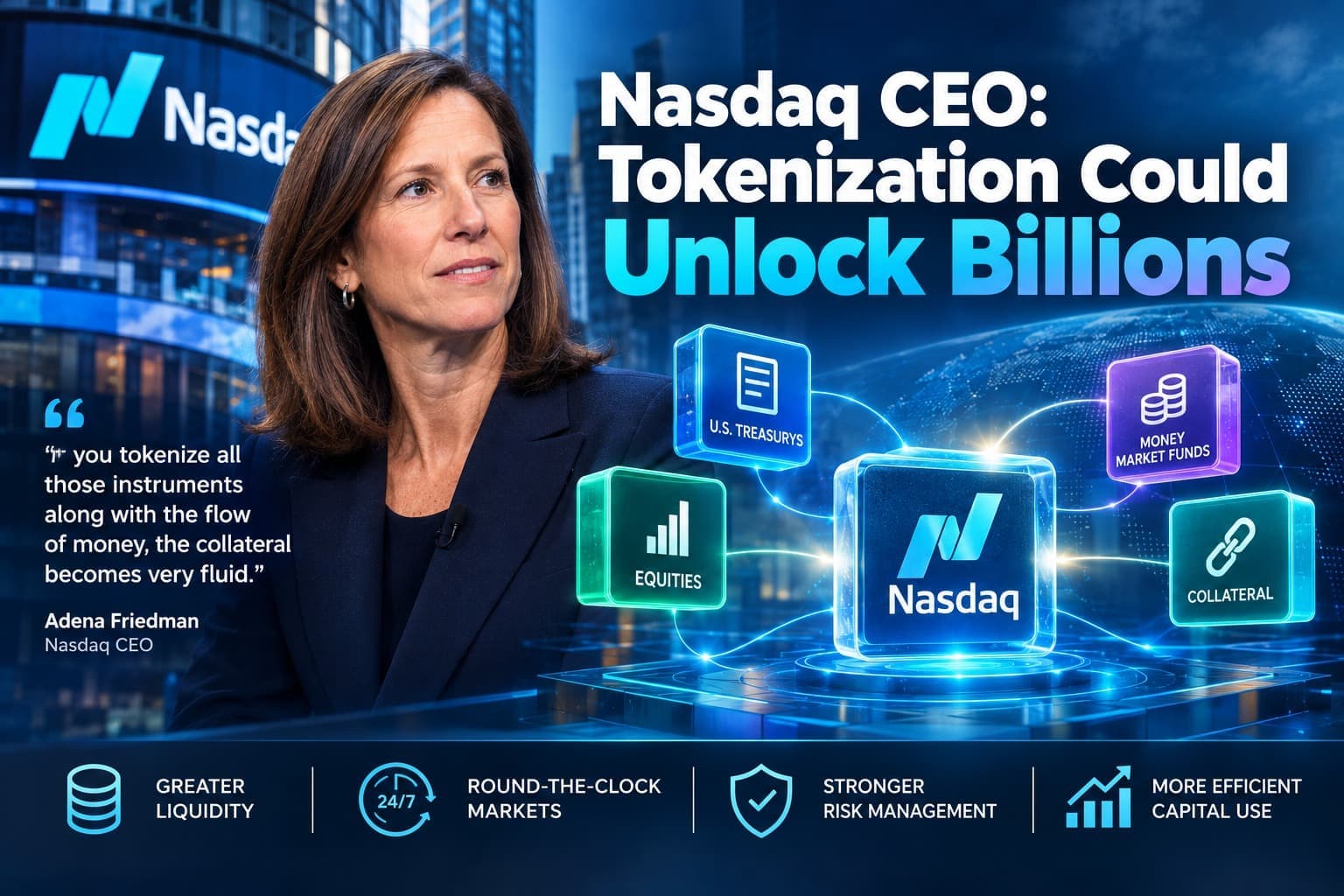
Nasdaq CEO Adena Friedman says blockchain-based financial infrastructure could release tens of billions of dollars currently tied up as collateral, as traditional markets move toward tokenized assets and potentially round-the-clock trading.
Speaking to CNBC’s Joanna Ossinger at TOKEN2049 in Singapore, Friedman pointed to U.S. Treasurys, equities and money market funds as assets that could become easier to move and reuse when represented digitally. Her argument goes beyond putting stocks on a blockchain: the bigger opportunity is making both financial assets and money programmable and transferable across modern market infrastructure.
“If you tokenize all those instruments along with the flow of money, then the collateral becomes very fluid,” Friedman told CNBC.
The comments highlight an increasingly important institutional use case for asset tokenization: improving collateral mobility and capital efficiency rather than simply creating blockchain versions of familiar securities.
 Securitize Brings Tokenized Stocks to Solana→
 Backpack Links Tokenized Stocks to Real Shares→
 Ondo Expands Intelligent Portfolios to Seven→
 Ondo and KakaoPay Securities Explore Global Distribution of Korean Equities→
Why Nasdaq sees billions locked in collateral
Collateral is fundamental to modern finance. Banks, broker-dealers, investment funds and other institutions post assets to support loans, derivatives positions and other financial obligations.
But collateral does not always move efficiently.
Assets can be held across different custodians, clearing systems, jurisdictions and trading venues. Transfers may depend on operating hours, reconciliation processes and settlement infrastructure that was designed long before blockchain networks existed.
Tokenization potentially changes that architecture by creating digital representations of assets that can be transferred through compatible networks.
Friedman argues that if both collateral assets and the money used to settle transactions become tokenized, institutions could move capital more fluidly instead of leaving assets immobilized while transactions clear through separate systems.
That does not mean tokenization automatically creates new economic value. Rather, the potential benefit comes from making existing assets more portable and reducing operational friction around settlement and collateral management.
Nasdaq has already moved beyond discussing that concept. In March 2026, the exchange operator announced an equity token design intended to preserve issuer rights, regulatory protections and governance while integrating tokenized equities into existing market infrastructure.
From tokenized money to tokenized capital
One important part of Friedman’s argument is the relationship between digital money and digital securities.
Stablecoins have demonstrated that value can move continuously across blockchain networks. The next institutional question is whether securities and other forms of collateral can move with similar flexibility while retaining legal ownership rights and regulatory protections.
“If we can tokenize money, then we can tokenize the flow of capital,” Friedman said during the CNBC interview.
She linked rising institutional interest partly to greater regulatory clarity around stablecoins in the United States.
But securities introduce more complex issues than payments alone. Stocks, bonds and fund interests can involve shareholder rights, corporate actions, regulatory reporting, custody obligations and investor-protection requirements.
The SEC emphasized that distinction in its January 2026 Statement on Tokenized Securities. The agency’s staff explained that a security does not cease to be a security simply because ownership is recorded through a crypto network.
That principle is crucial for institutional adoption: changing the technology does not eliminate the legal framework surrounding the underlying asset.
Nasdaq is building its own tokenization strategy
Friedman’s comments also fit Nasdaq’s broader strategy.
Nasdaq announced in March that it plans to develop an issuer-centric framework for tokenized equities. Instead of treating blockchain-based stocks as detached representations of conventional shares, the proposed architecture would integrate blockchain records with an issuer’s official share registry.
Nasdaq says a token transfer under this model would represent a transfer of the underlying security itself, preserving legal and regulatory equivalence.
The exchange operator has also been working with Payward, the parent company of Kraken and infrastructure provider behind xStocks, on an equities transformation gateway connecting permissioned traditional markets with blockchain environments.
In September, Nasdaq announced an agreement for Nasdaq Ventures to invest $100 million in Payward as the companies deepen their collaboration around tokenized equities, always-on markets and financial infrastructure.
For readers following the development of blockchain-based equities, CryptoQuorum recently examined how Securitize brought tokenized U.S. stocks to Solana, another example of traditional securities infrastructure moving closer to public blockchain networks.
The SEC is opening another path
Regulatory developments are also moving quickly.
In September 2026, the SEC granted a temporary conditional Innovation Exemption designed to facilitate limited trading of tokenized National Market System stocks through qualifying Tokenized Securities Venues.
Those venues may use permissioned automated market makers and liquidity pools under specified conditions.
SEC Commissioner Mark Uyeda said at the time that tokenization could modernize issuance, trading, transfers, settlement and ownership records while potentially reducing costs and expanding liquidity.
The development is significant because it suggests U.S. regulators are increasingly examining how blockchain infrastructure can coexist with established securities law rather than treating tokenized securities as an entirely separate asset class.
CryptoQuorum previously analyzed the SEC’s tokenized-stock Innovation Exemption, including what the framework could mean for onchain securities markets.
24/7 markets create a much harder problem
Friedman also addressed one of the biggest consequences of moving traditional assets onchain: markets may eventually be expected to operate continuously.
Crypto markets have accustomed retail investors to trading at virtually any hour. Traditional securities markets operate differently, with defined trading sessions and operational windows that allow institutions to perform reconciliation, risk calculations and collateral management.
Friedman said retail markets have been ahead of institutions in demanding continuous access.
Moving major securities markets toward 24/7 operation, however, involves much more than keeping an exchange matching engine running overnight.
Banks, brokers, custodians, clearing organizations and risk systems would also need to function continuously.
“Everything has to be real time all the time,” Friedman said.
That means collateral calculations, liquidity monitoring and risk controls would need to operate when there is no conventional overnight window for institutions to reconcile positions.
Artificial intelligence could play a role in automating some of those processes, but the transition introduces operational and regulatory questions that cannot be solved by blockchain alone.
Why collateral may be more important than tokenized stocks
Retail discussion around tokenization often focuses on the ability to buy blockchain-based versions of Apple, Nvidia or Tesla shares.
For institutional markets, collateral may ultimately represent a much larger structural opportunity.
Tokenized Treasurys, money market funds and equities could potentially move between trading, lending and financing environments more efficiently. If interoperable infrastructure develops, institutions could reposition eligible collateral without relying on multiple disconnected settlement processes.
This is where Friedman’s “tens of billions” argument becomes relevant.
The potential value is not simply that an asset exists as a token. It is that the token can potentially move through a financial system with fewer operational barriers while maintaining enforceable ownership rights and appropriate regulatory controls.
That distinction separates meaningful financial infrastructure from tokenization performed primarily for marketing purposes.
CryptoQuorum’s guide to real-world asset tokenization explains how blockchain representations can connect traditional financial assets with onchain markets.
Tokenization still faces major constraints
Despite growing institutional momentum, significant challenges remain.
Interoperability is one. A tokenized security that works efficiently inside one blockchain or permissioned network may offer limited benefits if it cannot interact with other trading, custody and settlement systems.
Liquidity is another. Digitizing an asset does not automatically create buyers and sellers.
Legal rights also matter. Different tokenization structures can give investors very different claims on underlying securities. Some represent direct ownership, while others provide contractual or beneficial interests.
Cybersecurity, wallet management, identity verification, settlement finality and regulatory compliance add further complexity.
And 24/7 trading creates its own risks. Continuous markets may improve accessibility, but thinner liquidity during certain hours could increase volatility or produce weaker price discovery.
A broader transformation of market infrastructure
Friedman’s comments illustrate how the institutional tokenization debate has evolved.
The question is increasingly not whether stocks or bonds can technically exist on a blockchain. Multiple platforms have already demonstrated that they can.
The more consequential question is whether asset tokenization can integrate trading, money, collateral, settlement and ownership into infrastructure capable of operating continuously while maintaining the protections expected in regulated markets.
Nasdaq is positioning itself directly inside that transition.
If tokenized securities, tokenized cash and interoperable settlement systems develop together, capital that currently remains immobilized during parts of the trading and settlement process could potentially move more efficiently.
Whether that ultimately releases tens of billions of dollars will depend on adoption, regulation, interoperability and market structure.
But when the CEO of one of the world’s largest exchange operators frames tokenization primarily as a collateral and capital-efficiency technology, it signals that the institutional conversation has moved well beyond crypto experimentation.
Disclaimer: This article is for informational purposes only and does not constitute investment, financial or legal advice. Tokenized securities involve regulatory, technological, liquidity and market risks. Investors should evaluate the legal structure and rights associated with any tokenized financial product before investing.