

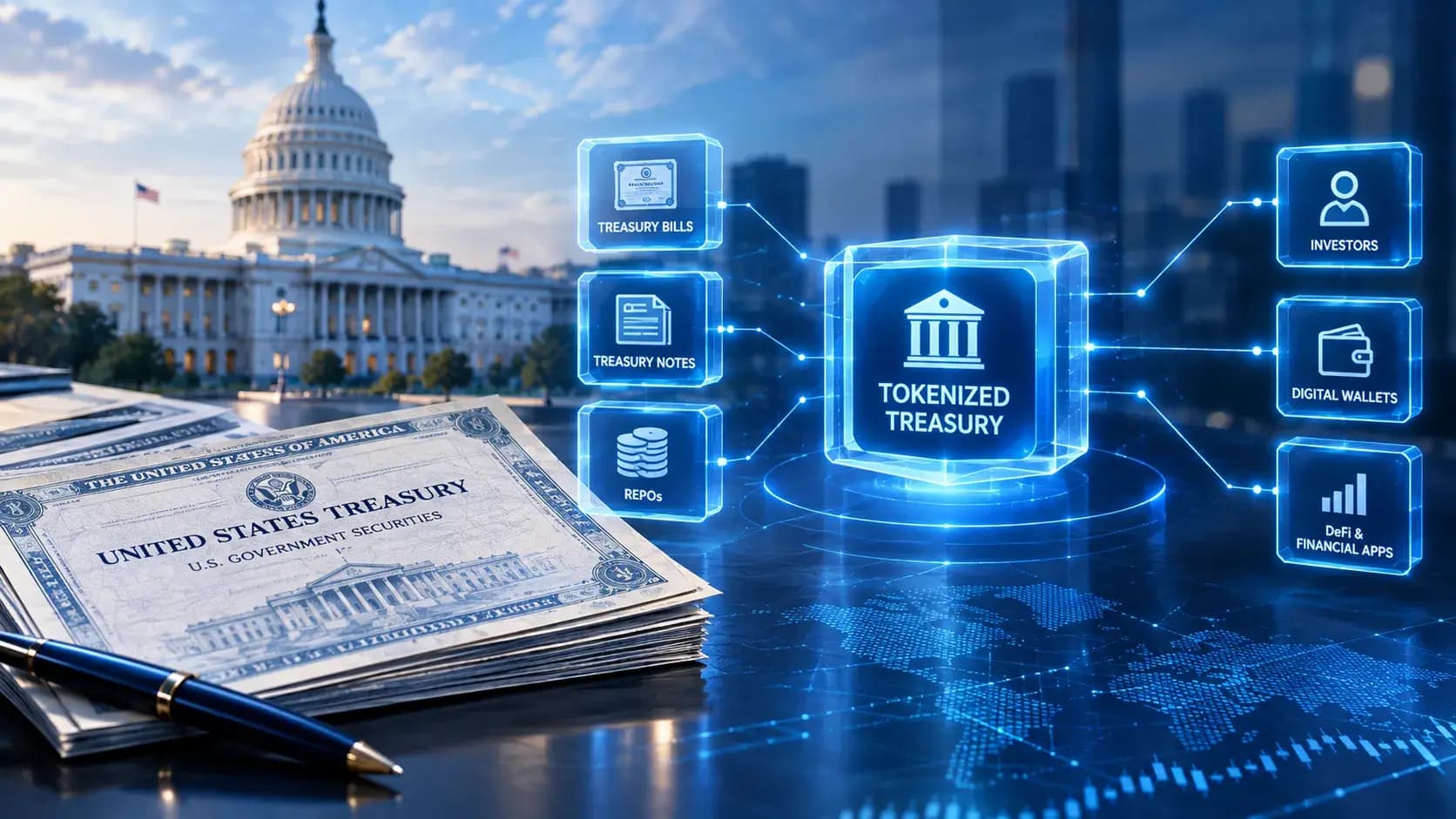
Tokenized U.S. Treasuries bring one of the world’s largest traditional financial markets onto blockchain infrastructure. Instead of changing the economics of government debt, tokenization changes how exposure to Treasury securities can be issued, recorded, transferred and potentially used across digital financial markets.
But a “tokenized Treasury” does not always mean that an investor directly owns a U.S. Treasury security.
Some products are shares in regulated funds that hold government securities. Others represent interests in special-purpose vehicles or assets held by custodians. The legal structure determines what the token holder actually owns, how yield is distributed and what happens if an intermediary fails.
This guide explains how tokenized U.S. Treasuries work, where their yield comes from, how they differ from stablecoins and traditional Treasury securities, and what investors should understand before using them.
 JPMorgan Brings Tokenized Money Market Funds to Solana→
 What Is Asset Tokenization and How Does It Work?→
 VersaBank Brings Tokenized Deposits to the U.S.→
 Ripple, Meritz Bring Tokenization to Korea→
What Are Tokenized U.S. Treasuries?
Tokenized U.S. Treasuries are blockchain-based digital representations of U.S. government securities or financial products backed by or invested in Treasury securities.
The underlying exposure can include instruments such as:
- U.S. Treasury bills;
- Treasury notes;
- government money market instruments;
- repurchase agreements backed by government securities;
- shares in funds holding Treasury securities and related assets.
The token acts as the digital layer through which an investor’s interest can be recorded or transferred.
However, the precise meaning of the token varies from product to product.
One token could represent a share in a regulated investment fund. Another could represent a contractual or beneficial interest in assets held through a separate legal entity.
That distinction matters because tokenization changes the infrastructure, not necessarily the underlying investment.
For a broader explanation of this process, see our guide to asset tokenization and how it works.
How Do Tokenized Treasuries Work?
Although individual products use different legal and technical structures, a simplified tokenized Treasury model can be represented as:
Investor capital → issuer or fund → U.S. Treasuries → custodian → blockchain token → investor wallet
The process generally involves several layers.
1. Investors Provide Capital
An eligible investor subscribes to a tokenized Treasury product using cash, a bank transfer or, in some structures, digital assets such as stablecoins.
Identity and compliance checks may be required before an investor can participate.
Institutional or securities-based products can restrict access according to jurisdiction, investor status and applicable securities laws.
2. The Issuer Acquires Treasury Assets
The fund, issuer or underlying investment vehicle allocates capital to U.S. government securities or other assets permitted by the product’s mandate.
For example, a short-duration product may hold Treasury bills and repurchase agreements rather than longer-maturity Treasury bonds.
This distinction affects duration, yield and interest-rate exposure.
3. The Assets Are Held or Recorded Through Regulated Infrastructure
Traditional financial infrastructure does not disappear simply because the investor receives a blockchain token.
Banks, custodians, broker-dealers, transfer agents, fund administrators or other regulated entities may remain involved.
The underlying Treasury securities can therefore remain within conventional custody and settlement systems while the investor-facing ownership or entitlement is represented onchain.
4. Tokens Are Issued
Once a subscription is accepted, tokens can be issued to an eligible blockchain address.
Depending on the structure, the token may represent:
- a fund share;
- a beneficial interest;
- an entitlement connected to assets held in custody;
- another legally defined financial claim.
The smart contract can also enforce restrictions governing who may receive or transfer the token.
5. Treasury Income Generates Yield
The blockchain itself does not generate Treasury yield.
The yield comes from the underlying financial assets.
If the portfolio holds Treasury bills yielding interest or discount income, that income flows into the fund or investment structure.
Depending on the product, returns can then be reflected through:
- an increasing token value;
- additional tokens;
- cash distributions;
- reinvestment within the fund.
This is an important distinction between tokenized Treasuries and crypto-native yield mechanisms.
6. Investors Can Redeem Their Tokens
Eligible holders may be able to redeem tokens according to the product’s terms.
A simplified process looks like:
Token holder → redemption request → token cancellation/burning → underlying liquidity → cash or other settlement asset
Redemption rules differ across products.
Some products may offer frequent subscriptions and redemptions, while others can impose minimum amounts, operating-hour restrictions, eligibility requirements or settlement delays.
Do Token Holders Actually Own U.S. Treasuries?
Not necessarily.
This is one of the most important distinctions in the tokenized Treasury market.
Imagine that a fund owns $100 million of Treasury bills and issues blockchain-based shares to investors.
The fund owns the securities.
The investor owns shares in the fund.
Those are not the same legal position.
A simplified structure would be:
Investor → tokenized fund share → fund → Treasury securities
The investor has economic exposure to the portfolio through the fund but does not necessarily own a specific Treasury bill held by that fund.
Other tokenization structures can create different rights.
Before evaluating a product, investors should determine:
- who legally owns the underlying securities;
- what exactly the token represents;
- who holds the assets in custody;
- whether the token is a security;
- how redemptions work;
- what rights investors have if the issuer or another intermediary fails.
The token’s name alone does not answer these questions.
Where Does the Yield Come From?
Tokenized Treasury yield ultimately originates from the underlying portfolio.
U.S. Treasury bills are short-term government securities generally sold at a discount to their face value. The difference between the purchase price and the amount received at maturity contributes to the investor’s return.
A tokenized fund may also hold other permitted short-term government instruments or repurchase agreements.
Suppose, purely as a simplified example, that an underlying portfolio generates an annualized gross yield of 4%.
The investor’s net return may be lower after:
- management fees;
- administrative expenses;
- custody costs;
- transaction costs;
- other product-specific charges.
Therefore:
Underlying Treasury yield ≠ guaranteed token holder yield
The blockchain does not create additional risk-free return simply because the security has been tokenized.
Tokenized Treasuries vs Traditional Treasuries
The underlying economic exposure can be similar, but the market infrastructure differs.
| Traditional Treasuries | Tokenized Treasury Products |
|---|---|
| Held through traditional brokerage or custody systems | Investor interest can be represented onchain |
| Transfers use conventional financial infrastructure | Transfers may use blockchain networks |
| Settlement follows traditional market processes | Some processes can potentially be automated |
| Ownership recorded through conventional systems | Token can form part of digital ownership or entitlement records |
| Usually difficult to integrate directly with DeFi | May interact with compatible blockchain applications |
| Access determined by broker and market structure | Access determined by issuer, platform, wallet and compliance rules |
Tokenization therefore should not be interpreted as creating a new type of U.S. government debt.
It creates a different technological and operational framework around existing financial assets or investment products.
Tokenized Treasuries vs Stablecoins
Tokenized Treasuries and stablecoins are sometimes grouped together because both can represent dollar-denominated value on blockchain networks.
But they serve different purposes.
A typical dollar stablecoin is designed primarily to maintain a stable value around $1 and function as a digital payment or settlement asset.
A tokenized Treasury product is primarily an investment asset designed to provide exposure to yield-generating government securities or a fund holding those securities.
| Stablecoin | Tokenized Treasury |
|---|---|
| Designed for stable transactional value | Designed primarily as an investment |
| Usually targets $1 | Value depends on product structure |
| Holder may not receive reserve yield | Investor may receive portfolio returns |
| Commonly used for payments and settlement | Commonly used for yield, treasury management or collateral |
| Reserve structure varies by issuer | Underlying portfolio is defined by investment structure |
The distinction is becoming increasingly important as stablecoins and tokenized securities begin to operate within the same blockchain-based financial infrastructure.
Why Put U.S. Treasuries on a Blockchain?
Treasuries already have highly developed traditional markets, so the case for tokenization is not simply that blockchain makes the asset itself better.
The potential value comes from changing how the asset can interact with other financial infrastructure.
Programmable Ownership and Transfers
Smart contracts can incorporate transfer restrictions, eligibility requirements and other rules directly into token infrastructure.
This can reduce the need to enforce every rule through separate systems.
Faster Movement of Assets
A tokenized security can potentially move between eligible blockchain addresses more efficiently than an asset that must pass through multiple disconnected databases.
Actual settlement speed, however, still depends on the product’s legal and operational structure.
Fractional Access
Tokenized structures can support smaller units of ownership.
This can reduce technical minimum sizes, although legal and platform requirements may still limit access.
Collateral
One of the most significant institutional use cases is collateral.
Treasury securities are already widely used as high-quality collateral in traditional markets.
Representing Treasury-related assets onchain could make it easier to move eligible collateral between compatible digital platforms.
Regulators are already examining how tokenized collateral and onchain records fit within existing financial frameworks.
Integration With DeFi
Tokenized Treasury products can potentially be integrated into decentralized financial applications.
For example, an eligible token could theoretically be used as collateral in lending or liquidity infrastructure.
This creates an important bridge between traditional yield-bearing assets and blockchain-native markets.
However, using a Treasury-backed token inside DeFi introduces additional smart-contract, protocol, oracle and liquidity risks beyond those associated with the underlying Treasury portfolio.
Examples of Tokenized Treasury Infrastructure
The market includes several different models rather than one standardized product structure.
BlackRock BUIDL
BlackRock’s USD Institutional Digital Liquidity Fund, commonly known as BUIDL, is one prominent institutional example of a tokenized fund structure.
The fund invests primarily in cash, U.S. Treasury bills and repurchase agreements while allowing investors to hold fund interests through blockchain-based infrastructure.
Its significance goes beyond a single product: it demonstrates how a major traditional asset manager can combine conventional securities, custody and fund administration with public blockchain technology.
Franklin Templeton
Franklin Templeton has also been an early participant in blockchain-based fund infrastructure.
Its Franklin OnChain U.S. Government Money Fund uses blockchain technology as part of its recordkeeping system, demonstrating another model for connecting regulated investment funds with public blockchain networks.
Ondo Finance
Ondo has developed blockchain-based products providing eligible investors with exposure to traditional yield-bearing assets, including U.S. government securities.
Its products illustrate how tokenized Treasuries can increasingly interact with crypto-native wallets, stablecoins and onchain financial infrastructure.
These examples should not be treated as interchangeable.
Each product can differ in legal structure, eligibility, custody, fees, liquidity, redemption terms and blockchain support.
Which Blockchains Are Used for Tokenized Treasuries?
Tokenized financial products increasingly operate across multiple blockchain networks rather than being limited to one ecosystem.
Networks used across the broader RWA market include:
- Ethereum;
- Solana;
- Stellar;
- Avalanche;
- Polygon;
- Arbitrum;
- other public and permissioned networks.
The choice of blockchain can affect transaction costs, settlement speed, interoperability, available liquidity and integration with other applications.
However, blockchain selection is only one part of the product.
For institutional assets, the legal structure, custody model and redemption mechanism are generally more important than raw blockchain transaction speed.
Can Tokenized Treasuries Trade 24/7?
Blockchain networks operate continuously, but that does not automatically mean the underlying financial product has unrestricted 24/7 liquidity.
A token might technically be transferable at any time while subscriptions, redemptions or underlying asset transactions still depend on:
- banking hours;
- traditional securities markets;
- transfer-agent processes;
- compliance checks;
- issuer operating hours.
This creates an important distinction between 24/7 blockchain transferability and 24/7 underlying market liquidity.
If traditional Treasury markets are closed, an issuer may not always be able to immediately create, redeem or rebalance positions even though the blockchain continues processing transactions.
What Are the Risks of Tokenized U.S. Treasuries?
U.S. government securities are often considered among the lowest-credit-risk financial assets, but tokenizing them introduces additional layers of risk.
Interest-Rate Risk
Treasury prices can change when market interest rates move.
Short-duration Treasury bills generally have less interest-rate sensitivity than longer-duration securities, but the risk is not zero.
Issuer and Counterparty Risk
The token holder may depend on a fund manager, issuer, custodian, administrator, broker or other intermediary.
A failure at one of these layers can create risks unrelated to the creditworthiness of the U.S. government.
Legal Structure Risk
A token representing a fund share is legally different from direct ownership of a Treasury security.
Investors should understand their position in the ownership chain.
Liquidity Risk
Blockchain transferability does not guarantee a deep secondary market.
A token may have limited buyers even if the underlying Treasury securities themselves are highly liquid.
Redemption Risk
Redemption can depend on the issuer, banking infrastructure and traditional market operating hours.
Stress conditions can make this especially important.
Smart-Contract Risk
A vulnerability in token infrastructure could disrupt transfers or other functionality even if the underlying Treasury assets remain secure.
Blockchain Risk
Congestion, network outages, transaction costs or other technical issues can affect the blockchain layer supporting a token.
DeFi Risk
When a tokenized Treasury is deposited into a lending protocol, liquidity pool or other DeFi application, investors take on the additional risks of that protocol.
The safety characteristics of the underlying Treasury do not automatically extend to every smart contract built around it.
Are Tokenized Treasuries Real-World Assets?
Yes. Tokenized U.S. Treasuries are one of the clearest examples of real-world assets (RWA).
The underlying economic value originates outside the blockchain from traditional government securities.
Blockchain technology provides the digital infrastructure through which the resulting financial interest can be issued, recorded, transferred or integrated with other applications.
The relationship can be summarized as:
U.S. Treasury securities → fund or legal structure → tokenization → blockchain token → investor
This makes tokenized Treasuries an important bridge between traditional capital markets and onchain finance.
Are Tokenized Treasuries the Same as RWA Tokens?
Not necessarily.
The term “RWA token” is often used broadly across crypto markets.
A cryptocurrency associated with an RWA protocol does not automatically represent ownership of real-world assets.
A governance token for a tokenization platform, for example, can gain or lose value based on crypto-market demand without giving its holder a legal claim on any Treasury securities.
By contrast, a tokenized Treasury product should have a defined legal and economic relationship with an underlying investment structure.
Investors should therefore distinguish between:
tokens representing RWA-related financial interests
and
crypto tokens associated with RWA protocols or ecosystems.
They are not the same thing.
Why Tokenized Treasuries Matter for Onchain Finance
Tokenized Treasuries solve an important structural problem for blockchain markets: how to bring traditional yield-bearing financial assets into programmable digital infrastructure.
Crypto markets historically relied heavily on stablecoins as the bridge between fiat currencies and blockchain networks.
Tokenized Treasuries add another layer.
Instead of holding only a dollar-like settlement asset, eligible market participants can potentially hold an onchain instrument connected to traditional interest-bearing securities.
This can create a financial stack in which:
stablecoins provide settlement → tokenized Treasuries provide yield-bearing assets → smart contracts provide financial applications
If these layers become interoperable, tokenized government securities could play an important role in institutional onchain markets, collateral systems and blockchain-based treasury management.
Frequently Asked Questions
What is a tokenized U.S. Treasury?
A tokenized U.S. Treasury is a blockchain-based token representing a Treasury security, a fund share or another financial interest connected to U.S. government debt. The exact legal rights depend on the structure of the product.
Do tokenized Treasuries pay interest?
Tokenized Treasury products can provide returns derived from the underlying Treasury securities or other eligible assets. How those returns reach investors depends on the product’s structure, fees and distribution mechanism.
Are tokenized Treasuries the same as Treasury bills?
No. Some products hold Treasury bills, but the investor may own a tokenized fund share or another entitlement rather than an individual Treasury bill directly.
Are tokenized Treasuries stablecoins?
No. Stablecoins are generally designed as payment and settlement assets that maintain a stable value, while tokenized Treasury products are investment instruments designed to provide exposure to yield-bearing securities.
Can tokenized Treasuries be used in DeFi?
Some tokenized Treasury products can potentially interact with compatible DeFi protocols. Doing so introduces additional smart-contract, liquidity, oracle and protocol risks beyond those of the underlying Treasury assets.
Can tokenized Treasuries trade 24/7?
Blockchain tokens may be technically transferable around the clock, but subscriptions, redemptions and underlying market liquidity can still depend on banks, traditional securities markets and issuer operating procedures.
Are tokenized U.S. Treasuries safe?
The underlying U.S. government securities have a different risk profile from many crypto assets, but tokenized products introduce additional issuer, custody, legal, liquidity, smart-contract, blockchain and counterparty risks.
The Bottom Line
Tokenized U.S. Treasuries combine traditional government securities with blockchain-based financial infrastructure.
Their most important innovation is not the creation of a new form of Treasury debt. It is the ability to represent Treasury-related investment interests on programmable networks where they can potentially move between wallets, interact with digital settlement assets and serve as collateral.
But investors should look beyond the word “Treasury.”
A token can represent a fund share, beneficial interest or another financial claim rather than direct ownership of a specific government security.
The essential questions remain:
What does the token legally represent? Who owns and custodies the underlying securities? Where does the yield come from? How does redemption work?
Understanding those layers is critical because tokenization can change how an investment is issued, recorded and transferred — but it does not eliminate the risks of the underlying asset or the financial institutions surrounding it.
This article is for informational and educational purposes only and does not constitute investment, legal or financial advice.