

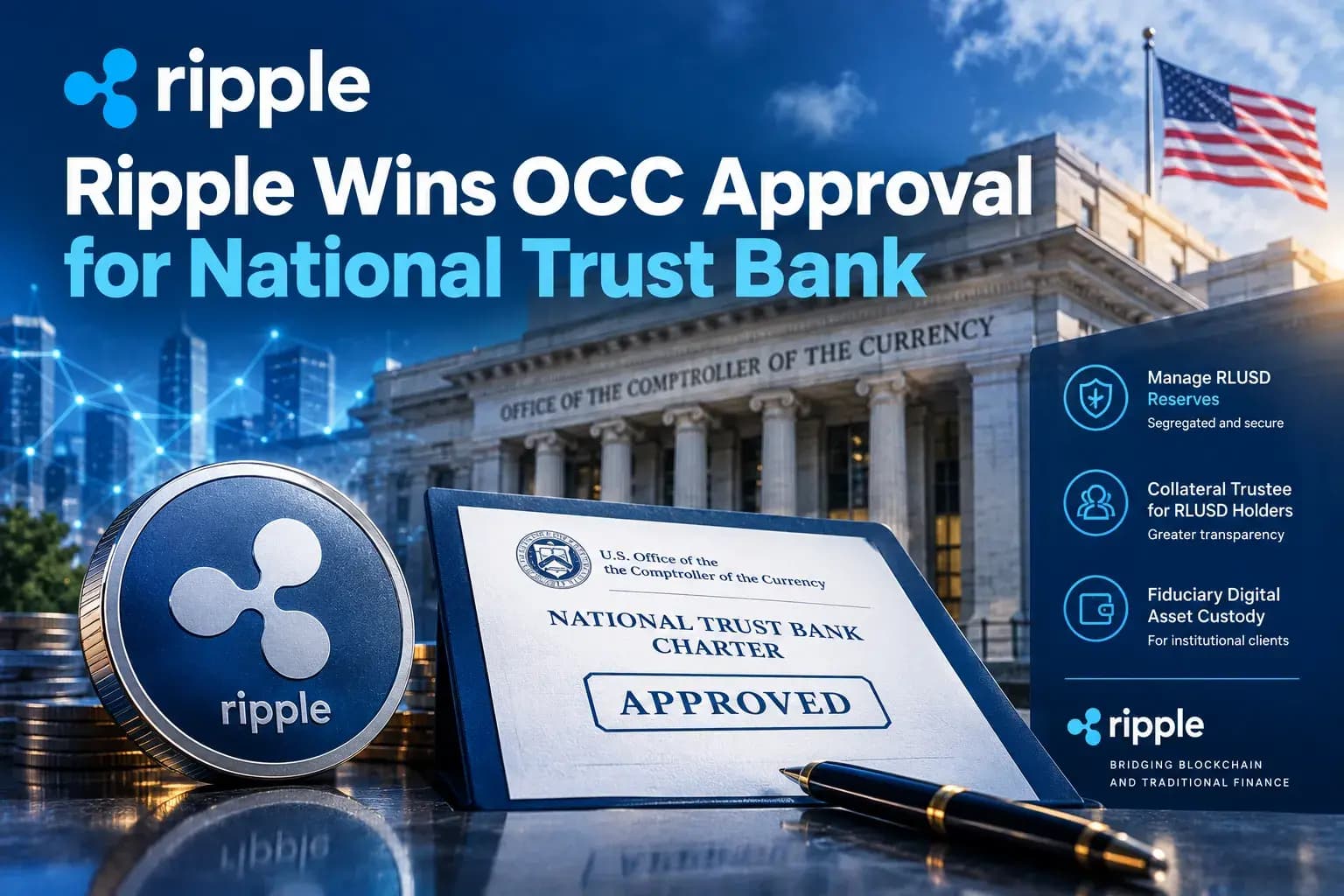
Ripple has received final approval from the U.S. Office of the Comptroller of the Currency to establish a federally supervised national trust bank, marking a major expansion of the crypto company’s regulated financial infrastructure in the United States.
The October 26 approval completes a process that began when the OCC granted preliminary conditional approval in December 2025. The new institution will manage segregated reserves supporting Ripple USD (RLUSD), act as collateral trustee for the benefit of RLUSD holders and provide fiduciary digital asset custody services.
BINANCE:XRPUSDT
The development gives Ripple a direct foothold inside the U.S. federal banking system at a time when stablecoins are moving deeper into payments, treasury management and institutional capital markets.
However, the charter does not turn Ripple into a conventional retail or commercial bank. The approved institution is a specialized national trust bank focused on trust, custody and related activities rather than traditional deposit-taking and lending.
 SEC examination priorities put tokenization on 2027→
 Tokenized U.S. Treasuries: How They Work→
 JPMorgan Brings Tokenized Money Market Funds to Solana→
 What Is Asset Tokenization and How Does It Work?→
Ripple Completes Its OCC Charter Process
The official Ripple announcement confirms that final OCC approval completes the organizational process that began with conditional approval in December 2025.
The distinction between conditional and final approval matters.
When the OCC initially approved Ripple’s application, the regulator required the proposed institution to meet a series of pre-opening requirements before it could receive authorization to commence business.
The OCC’s original decision also limited the institution to trust-company operations and related activities.
With those requirements now satisfied, Ripple has moved from a proposed federally chartered institution to an approved national trust bank.
The development represents a significant regulatory milestone for a company that built much of its business around blockchain payments, XRP Ledger infrastructure, stablecoins and institutional digital assets.
What Ripple National Trust Bank Will Actually Do
The approved business model is narrower than the word “bank” might suggest.
The institution’s central role will be supporting RLUSD and providing institutional custody.
According to Ripple, its approved activities include managing segregated reserves backing the stablecoin and serving as collateral trustee for those assets on behalf of RLUSD holders.
It will also provide fiduciary custody for digital assets.
The OCC’s earlier decision specifically authorized cryptocurrency custody in a fiduciary capacity and collateral trustee services.
That creates a federally supervised infrastructure layer connecting stablecoin reserves, custody and institutional digital assets.
It does not, however, give Ripple the same business model as JPMorgan Chase, Bank of America or another conventional commercial bank.
The OCC required the institution to limit its operations to those of a trust company and related activities.
RLUSD Remains Under a Dual Regulatory Structure
One of the most important details is what the charter does not change.
RLUSD will continue to be issued by Standard Custody & Trust Company, Ripple’s limited-purpose trust company regulated by the New York Department of Financial Services.
The new federal institution therefore does not replace the existing issuer.
Instead, it adds another regulatory layer.
Standard Custody remains responsible for issuance under New York supervision, while the federally supervised trust bank will manage reserves and perform collateral trustee and custody functions.
For institutional users, that separation could become an important part of Ripple’s stablecoin strategy.
Ripple says RLUSD is backed by U.S. dollar deposits, U.S. government securities and other cash equivalents. BNY acts as the primary reserve custodian, while independent third-party attestations are published monthly covering circulating supply and reserve assets.
Why the OCC Charter Matters for RLUSD
Stablecoin competition is increasingly becoming a competition over regulatory infrastructure as much as technology.
Institutional users need to evaluate more than transaction speed or blockchain support. Reserve quality, custody, redemption arrangements, regulatory oversight and counterparty structure can be critical when stablecoins are used for corporate treasury, collateral or payments.
The federal charter gives Ripple National Trust Bank direct OCC supervision.
That could strengthen Ripple’s institutional proposition as it attempts to expand RLUSD across payments and capital markets.
Brad Garlinghouse, Ripple’s CEO, described the approval as evidence of the company’s long-standing argument that crypto and banks can work together.
He said a national trust charter provides a stronger foundation for RLUSD and the company’s products across payments, custody and capital markets.
Garlinghouse’s comments represent Ripple’s own assessment and should be understood in that context. But the underlying regulatory change is concrete: reserve-management and institutional custody functions will now sit inside an OCC-supervised entity.
Expert View: OCC Opens the Door to Digital Asset Firms
The development also fits a broader shift in the OCC’s approach to financial innovation.
When the regulator conditionally approved Ripple and several other national trust bank applications in December 2025, Comptroller of the Currency Jonathan Gould argued that new entrants could increase competition and help the federal banking system keep pace with financial innovation.
More recently, Gould said companies engaged in legally permissible activities involving digital assets and other new technologies should have a path to becoming national banks.
That regulatory position is significant.
Rather than requiring digital-asset businesses to develop entirely outside existing banking structures, the OCC is signaling that qualifying companies can operate inside federally supervised frameworks if they satisfy chartering, risk-management and compliance requirements.
Ripple’s final approval is a practical example of that approach.
GENIUS Act Changes the Stablecoin Landscape
The timing is also notable because the U.S. stablecoin regulatory framework is entering a new phase.
The GENIUS Act established a federal framework for payment stablecoins, including rules involving permitted issuers, reserves, redemption, risk management, reporting and supervision.
The OCC published its final implementation rule in October 2026, with the framework scheduled to take effect on January 18, 2027.
The OCC’s GENIUS Act final rule covers reserve assets, redemption requirements, risk management, audits, custody and supervision of entities under its jurisdiction.
Ripple says it will continue working with both the OCC and NYDFS as its new trust bank begins operations and the GENIUS Act framework takes effect.
The convergence of these developments matters because stablecoins are increasingly moving from crypto-native trading instruments toward regulated payment and settlement infrastructure.
Digital Asset Custody Is the Other Major Opportunity
RLUSD may be the immediate focus, but the charter extends beyond Ripple’s stablecoin.
Once operational, the bank will also be authorized to provide fiduciary digital asset custody to enterprises.
Institutional custody has become strategically important as banks, asset managers, payment companies and corporations increase their exposure to tokenized assets and blockchain-based financial infrastructure.
Holding digital assets introduces risks that differ from traditional securities custody.
Private-key management, wallet infrastructure, cybersecurity, transaction authorization and blockchain-specific operational risks all require specialized controls.
Federal supervision does not eliminate those risks. It does, however, place the institution providing the service inside an established prudential oversight framework.
That could be particularly important for institutional clients that require regulated counterparties.
What Does the Charter Mean for XRP?
The OCC approval should also be separated from speculation about XRP.
The charter is directly tied to Ripple’s banking infrastructure, RLUSD reserve management and institutional custody business.
It does not make XRP a bank-issued asset, nor does it establish XRP as a reserve asset for RLUSD.
Ripple’s announcement does not identify XRP as a beneficiary of the charter.
There could be indirect strategic benefits if Ripple’s broader payments and digital-asset ecosystem expands, but those effects are different from the direct regulatory implications for RLUSD.
That distinction is important for investors because company-level regulatory progress does not automatically translate into a particular valuation outcome for a cryptocurrency associated with that company.
Ripple Joins a Broader Institutional Crypto Shift
Ripple’s approval is part of a wider movement toward federally supervised digital-asset infrastructure.
The OCC conditionally approved several crypto-related national trust bank applications in December 2025, including Ripple’s application, while also approving conversions involving BitGo, Fidelity Digital Assets and Paxos.
This trend overlaps with developments CryptoQuorum has been tracking across stablecoins, tokenized deposits and real-world assets.
Traditional financial institutions are experimenting with tokenized deposits, asset managers are putting money market funds and Treasuries on public blockchains, and regulated custody is becoming increasingly important as institutional assets move onchain.
Ripple’s strategy combines several of these trends: stablecoins, custody, payments and regulated institutional infrastructure.
Why This Matters for Institutional Crypto
For years, one of the main barriers to institutional crypto adoption has been the gap between blockchain technology and established financial regulation.
Large institutions generally require regulated custody, defined legal relationships, auditable reserves, risk-management systems and identifiable supervisory authorities.
The new charter addresses part of that infrastructure problem.
Instead of attempting to build a parallel financial system entirely outside banking regulation, Ripple is integrating blockchain products into existing state and federal frameworks.
Garlinghouse summarized the strategy by arguing that the financial transformation is increasingly happening within the existing system rather than outside it.
That statement is promotional, but it captures a broader market trend.
Stablecoins, tokenized funds, tokenized deposits and blockchain settlement systems are increasingly being developed by — or connected to — regulated financial institutions.
What Comes Next
Final approval does not mean every planned service becomes available immediately.
Ripple says it will continue working with the OCC, NYDFS and other regulators as the new institution begins operations.
The next developments to watch include the operational launch of the trust bank, the expansion of institutional custody services and the role RLUSD plays within Ripple’s payments and Ripple Prime infrastructure.
The implementation of the GENIUS Act in January 2027 will also be important.
Stablecoin issuers and service providers will increasingly operate within a clearer federal framework covering reserves, redemption, risk management and supervision.
That could raise compliance costs, but it may also reduce some of the regulatory uncertainty that has limited institutional adoption.
Bottom Line
Final OCC approval for Ripple National Trust Bank represents a meaningful change in Ripple’s U.S. regulatory position.
The company now has authorization to operate a federally supervised national trust bank focused on reserve management, collateral trustee services and fiduciary digital asset custody.
The implications are strongest for RLUSD.
Its issuer remains under NYDFS supervision, while the new institution adds federal oversight around reserve management and custody. Ripple is effectively combining state and federal regulatory infrastructure around its stablecoin business.
The development should not be confused with Ripple becoming a conventional commercial bank or with the OCC endorsing XRP.
Its significance is more structural.
A major crypto company is bringing stablecoin reserves and digital asset custody directly into the federal banking system.
As stablecoins and tokenized assets move further into payments, treasury management and capital markets, that bridge between blockchain infrastructure and traditional banking regulation could become increasingly important.
Disclaimer: This article is for informational purposes only and does not constitute investment, financial or legal advice. Digital assets involve risk, and regulatory frameworks may change.