

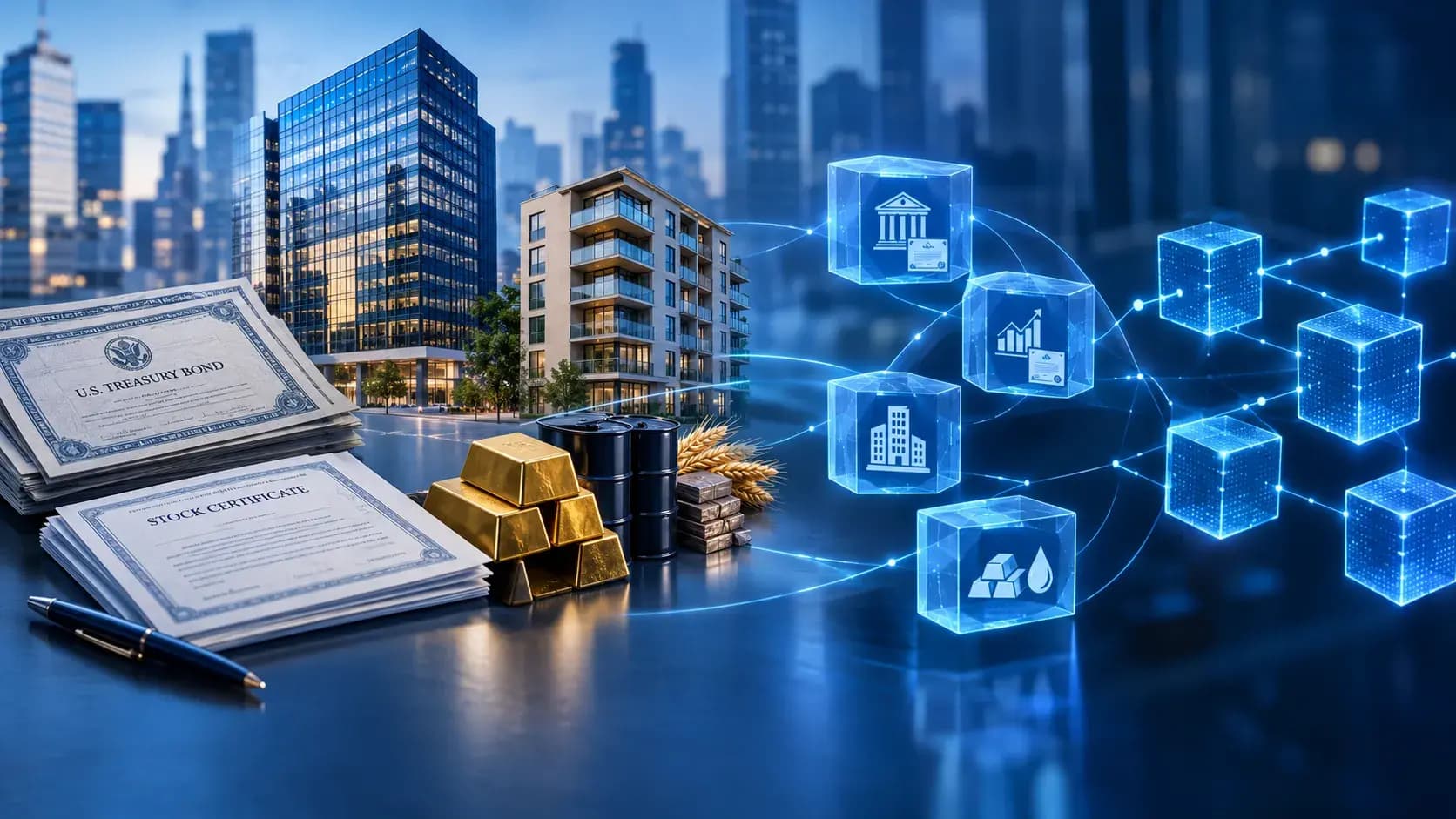
Asset tokenization is the process of representing ownership rights, claims or interests in an asset as digital tokens on a blockchain or other distributed ledger. Stocks, bonds, investment funds, real estate and other assets can potentially be represented in tokenized form.
The concept is an important part of the growing real-world asset (RWA) market because it connects traditional assets and financial infrastructure with blockchain-based systems.
But putting an asset “onchain” does not automatically change what the asset is, who legally owns it or what rights an investor receives. The legal structure behind a token can be just as important as the blockchain technology used to issue it.
This guide explains how asset tokenization works, what can be tokenized, how ownership is connected to a digital token, and what benefits and risks investors should understand.
 VersaBank Brings Tokenized Deposits to the U.S.→
 Ripple, Meritz Bring Tokenization to Korea→
 Morgan Stanley Sees $10T Tokenized Asset Market→
 Nasdaq CEO: Tokenization Could Unlock Billions→
What Is Asset Tokenization?
Asset tokenization is the process of creating a digital representation of an asset or rights associated with an asset on a blockchain or distributed ledger.
The U.S. Securities and Exchange Commission describes tokenization as creating a digital representation of a tangible or intangible asset using distributed ledger technology. The Bank for International Settlements (BIS) uses a similarly broad concept, describing tokenization as using technologies such as distributed ledger technology to issue or represent assets digitally as tokens.
In practical terms, tokenization can connect an asset that exists in the traditional financial or legal system with a digital token capable of being recorded and transferred through blockchain infrastructure.
Consider a simplified example.
An investment vehicle owns $10 million of government securities. Instead of recording investor interests exclusively in a conventional database, an issuer could create blockchain-based tokens representing interests in the investment vehicle or underlying securities.
Those tokens could then be held in digital wallets and, subject to the product’s rules and applicable regulation, transferred between eligible participants.
The important distinction is that the token is not necessarily the underlying asset itself.
It is a digital representation whose economic and legal meaning depends on the structure behind it.
How Does Asset Tokenization Work?
There is no single model for tokenizing every asset. A tokenized fund, stock, bond and property interest can have very different legal structures.
However, the process can generally be understood through several stages.
1. Select the Underlying Asset
The first step is determining what will be tokenized.
Possible assets include:
- government securities;
- corporate bonds;
- stocks;
- investment funds;
- private credit;
- real estate;
- commodities;
- intellectual property or contractual claims.
The underlying asset may already exist offchain, or a financial instrument can be issued natively using blockchain infrastructure.
This distinction matters.
A traditional security held by a custodian and represented by a blockchain token is structurally different from a security whose authoritative ownership record exists directly onchain.
2. Establish the Legal Structure
This is one of the most important — and frequently overlooked — parts of tokenization.
Before creating tokens, an issuer must determine exactly what rights those tokens represent.
For example, a real estate token might represent:
- direct ownership rights where legally permitted;
- shares in a company that owns the property;
- an interest in a special-purpose vehicle (SPV);
- debt secured against the property;
- a contractual claim on income generated by the property.
These arrangements are not economically or legally identical.
The same issue applies to tokenized securities.
The SEC has outlined multiple structures for tokenized securities, including securities tokenized by or on behalf of their issuers and structures created by unaffiliated third parties.
Some third-party tokens may represent an interest in an underlying security held in custody. Others can provide synthetic exposure instead.
As a result, investors should not assume that two tokens tracking the same asset provide the same ownership rights.
3. Custody or Control the Underlying Asset
If an existing offchain asset backs the token, someone generally needs to hold or control that asset.
Depending on the structure, this could involve a:
- regulated custodian;
- bank;
- broker or transfer agent;
- fund;
- trust;
- special-purpose vehicle;
- other legally recognized entity.
Suppose 1 million tokens are issued against assets held by a custodian.
The system needs a mechanism to ensure that token issuance remains consistent with the assets or entitlements that the tokens are intended to represent.
This relationship between onchain supply and offchain assets is fundamental to many RWA structures.
4. Create the Smart Contract
Once the legal and operational framework has been established, smart contracts can define how the token operates onchain.
Depending on the design, a smart contract can control:
- token issuance;
- transfers;
- minting and burning;
- wallet permissions;
- investor eligibility;
- compliance restrictions;
- redemption procedures;
- transaction rules.
This programmability is one of the major differences between blockchain-based assets and conventional database records.
For regulated financial assets, unrestricted transfer may not be appropriate. Smart contracts can therefore incorporate permissioning or other controls governing which wallets are allowed to receive or transfer a token.
5. Issue the Tokens
Tokens are then created — or minted — on the selected blockchain or distributed ledger.
A simplified structure looks like this:
Underlying asset → legal ownership structure → custody/recordkeeping → smart contract → digital token → investor wallet
The exact relationship between these layers is critical.
In some structures, the blockchain itself forms part of the official ownership record.
In others, an offchain register remains authoritative while blockchain records facilitate transfers or provide a digital representation.
6. Distribute Tokens to Investors
Eligible investors can receive tokenized assets in compatible digital wallets.
Depending on the product and jurisdiction, investors may first need to complete:
- identity verification;
- Know Your Customer (KYC) procedures;
- Anti-Money Laundering (AML) checks;
- investor qualification requirements;
- jurisdictional eligibility checks.
Blockchain does not inherently mean anonymous or permissionless access.
A token can operate on a public blockchain while still restricting ownership and transfers to approved addresses.
7. Transfer, Trade or Use the Token
Once issued, tokenized assets may be transferred between eligible wallets or used within compatible financial applications.
Depending on the asset and regulatory framework, tokenization can potentially enable:
- faster transfers;
- extended operating hours;
- automated settlement;
- collateral mobility;
- integration with decentralized finance;
- programmable distributions;
- fractional ownership.
The Bank for International Settlements has highlighted the possibility of combining asset transfer, messaging and reconciliation on programmable platforms.
That could reduce some of the fragmentation found in traditional financial infrastructure.
However, the practical benefits depend on liquidity, interoperability, regulation and whether both the asset and payment side of a transaction can operate efficiently on compatible infrastructure.
8. Redemption and Token Burning
Some tokenized products allow holders to redeem tokens for cash, underlying assets or another form of ownership record.
When redemption occurs, the corresponding token may be burned, meaning permanently removed from circulation.
For example:
Investor returns token → issuer verifies redemption → token is burned → cash or underlying entitlement is delivered
This mechanism can help maintain alignment between the number of tokens in circulation and the assets or claims supporting them.
Different platforms can use different redemption and ownership models. Backpack, for example, has described an infrastructure connecting tokenized securities with underlying shares through brokerage infrastructure.
What Assets Can Be Tokenized?
Tokenization is not limited to one asset class.
Tokenized U.S. Treasuries
Treasury securities and funds holding government securities have become an important use case for RWA infrastructure.
Rather than simply buying a cryptocurrency whose price tracks Treasury yields, investors can access blockchain-based financial products connected to traditional government securities or funds.
The exact ownership structure varies by product. Some structures represent fund interests, while others can provide exposure through different legal and custody arrangements.
Understanding that distinction is essential because a token associated with U.S. government debt does not necessarily mean that the holder directly owns an individual Treasury security.
Tokenized Stocks
Stocks can be represented onchain in several ways.
An issuer might tokenize its own shares, or a third party could issue a token representing an interest in shares held in custody.
A third structure could provide synthetic exposure without giving the token holder ownership of the underlying shares.
These distinctions can affect voting rights, dividends, counterparty exposure and investor protections.
A recent example of this developing market is Securitize’s launch of tokenized U.S. stocks on Solana, illustrating how traditional securities can be connected with public blockchain infrastructure while retaining a regulated ownership structure.
Tokenized Investment Funds
Investment funds are another established use case.
Franklin Templeton’s Franklin OnChain U.S. Government Money Fund uses public blockchain technology in its recordkeeping system, demonstrating how distributed ledger infrastructure can be integrated into a regulated investment product.
Tokenized funds illustrate how blockchain can be incorporated into financial products without necessarily replacing the legal and institutional framework surrounding the fund.
Tokenized Real Estate
Property tokenization can divide economic interests in real estate into digital units.
For example, an SPV could own a building while investors hold tokens representing interests in that entity.
This can potentially reduce the minimum investment size, but it does not automatically make an illiquid property liquid.
Investors still depend on demand, market structure, legal enforceability and the ability to redeem or sell their interests.
Tokenized Private Credit
Private loans and credit funds can also be represented through blockchain-based instruments.
Tokenization can potentially make loan ownership, interest distributions and collateral management more programmable.
But credit risk remains.
If a borrower defaults, putting the loan on a blockchain does not eliminate the economic loss or the legal process required to enforce creditor rights.
Native vs Wrapped Tokenized Assets
One of the most useful distinctions in understanding tokenization is the difference between native and wrapped or custodial structures.
Native Tokenization
In a native structure, the financial instrument itself is issued using blockchain infrastructure, with the blockchain potentially forming part of the authoritative ownership record.
Conceptually:
Issuer → tokenized security → investor
The token is integrated into the issuance and recordkeeping structure of the financial instrument rather than merely mirroring an asset held elsewhere.
Wrapped or Custodial Tokenization
In another model, an existing traditional asset remains with a custodian while a blockchain token represents an interest or entitlement connected to that asset.
Conceptually:
Traditional asset → custodian → token → investor
Understanding this difference is essential before evaluating any tokenized investment.
A blockchain token may look similar from a technical perspective while representing very different legal rights depending on the structure behind it.
Asset Tokenization vs Digitization
Tokenization and digitization are related but not identical.
Traditional finance has already been largely digitized. Bank balances, brokerage accounts and securities ownership records generally exist electronically rather than as physical certificates.
Tokenization adds another layer: assets or claims can be represented on programmable infrastructure using digital tokens.
| Digitization | Tokenization |
|---|---|
| Converts information into digital records | Represents assets or rights as digital tokens |
| Often uses centralized databases | Can use blockchain or DLT |
| Rules typically reside in separate systems | Rules can be embedded in smart contracts |
| Transfers may require multiple intermediaries | Transfers can potentially occur through shared infrastructure |
| Reconciliation may occur across databases | Participants may share synchronized ledger information |
Tokenization should therefore not be understood simply as converting paper documents into digital files.
What Are the Benefits of Asset Tokenization?
The potential benefits depend heavily on the asset, infrastructure and regulatory environment.
Programmability
Smart contracts can automate certain rules and processes associated with financial assets.
These might include transfer restrictions, distributions, redemptions or collateral management.
Programmability can also make compliance requirements part of the asset’s technical infrastructure rather than relying entirely on separate operational processes.
Fractionalization
Assets can potentially be divided into smaller digital units.
A high-value asset that traditionally requires a large minimum investment could theoretically be represented by many smaller tokens.
This may broaden access, although securities laws and platform eligibility rules can still restrict who may invest.
Fractionalization should not be confused with liquidity. Dividing an asset into smaller units does not guarantee that an active secondary market will develop.
Faster and More Efficient Settlement
Traditional financial transactions can involve multiple institutions maintaining separate records.
Shared blockchain infrastructure could reduce reconciliation requirements and allow assets to move more efficiently between market participants.
The potential becomes more significant when both the asset and payment sides of a transaction can interact through compatible digital infrastructure.
Greater Collateral Mobility
Tokenized securities could potentially be moved and pledged as collateral more efficiently across compatible platforms.
This has become an important area of development for institutional market infrastructure.
U.S. regulators have also addressed how tokenized collateral and onchain records can operate within existing financial rules, illustrating how tokenization is increasingly intersecting with established derivatives and collateral frameworks.
Transparency
Blockchain networks can provide auditable transaction histories.
However, blockchain transparency does not necessarily reveal everything investors need to know about the underlying asset.
The existence, valuation, custody and legal status of offchain assets may still require trusted data providers, auditors, custodians and legal documentation.
What Are the Risks of Asset Tokenization?
Tokenization changes infrastructure. It does not remove investment risk.
The BIS has cautioned that although tokenization could improve efficiency, transparency and access, potential benefits may come with new trade-offs and risks.
Major risks include:
Legal and Ownership Risk
The token holder’s legal claim on the underlying asset may be different from what the token’s name or price suggests.
Investors need to understand exactly what they own and what legal claim they have if an issuer, custodian or other intermediary fails.
Counterparty Risk
A token can depend on an issuer, custodian, broker, SPV or other intermediary.
If one of those entities fails, token holders may face losses or difficulty enforcing claims.
Moving the representation of an asset onto a blockchain does not automatically eliminate the intermediaries involved in its legal ownership or custody.
Smart-Contract Risk
Programming errors or vulnerabilities can affect token issuance, transfers and other functionality.
Even when the underlying asset remains safe, a technical failure can potentially disrupt access, transfer or redemption.
Custody Risk
The underlying asset and the token itself may have separate custody arrangements, creating different layers of operational risk.
An investor therefore needs to understand both who controls the blockchain-based asset and who holds any offchain assets supporting it.
Liquidity Risk
Fractionalization does not guarantee liquidity.
An asset can be divided into thousands or millions of tokens and still have very few buyers.
Liquidity ultimately depends on market participation, trading infrastructure, transfer restrictions and demand.
Oracle and Data Risk
Blockchain systems may need external data about prices, interest rates, asset status or other offchain events.
Incorrect, delayed or manipulated data can affect onchain processes.
This is particularly important for tokenized equities used in DeFi, where applications may require reliable market prices, corporate-action information and other data originating outside the blockchain.
Regulatory Risk
Tokenized securities remain subject to applicable securities and financial laws.
Changing a security’s technological format does not automatically change its legal status.
In the United States, regulators and market participants are also examining frameworks for onchain trading of tokenized securities, including how existing investor-protection and market-structure requirements apply to blockchain-based markets.
Does Tokenization Mean You Own the Underlying Asset?
Not necessarily.
This is perhaps the most important question to ask about any tokenized product.
A token might represent:
- direct ownership of an asset;
- ownership of a security issued directly onchain;
- shares in an entity that owns an asset;
- a security entitlement to assets held by a custodian;
- a contractual claim against an issuer;
- synthetic economic exposure without ownership of the underlying asset.
Two tokens could therefore track the same stock, bond or other asset while providing fundamentally different legal rights.
Before evaluating a tokenized product, investors should examine its offering documents, ownership structure, custody arrangements, redemption terms and applicable regulatory framework.
The underlying question should always be:
What legal and economic rights does this token actually provide?
How Is Asset Tokenization Related to RWA?
Real-world assets (RWA) is the broader category covering traditional financial or physical assets connected to blockchain infrastructure.
Tokenization is the process used to create their digital representation.
A simple way to understand the relationship is:
RWA = the asset or claim
Tokenization = the process
Token = the digital representation
For example:
U.S. Treasury security → tokenization process → tokenized Treasury product
or:
Real estate → legal/SPV structure → tokenization → property token
Not every RWA structure works in exactly the same way, which is why understanding the legal and technical architecture behind the token matters.
Public blockchains can provide part of that infrastructure. Networks such as Solana, for example, are increasingly being used for real-world asset tokenization involving financial products and other forms of tokenized value.
Is Asset Tokenization the Future of Finance?
Tokenization has moved beyond purely experimental blockchain projects.
Asset managers, banks, market infrastructure providers and fintech companies are developing systems for issuing, recording, transferring and settling traditional financial assets using distributed ledger technology.
The development of tokenized funds, securities and collateral demonstrates that the technology is increasingly intersecting with existing financial infrastructure rather than operating entirely outside it.
Still, widespread adoption is not guaranteed.
Tokenized markets need interoperable technology, clear legal rights, reliable custody, compliant distribution, deep liquidity and efficient settlement assets.
Moving a security from a conventional database to a blockchain does not solve all of those problems by itself.
The more significant long-term development may therefore be not simply putting assets onchain, but integrating assets, money, settlement and compliance within compatible programmable financial infrastructure.
Frequently Asked Questions
What is asset tokenization in simple terms?
Asset tokenization is the process of creating a blockchain-based digital representation of an asset or rights associated with it. The token can represent ownership, an entitlement, a contractual claim or another form of economic exposure depending on its legal structure.
Is tokenization the same as cryptocurrency?
No. Cryptocurrency is a broad category of blockchain-based digital assets. Asset tokenization uses blockchain infrastructure to represent an existing or newly issued asset or claim, such as a bond, stock, fund interest or property interest.
Can any asset be tokenized?
Many financial, physical and intangible assets can technically be represented by tokens. However, legal ownership, regulation, custody, transfer restrictions and market infrastructure determine whether a particular tokenization structure is practical.
Does owning a token mean owning the real asset?
Not always. A token may represent direct or indirect ownership, a security entitlement, a contractual claim or synthetic economic exposure. Investors should examine the legal structure and product documentation.
Why use blockchain for asset tokenization?
Blockchain can provide shared recordkeeping, programmability, automated rules and potentially more efficient transfers and settlement. It can also make fractional ownership easier to administer.
What is the difference between RWA and asset tokenization?
RWA refers to traditional financial or physical assets connected to blockchain-based markets. Asset tokenization is the process of creating a digital representation of those assets or associated rights.
The Bottom Line
Asset tokenization creates a bridge between traditional assets and programmable digital infrastructure.
Its significance is not simply that stocks, bonds, funds or real estate can be represented by blockchain tokens. The more important change is that ownership records, transfer rules, compliance controls and settlement processes can potentially become part of programmable financial systems.
But the technology should not obscure the legal reality.
A token is only as meaningful as the rights, assets and institutions behind it.
Before assessing any tokenized asset, investors should determine what the token legally represents, who controls or custodies the underlying asset, how redemption works, what happens if an intermediary fails and which regulatory protections apply.
Tokenization can change how an asset is issued, recorded and transferred. It does not eliminate the fundamental risks of owning that asset.
This article is for informational and educational purposes only and does not constitute investment, legal or financial advice.