

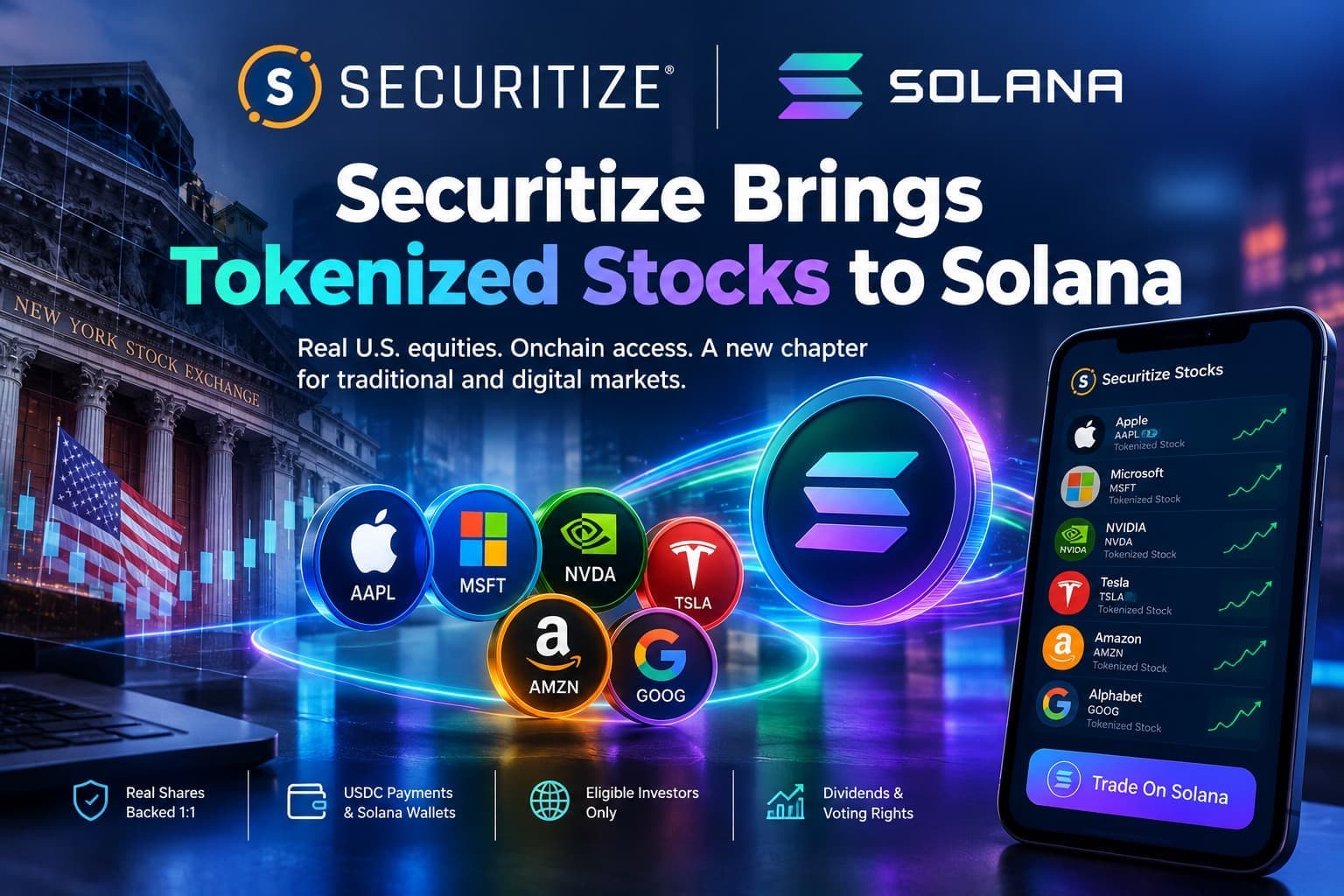
Securitize has launched blockchain-based access to major U.S. stocks through Solana, giving eligible investors a way to hold tokenized securities linked to underlying shares. The October 8 announcement introduces Securitize Stocks, a product designed to combine traditional equity ownership benefits with blockchain-based transfers and trading.
The initial lineup includes shares associated with Apple, Microsoft, Nvidia, Alphabet, Tesla, Meta, Amazon, Netflix, Circle, SpaceX, Strategy and Palantir. The securities are offered through Securitize Markets, LLC, an SEC-registered broker-dealer, subject to investor eligibility and onboarding requirements.
The launch marks another step in the convergence of public equity markets and blockchain infrastructure. Rather than offering only synthetic exposure to stock prices, Securitize says its products are backed 1:1 by underlying shares and provide associated economic and shareholder benefits.
The company announced the launch on October 8, with Solana identified as the initial blockchain network for the product.
 Backpack Links Tokenized Stocks to Real Shares→
 Ondo Expands Intelligent Portfolios to Seven→
 Ondo and KakaoPay Securities Explore Global Distribution of Korean Equities→
 What Are Real-World Assets (RWA)? A Guide to Tokenization→
How Securitize Stocks Work
According to Securitize’s official announcement, the product represents security entitlements connected to underlying U.S. equities.
Securitize says the underlying shares are held in segregated accounts through its brokerage infrastructure. Each tokenized position is backed on a 1:1 basis, connecting the blockchain-based representation with the corresponding securities entitlement.
This distinction matters because not every blockchain product referencing a publicly traded company conveys rights linked to actual shares. Some products provide price exposure through derivatives or contractual arrangements instead.
Securitize’s model is intended to maintain a connection to the underlying security while allowing eligible investors to hold the position in an approved Solana wallet.
The company says holders can receive dividends when the underlying company pays them, subject to applicable withholding, and participate in shareholder voting. The precise legal rights depend on the product’s terms and the structure of the security entitlement.
Securitize also notes that holders are not registered shareholders of the underlying issuer unless they convert their holdings. The underlying companies have not necessarily sponsored or endorsed these products.
Which Stocks Are Available?
The initial offering includes 12 publicly traded equities or equity-related securities:
| Company | Ticker |
|---|---|
| Apple | AAPL |
| Microsoft | MSFT |
| Nvidia | NVDA |
| Alphabet | GOOG |
| Tesla | TSLA |
| Meta Platforms | META |
| Amazon | AMZN |
| Netflix | NFLX |
| Circle | CRCL |
| SpaceX | SPCX |
| Strategy | MSTR |
| Palantir | PLTR |
The list brings several of the largest U.S. technology companies onto a blockchain-based securities platform, alongside companies connected to digital assets and private-space technology.
The offering is not unrestricted access for every wallet. Investors must meet Securitize’s eligibility requirements, complete identity verification and use the approved platform and wallet arrangements.
Availability also depends on the investor’s jurisdiction and applicable securities rules.
Trading Through Solana and USDC
Securitize says its stocks can be held in an approved Solana wallet alongside other onchain assets. Eligible customers can purchase the products using USDC, the dollar-pegged stablecoin issued by Circle.
This creates a direct link between blockchain-based securities and stablecoin payment infrastructure.
Instead of relying exclusively on conventional brokerage interfaces and payment processes, eligible users can access the securities through a wallet-based workflow. Securitize also says its platform supports trading beyond standard U.S. market hours.
The company advertises trading five days a week, with broader 24/7 availability planned. Extended-hours trading can involve lower liquidity, wider spreads and greater price volatility, and the availability of particular securities or features may change.
The use of USDC does not eliminate settlement, custody, counterparty or stablecoin risks. USDC is not legal tender, is not a bank deposit and does not receive FDIC deposit insurance.
Why the Launch Matters for Solana
Solana has become an important venue for the tokenization of financial assets, including equities, investment funds and other real-world assets.
The network offers blockchain-based transfers and programmable asset infrastructure, allowing approved products to interact with wallet software and selected onchain applications. For securities, however, technical transferability must coexist with investor eligibility rules and the legal requirements governing ownership.
Solana’s own tokenization overview describes the network’s role in bringing traditional financial assets onto blockchain infrastructure.
Securitize’s launch adds another provider to an ecosystem that already includes products from platforms such as xStocks, Backpack Securities, Ondo and other tokenization firms.
CryptoQuorum previously reported that Solana’s tokenized-equity supply reached a reported $684 million in September. That figure reflects the market at that time and should not be confused with Securitize’s own assets or trading volume.
The new launch therefore represents further product expansion, rather than evidence that Securitize already dominates the market.
Securitize’s View: Tokenization Needs Market Infrastructure
Securitize has previously argued that the industry’s next challenge is not simply creating blockchain representations of financial assets, but developing markets where those assets can trade with appropriate liquidity and regulatory safeguards.
In a May 2026 announcement about its collaboration with Jump Trading Group and Jupiter, Securitize CEO Carlos Domingo said:
“The question is no longer whether assets can be issued onchain, but whether they can trade at scale in a way that meets the standards of public markets.”
The comment was made in the context of the May partnership, not specifically the October stock launch. It nevertheless captures an important challenge facing the sector: issuing a token is only one part of building a functioning securities market.
Investors also need reliable underlying asset arrangements, a clear legal framework, suitable liquidity, transparent pricing and effective compliance procedures.
Securitize’s new product addresses several of these requirements through its registered brokerage infrastructure and its stated 1:1 backing model. Actual trading conditions, liquidity and investor experience will depend on market participation and product-specific terms.
What the SEC’s Position Means
Tokenized securities remain subject to U.S. securities laws. Putting a stock on a blockchain does not automatically exempt it from existing legal requirements.
In a January 2026 statement on tokenized securities, the SEC’s Divisions of Corporation Finance, Investment Management, and Trading and Markets explained that tokenized securities can take different legal and technical forms.
The statement distinguishes securities tokenized by or on behalf of their issuers from products tokenized by unaffiliated third parties. It also explains that the use of blockchain technology does not, by itself, change the application of federal securities laws.
That distinction is relevant to Securitize Stocks because the underlying companies have not necessarily issued or endorsed the blockchain-based products themselves.
Securitize says its offering is provided through an SEC-registered broker-dealer and is subject to eligibility and onboarding requirements. Registration of the intermediary should not be interpreted as an SEC endorsement of the product or a guarantee against investment losses.
Investors should review the legal documentation, custody structure, transfer restrictions and redemption procedures before purchasing any tokenized security.
How Securitize Compares With Other Solana Platforms
The launch comes as several companies develop different approaches to bringing traditional equities onto blockchain networks.
Backpack, for example, links tokenized stocks to real shares through its brokerage infrastructure, with a mechanism designed to connect tokenized positions to underlying securities.
Other platforms use different structures, eligibility rules and distribution channels. These products should not be treated as interchangeable simply because they reference the same publicly traded company.
For investors, the most important questions are whether the product represents an actual securities entitlement, how the underlying shares are held, what rights are conveyed, whether redemption is available and which parties are responsible for brokerage and custody.
These differences can affect the legal and economic experience of holding an asset onchain.
Risks Investors Should Understand
The availability of blockchain-based securities introduces new ways to access financial markets, but it does not remove the risks associated with investing in equities.
Investors remain exposed to movements in the underlying stock price and can lose money. Additional risks may include wallet security, restricted transfers, liquidity limitations, technical outages and the operational or legal risks associated with intermediaries.
A token held in a wallet may also be subject to transfer restrictions even when the underlying blockchain permits transfers at the technical level.
Investors should confirm whether they can transfer a position to another approved wallet, redeem it for a conventional security and access shareholder benefits under the product’s terms.
They should also distinguish the underlying stock’s market performance from the liquidity and pricing of the blockchain-based product itself.
What Comes Next for Onchain Equities?
Securitize’s launch highlights the growing effort to connect traditional equity ownership with blockchain-based trading and custody infrastructure.
The initial availability of major U.S. stocks on Solana creates another route for eligible investors to hold securities alongside digital assets. It also increases competition among providers seeking to establish the legal, operational and market infrastructure needed for onchain finance.
The next indicators to watch will include investor adoption, trading liquidity, the range of supported securities, the reliability of the backing arrangements and the practical operation of shareholder rights.
The broader significance is not that traditional stock markets are being replaced. Instead, securities firms are experimenting with new ways to represent, distribute and transfer existing financial assets.
Whether these models achieve sustained adoption will depend on their ability to combine blockchain functionality with investor protection, transparent legal rights and dependable market infrastructure.
Disclaimer
This article is for informational and educational purposes only and does not constitute investment, legal or tax advice. Tokenized securities involve market, custody, technology, liquidity and counterparty risks. Investors should review official product documentation and seek qualified advice where appropriate before making investment decisions.
Primary sources: Securitize’s October 8, 2026 launch announcement; Securitize’s official product documentation; the U.S. Securities and Exchange Commission’s statement on tokenized securities.