

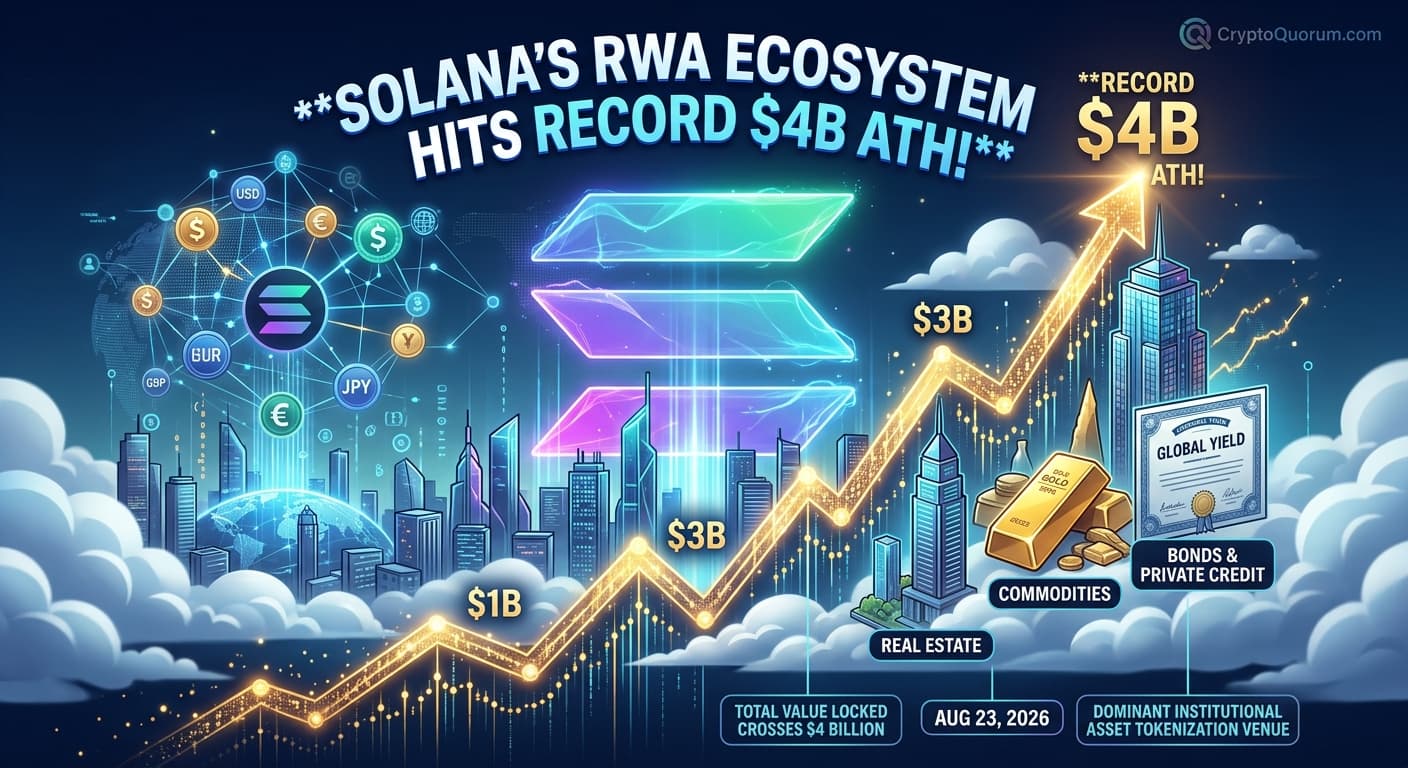
Institutional adoption of tokenized real-world assets (RWAs) on high-performance blockchains has reached a new high. According to an official update published by the Solana Foundation on August 23, 2026, Solana’s RWA ecosystem has officially crossed $4 billion in total value locked and tokenized issuance, marking an all-time high (ATH) for the network.
The milestone highlights a structural shift in how traditional asset managers, fintech issuers, and decentralized finance (DeFi) protocols deploy off-chain capital. What began as an experimental market for tokenized short-term U.S. Treasuries has transformed into a multi-asset ecosystem encompassing public equities, pre-IPO shares, sovereign debt, corporate credit, and physical commodities.
CRYPTOCAP:TOTAL Real-Time Chart
| Asset Category | Key Issuers / Assets | Market Share | Primary Use Case |
|---|---|---|---|
| Tokenized Equities | xStocks, Ondo, SECZ | ~46% ($1.84B) | 24/7 Global Trading |
| US Treasuries & Yield | Ondo (OUSG), BAGEY | ~31% ($1.24B) | DeFi Cash Management |
| Private & Corporate Debt | STRC, Solstice USX | ~15% ($600M) | High-Yield Income |
| Commodities & Consumer | Vaulted Gold, Silver | ~8% ($320M) | Asset Backing/Store |
| TOTAL VALUE ALLOCATED | $4,000,000,000+ | ATH August 2026 |
The Four Catalysts Fueling the $4 Billion Breakout
The expansion of Solana’s RWA ecosystem reflects consistent institutional deployment across four distinct financial verticals:
1. Tokenized Equities and Pre-IPO Assets Take Center Stage
Solana has captured over 95% of cumulative on-chain tokenized equities spot trading volume worldwide. The availability of tokenized shares for high-demand private enterprises—including tokenized SpaceX stock ($SPCX) via Backpack Securities—paired with public stock registries from xStocks and Ondo Global Markets, has driven hundreds of millions of dollars in secondary volume.
 JPMorgan Brings Tokenized Money Market Funds to Solana→
 What Is Asset Tokenization and How Does It Work?→
 VersaBank Brings Tokenized Deposits to the U.S.→
 Cross River Brings RLUSD Into Core Banking→
Public corporations are also minting native equity rails: Securitize brought tokenized shares of its NYSE-listed stock (ticker: SECZ) to Solana, while Bullish tokenized its 151-million-share cap table following its major corporate acquisition of transfer agent Equiniti.
2. High-Yield Sovereign Debt and Regulated Bond Funds
As global risk-free rates remain attractive, tokenized money-market funds and government debt have become foundational collateral across Solana DeFi. Instruments such as Ondo’s Short-Term US Government Treasuries (OUSG) and the Baillie Gifford Enhanced Yield Fund (BAGEY)—the UK’s first fully native regulated tokenized bond fund on a public blockchain—allow Web3 treasuries to generate yield without exiting into fiat off-ramps.
3. Corporate Credit and Structured Income Products
Rather than relying purely on speculative yield farming, Solana lending protocols now integrate institutional credit. Structured products, including Solstice Finance’s senior-tranche tokens backed by Strategy’s Nasdaq-listed preferred stock, give institutional allocators predictable fixed-income streams that isolate credit yield from spot crypto market fluctuations.
4. Alternative Assets and Vaulted Commodities
Tokenization on Solana has moved beyond financial paper into real-world physical custody. Vaulted precious metals (including native tokenized physical silver through Dominion Market) and tokenized infrastructure assets (such as clean energy charging networks) have brought tangible economic value directly onto Solana’s high-throughput ledger.
Technical Infrastructure: Why Issuers Choose Solana Over Layer-2s
The migration of institutional assets onto public blockchains has historically faced roadblocks around transaction latency, high gas fees, and liquidity fragmentation across modular rollups.
The growth trajectory of Solana’s RWA ecosystem demonstrates that institutional issuers prioritize monolithic execution with immediate deterministic finality.
| Metric | Solana Mainnet | Modular Layer-2 Rollups |
|---|---|---|
| Average Settlement Time | ~400 milliseconds | 10 minutes – 7 days |
| Average Fee per Tx | < $0.001 | $0.05 – $0.45 |
| Programmable Rules | Token-2022 Native | Wrapped Smart Contracts |
| Liquidity Architecture | Unified Global State | Fragmented Across Bridges |
The adoption of the Token-2022 (SPL Token Extensions) standard has played a key role in institutional adoption. This upgrade allows institutional issuers to embed regulatory compliance directly into asset smart contracts, including:
- Transfer Hooks: Enforcing real-time sanctions screening and KYC verification before transactions clear.
- Confidential Balances: Enabling private institutional settlement balances while maintaining verifiable on-chain solvency.
- Non-Transferable Badges & Metadata: Ensuring compliance with accredited investor standards across different regulatory jurisdictions.
Expert Opinions: Financial Analysts on the $4B Landmark
Industry executives and research analysts note that crossing $4 billion marks a turning point where blockchain technology transitions from speculative trading to fundamental financial plumbing.
“Reaching $4B in total RWA value confirms that capital allocators are no longer treating public blockchains as isolated sandboxes,” stated David Redin, Lead Financial Crypto Analyst at CryptoQuorum. “By combining sub-second settlement with native compliance extensions, Solana has eliminated the structural friction that previously prevented institutional securities from clearing on-chain. What we are witnessing is the beginning of 24/7 global capital markets.”
Institutional asset managers echo this perspective. In a recent research briefing on digital asset capital formation, market strategists observed:
“The critical differentiator for Solana’s RWA ecosystem is secondary market liquidity. Tokenizing an asset is simple; providing continuous, low-cost liquidity and instant collateral composability in DeFi is what generates genuine institutional utility. Solana’s single global state provides that liquidity advantage.”
Regulatory Headwinds and Counterparty Risk Considerations
Despite rapid growth, the tokenization of real-world assets carries distinct operational, structural, and legal challenges that participants must navigate:
- Custodial & Legal Enforceability: A tokenized bond or stock represents an off-chain legal claim. Investors remain dependent on the legal solvency and vault integrity of custodian banks, broker-dealers, and trust companies.
- Regulatory Divergence: While regulatory clarity is advancing in Europe (MiCA) and Asia, regulatory alignment in the United States surrounding tokenized securities distribution remains subject to ongoing legislative debates, including the pending CLARITY Act.
- Smart Contract & Oracle Security: Connecting off-chain asset pricing to on-chain decentralized lending protocols requires real-time, tamper-proof oracle data feeds. Malfunctions or liquidity disconnects could cause premature liquidations in automated credit markets.
Market Outlook: The Road to $10 Billion
With over 313,000 active on-chain RWA holders and stablecoin supply on Solana exceeding $16 billion, the infrastructure supporting tokenized financial assets is maturing rapidly.
As traditional asset managers look to streamline fund administration, reduce transfer agent overhead, and offer global liquidity, Solana’s RWA ecosystem is well-positioned to remain at the forefront of institutional decentralized finance through 2026 and beyond.
CRYPTOCAP:TOTALDEFI Real-Time Chart
Editorial Disclosure: This article is published for educational and informational purposes only and does not constitute financial, legal, or investment advice. Tokenized real-world assets involve counterparty, market, and smart contract risks. Always conduct rigorous due diligence before allocating capital.