

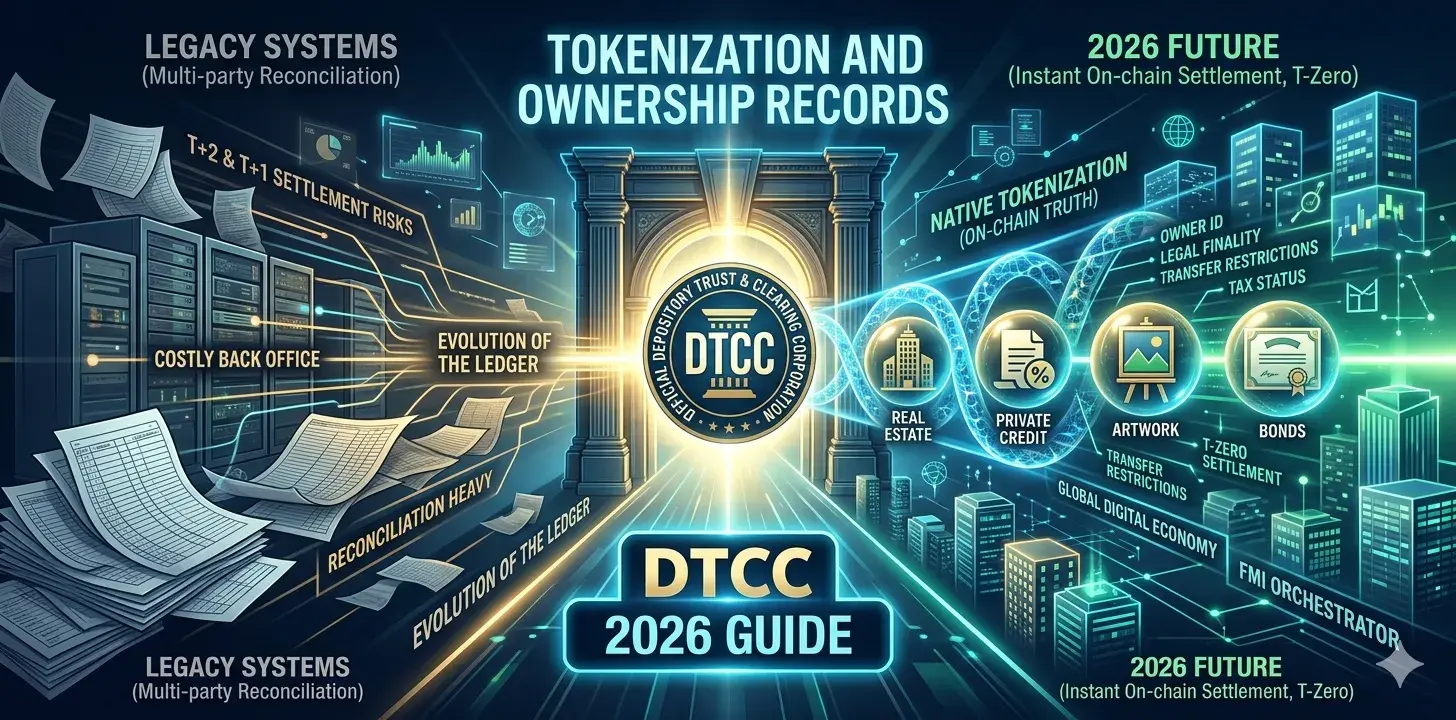
As we cross the first quarter of 2026, the global financial system is undergoing its most significant structural upgrade since the transition from paper certificates to electronic bookkeeping. The Depository Trust & Clearing Corporation (DTCC), the backbone of the U.S. financial market infrastructure, recently released a definitive guide titled “Understanding the Models.” This report serves as a roadmap for how Tokenization and Ownership Records will function in a world where trillions of dollars in assets are moving onto the blockchain.
The transition is no longer about “proofs of concept.” It is about institutional reality. From private credit to government bonds, the way we record who owns what is shifting from isolated bank ledgers to shared, immutable digital protocols.
The Evolution of the Ledger: From Databases to Tokens
For decades, ownership was recorded in centralized databases. If you bought a stock, your broker recorded it, the exchange recorded it, and the DTCC recorded it. This “reconciliation-heavy” model created delays, costs, and the infamous “T+2” (and recently T+1) settlement cycles.
In 2026, the goal is “T-Zero”—instant settlement. This is only possible through the sophisticated use of Tokenization and Ownership Records. By embedding the ownership data directly into the asset (the token), we eliminate the need for three different parties to check three different books. The token is the record.
 MoneyGram Unveils the Stablecoin-Backed MoneyGram Card to Revolutionize Global Financial Freedom→
 Zebec and MoneyGram Expand Stablecoin Payroll Through Stellar→
 BIS Tests XRP Ledger to Verify Official Statistics Onchain→
 Ripple Partners With Jeonbuk Bank to Modernize Korea’s Cross-Border Payments→
The DTCC’s Three Primary Models for 2026
The DTCC identifies three distinct ways financial institutions are currently handling the migration of assets to the blockchain. Each model has different implications for how Tokenization and Ownership Records are managed legally and technically.
1. The Traditional Ledger-Wrapped Model (Off-Chain Truth)
In this model, the “Golden Record” of ownership remains in a traditional database. A token is issued on a blockchain to represent that asset for trading or collateral purposes, but if there is a dispute, the off-chain database is the final legal authority. This is often seen as a “bridge” technology for legacy banks.
2. The Digital Twin Model (Parallel Truth)
The Digital Twin model maintains a 1:1 relationship between an off-chain asset and an on-chain token. Both systems update simultaneously. While more efficient than the wrapped model, it still requires high-level synchronization to ensure that Tokenization and Ownership Records stay consistent across both environments.
3. Native Tokenization (On-Chain Truth)
This is the “end-state” for digital finance. In this model, the asset is born on the blockchain. There is no off-chain ledger. The blockchain itself serves as the official registry of record. For the first time, federal Tokenization and Ownership Records are maintained entirely by decentralized or semi-decentralized protocols, providing maximum transparency and settlement speed.
The Technical Infrastructure of Ownership
How does a blockchain actually prove you own a piece of a commercial building or a high-yield bond? It comes down to the metadata. Modern smart contracts are now capable of carrying encrypted identity data, tax status, and transfer restrictions directly within the token’s code.
When we discuss Tokenization and Ownership Records, we are really talking about the ability of a protocol to enforce legal rights automatically. If a token is transferred, the record of ownership is updated across all nodes in the network in seconds. This eliminates the “settlement risk” that has historically plagued the over-the-counter (OTC) markets.
Analyst Perspectives: The “Golden Record” Standard
The move toward on-chain records has divided analysts into two camps: the “Gradualists” and the “Revolutionaries.”
“The DTCC’s focus on ‘Understanding the Models’ is a clear signal that the plumbing of Wall Street is being replaced,” says Alexei Petrov, Lead Analyst at Crypto Quorum. “The real challenge in 2026 isn’t the technology—it’s the legal finality. We need the courts to recognize that Tokenization and Ownership Records on a public-permissioned ledger are just as valid as a entry in a bank’s private database.”
Other experts point to the cost savings as the primary driver. Sarah Chen, a digital asset strategist, notes:
“By moving to Model 3 (Native Tokenization), institutions can reduce back-office costs by up to 40%. When the asset carries its own record, you don’t need a thousand people checking spreadsheets. This efficiency is why Tokenization and Ownership Records are the hottest topic in private credit this year.”
Legal and Operational Hurdles: The 2026 Reality
Despite the progress, several hurdles remain for the widespread adoption of Tokenization and Ownership Records.
- Jurisdictional Conflict: What happens if a token is issued in New York but traded by a user in Singapore? Which country’s Laws to Crypto Assets apply?
- Privacy vs. Transparency: While the blockchain is a public record, institutional investors require privacy. 2026 has seen a surge in “Zero-Knowledge Proofs” (ZKPs) that allow a user to prove ownership without revealing their identity or the size of their position to the entire world.
- Interoperability: If your Tokenization and Ownership Records are on Ethereum, but the buyer is using a Solana-based liquidity pool, the “bridge” between those networks must be perfectly secure. A failure in the bridge means a failure in the record of truth.
Supporting Figures: Market Adoption 2026
| Asset Class | Tokenization Level (2024) | Tokenization Level (2026 Est.) |
| Private Equity | <1% | 12% |
| Real Estate | <1% | 8% |
| Government Bonds | 2% | 25% |
| Corporate Credit | 1% | 18% |
The Role of FMIs (Financial Market Infrastructures)
The DTCC’s role is evolving from a “central record keeper” to a “protocol orchestrator.” In the future, the DTCC may not hold the records themselves; instead, they may act as the “root of trust” that validates the Tokenization and Ownership Records generated by various blockchain networks.
This shift ensures that even in a decentralized world, there is a standard for what constitutes a “valid” record. As the SEC continues to clarify laws to crypto assets, the industry is converging on a set of standards that allow for the seamless movement of value.
Conclusion: The New Foundation of Trust
The DTCC’s “Understanding the Models” report is a landmark document for the 2026 economy. It confirms that the future of finance is tokenized, programmable, and radically transparent. By integrating Tokenization and Ownership Records into the very fabric of our digital assets, we are building a system that is faster, cheaper, and more accessible than ever before.
As we move toward a world where every asset—from a share of stock to a gallon of oil—exists as a digital token, the quality of our Tokenization and Ownership Records will be the difference between a chaotic market and a stable, thriving global economy.
The transition to a tokenized economy is the biggest investment opportunity of the decade. At Crypto Quorum, we track the protocols, the regulations, and the technical models that are shaping the future of ownership.