

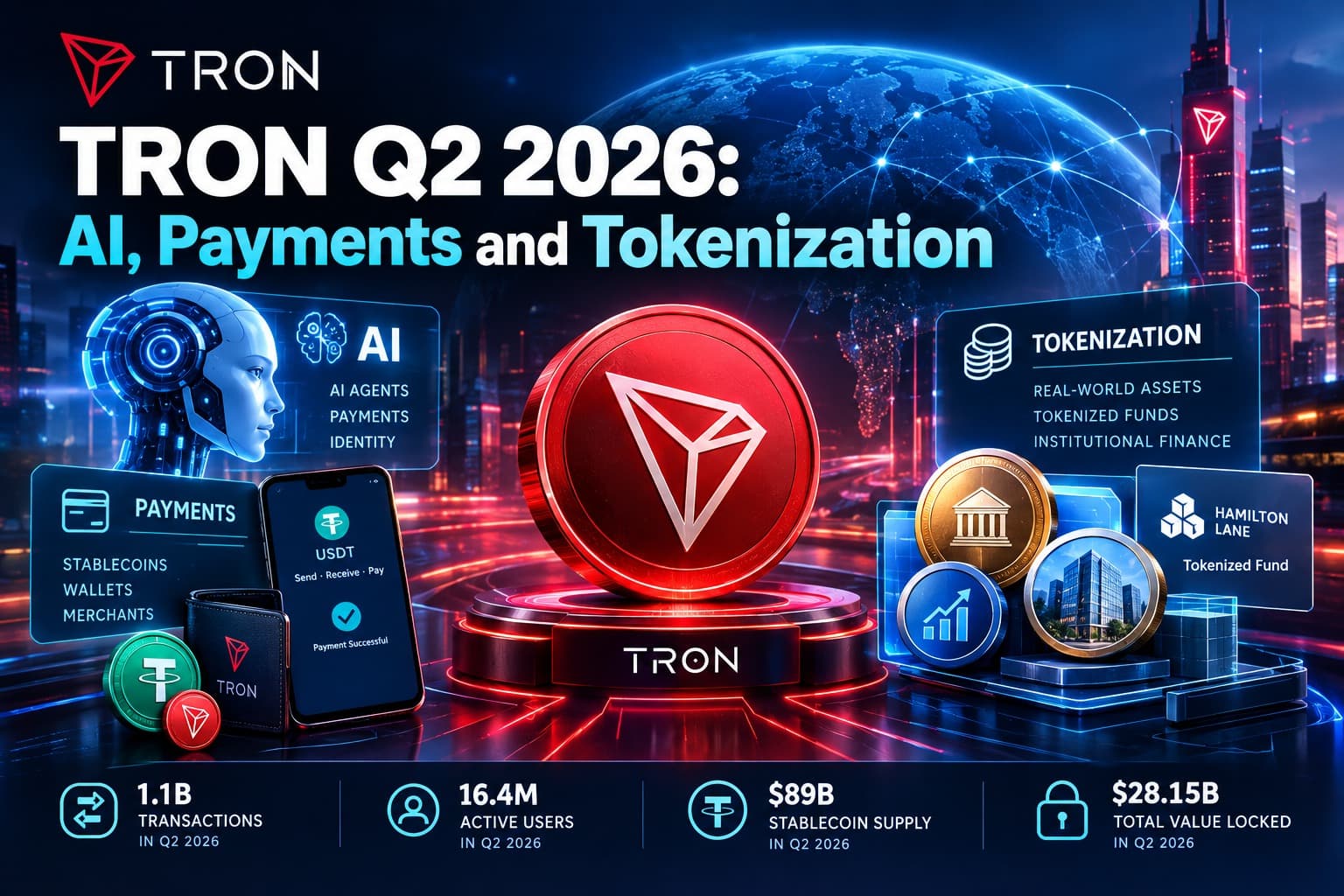
The TRON ecosystem continued its expansion during the second quarter of 2026, adding integrations across artificial intelligence, cross-chain infrastructure, tokenized assets, wallets and digital payments. The latest developments point to a broader strategy: positioning TRON not simply as a blockchain for transactions, but as settlement infrastructure connecting users, financial applications and emerging AI-driven services.
TRON DAO highlighted the expansion in a September 2026 post, pointing to new integrations across several infrastructure categories. The announcement follows a strong Q2 operating period documented in TRON’s quarterly report and by independent research firms.
BINANCE:TRXUSDT
According to TRON DAO, the network processed 1.1 billion transactions in Q2, while active users reached 16.4 million. Stablecoin supply reached approximately $89 billion, stablecoin settlement volume reached $2.08 trillion, and reported total value locked was $28.15 billion.
Those figures suggest that the network’s expansion is increasingly being driven by payment and settlement activity rather than a single application category.
 MoneyGram Joins XDC Network as Institutional Validator→
 Fink: Data Center Moratorium Risks Recession→
 IMF Sees Global Growth at 3.1% in 2026 as AI Boom Offsets Energy Shock→
 Morgan Stanley Sees $10T Tokenized Asset Market→
TRON Moves Beyond a Single-Use Blockchain Model
For much of the crypto market’s history, blockchain ecosystems have competed by emphasizing a particular feature: smart contracts, decentralized finance, NFTs, gaming or payments.
TRON’s current strategy is becoming broader.
The network’s Q2 developments combined stablecoin liquidity, cross-chain connectivity, institutional tokenization, wallet infrastructure and AI-agent payments. That combination matters because each component can reinforce the others.
A deeper stablecoin base provides liquidity for payments. Cross-chain infrastructure makes that liquidity accessible to applications outside the network. Tokenized financial products introduce traditional assets, while wallets and payment integrations bring those assets closer to end users.
AI adds another layer by creating the possibility of software agents initiating transactions without a human manually executing every payment.
This is increasingly reflected in the independent data.
Messari reported that TRON’s stablecoin market capitalization rose 4.1% quarter over quarter to a record $89.2 billion, with USDT accounting for 98.5% of the network’s stablecoin supply at the end of Q2. The research firm also recorded approximately $2.1 trillion in USDT transfer volume during the quarter.
AI Becomes Part of the Payment Infrastructure
One of the most notable changes in Q2 was TRON’s move into what is often described as agentic finance.
TRON integrated B.AI, a platform designed around financial infrastructure for AI agents, including payments, identity and coordination. TRON DAO describes the integration as part of its effort to provide infrastructure for autonomous digital agents.
The significance is less about AI branding and more about transaction execution.
An AI agent may need to obtain data, purchase computing resources, pay for an API or settle a service without relying on a conventional banking workflow. For such applications, payment rails need to be programmable, inexpensive and available around the clock.
TRON’s stablecoin infrastructure gives the network an existing settlement base on which such systems can operate.
CoinDesk Research identified the B.AI integration alongside deBridge’s MCP server integration and TRON’s membership in the Agentic AI Foundation as key Q2 developments.
The MCP integration is particularly notable because it gives developers and AI agents programmatic access to cross-chain liquidity and execution. That potentially moves blockchain interaction from manually operated wallets toward machine-readable financial infrastructure.
Cross-Chain Expansion Widens TRON’s Reach
Another major Q2 theme was interoperability.
TRON integrated with Hyperlane, LI.FI, Jumper, Allbridge and 0x, expanding the network’s ability to interact with external blockchains and liquidity venues.
According to CoinDesk Research, Hyperlane connected TRON to more than 150 chains, while 0x’s Cross-Chain API enabled transfers involving TRX and USDT across more than 15 networks. Allbridge also positioned TRON as a priority cross-chain hub for routing USDT.
This is strategically important because a blockchain’s value is not determined only by activity occurring inside its own environment.
Liquidity that cannot move efficiently between ecosystems can become fragmented. Cross-chain infrastructure attempts to reduce that fragmentation by allowing assets, messages and liquidity to move between networks.
For TRON, the focus on USDT is particularly relevant. The network already hosts one of the largest concentrations of dollar-denominated liquidity in crypto. Connecting that liquidity to other chains can potentially increase the number of applications that can access it.
CryptoQuorum previously examined TRON’s position as a payment-focused blockchain and the role of stablecoins in its 2026 strategy. TRON 2026: The Global Digital Payment Pivot provides additional background on that transition.
Tokenized Funds Bring Traditional Finance On-Chain
Q2 also produced a significant development in tokenization.
Hamilton Lane’s Senior Credit Opportunities Fund (HLSCOPE) was launched on TRON through Securitize, marking the first Securitize-issued asset on the network, according to CoinDesk Research and TRON’s ecosystem reporting.
Tokenized private credit is important because it represents a fundamentally different use case from conventional crypto trading.
Rather than creating a new speculative token, tokenization attempts to represent an existing financial asset on blockchain infrastructure. That can potentially improve distribution, settlement and interoperability while creating programmable ownership structures.
The Hamilton Lane deployment therefore gives TRON exposure to the broader real-world asset (RWA) market.
It also connects several parts of the network’s strategy. A tokenized fund requires custody and wallet infrastructure, settlement liquidity and potentially cross-chain connectivity. Payments and stablecoins can provide the settlement layer, while institutional platforms supply the traditional financial products.
This combination is one reason tokenization has become an increasingly important theme across major blockchain networks.
Wallets and Payments Expand the User Layer
Infrastructure only becomes useful at scale when people and businesses can actually access it.
TRON’s Q2 expansion included integrations involving Tether Wallet, Trezor and Fireblocks Flow, according to CoinDesk Research. Tether Wallet added support for USDT on TRON, while Trezor introduced native support for TRX, USDT and TRC-20 assets. Fireblocks Flow, built with Dynamic, expanded stablecoin-payment functionality for payment service providers and fintech applications.
These integrations address different segments of the market.
Trezor focuses on self-custody. Fireblocks targets institutional and fintech infrastructure. Tether Wallet focuses on accessible stablecoin usage.
Together, they illustrate a strategy of expanding the number of interfaces through which users can interact with the network.
The payment story is reinforced by Q2 card data. CoinDesk Research reported that crypto payment-card volume across chains rose from $2.0 billion in Q1 to $2.4 billion in Q2, while TRON’s share increased from 33% to 34%, the highest chain-level share in the study.
Independent Research Confirms Strong Network Activity
The strongest case for the TRON ecosystem is not simply the number of announcements. It is the combination of integrations with measurable on-chain activity.
Nansen reported that TRON averaged approximately 11.8 million daily transactions during Q2 and processed more than 1 billion transactions during the quarter. Its analysis found that activity was heavily associated with stablecoin transfers, highlighting TRON’s role as a high-volume settlement corridor.
Messari’s findings point in the same direction.
The research firm recorded an average of 11.8 million daily transactions, average daily active addresses of 3.6 million, and a 4.1% quarterly increase in stablecoin market capitalization. It also highlighted expanding institutional and regulated access, including Bitnomial’s spot TRX listing and Securitize’s tokenized fund launch.
These figures provide useful context for the latest TRON DAO announcement: the network is not only adding partnerships but doing so while maintaining substantial transaction and stablecoin activity.
Expert Opinions: Adoption Versus Concentration
The independent research creates a more nuanced picture than a simple growth narrative.
Messari’s analysis shows strong stablecoin and network activity, but also identifies value-accrual tensions. Circulating TRX supply increased by roughly 87 million during Q2, while the staking rate declined to 48.2%, its first quarterly decline in six quarters.
That distinction matters for investors.
Network usage can grow without the native token necessarily capturing all of that economic value. A blockchain can become an important settlement layer while much of its transaction activity is denominated in stablecoins.
Nansen’s research similarly emphasizes that TRON’s high transaction count is closely tied to its role as a USDT transfer network rather than purely speculative DeFi activity.
In other words, the quality and durability of adoption matter as much as headline transaction numbers.
What Comes Next for TRON?
The Q2 developments establish several potential growth vectors for the second half of 2026.
The first is stablecoin payments. TRON already has a substantial USDT base, giving additional wallet and payment integrations a significant liquidity foundation.
The second is agentic payments. AI agents could eventually create demand for automated, machine-to-machine settlement, particularly for digital services.
The third is tokenized assets. Institutional products such as HLSCOPE show how traditional financial instruments can enter the network alongside native crypto assets.
The fourth is interoperability. Connections with more than 150 chains could make TRON’s stablecoin liquidity accessible to a wider group of applications.
But each opportunity carries execution risks. Cross-chain bridges create additional security considerations, tokenized assets remain dependent on regulatory and legal structures, and AI-agent payments require reliable identity, authorization and transaction controls.
The expansion of infrastructure therefore does not guarantee adoption. It creates the conditions under which adoption can occur.
Bottom Line
The latest TRON DAO update reflects a broader transformation underway across the TRON ecosystem.
Q2 2026 combined strong network activity with a growing set of integrations spanning AI, cross-chain infrastructure, tokenized funds, wallets and payments. TRON’s own quarterly data reported 1.1 billion transactions, $89 billion in stablecoins and $28.15 billion in TVL, while independent research from Messari and Nansen confirmed the network’s unusually high transaction and stablecoin activity.
The most important development may be the convergence of these separate categories. Stablecoins provide liquidity, cross-chain infrastructure expands access, tokenization connects traditional finance, wallets improve distribution, and AI introduces new automated use cases.
That makes the next stage of TRON’s development less about adding individual partnerships and more about whether these components can operate as one coherent financial infrastructure layer.
For users, developers and institutions watching blockchain adoption in 2026, that is the key trend to monitor.
Disclaimer
This article is provided for informational and educational purposes only and does not constitute financial, investment, trading, legal or other professional advice. Cryptocurrency markets and digital assets are highly volatile and involve substantial risk. Readers should conduct independent research and evaluate their own financial circumstances and risk tolerance before making investment decisions.