

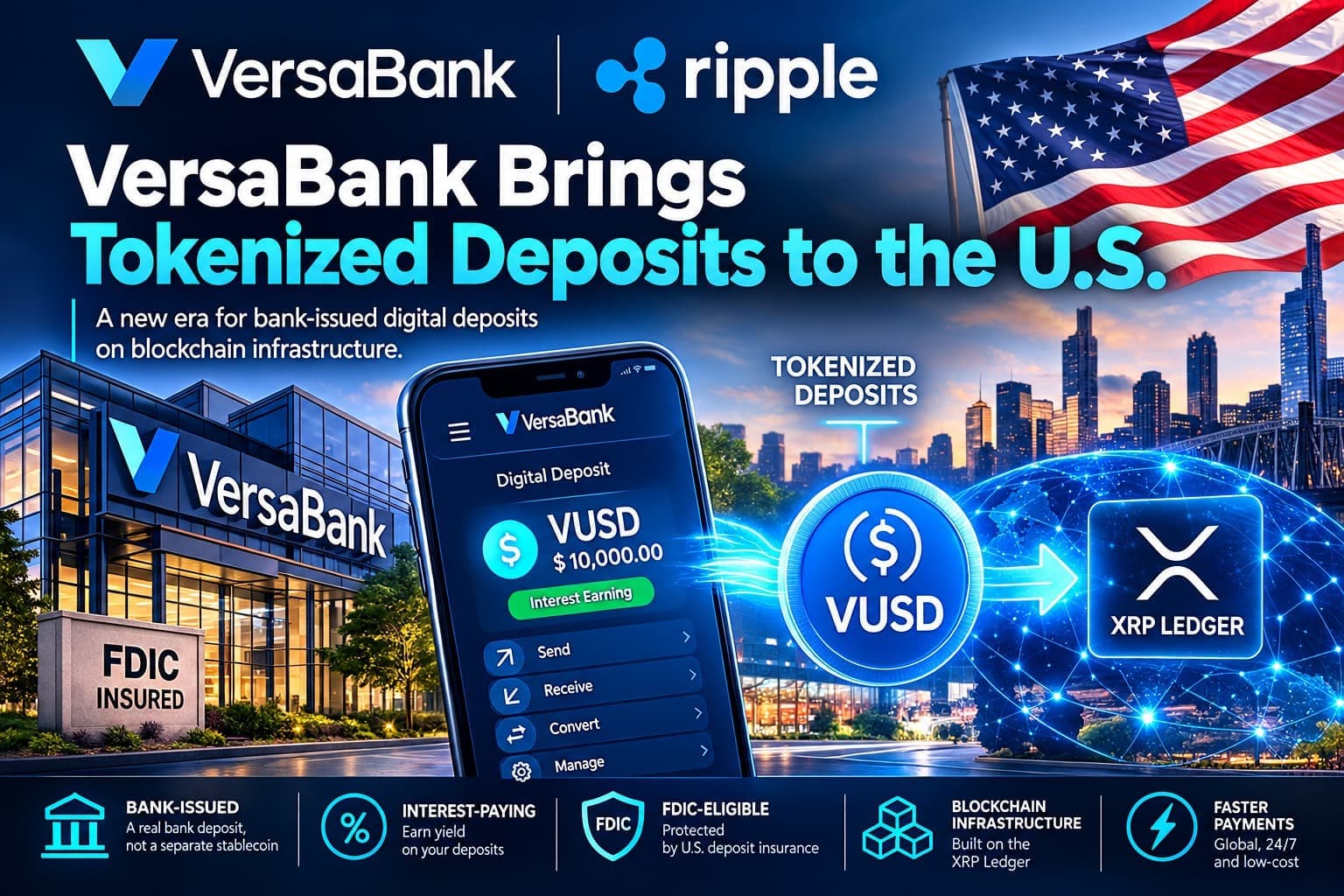
VersaBank has moved its blockchain-based deposit strategy into the commercial phase in the United States, preparing to issue VUSD through its U.S. banking subsidiary as a digital representation of a conventional bank deposit.
The October 15 announcement marks an important transition from pilot testing to commercialization for the Canada-based digital bank. VersaBank describes VUSD as an interest-paying, U.S.-dollar Real Bank Tokenized Deposit, or RBTD, issued by VersaBank USA and represented on blockchain infrastructure.
Unlike a conventional stablecoin issued by a nonbank company, VUSD is designed to remain a liability of a regulated bank. VersaBank says the product will be eligible for FDIC deposit insurance and expects it to become available broadly to businesses and consumers.
The distinction could become increasingly important as banks compete with stablecoin issuers to determine how dollars move through blockchain-based financial markets.
 Ripple, Meritz Bring Tokenization to Korea→
 Morgan Stanley Sees $10T Tokenized Asset Market→
 Nasdaq CEO: Tokenization Could Unlock Billions→
 Securitize Brings Tokenized Stocks to Solana→
What VersaBank Is Launching
VersaBank’s U.S. strategy begins with its own VUSD product.
The bank defines its RBTDs as highly encrypted versions of conventional digital bank deposits represented on blockchain networks. In economic terms, the customer’s claim remains against the bank rather than against a separate stablecoin issuer or reserve vehicle.
VUSD is expected to pay interest.
VersaBank also says it intends to list the product on major bona fide digital-asset exchanges as soon as feasible, potentially giving customers another way to access and move bank-issued digital dollars.
However, the announcement describes the start of the commercial phase rather than evidence of large-scale circulation. VersaBank has not disclosed current VUSD deposits, transaction volumes or a specific exchange-listing schedule.
That distinction is important: the infrastructure is moving toward commercialization, but adoption still has to be demonstrated.
Tokenized Bank Deposits Are Not the Same as Stablecoins
Both products can represent dollar-denominated value on blockchain infrastructure, but their legal and economic structures can differ substantially.
A typical payment stablecoin is issued by a permitted nonbank or bank-related issuer and backed by reserve assets such as cash and short-term government securities.
A bank deposit is different. It represents a liability of the issuing bank and forms part of the traditional banking system.
The Federal Reserve Bank of Kansas City highlighted this distinction in an October 16 research briefing examining the development of deposit tokens and tokenized bank money.
Its analysis explains that tokenization has evolved into multiple structures. Some instruments are blockchain-native bearer-style deposit tokens, while others use blockchain representations linked to conventional bank ledger entries.
For customers, the critical questions are therefore not simply whether an instrument uses blockchain, but who owes the money, how ownership is recorded, how settlement works and what protections apply.
That is where VersaBank is positioning VUSD differently from the stablecoin model.
FDIC Treatment Is a Major Part of the Story
VersaBank says VUSD will be eligible for FDIC insurance.
That claim aligns with the direction U.S. regulators have been taking on the underlying principle.
In April, the FDIC proposed rules clarifying that the application of deposit insurance should not depend on the technology or recordkeeping system used to represent a bank’s deposit liabilities.
In other words, if an instrument legally qualifies as a deposit under the Federal Deposit Insurance Act, recording or representing it using distributed-ledger technology does not automatically turn it into something else.
FDIC Chairman Travis Hill summarized the principle by saying that deposits in tokenized form remain deposits under the Federal Deposit Insurance Act.
That provides an important regulatory foundation for products such as VUSD.
It does not mean every blockchain-based dollar receives FDIC insurance. Stablecoins, tokenized securities and bank deposits can have very different legal structures. Eligibility also should not be confused with unlimited coverage; applicable FDIC insurance rules and limits still matter.
For users, understanding the legal claim behind the token is therefore essential.
Why VersaBank Wants Digital Deposits
VersaBank sees VUSD as more than a payments experiment.
The bank expects the product to become a new source of deposits for its U.S. operation.
Initially, VersaBank says funds generated through VUSD will be invested in U.S. Treasury bills, which the bank describes as carrying zero risk weighting under applicable banking rules.
Later, the bank expects the deposits to support growth of its U.S. Structured Receivable Program.
That creates a fundamental difference between the bank-deposit model and many fully reserved stablecoins.
Banks traditionally use deposits to fund lending and other assets. Stablecoin issuers generally maintain reserve portfolios designed to support redemption of the outstanding tokens.
Researchers at the Federal Reserve Bank of New York have examined precisely this trade-off. Their 2026 research found that competition between stablecoins and bank-issued digital deposits can have implications for bank credit, investment and welfare because the two structures use balance sheets differently.
The question is therefore larger than which digital dollar settles faster.
It concerns how blockchain-based money interacts with the banking system’s traditional role in credit creation.
VersaBank Wants Other U.S. Banks to Use Its Technology
The strategy does not stop with VUSD.
VersaBank says it plans to offer its proprietary tokenization technology to U.S. community and regional banks.
That could become one of the more consequential elements of the program.
Smaller banks generally do not have the same technology budgets as Wall Street institutions. Building blockchain custody, issuance, compliance and transaction infrastructure internally could therefore be difficult.
A ready-made banking platform could allow smaller institutions to experiment with blockchain-based deposits without developing every component independently.
VersaBank CEO David Taylor has argued that regulated banks are well positioned to provide digital money because they already operate within established prudential, compliance and deposit frameworks.
The commercial test will be whether other banks see sufficient customer demand to justify adopting the technology.
The U.S. Banking Industry Is Moving in the Same Direction
VersaBank is not operating in isolation.
The Kansas City Fed notes that banks globally have moved from theoretical discussions toward implementation of blockchain-based commercial bank money.
JPMorgan’s institutional digital-money infrastructure was an early example. Citi has developed tokenized services for institutional payments and liquidity management, while BNY has been developing tokenized deposit capabilities.
Regional banks are also participating.
The Cari Network, launched in 2026 by Huntington, First Horizon, M&T Bank, KeyBank and Old National, is developing shared infrastructure for digital representations of bank deposits.
Meanwhile, a group of major U.S. banks has been working through The Clearing House on shared infrastructure designed to connect blockchain-based deposit activity with established payment systems.
This suggests that the emerging competition may not simply be banks versus stablecoins.
The future monetary infrastructure could contain bank deposits, stablecoins, instant-payment networks and central-bank settlement systems operating alongside one another.
Why Ondo Highlighted the Announcement
Ondo Finance amplified VersaBank’s announcement on X, which is noteworthy given Ondo’s focus on bringing traditional financial assets onchain.
But the social post should not be interpreted as a partnership announcement.
Neither the VersaBank announcement nor the cited material establishes that Ondo is issuing VUSD, distributing it or integrating it into Ondo products.
The relevance is thematic.
Tokenized securities require a settlement asset—the “cash leg” of a financial transaction. As stocks, Treasurys, funds and other real-world assets increasingly move onchain, regulated digital forms of money could become more important.
CryptoQuorum’s guide to real-world asset tokenization explains how conventional financial claims can be represented and transferred through blockchain infrastructure.
A mature tokenized financial system would likely need both sides of a transaction: tokenized assets and reliable tokenized money.
Bank-issued digital deposits are one candidate for that role.
Regulatory Clarity Is Improving, but Risks Remain
U.S. regulators are increasingly treating tokenization as a technological form rather than automatically as a new economic asset class.
Earlier this year, federal banking agencies similarly clarified that eligible tokenized securities generally receive the same regulatory capital treatment as their non-tokenized equivalents.
The underlying principle is technology neutrality.
But putting deposits on blockchain infrastructure creates new operational questions.
Researchers at the Federal Reserve Bank of Dallas have warned that greater adoption could affect bank liquidity and maturity transformation. Faster, round-the-clock movement of deposits could alter how quickly funds leave institutions and how banks manage liquidity.
The Kansas City Fed identifies similar concerns, including deposit “stickiness,” anti-money-laundering compliance and the practical operation of deposit insurance.
These risks do not negate the potential benefits. They show why regulated blockchain banking involves more than putting a token on a public ledger.
VUSD Could Test the Stablecoin Alternative
The most interesting question is whether consumers and businesses will prefer an interest-bearing blockchain representation of a bank deposit when stablecoins already provide fast digital-dollar settlement.
Stablecoins have strong network effects across crypto markets and are increasingly being integrated into payments infrastructure.
Bank-issued digital deposits offer a different proposition: blockchain functionality combined with a direct banking relationship and, where applicable, deposit-insurance protection.
VUSD may therefore provide a real-world test of how those models compete.
The answer could depend on the use case.
Stablecoins may remain attractive for global payments and crypto-native markets, while digital bank deposits could appeal to customers that prioritize regulated banking relationships, yield and integration with traditional financial services.
They may also coexist.
What Comes Next
Several milestones will determine whether VersaBank’s move becomes significant beyond the initial announcement.
The first is actual VUSD issuance and customer adoption.
The second is distribution. VersaBank intends to pursue exchange listings, but no definitive listing schedule has been disclosed.
The third is institutional adoption of its technology. If community or regional banks begin deploying VersaBank’s platform, the project could develop from a single-bank product into broader infrastructure.
Finally, transaction and deposit data will matter.
Commercialization becomes economically meaningful only when customers begin holding and using the product at scale.
For now, VersaBank has crossed an important boundary from testing toward commercial deployment.
That makes VUSD part of a broader competition over what money will look like when banking, payments and capital markets increasingly operate onchain.
Disclaimer: This article is for informational purposes only and does not constitute investment, financial, banking or legal advice. Deposit-insurance coverage depends on applicable laws, account structures, ownership records and regulatory requirements. Digital financial products also involve operational, technology, liquidity and regulatory risks.