

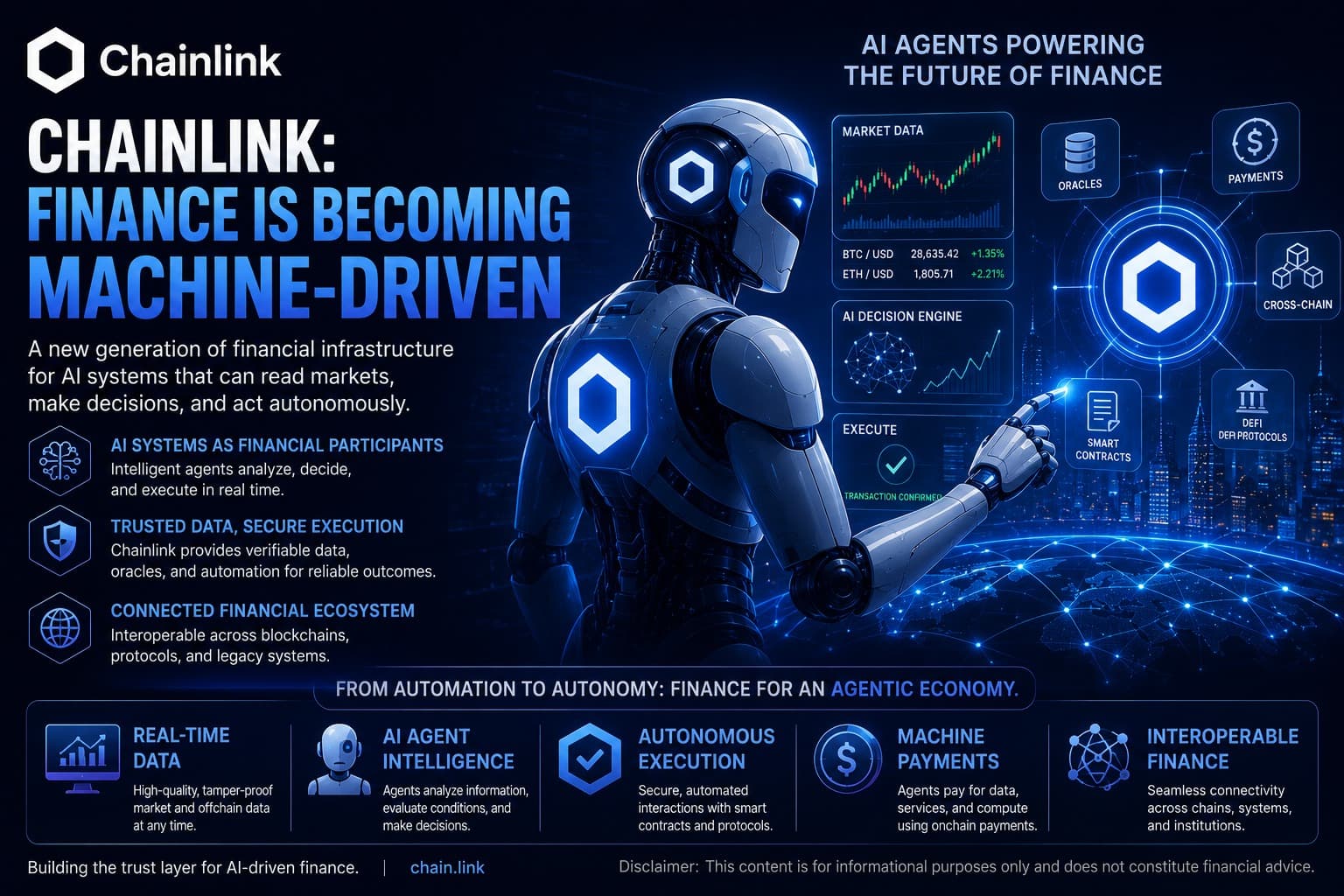
Chainlink is framing the next stage of financial infrastructure around a new type of participant: autonomous software capable of reading market information, making decisions and executing actions.
In a September 5, 2026 post, Chainlink argued that every generation of financial infrastructure has expanded the range of participants that can interact with markets. The company now sees a similar transition emerging around artificial intelligence, where software agents could become active participants rather than passive analytical tools.
BINANCE:LINKUSDT
The idea is broader than simply adding AI to existing financial applications. It points toward an emerging model in which software can access verified market data, evaluate conditions, trigger transactions and interact with financial infrastructure with limited human intervention.
That shift could have significant implications for blockchain, tokenized assets, stablecoins and decentralized finance.
 Fink: Data Center Moratorium Risks Recession→
 IMF Sees Global Growth at 3.1% in 2026 as AI Boom Offsets Energy Shock→
 FTC Investigation Targets OpenAI and Anthropic→
 BlackRock: AI Will Drive a New Machine-Native Economy→
From financial users to machine participants
Financial infrastructure has historically been designed around identifiable human and institutional participants.
Banks, brokers, exchanges, asset managers and payment providers all operate within systems designed for people and organizations. Even when transactions are automated, humans typically define the rules, approve important actions and remain responsible for the outcome.
Artificial intelligence changes the architecture.
An autonomous agent can continuously monitor information, interpret conditions and execute predefined actions. Instead of waiting for a human to open an application and place an order, an agent could theoretically identify a condition, verify relevant data and initiate a transaction automatically.
This is the concept behind what is increasingly called agentic finance.
Research published in Technological Forecasting and Social Change in July 2026 examined 306 AI agents across several DeFi application areas, including trading, governance and other financial functions. The study also highlighted risks involving opacity, misalignment and centralization.
The important point is that autonomous finance is moving from a theoretical discussion toward an infrastructure problem.
Intelligence alone is not enough
A large language model can analyze information, but financial execution requires substantially more infrastructure.
An agent interacting with a financial market needs access to current and trustworthy data. It needs to know whether information is fresh, whether a market is open, what an asset is worth and whether an action complies with predefined rules.
It also needs a secure method for executing transactions.
Chainlink’s architecture increasingly focuses on this layer.
The company’s Chainlink Runtime Environment (CRE) is designed to orchestrate workflows between onchain and offchain systems. Chainlink says CRE can enable authenticated data, AI-driven automation and workflows that agents can discover, use and pay for.
That creates a more complete architecture:
Data → reasoning → verification → execution → settlement
Each component matters.
An intelligent agent that receives inaccurate market data can make a bad decision. An agent with accurate information but unrestricted transaction permissions can still create unacceptable financial risk.
The infrastructure therefore has to control both information and execution.
Chainlink’s move toward agent infrastructure
The company’s Chainlink for Agents initiative provides a more concrete example of where this strategy is heading.
Chainlink describes the service as an onchain engine for the agentic economy, combining verified data, execution and cross-chain capabilities. Its current beta supports connections with agent frameworks and provides access to Chainlink-powered workflows.
Several components are particularly important.
Verified market data
Financial agents need current information rather than static datasets. Chainlink’s data infrastructure is designed to provide market information to blockchain applications, including data feeds and low-latency Data Streams.
This becomes especially important when an automated strategy is making decisions based on rapidly changing prices.
Transaction execution
An agent must eventually turn a decision into an action.
CRE is designed to connect agent-driven workflows with onchain execution, allowing applications to trigger smart contracts and coordinate more complex financial processes.
Cross-chain interoperability
Financial activity increasingly spans multiple blockchain networks.
Chainlink’s Cross-Chain Interoperability Protocol (CCIP) is designed to transfer data and value between supported blockchain environments. For autonomous agents, cross-chain infrastructure could allow a decision made on one network to trigger an action on another.
Machine-native payments
Agents also need a way to pay for data and services.
Chainlink’s agent infrastructure incorporates x402-style pay-per-call functionality, while its research on AI-agent payments describes blockchain and stablecoins as potential settlement mechanisms for autonomous software.
This creates an important conceptual shift.
The machine is no longer simply consuming financial information. It can potentially become a participant in a digital economy.
Tokenized assets could become a major use case
The connection between autonomous agents and tokenized assets is particularly significant.
CryptoQuorum has previously examined how Chainlink is becoming deeply involved in the tokenized-equity ecosystem across Coinbase, Robinhood, xStocks and Ondo.
Tokenized assets provide blockchain-native representations of financial instruments, but they still require external information.
A tokenized stock needs reliable pricing.
A lending protocol needs collateral valuation.
A tokenized fund may require current NAV information.
A cross-chain application needs secure messaging.
An autonomous portfolio manager needs all of those components before it can safely make decisions.
This is where oracle infrastructure becomes more than a supporting service. It can become part of the execution layer connecting traditional financial information with blockchain-based actions.
Chainlink’s own tokenization infrastructure is explicitly designed around data, interoperability, compliance and asset servicing.
Expert opinion: the infrastructure must connect with existing finance
The institutional perspective is important because autonomous finance cannot develop independently from the existing financial system.
Nelli Zaltsman, Head of Platform Settlement Solutions at Kinexys Digital Payments at J.P. Morgan, has emphasized the importance of connecting new infrastructure with systems institutions already trust. Chainlink cites the Chainlink Runtime Environment as a mechanism for integrating new technologies into established workflows.
That observation highlights a key limitation of the machine-finance narrative.
Financial institutions are unlikely to replace their entire infrastructure simply because autonomous agents become more capable.
Instead, agents are more likely to operate through controlled interfaces connecting legacy systems, blockchain networks, payment infrastructure, custody systems and compliance processes.
The winning infrastructure may therefore be interoperability rather than replacement.
The biggest issue: controlled autonomy
The concept of fully autonomous finance sounds powerful, but it introduces a difficult question:
Who is responsible when the machine makes the wrong decision?
Recent academic research on agent-to-agent finance argues that autonomous economic systems require mechanisms for identity, authorization, payment, verification, reputation and accountability. The paper describes “bounded autonomy” as a key design challenge for machine-mediated financial interactions.
This is particularly relevant to financial markets.
An agent should not necessarily have unlimited access to a wallet.
Instead, developers may need to define:
- maximum transaction sizes;
- approved counterparties;
- permitted assets;
- spending limits;
- geographic restrictions;
- execution conditions;
- emergency shutdown mechanisms;
- human approval thresholds;
- audit trails.
Chainlink itself acknowledges that its agent infrastructure does not eliminate financial risk. The company’s documentation explicitly notes that agents can still make incorrect decisions that result in losses and that DeFi carries inherent risks.
That caveat is critical.
Reliable infrastructure can reduce certain technical risks, but it cannot guarantee that an AI model will make the correct economic decision.
Why this matters for DeFi
DeFi could become one of the earliest environments where machine-driven financial activity becomes visible at scale.
An autonomous agent could theoretically:
- monitor market prices;
- compare liquidity across protocols;
- calculate transaction costs;
- identify an opportunity;
- verify relevant oracle data;
- execute a transaction;
- move assets between networks;
- rebalance its portfolio.
The individual steps already exist in various forms.
The emerging development is their combination into a single automated workflow.
Chainlink’s Q1 2026 review reported significant developer activity around AI agents, strategy managers, tokenization and related CRE applications, illustrating that agent-oriented infrastructure is becoming part of the broader blockchain development stack.
CryptoQuorum has also covered the regulatory debate around autonomous trading, including calls from U.S. lawmakers for greater clarity over AI-driven trading and responsibility when automated systems make investment decisions.
That regulatory question will become increasingly important as autonomous systems move from experimentation toward real capital.
AI could change the economics of blockchain transactions
There is another implication behind Chainlink’s argument.
If autonomous agents become widespread, the number of machine-to-machine financial interactions could increase substantially.
A human investor may make a handful of financial decisions each day.
An automated system could potentially monitor thousands of events continuously and execute transactions whenever predefined conditions are met.
That could create demand for:
- machine-readable financial data;
- automated settlement;
- micropayments;
- programmable wallets;
- cross-chain execution;
- verifiable computation;
- compliance automation;
- identity and authorization infrastructure.
The resulting economy would not necessarily be dominated by humans clicking buttons.
Instead, humans could increasingly define objectives and constraints while software handles individual execution decisions.
Finance is becoming machine-driven — but not overnight
Chainlink’s statement should therefore be viewed as a direction of travel rather than a claim that autonomous finance has already replaced conventional markets.
Traditional financial infrastructure remains dominant.
Banks, exchanges, custodians and regulators still control much of the world’s financial activity. AI adoption is increasing, but human supervision remains important, particularly for high-value and regulated transactions.
The transition is likely to be gradual.
First, agents will monitor markets.
Then they will recommend actions.
Next, they will execute tightly constrained transactions.
Over time, more complex workflows could become autonomous, provided regulators, institutions and users can establish sufficient trust.
The distinction between an AI assistant and an autonomous financial participant will increasingly depend on whether the software can actually control assets and execute transactions.
The bigger picture
Chainlink’s latest message reflects a broader change taking place across both AI and blockchain.
The first generation of financial technology digitized information.
The next generation automated transactions.
The emerging agentic model attempts to automate parts of decision-making itself.
For that model to work, intelligence must be connected to trustworthy data, programmable assets, secure execution and clear controls.
That is where blockchain infrastructure could become particularly important.
The future of finance may not simply be digital finance.
It could be finance in which software itself becomes an active economic participant.
The central question will not be whether machines can make financial decisions.
It will be whether the industry can build infrastructure that allows them to do so verifiably, securely and within clearly defined limits.
Disclaimer: This article is for informational and educational purposes only and does not constitute investment, financial, legal or regulatory advice. Statements about future autonomous finance, AI agents and blockchain adoption describe emerging technologies and should not be interpreted as guarantees of future performance or adoption. Readers should conduct their own research and assess the risks associated with digital assets, AI-driven systems and DeFi protocols.