

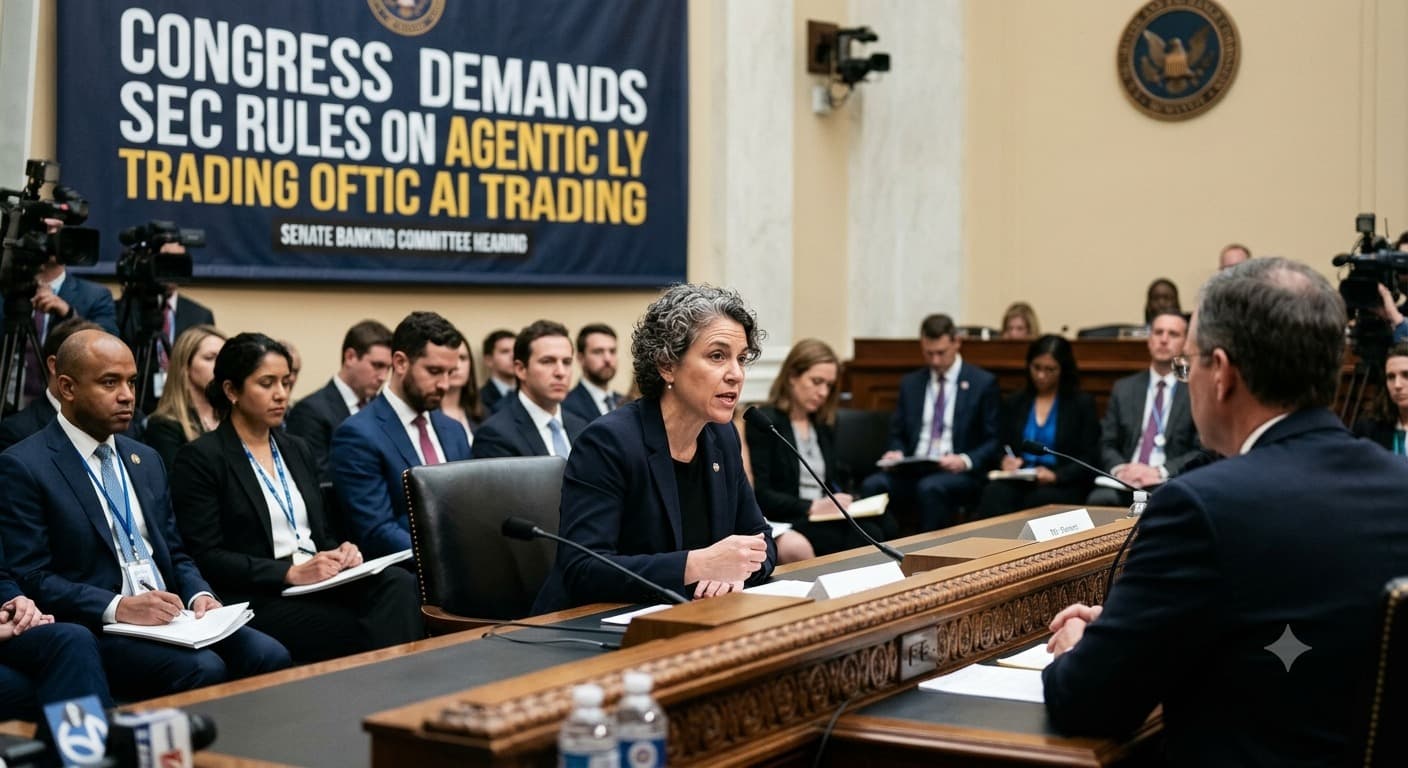
Two senior members of the House Financial Services Committee have put the SEC on notice: the autonomous AI trading revolution has arrived in retail investing, and Washington wants to know who is responsible when the algorithm gets it wrong.
On June 24, 2026, Representatives Bill Foster (D-IL) and Brad Sherman (D-CA) formally called on SEC Chairman Paul Atkins to explain what regulatory framework — if any — currently governs agentic AI trading in consumer brokerage accounts. The bipartisan letter, cosigned by six additional House members and addressed directly to the SEC Chair, reflects a growing concern in Washington that the technology has moved significantly faster than the rules designed to protect investors from it.
The urgency is not hypothetical. Less than a month earlier, on May 27, 2026, Robinhood launched its Agentic Trading product, making one of the first attempts to bring autonomous finance technology to ordinary investors rather than institutions and giving its 27 million customers the ability to connect third-party AI assistants to execute investing strategies with minimal human involvement. The product is live. The regulatory framework governing it is not.
What Congress Is Actually Asking the SEC
The Letter to Chairman Atkins
Representatives Foster and Sherman led members of the House Financial Services Committee in calling on SEC Chair Paul Atkins to explain what oversight, guidance, and investor protections are in place as brokerage firms begin allowing AI agents to make autonomous trades on behalf of retail investors, and whether the agency has evaluated the risks these systems pose to market integrity and consumer protection.
 Fink: Data Center Moratorium Risks Recession→
 IMF Sees Global Growth at 3.1% in 2026 as AI Boom Offsets Energy Shock→
 FTC Investigation Targets OpenAI and Anthropic→
 BlackRock: AI Will Drive a New Machine-Native Economy→
The letter also asks Chairman Atkins to provide clarity on the legal responsibilities of broker-dealers, AI developers, and AI agents themselves, and whether existing securities laws are sufficient to regulate agentic AI trading or if additional action from Congress would be needed.
The lawmakers were pointed in their diagnosis of what is at stake. In their letter, they wrote: “The AI firms developing and deploying these agents have thus far operated largely outside the securities regulatory framework, even though their systems are making or enabling consequential investment decisions on behalf of retail investors. It is essential that this technology be delivered in a manner that preserves the protections investors expect in regulated financial markets, and not as a tool to conceal conflicts of interest, evade broker-dealer responsibilities, manipulate markets, or provide unsound investment advice.”
The letter was cosigned by Representatives Stephen Lynch (D-MA), Jim Himes (D-CT), Sean Casten (D-IL), Rashida Tlaib (D-MI), Brittany Pettersen (D-CO), and Sylvia Garcia (D-TX) — a cross-section of the committee that signals this is not a fringe concern.
The Core Questions Left Unanswered
The Foster-Sherman letter identifies three questions that regulators have not yet answered: who is liable when an AI agent executes an unintended trade; whether broker-dealers have adequate supervisory obligations over the AI systems they connect to retail accounts; and whether the SEC has even begun evaluating the systemic risks that autonomous retail trading poses to market stability at scale.
These are not hypothetical edge cases. They are the foundational questions of investor protection in a market where, for the first time, millions of everyday investors can hand legal control of their money to a third-party AI system without a licensed financial adviser in the loop.
The Robinhood Launch That Triggered Washington’s Response
How Agentic AI Trading Reached Retail Investors
Robinhood launched Agentic Trading and the Agentic Credit Card, enabling AI agents to trade and make credit card purchases on behalf of its customers, allowing users to execute specific trading strategies or automate spending — entirely via connected AI agents operating through Robinhood’s Model Context Protocol servers.
Users on the platform can now create a separate account for their AI agents, connected to a dedicated wallet. While these agents can read and analyse users’ portfolios and suggest investments, they are only able to access the pre-loaded balance in the dedicated wallet to place orders.
The safety guardrails Robinhood introduced are notable — but so are their limits. Robinhood’s disclosures acknowledge that AI agents can misinterpret instructions, act on stale information, and behave unpredictably. The company explicitly states it does not control, supervise, monitor, recommend, or audit the agents customers choose to connect, and that once customer data leaves Robinhood’s environment and reaches a third-party AI provider, it falls under that provider’s terms. Customers assume all risk for orders placed by their agents.
That liability language is precisely what concerns the lawmakers who wrote to Chairman Atkins.
Options, Crypto, and Futures: The Roadmap Ahead
The agentic trading feature is launching in beta and currently only allows stock trading. Robinhood plans to add support for options, crypto, event contracts, futures, and prediction markets as it moves out of beta.
The expansion of agentic AI trading into crypto and derivatives — asset classes with significantly higher volatility and fewer investor protections than equities — makes the absence of regulatory guidance even more pressing. A retail investor who misunderstands what their AI agent is doing in a leveraged futures position faces risks qualitatively different from a misplaced equity rebalance.
Expert Opinions: What Regulators and Analysts Are Saying
FINRA: Autonomous AI With No Human in the Loop Is a Top Risk
The concerns raised by Foster and Sherman are echoed by the industry’s own self-regulatory body. FINRA’s 2026 Annual Regulatory Oversight Report includes a major section on generative AI, identifying AI agents acting autonomously with no “human in the loop,” agent permission and access issues, and AI independently misusing sensitive data in unauthorised ways as the emerging AI risks of greatest concern. FINRA emphasises that firms must hold AI systems to the same compliance standards as their communications, governance, and documentation in all other business areas.
FINRA supervision requirements, SEC best execution standards, and existing dispute rules were not designed for autonomous agent execution, and no regulator has published definitive guidance on how they map to agentic trading.
The Explainability Problem
AI-powered strategy agents in 2026 generate decisions that are difficult to audit at the individual trade level. This creates accountability gaps for professional users operating under regulatory obligations — and those gaps are significantly larger for retail investors with no compliance infrastructure at all.
Technology-neutral supervision rules require broker-dealers to be able to reconstruct and explain trading decisions. If an agent’s decision logic cannot be reconstructed in a format a regulator can review, the broker-dealer’s supervisory system is not considered reasonably designed under current standards.
Global Regulators Are Already Moving
The United States is not alone in recognising the risks. Australia’s ASIC published its 2026 key issues outlook explicitly identifying agentic AI as a risk for investors due to “its capability to independently plan and act.” IOSCO has put AI as a clear focus in its 2026 workplan with a goal to create a supervisory toolkit and guidance for firms on disclosure and governance. FINRA also gave explicit guidance in their 2026 regulatory oversight report, discussing the specific need for governance and controls around agentic AI.
The SEC’s relative silence — which is what the Foster-Sherman letter is addressing — stands in contrast to the regulatory movement happening at FINRA, IOSCO, and financial regulators across allied economies.
Debevoise & Plimpton: The Conflict of Interest Risk
Legal analysts have flagged a dimension of the problem that goes beyond individual investor losses. Many broker-dealers and investment advisers are embracing generative AI to support parts of the investment lifecycle — from synthesising investment research to undertaking trend analysis, anomaly detection, and pattern recognition for risk modelling. The rapid adoption raises questions about how well these systems are disclosed to clients and whether they introduce undisclosed conflicts of interest. sec
This is exactly the concern the letter to Chairman Atkins articulates when it warns against AI being used “as a tool to conceal conflicts of interest” — language that suggests lawmakers are aware that AI systems can embed the preferences and incentives of their developers in ways that are invisible to users.
What Happens Next
The Foster-Sherman letter requests a formal response from SEC Chairman Atkins explaining the agency’s current position, any guidance it has issued or plans to issue, and its assessment of whether existing securities laws are adequate.
The broader question it raises is whether the SEC — under a chairman who has generally favoured a lighter regulatory touch on emerging technologies — will move proactively, or whether Congress will ultimately need to act. With Robinhood’s agentic AI trading product already live for 27 million customers, and crypto, options, and futures access on its roadmap, the window for proactive regulation is narrowing.
Regulators including the SEC and CFTC are actively examining how existing laws apply when an AI — rather than a licensed human — executes a trade or authorises a payment. The CFTC recently issued a no-action letter related to AI-driven platforms, but clear liability frameworks, disclosure rules, and fiduciary standards for agentic finance are still being developed. This is a fast-moving area, and the regulatory picture could look very different by the end of 2026.
For retail investors using or considering agentic AI trading tools right now, the message from Washington is unambiguous: the guardrails that protect you in a traditional brokerage account do not straightforwardly apply to an AI agent operating on your behalf. Congress has asked the SEC to explain what does. The answer, when it comes, will shape the future of autonomous finance.
Disclaimer: This article is for informational purposes only and does not constitute financial or legal advice. Always conduct your own research and seek professional guidance before making investment decisions.