English
  Español

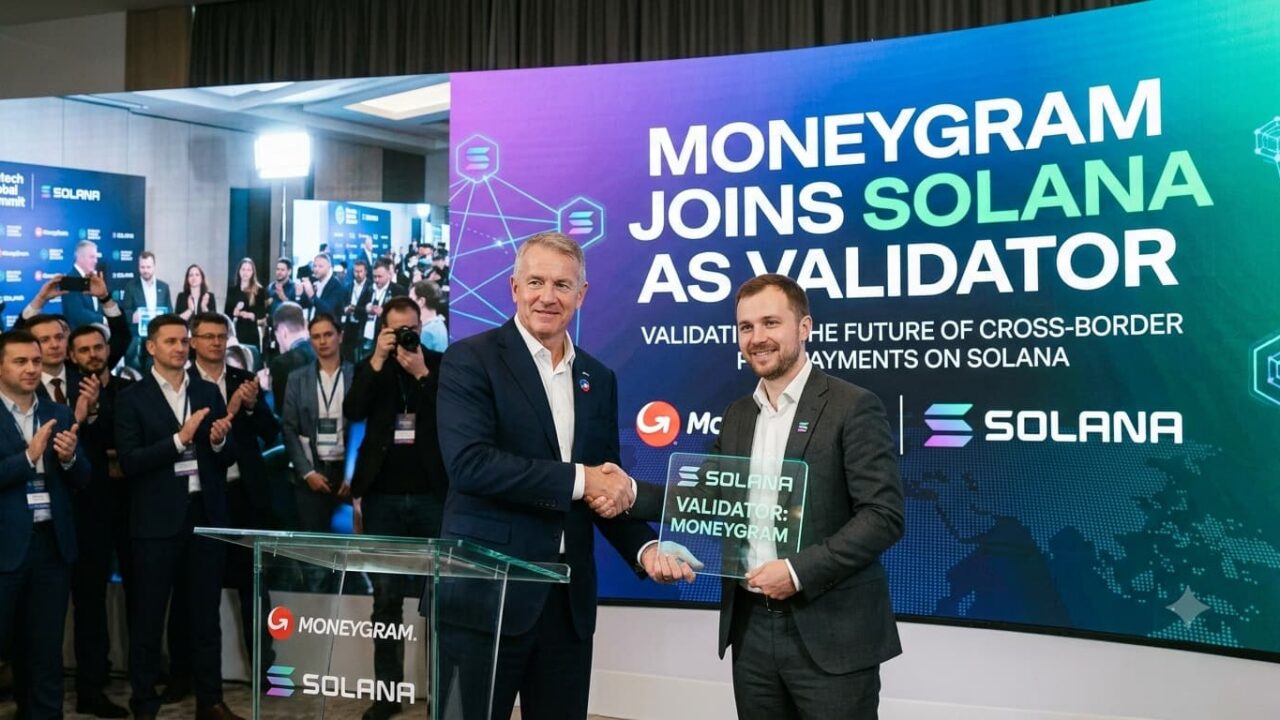
When a company that has been moving money across borders for more than 80 years decides to help run the rails it moves money on, the message is unambiguous: the era of blockchain-powered global payments is no longer coming. It is here.
On July 16, 2026, MoneyGram announced its entry into the Solana ecosystem, becoming an active Solana validator and simultaneously joining the Solana Developer Platform – a move shared directly on the company’s official X account. “Running a validator puts MoneyGram inside Solana’s consensus,” said Luke Tuttle, Chief Product and Technology Officer of MoneyGram. “We stake Solana (SOL), process transaction blocks and help secure the network at the protocol level. We help run the rails we move money on.”
That single sentence — “we help run the rails we move money on” – encapsulates a strategic repositioning that would have seemed improbable just two years ago. MoneyGram is not merely a user of blockchain infrastructure. It is now an active participant in building and securing it, serving more than 60 million active customers through nearly 500,000 retail locations, with over 70% of transactions flowing through digital channels.
Read Also
From Payments User to Protocol Participant
What Becoming a Solana Validator Actually Means
In Solana’s proof-of-stake consensus system, validators are the backbone of the network. They stake SOL, process transaction blocks, vote on the validity of the ledger, and collectively determine the state of the chain. Without validators, there is no Solana.
By operating a validator, MoneyGram will help process transactions and secure Solana’s proof-of-stake network, becoming a key part of the infrastructure that keeps the network running. The company also joined the Solana Developer Platform, an AI-ready, API-driven institutional build environment designed for compliant financial product development. Fellow members of the platform include Mastercard — placing MoneyGram in elite institutional company on the network.
ETH / USD Real-Time Chart
Solana now becomes the third blockchain network where MoneyGram operates an official Solana validator, alongside Tempo — a payments-focused blockchain where MoneyGram serves as an anchor remittance validator — and Midnight, Cardano’s privacy-focused sidechain. The pattern is consistent: MoneyGram is not picking one blockchain winner. It is embedding itself into the infrastructure of the most strategically relevant networks in global payments.
A Five-Year Runway to This Moment
This move did not happen overnight. “We’ve spent more than five years building real-world payment solutions using blockchain and stablecoins,” CEO Anthony Soohoo noted. That runway is visible in the data. MoneyGram has operated on Stellar since a 2021 partnership with the Stellar Development Foundation that has since facilitated more than $4.2 billion in USDC remittance volume. Its global crypto cash service using USDC on Stellar now operates across 170+ countries, with nearly $30 million in cumulative transaction volume.
Stay Ahead of the Curve
Join our weekly newsletter for exclusive insights.
MoneyGram has also introduced stablecoin-based remittance services, crypto-to-cash withdrawals and digital dollar products across multiple markets. The company’s most recent partnership with Kraken, announced in May 2026, enables Bitcoin-to-cash withdrawals — connecting Kraken’s crypto liquidity directly to MoneyGram’s global cash-out network.
The MGUSD Stablecoin: MoneyGram’s Asset Across Multiple Chains
A Native Dollar for 60 Million Customers
The Solana validator announcement arrived three weeks after the most significant product launch in MoneyGram’s blockchain history. On June 2, 2026, MoneyGram announced the launch of MGUSD, a native U.S. dollar stablecoin and the foundation for a growing suite of financial services across its global network, with native issuance on Stellar and support from Bridge (a Stripe company), M0, and Fireblocks.
The company partnered with Bridge, the stablecoin infrastructure platform acquired by Stripe, which serves as MGUSD’s regulated issuer. Blockchain infrastructure firm M0 developed the smart contracts used to mint and redeem the token, while Fireblocks provides wallet infrastructure.
The strategic framing is deliberate and important. CEO Anthony Soohoo said: “The stablecoin market has largely focused on the asset itself. MoneyGram is taking a fundamentally different approach. Starting with our distribution platform, we’re using stablecoin as a foundation to build future applications on our global network.”
Where Tether and Circle built their assets first and then sought distribution over years, MoneyGram already has the distribution — 60 million customers, nearly 500,000 locations – and is layering the asset on top of it. The reversal of the traditional crypto launch playbook is the strategic asymmetry that makes MoneyGram’s stablecoin move genuinely distinctive.
The Multi-Chain Architecture
MoneyGram now has a Solana validator, an MGUSD stablecoin on Stellar, validator roles on Tempo and Midnight, and cash-access partnerships tied to crypto wallets and exchanges.
That positioning makes MoneyGram increasingly a liquidity bridge between the most payments-focused public blockchains. Stellar continues to anchor its retail cash network and native MGUSD stablecoin issuance. Solana offers access to deeper stablecoin liquidity, higher throughput, and a developer ecosystem that is rapidly attracting institutional finance. Tempo and Midnight extend the reach into payments-specific and privacy-preserving infrastructure respectively.
Circle’s USDC, for example, settles across more than ten public blockchains – and the stablecoin industry’s direction of travel is clearly toward multi-chain interoperability rather than single-chain dominance. MoneyGram’s architecture reflects that reality from day one.
Expert Opinions: Why This Matters for Global Finance
Anthony Soohoo, MoneyGram CEO: Interoperability Is the End Goal
The clearest statement of MoneyGram’s long-term vision came from its chairman and CEO. “MoneyGram has spent the past several years integrating blockchain into our payment infrastructure, and everything we are building now leverages this foundation,” Soohoo said. “We believe the future of global money movement will be built on open, interoperable stablecoin rails that anyone, anywhere can access.”
That phrase — “open, interoperable stablecoin rails” — is the thesis in five words. Soohoo is not describing a world where MoneyGram competes with a single blockchain’s native token. He is describing a world where stablecoins denominated in dollars, and eventually in multiple currencies, move frictionlessly across public blockchain infrastructure the same way TCP/IP moves data across the internet — with MoneyGram as a key node in that network.
Luke Tuttle, MoneyGram CTO: Infrastructure First
Luke Tuttle, MoneyGram’s chief product and technology officer, framed the move in operational terms: “We help run the rails we move money on.” This framing is significant because it positions MoneyGram not as a product company building on someone else’s infrastructure, but as an infrastructure participant itself. Running a Solana validator is not a marketing exercise. It requires technical commitment, staked capital, and operational reliability. MoneyGram is making that bet publicly and permanently.
The Defiant: A Third Blockchain Infrastructure Commitment
MoneyGram has launched an active validator node on the Solana network and joined Solana’s institutional developer platform, marking the payments company’s third blockchain infrastructure commitment and its first direct participation in Solana consensus.
The progression – Stellar partnership (2021), MGUSD stablecoin (June 2026), Solana Solana validator (June 2026) — represents a company systematically transforming its payments infrastructure rather than making isolated blockchain bets.
FinanceFeeds: Closer to the Infrastructure Layer
MoneyGram’s Solana validator role is a signal of deeper infrastructure involvement, not just blockchain usage. The company is moving closer to the networks that could support future stablecoin payments, settlement products, and institutional payment rails.
That distinction – between using a blockchain and securing it – is the critical one. A company that merely uses a blockchain is a customer of its infrastructure. A company running a validator is a co-owner of its security guarantees and a direct beneficiary of its economic model through staking rewards.
Competitive Context: Payments Giants Are Racing to Blockchain Infrastructure
Western Union, PayPal, Visa: The Race Is On
MoneyGram is not alone in this strategic direction, but the depth of its blockchain commitment is notable even against competitive peers. Western Union launched its USDPT stablecoin on Solana in early May 2026. PayPal and Visa have integrated stablecoin infrastructure into their cross-border settlement systems.
MoneyGram joins other established payments companies that have introduced proprietary stablecoins. Western Union launched its USDPT stablecoin on Solana in early May 2026, while PayPal and Visa have integrated stablecoin infrastructure into their cross-border settlement systems.
But there is a key differentiator that MoneyGram holds: its validator role. Western Union has a stablecoin on Solana. MoneyGram has a stablecoin and is actively helping to secure the network. That is a deeper, more structural form of commitment.
The Unbanked: The Market That Matters Most
The biggest addressable market for MoneyGram’s blockchain strategy is not institutions or crypto-native users. It is the roughly 1.4 billion people worldwide who remain underserved by traditional banking systems — many of whom are already MoneyGram customers sending remittances home to families in markets where a stable dollar balance is not a financial product but a lifeline.
“MGUSD is the stablecoin we built for our customers, for the families sending money home and for the billions of people around the world with limited financial access,” said CEO Anthony Soohoo. For many of those customers, MGUSD will be the first time they have held a stable dollar balance in a self-custodial digital wallet – not a speculative investment, but a practical tool for financial stability.
What Comes Next for MoneyGram’s Blockchain Strategy
As of July 2026, MoneyGram’s blockchain playbook is still in its early chapters. MGUSD launched in the United States first, with a global rollout planned across its 200+ country network. The Solana Developer Platform membership gives the company access to tools for building new financial products — products that do not yet exist but that a team with 60 million customer relationships and nearly 500,000 physical locations is uniquely positioned to distribute at scale.
The move follows MoneyGram’s recent launch of its MGUSD stablecoin and broader efforts to integrate blockchain infrastructure into global money transfers. The company now operates official validator nodes on Solana, Tempo, and Midnight, while continuing to build stablecoin-based payment services across its global network.
Five years of groundwork. A native stablecoin. A Solana validator. Three blockchain infrastructure commitments. For a company that was reminding customers to send money to their grandchildren just a few years ago, MoneyGram’s blockchain transformation is one of the most consequential – and underreported – shifts in global finance today.
Disclaimer: This article is for informational purposes only and does not constitute financial or investment advice. Always conduct your own research before making any investment decisions.