

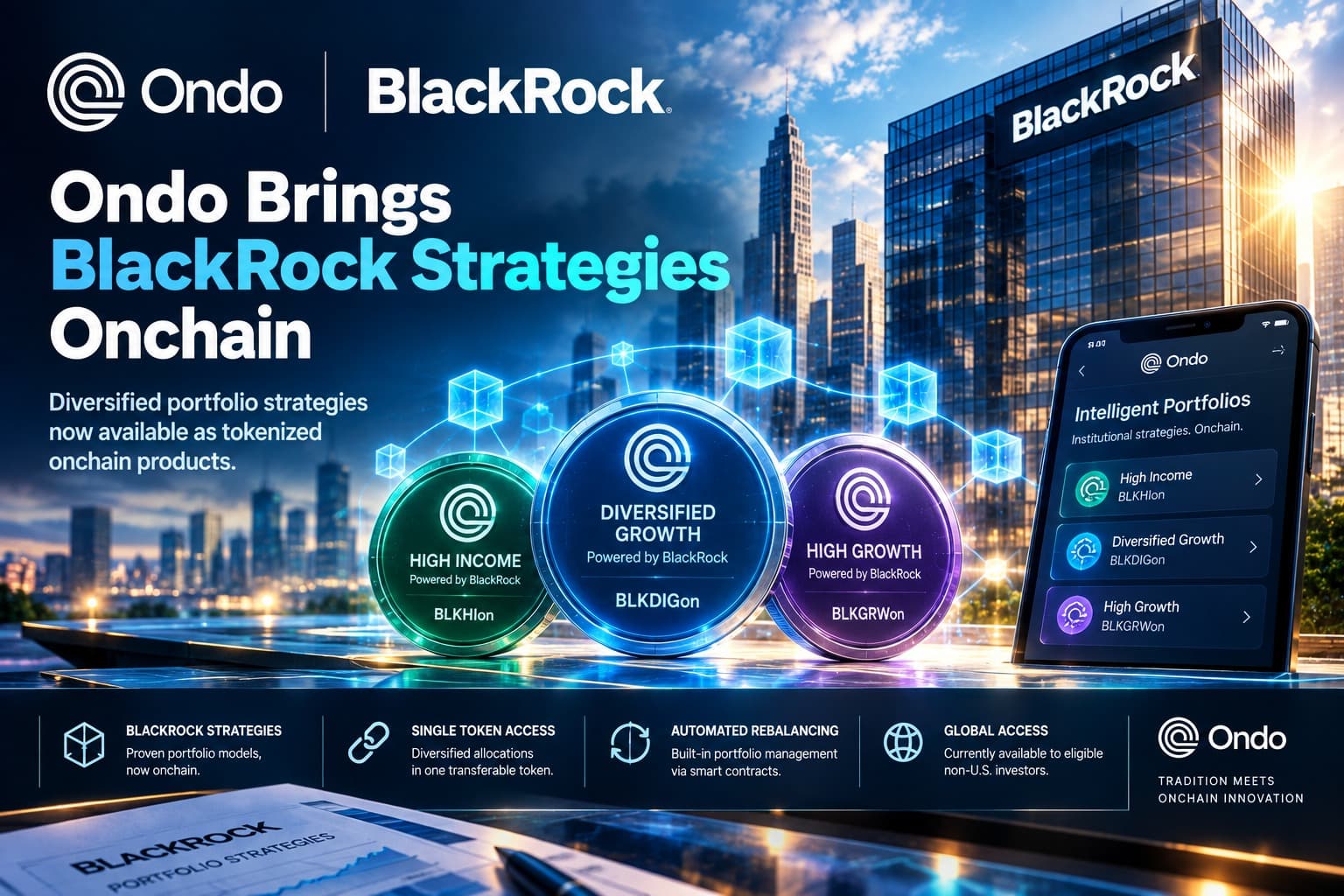
Ondo Finance has launched a new onchain investment category-Ondo Intelligent Portfolios that packages diversified portfolio strategies into single transferable tokens, with the first three products based on portfolio strategies developed by BlackRock for Ondo. The launch marks another step in the shift from tokenizing individual stocks and funds toward putting entire investment allocations on blockchain infrastructure.
The products, introduced on September 24, 2026, are designed for eligible investors outside the United States in permitted jurisdictions. Ondo’s product page currently states that the portfolios are not available in the U.S.
The three initial offerings are an income strategy, a diversified-growth strategy and a high-growth strategy. Rather than requiring an investor to purchase and rebalance each underlying asset separately, each portfolio is represented by a single blockchain token.
The development is important because it changes the unit of tokenization.
 CFTC Clarifies Tokenized Collateral Rules and On-Chain Recordkeeping→
 Solana Tokenized Stocks Smash Records with 850K Unique Holders and Institutional Adoption→
 Tokenized Credit Funds Surge: Maple Finance Leads Market Cap Growth Across Real-World Asset Sectors→
 SEC Allows Limited Tokenized NMS Stock Trading→
The industry has spent the past several years putting individual Treasuries, funds, stocks and ETFs onchain. Ondo is now attempting to package those tokenized assets into complete portfolio strategies.
From tokenized securities to tokenized portfolios
Tokenization has historically focused on individual assets.
A Treasury can be represented by a token. A stock or ETF can be represented by a blockchain-based instrument. A money-market fund can also be issued in tokenized form.
The new Ondo model operates at the next layer.
Instead of asking an investor to assemble a portfolio from multiple tokenized positions, Ondo packages the allocation into a single instrument.
According to the company, the underlying positions are built from Ondo Stocks, which represent tokenized equities and ETFs backed by corresponding real securities. Portfolio allocation, rebalancing and fee logic are encoded into smart contracts and executed according to defined rules.
That creates a structure that is closer to a traditional managed portfolio than to a single tokenized security.
The difference is the delivery mechanism.
A conventional portfolio generally requires a brokerage or investment account, multiple transactions and periodic rebalancing. The onchain version is designed to make the entire allocation transferable through one token.
The first three products
The initial portfolio lineup gives investors three different approaches rather than one universal strategy.
| Token | Portfolio | Strategy |
|---|---|---|
| BLKHIon | Ondo High Income Powered by BlackRock | Income-focused allocation |
| BLKDIGon | Ondo Diversified Growth Powered by BlackRock | Diversified growth allocation |
| BLKGRWon | Ondo High Growth Powered by BlackRock | Equity-led growth allocation |
*Source: Ondo Finance and The Block. Portfolio composition and weights can change according to scheduled rebalancing. *
The current product pages show that these portfolios already contain combinations of tokenized securities and, in some cases, digital-asset exposure. For example, the current High Growth portfolio page shows an equity-led strategy with a Bitcoin allocation.
That is significant because the tokenization model is not limited to traditional assets.
It can combine equities, bonds, alternatives and digital assets within a single portfolio structure.
BlackRock’s role needs to be understood correctly
The launch headline can easily create the impression that BlackRock is launching or managing these tokens.
That is not the structure described by Ondo.
Ondo says the first three strategies were developed by BlackRock for Ondo. BlackRock provides the portfolio models, while Ondo implements those strategies through its own tokenized portfolio infrastructure.
Ondo’s platform also explicitly states that BlackRock is not the investment adviser, sub-adviser, portfolio manager, manager, sponsor, promoter, underwriter, marketer or distributor of the onchain portfolios or their tokens. BlackRock does not manage the portfolios or make investment decisions for them.
This distinction is important for both investors and financial reporting.
The launch represents a collaboration between a major asset manager’s portfolio-construction expertise and Ondo’s tokenization infrastructure.
It should not be presented as a BlackRock-issued or BlackRock-managed crypto fund.
Why the single-token format matters
The strongest argument for the new structure is simplification.
Consider a portfolio containing multiple stocks, bond funds and other assets.
In a conventional structure, an investor needs to determine position sizes, execute several transactions and periodically rebalance the portfolio.
Ondo’s model shifts those functions into the product itself.
The company says each portfolio token tracks the target allocation and rebalances programmatically on a defined schedule, with the relevant activity visible onchain.
This introduces several characteristics associated with blockchain-based finance:
Transferability: the portfolio can move peer-to-peer between supported wallets and platforms.
Composability: the token can potentially interact with other onchain applications, subject to applicable restrictions.
Transparency: portfolio holdings and target weights are designed to be visible onchain.
Automation: rebalancing follows predetermined rules rather than requiring the holder to trade each constituent manually.
Those features do not necessarily make the strategy superior to a conventional investment product. They represent a different delivery and operating model.
Expert opinions: Ondo sees tokenization following the ETF path
John Hoffman, Ondo Finance’s managing director and head of product portfolios, has previously compared the development of tokenized assets with the early years of exchange-traded funds.
In August, Hoffman told The Block that he sees similarities between the skepticism that initially surrounded ETFs and the questions investors now have about tokenized assets. He argued that tokenization could eventually change how financial products are distributed and accessed.
That context helps explain the latest launch.
The company is not simply trying to put another security on a blockchain. It is attempting to reproduce a familiar investment concept — a diversified managed allocation — in a blockchain-native format.
In its latest messaging around the launch, Ondo has described the shift from a roughly $3 trillion onchain market toward a potential $100 trillion onchain technology market. That figure is an Ondo/Hoffman outlook, not an independently established market forecast.
The distinction matters.
The underlying observation is that digitization can broaden distribution and reduce transaction friction. The $100 trillion figure represents a forward-looking company thesis about how large tokenized financial infrastructure could eventually become.
BlackRock sees established portfolio construction moving into new channels
BlackRock Global Head of Model Portfolio Solutions Lisa O’Connor also commented on the launch.
Her assessment, as reported by The Block, is that established portfolio-construction approaches can be incorporated into tokenized products, allowing diversified allocations to be accessed through a single instrument.
That is perhaps the most important institutional aspect of the announcement.
Portfolio construction itself is not new technology.
Asset managers have been building multi-asset allocations for decades.
What changes is where the portfolio lives and how it can move.
A portfolio token can potentially be held in a blockchain wallet, transferred between compatible participants and integrated with other digital financial applications.
The underlying investment logic can therefore remain familiar while the operational layer changes.
The launch builds on Ondo’s tokenized-stock infrastructure
The Intelligent Portfolios launch did not happen in isolation.
Ondo has spent 2026 expanding the infrastructure underneath its tokenized securities business.
On September 21, the company announced that approved institutions could convert existing underlying shares into corresponding Ondo Stocks tokens through an integration with Alpaca’s Instant Tokenization Network. The company said the feature allows institutions to use existing equity inventory to mint tokenized positions and redeem those positions back into shares.
Two days earlier, Ondo announced that its subsidiary Oasis Pro Markets had joined DTCC’s Fund/SERV as the first tokenization platform member. DTCC said the system processes more than 85% of U.S. mutual-fund transaction activity, providing a standardized connection between tokenized funds and traditional fund distributors.
These developments are important because portfolio tokenization requires more than smart contracts.
It requires:
- asset sourcing;
- custody;
- issuance and redemption;
- compliance;
- transfer infrastructure;
- liquidity;
- fund-distribution connectivity.
Ondo is attempting to build these components as a connected system.
Why DTCC integration matters
The Fund/SERV development is particularly relevant to the portfolio story.
A tokenized investment can exist on a blockchain, but institutional adoption requires connections to the traditional financial system.
DTCC says Fund/SERV provides connectivity for account-level data, transaction confirmations, reconciliation, fund distributions, tax reporting and regulatory reporting.
That creates a bridge between two environments that have historically operated separately.
The significance is therefore broader than one Ondo membership.
It suggests that tokenized funds are increasingly being designed to communicate with existing fund-industry infrastructure, rather than operating entirely outside it.
The regulatory environment is evolving at the same time
The launch also comes during rapid regulatory development around tokenized securities in the United States.
On September 17, the SEC issued its Innovation Exemption, creating a temporary framework for certain tokenized NMS stocks to trade on permissioned onchain venues. The Commission said the exemption is designed to allow experimentation while it considers longer-term rules for onchain markets.
CryptoQuorum recently covered that development in SEC Allows Limited Tokenized NMS Stock Trading.
DTCC is also preparing its own tokenization infrastructure for DTC-custodied securities.
Together, these changes address different parts of the financial system:
SEC: trading framework.
DTCC: custody, settlement and market infrastructure.
Ondo: tokenized securities and portfolio products.
That creates an increasingly complete institutional tokenization stack.
The U.S. restriction is important
Despite the institutional names involved, the new portfolios are not currently offered to U.S. investors.
Ondo’s official Intelligent Portfolios page states “Not Available in US” and says access is intended for eligible investors in permitted jurisdictions.
That limitation should be included in any coverage because it materially changes the current addressable market.
The regulatory environment is still evolving, and Ondo’s U.S. infrastructure strategy is developing through Oasis Pro Markets, but the existence of regulated entities does not mean every Ondo product is immediately available to U.S. retail investors.
This is another reason not to describe the launch as the arrival of tokenized ETFs for the entire American market.
Potential advantages and risks
The new format offers several potential benefits.
Lower operational friction: one token can represent a diversified allocation rather than multiple positions.
Programmability: portfolio logic can be embedded in smart contracts.
Onchain transparency: holdings, weights and rebalancing activity can be visible through blockchain data.
Composability: tokens can potentially interact with compatible wallets, exchanges and DeFi applications.
But the model also introduces risks.
The underlying assets still carry market risk.
Blockchain infrastructure adds smart-contract, custody and operational risks.
Liquidity in the tokenized secondary market may differ from liquidity in the underlying securities.
Regulatory restrictions can limit access by jurisdiction.
And a tokenized portfolio does not eliminate management decisions: the portfolio methodology, asset selection, rebalancing schedule and implementation rules still determine the actual exposure.
A new layer between ETFs and DeFi
The broader significance of Ondo Intelligent Portfolios is that they occupy a space between traditional portfolio products and decentralized finance.
The products retain an investment concept familiar to asset management — a rules-based basket of securities — while adopting characteristics associated with blockchain markets.
That could create a new category of financial product.
An investor may increasingly be able to choose between:
individual tokenized assets → tokenized funds → tokenized portfolios → onchain financial applications.
Each layer offers a different level of abstraction.
This is similar to how conventional markets evolved from individual securities toward mutual funds, ETFs and increasingly automated portfolio solutions.
The difference is that blockchain can make the resulting instruments programmable and transferable as digital-native objects.
What to watch next
Several indicators will show whether the launch can scale beyond its initial group of portfolios.
Assets under management: sustained inflows would demonstrate demand for the format.
Secondary-market liquidity: active trading will be important if portfolio tokens are expected to move continuously between platforms.
Geographic expansion: the current non-U.S. limitation leaves future regulatory expansion as an important variable.
New strategies: Ondo says it plans to add additional portfolios over time.
Institutional connectivity: further integration with traditional market infrastructure could make tokenized portfolio products easier to distribute.
Product transparency: investors will need to distinguish model performance, actual portfolio performance, fees and the specific assets held at any point in time.
Bottom line
Ondo’s launch of Ondo Intelligent Portfolios represents a move from tokenizing individual securities toward tokenizing portfolio construction itself.
The first three products package income, diversified-growth and high-growth strategies into single transferable tokens, with strategies developed by BlackRock for Ondo and implemented through Ondo’s own tokenization infrastructure.
The distinction between the two companies is important: BlackRock provides the model portfolio strategies, while Ondo states that it manages, sponsors and administers the onchain portfolios. The products are currently aimed at eligible investors outside the United States in permitted jurisdictions.
The launch also builds on a broader infrastructure push. Ondo recently joined DTCC’s Fund/SERV and added in-kind conversion between underlying shares and tokenized stocks, strengthening the connection between traditional securities infrastructure and blockchain-based markets.
The long-term thesis is therefore broader than a new crypto investment product.
The question is whether traditional portfolio construction can be transformed into programmable, transferable and composable onchain infrastructure without sacrificing the custody, compliance, liquidity and investor protections expected in conventional markets.
That experiment has now moved from concept to live products.
Disclaimer
This article is provided for informational and educational purposes only and does not constitute financial, investment, tax, legal or other professional advice. Ondo Intelligent Portfolios involve investment and market risks, and availability is restricted by jurisdiction and eligibility requirements. Portfolio compositions, fees, performance and supported networks may change. BlackRock’s role is limited to providing model portfolio strategies for Ondo and does not mean that BlackRock manages, sponsors or recommends the Ondo portfolio tokens. Readers should review the official product documentation and conduct independent due diligence before making investment decisions.