

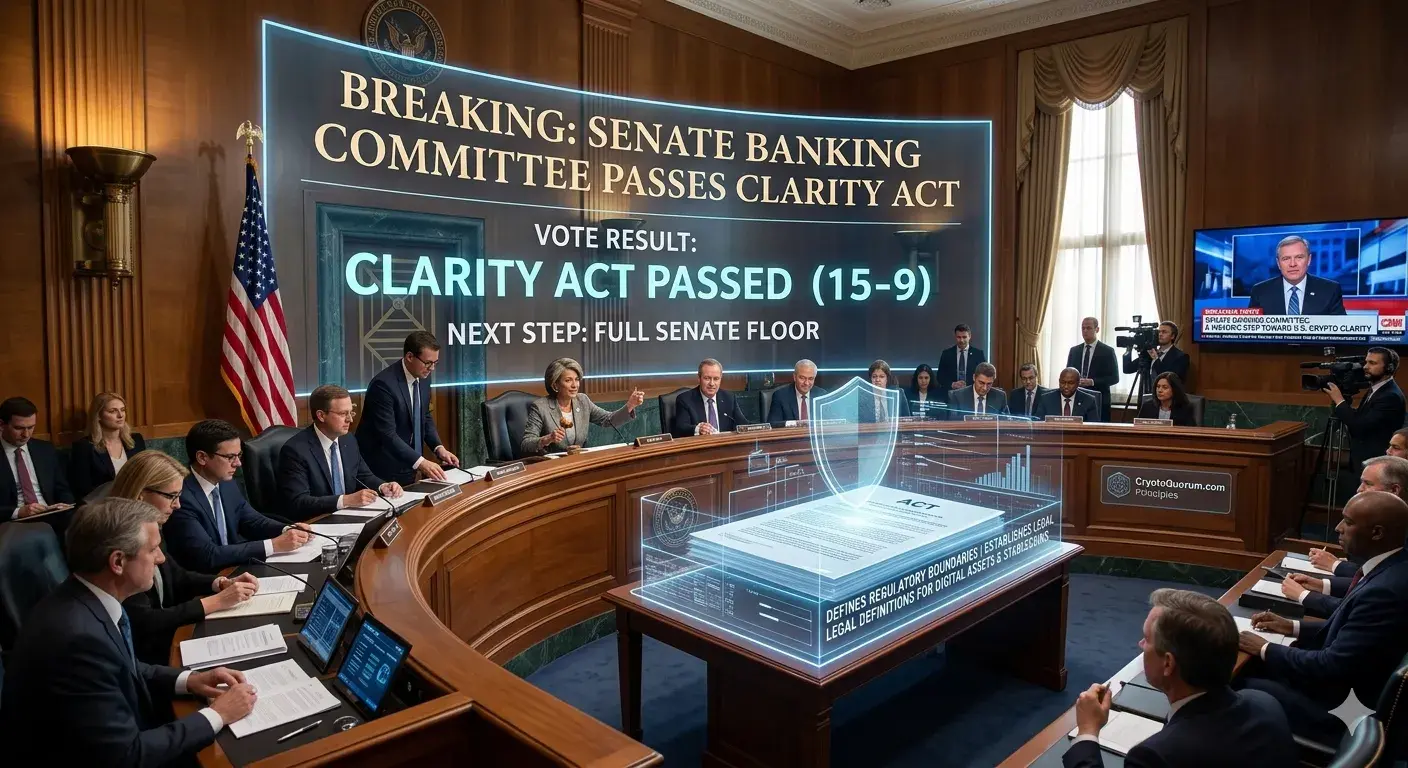
In a significant step toward establishing a formal regulatory framework for digital assets, the Senate Banking Committee has officially passed the Clarity Act with a 15-9 vote. The bill, which aims to provide long-awaited legal definitions and oversight rules for the cryptocurrency industry, now advances to the full Senate for further consideration. This legislative progress marks a critical turning point for market participants who have long advocated for “clear rules of the road” to foster domestic innovation.
Legislative Status:
BINANCE:BTCUSDT Real-Time Chart
- Committee Action: Successfully passed the Senate Banking Committee.
- Vote Result: 15 Yeas to 9 Nays.
- Next Milestone: Scheduled for a full Senate floor vote.
- Primary Objective: To define the regulatory boundaries for digital assets and stablecoins in the U.S.
Breaking the Regulatory Gridlock
The 15-9 vote in the Senate Banking Committee signals a growing bipartisan recognition that the “regulation by enforcement” era may be coming to an end. For years, the digital asset sector has operated in a gray area, often caught between competing jurisdictions. The Clarity Act seeks to resolve these tensions by providing a standardized set of requirements for issuers and service providers.
This movement aligns with the broader shift toward a New Financial World Order that institutional leaders have championed throughout 2026. As the U.S. looks to maintain its status as a global financial hub, the passage of this bill is seen as a necessary defensive and offensive measure.
 Michael Saylor Proposes a Bill of Digital Rights to Fuel a $100 Trillion Digital Economy→
 VanEck: Bitcoin Could Hit $100,000 by Next Year as Fiscal Pressure and Liquidity Shape the Market→
 Chainlink Bridges Traditional Capital Markets and Decentralized Finance Through Secure Oracle Infrastructure→
 Fed Rate Hike May Not Rattle Crypto Markets, Grayscale Says→
What the Clarity Act Means for Investors
If the bill passes the full Senate, it is expected to bring a wave of institutional confidence to the markets. Key provisions are rumored to include:
- Clear Definitions: Distinguishing between digital commodities and securities.
- Stablecoin Oversight: Establishing federal standards for reserve backing and transparency.
- Consumer Protection: Implementing rigorous auditing requirements for centralized exchanges.
This level of transparency is exactly what is required for the mass accumulation models proposed by figures like Michael Saylor to become a reality. Without a clear legal path, the “land grab” for digital assets remains a high-risk endeavor for traditional fiduciaries.
The Path to the Full Senate
While the committee victory is a milestone, the road ahead remains challenging. The bill will now face the scrutiny of the full Senate, where debate over specific consumer protection clauses and tax implications is expected to intensify. Industry groups are already mobilizing to ensure that the final version of the act maintains a balance between safety and the flexibility required for technological growth.
Market Implications (Analysis)
- Institutional Catalyst: Passage of the Clarity Act could serve as the “green light” for the next wave of spot ETFs and institutional custody solutions.
- Global Competition: By formalizing its stance, the U.S. directly competes with the EU’s MiCA framework, potentially preventing “brain drain” of crypto talent to more regulated offshore jurisdictions.
Expert Commentary
Reflecting on the significance of the vote, industry advocates noted that the Senate Banking Committee has effectively moved the needle from theoretical debate to actionable policy. The bipartisan nature of the 15-9 vote suggests that digital asset regulation is becoming an essential economic priority rather than a niche partisan issue.
Risks and Limitations
- Political Timing: As we approach the latter half of 2026, election-year politics could delay the full Senate vote.
- Amendments: There is a risk that the bill could be “watered down” or burdened with restrictive amendments during the floor debate.
Conclusion
The passage of the Clarity Act by the Senate Banking Committee is the strongest signal yet that the United States is ready to integrate digital assets into its core financial system. By moving the bill to the full Senate, lawmakers have taken a giant leap toward the “clarity” the industry has been demanding for over a decade.
CRYPTOCAP:TOTALDEFI Real-Time Chart
Stay updated on the full Senate vote — follow CryptoQuorum for real-time legislative tracking and market impact analysis.