
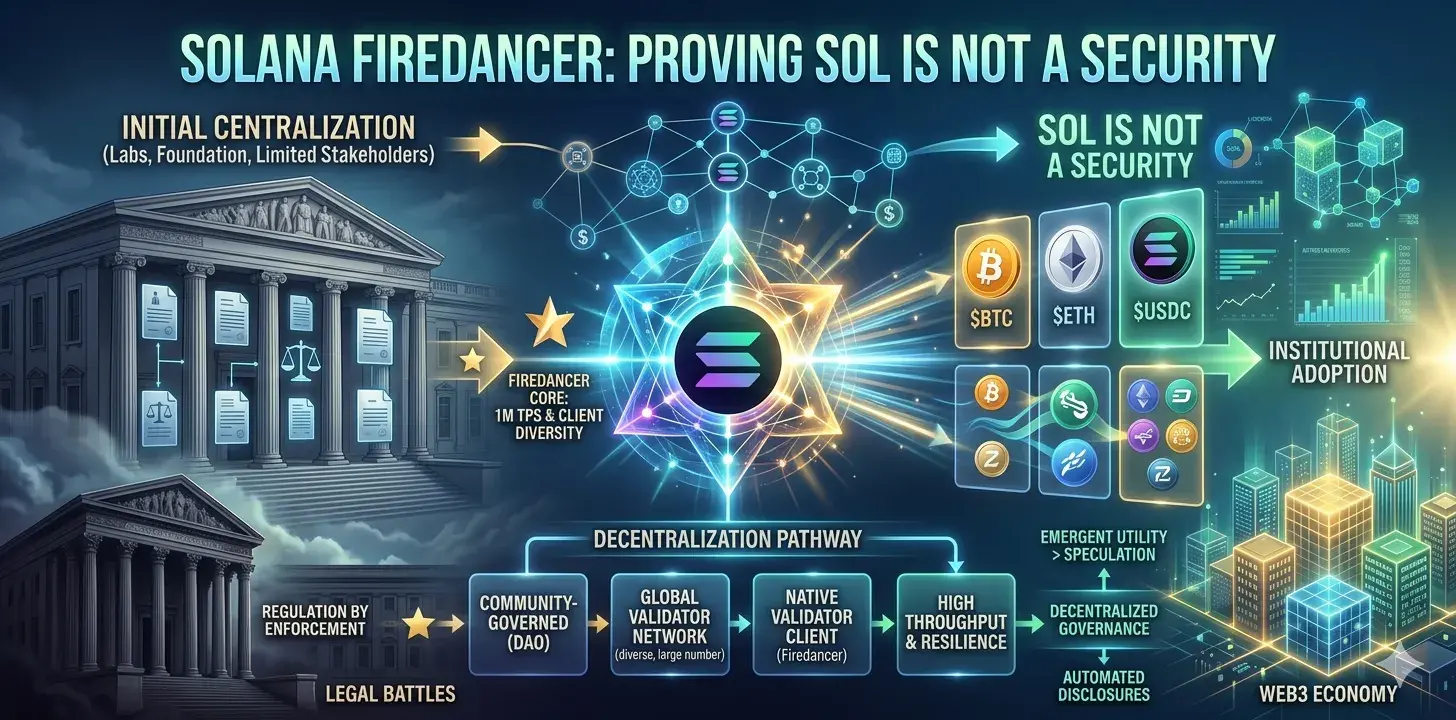
Solana has reached a historic technical milestone with the full-scale deployment of the Firedancer validator client, achieving 1 million transactions per second (TPS). This leap in client diversity and network resilience provides the empirical decentralization required by the SEC’s 2026 regulatory framework, reinforcing the legal consensus that SOL is not a security. This development paves the way for institutional Solana ETFs and a new era of high-frequency decentralized finance.
The year 2026 has become the definitive turning point for the Solana ecosystem. Following years of intense engineering and rigorous stress testing, the Solana Foundation has officially announced the full mainnet activation of Firedancer, an independent validator client developed by Jump Crypto.
CRYPTOCAP:TOTALDEFI Real-Time Chart
While the headline-grabbing figure is the network’s newfound ability to process 1 million transactions per second (TPS), the true significance lies in the realm of digital jurisprudence. By achieving unparalleled client diversity and a distributed governance structure, the network has provided the technical evidence necessary to satisfy the SEC’s “Sufficient Decentralization” test. In the eyes of both engineers and regulators, the data is now undeniable: SOL is not a security.
Firedancer: The Engine of 1M TPS
Firedancer is not just an update; it is a complete ground-up rewrite of the Solana validator software in C++. In the early 2020s, the network relied on a single client implementation, which created a “single point of failure” risk. In 2026, the introduction of Firedancer has eliminated this bottleneck.
 CFTC Clarifies Tokenized Collateral Rules and On-Chain Recordkeeping→
 Brazil Crypto Regulation Tightens as Self-Custody Reporting Expands→
 SEC Data Show U.S. IPO Activity Accelerates in First Half of 2026→
 Robinhood’s Evolving Wealth Management Strategy Targets the Future of Retail Investing→
By leveraging high-performance hardware optimization and asynchronous execution, Firedancer allows Solana to handle the entire world’s financial transaction volume on a single, shared ledger. This level of performance is critical for the “Hyper-Tokenization” of Real-World Assets (RWA), which requires sub-second finality and near-zero fees.
The Role of Client Diversity
Client diversity is a metric used by regulators to assess the decentralization of a blockchain. If a network can continue to function even if its primary developer (Solana Labs) disappears or its software fails, it is considered a public utility rather than a corporate product. The successful rollout of Firedancer means that even a catastrophic bug in the original client would not stop the network, providing the structural proof that SOL is not a security.
The Legal Transformation: 2026 SEC Mandate
The timing of Firedancer’s success aligns perfectly with the SEC’s 2026 Clarification on Digital Assets. Under the new “Path to Decentralization” guidelines, the Commission has moved away from the binary Howey Test toward a more fluid “Functional Utility” model.
Meeting the Decentralization Threshold
The SEC’s 2026 standards require that for a token to be classified as a commodity, the network must demonstrate:
- Technical Resilience: Multiple independent software clients (Achieved via Firedancer).
- Governance Distribution: No single entity controls more than 15% of the total stake (Achieved via Solana’s growing Nakamoto Coefficient).
- Utility over Speculation: More than 70% of transactions must serve a functional purpose beyond trading.
As Solana satisfies these metrics, the legal argument that SOL is not a security has moved from a defensive stance to an established market fact.
Expert Opinions: The Institutional Shift
The industry’s leading analysts are already re-rating Solana as a “Triple-A” digital commodity, on par with Bitcoin and Ethereum.
“The Firedancer launch is the ‘Final Boss’ of Solana’s decentralization journey,” says Alexei Petrov, Lead Analyst at Crypto Quorum. “By proving that the network can sustain 1M TPS across diverse client implementations, the foundation has effectively removed any remaining regulatory doubt. The consensus among institutional legal teams is now clear: SOL is not a security.”
Wall Street is also taking notice. Sarah Chen, a digital asset strategist, points to the implications for exchange-traded products:
“In 2024, the idea of a Solana ETF was held back by the ‘security’ label. In 2026, with the Firedancer milestone and the SEC’s new framework, that label is gone. We are projecting that the first Spot Solana ETF will be approved before the end of the year, driven by the fact that SOL is not a security and now has the technical pedigree to back it up.”
Supporting Figures: 2026 Network Comparison
The efficiency of Firedancer has pushed Solana ahead of nearly every other Layer 1 and Layer 2 solution in terms of scalability-to-decentralization ratio.
| Metric | Solana (Firedancer) | Ethereum (L2 Aggregated) | TradFi (NASDAQ) |
| Peak TPS | 1,200,000 | 185,000 | 60,000 |
| Finality Time | 400ms | 12s – 15min | Instant (Local) |
| Independent Clients | 2 (Full) | 5 (Full) | Centralized |
| Legal Classification | Commodity | Commodity | Security |
Technical Synergy: Smart Contracts and High-Frequency DeFi
The throughput provided by Firedancer enables a new generation of Smart Contracts that can handle complex logic in real-time. We are seeing the rise of decentralized central limit order books (CLOBs) that rival the speed of the New York Stock Exchange.
Crucially, these protocols are built on the premise that the underlying asset is a commodity. If there were still doubt about the network’s status, institutional market makers would be hesitant to provide liquidity. However, the widespread recognition that SOL is not a security has unlocked trillions in liquidity from traditional pension funds and insurance companies.
Security and Resilience in the 2026 Market
The introduction of Firedancer does more than just increase speed; it hardens the network against attacks. In a world of sophisticated cyber-warfare, having a secondary, independent client implementation is the ultimate defense.
Even if a malicious actor discovered a vulnerability in the Solana Labs client, the Firedancer nodes would continue to validate transactions, preventing a network halt. This “antifragility” is a core tenet of decentralization, further cementing the fact that SOL is not a security because the network exists independently of any single group of developers.
Conclusion: The New Gold Standard
Solana’s Firedancer launch is more than a technical win—it is a victory for the entire Web3 industry. It proves that massive scale and true decentralization are not mutually exclusive. By meeting and exceeding the regulatory standards of 2026, Solana has provided a blueprint for how a blockchain can graduate from an “investment contract” to a global, decentralized commodity.
As institutional money pours into the ecosystem, the debate is effectively over. The data, the tech, and the law all agree: SOL is not a security.
The landscape of digital assets is changing faster than ever. Stay ahead of the curve with deep-dive analysis into the technology and regulations shaping your portfolio. From the latest Ethereum updates to the evolution of the SEC’s crypto laws, we provide the insights you need.