

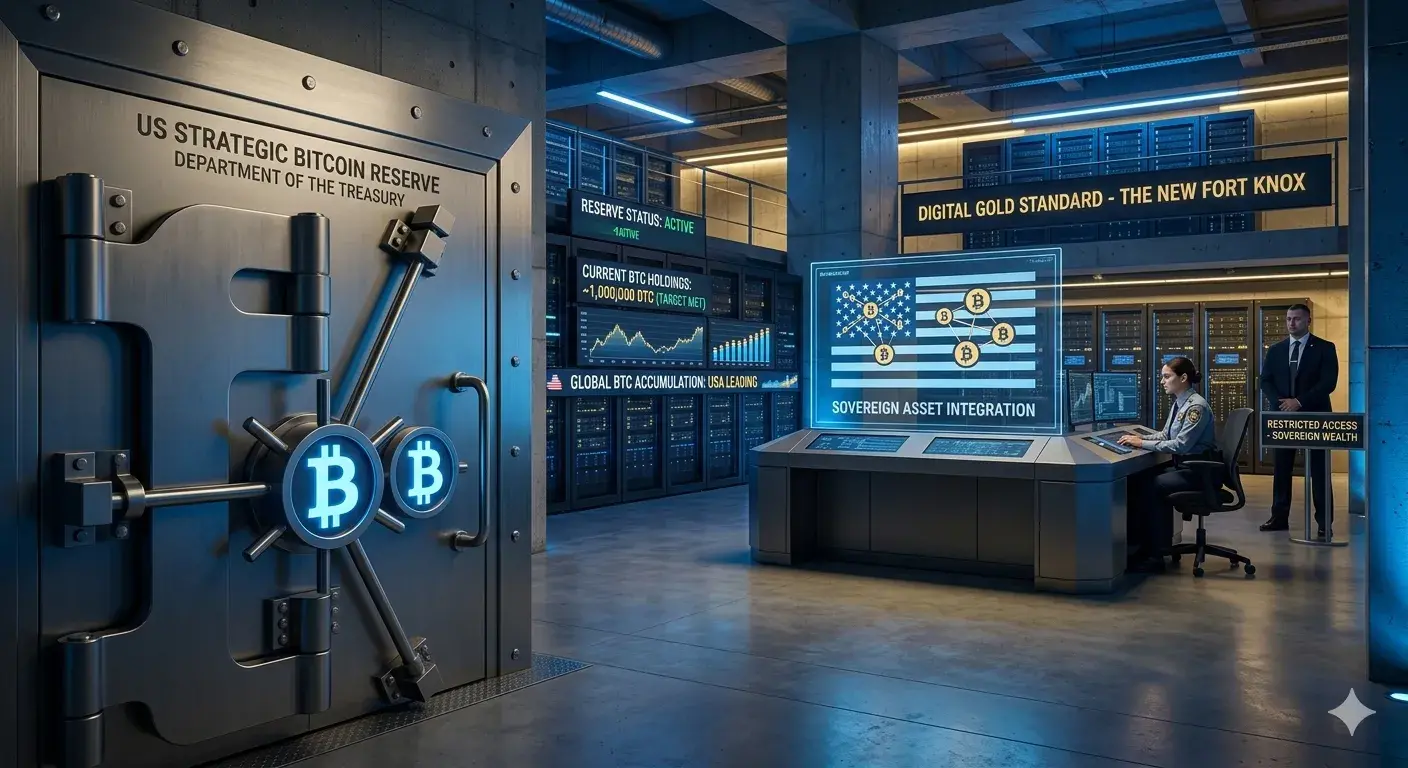
The global race to accumulate digital scarcity has officially entered a new, high-stakes chapter. According to recent reports covered by major financial networks like Fox News, a monumental legislative push is gaining rapid momentum in Washington to establish an official US Strategic Bitcoin Reserve. The bill targets an incredibly ambitious acquisition of 5% of the total Bitcoin supply, which equates to over 1,000,000 BTC. This move represents a tectonic shift in how the world’s leading economic superpower views national security, debt management, and sovereign wealth in the digital age.
By positioning Bitcoin as the “New Fort Knox,” lawmakers are acknowledging that physical gold alone can no longer anchor a modern financial superpower. The proposed framework outlines a programmatic purchasing structure where the U.S. Treasury would acquire 200,000 BTC annually over a five-year period. Crucially, these assets would be placed under a strict statutory lock-up period of at least 20 years, with the primary objective being the long-term stabilization of the national balance sheet and the reduction of mounting federal deficits.
BINANCE:BTCUSDT Real-Time Chart
Funding the Next Financial Frontier
Unlike traditional state spending, the proposed legislation does not rely on taxpayer dollars or increased inflation to finance the massive acquisition. Instead, the reserve would be funded by diversifying existing assets within the Federal Reserve System and the Treasury Department. One innovative mechanism involves utilizing the value appreciation of legacy Gold Certificates, which have sat on the government’s balance sheet undervalued for decades. By revaluing these certificates to reflect fair market values and transferring the difference, the U.S. can essentially trade analog equity for digital scarcity.
This institutional pivot follows months of quiet structural preparation in Washington. Regulatory bodies have been steadily providing the legal scaffolding needed to allow sovereign-level entities to hold digital assets securely. A prime example is the recent progress seen with the Senate Banking Committee passing the Clarity Act, which cleared away much of the jurisdictional gray area surrounding crypto classifications. Without that baseline regulatory framework, an ambitious initiative like a national Bitcoin treasury would have been dead on arrival.
 Michael Saylor Proposes a Bill of Digital Rights to Fuel a $100 Trillion Digital Economy→
 VanEck: Bitcoin Could Hit $100,000 by Next Year as Fiscal Pressure and Liquidity Shape the Market→
 Chainlink Bridges Traditional Capital Markets and Decentralized Finance Through Secure Oracle Infrastructure→
 Fed Rate Hike May Not Rattle Crypto Markets, Grayscale Says→
Geopolitical Triggers and the Global Asset Race
The timing of this bill is anything but accidental. The U.S. is facing intense pressure to preserve the dominance of the dollar as global markets increasingly shift toward decentralized infrastructure. Central banks worldwide are already realizing that traditional debt instruments are no longer reliable safe-havens against systemic currency debasement. As macroeconomists have noted, central banks are structurally incentivized to buy Bitcoin over physical gold due to its absolute self-custody properties and trustless, real-time cryptographic verification.
By moving first to capture 5% of the total circulating supply, the U.S. is attempting to preemptively secure a dominant position in the next international monetary architecture. If a major economic block begins removing hundreds of thousands of coins from open markets every single year, it triggers a severe supply squeeze for the rest of the world. This direct threat to open liquidity is forcing every other G20 nation to reconsider their own sovereign reserve strategies before the window of affordable accumulation permanently shuts.
Expert Opinions: A Financial Savior or a Market Disruptor?
The scale of the 1,000,000 BTC proposal has sparked intense debate among Wall Street analysts, public policy experts, and digital asset strategists. While some view the reserve as an inevitable evolution of sovereign money, others caution that state-level intervention on this scale will permanently reshape free-market mechanics.
Sovereign Accumulation and Debt Mitigation
Proponents of the bill, including pro-crypto legislators, argue that Bitcoin represents a generational “Louisiana Purchase” moment. They emphasize that using a programmatically scarce asset as a savings technology is the only viable way to offset dollar debasement and mitigate the trillions in national debt. Given its historical outperformance, a 20-year government lock-up could realistically generate enough sovereign equity to structurally alter the nation’s long-term financial health.
The Inevitability of a Global Supply Shock
Market analysts are focusing closely on the structural price implications of a state-backed purchasing program. Financial commentators recently highlighted on CNBC that Bitcoin’s long-term path to a seven-figure valuation follows unstoppable laws of nature and technological innovation. Experts point out that adding a persistent, programmatic buy wall of 200,000 BTC per year will inevitably trigger an unprecedented supply shock, making any corporate or retail accumulation models look minuscule by comparison.
The Risk of State-Sponsored Centralization
On the other hand, some privacy advocates and purists express concern over state-level hoarding. They warn that when a single government entity controls 5% of a global, decentralized network, it creates a unique centralization risk. Critics worry that while the bill explicitly protects individual self-custody rights, a massive state-held reserve could eventually lead to heavy-handed governance influence or unfair market distortion during periods of extreme macroeconomic volatility.
Institutional Implications for Corporate Treasuries
The true significance of a U.S. strategic reserve extends far beyond the government’s balance sheet. The moment a nation-state codifies Bitcoin into its statutory reserves, it effectively de-risks the asset class for every corporate board on Earth. For years, pioneers have been demonstrating the viability of corporate treasury diversification, most notably seen through Michael Saylor’s aggressive supply accumulation models. However, if the U.S. government becomes a major holder, holding Bitcoin transitions from an aggressive tech strategy to a mandatory fiduciary duty for global enterprise funds.
Furthermore, this geopolitical race highlights the widening gap between active market builders and regions stuck in bureaucratic inertia. While the U.S. speeds toward permanent sovereign adoption, other major economic zones are scrambling due to over-regulation. As observed during recent ECB debates surrounding the threat of digital dollarisation in Europe, moving too slowly to embrace the blockchain revolution risks leaving an entire continent dependent on foreign digital infrastructure.
Ultimately, the Strategic Bitcoin Reserve bill proves that the transition toward digital hard money is no longer a fringe theory. Whether driven by fear of inflation, geopolitical posturing, or pure economic opportunism, the world’s largest superpower has recognized that the code of Bitcoin is the safest place to store its future power.
CRYPTOCAP:TOTALDEFI Real-Time Chart
To follow this historic legislative development closer to the source, view the broadcast updates directly via The Bitcoin Historian on X.