

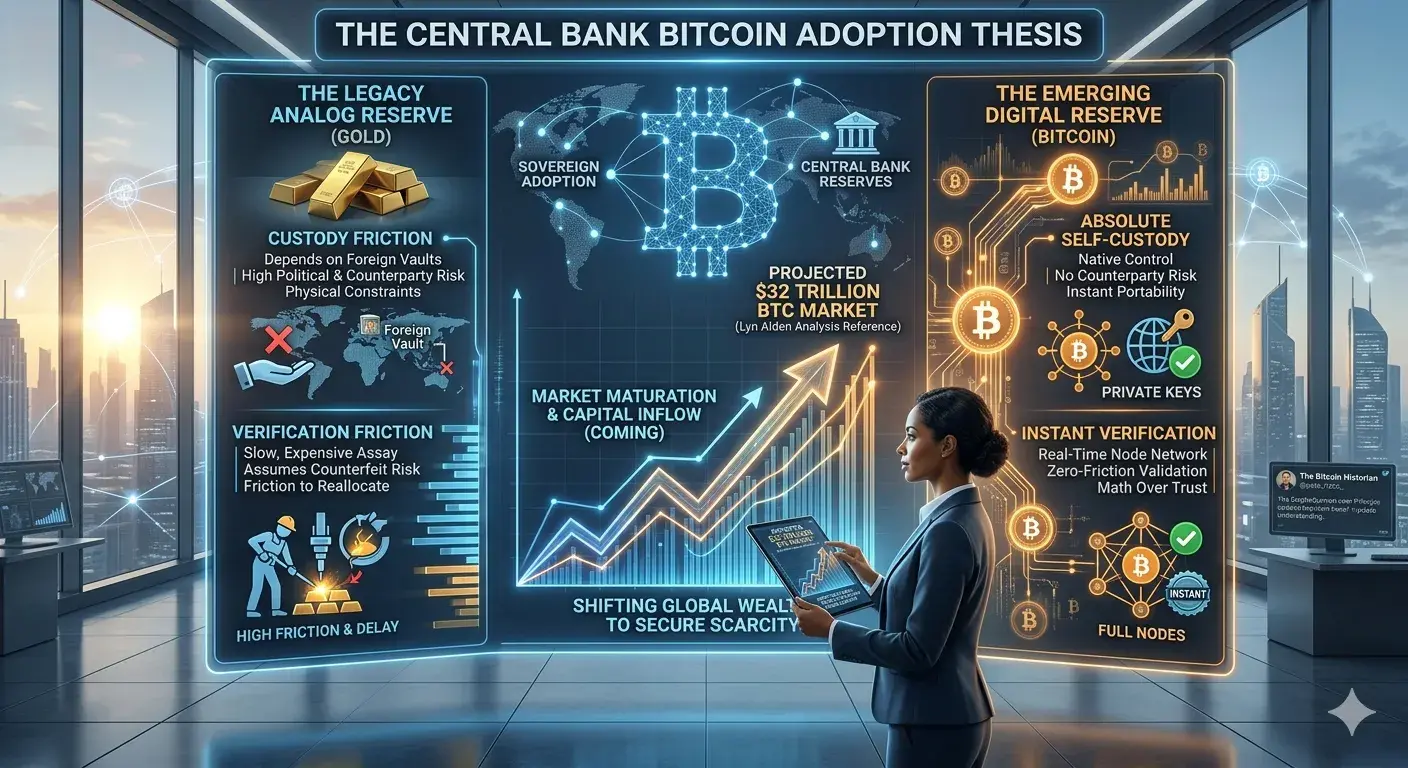
The global macroeconomic landscape is quietly preparing for a shift in how nations store their sovereign wealth. While gold has served as the ultimate tier-one asset for centuries, renowned macro analyst Lyn Alden recently laid out a compelling thesis explaining why central banks will buy Bitcoin in the near future. Highlighted by prominent Bitcoin historian Pete Rizzo, Alden’s argument strips away the speculative noise of crypto trading and focuses entirely on the raw physics of asset custody and validation. According to this framework, the unique properties of a decentralized digital ledger solve the fundamental vulnerabilities that have plagued physical gold for generations, setting the stage for an ultimate market expansion toward a $32 trillion valuation.
The Custody Conundrum: Sovereign Freedom vs. Geopolitical Risk
The first pillar of Alden’s thesis addresses a vulnerability that central banks have struggled with for decades: physical custody. Gold is heavy, cumbersome, and inherently difficult to move securely during times of geopolitical tension. Because of these physical limitations, many smaller or developing nations choose to store their gold reserves in foreign vaults, such as the Federal Reserve Bank of New York or the Bank of England.
BINANCE:BTCUSDT Real-Time Chart
However, recent global events have demonstrated that foreign-custodied assets can be frozen or seized during political conflicts. This is where Bitcoin completely changes the game.
- Absolute Self-Custody: Bitcoin can be held natively within a nation’s borders using cryptographic keys.
- Zero Counterparty Risk: A central bank does not need to trust a foreign superpower to safeguard its digital reserves.
- Instant Portability: Unlike tons of physical gold bullion that require armored transport and military escorts, billions of dollars in Bitcoin value can be reallocated across the globe instantly.
By eliminating the need for international middlemen, Bitcoin offers true financial sovereignty—a feature that physical gold simply cannot replicate in a digitized world.
 Michael Saylor Proposes a Bill of Digital Rights to Fuel a $100 Trillion Digital Economy→
 VanEck: Bitcoin Could Hit $100,000 by Next Year as Fiscal Pressure and Liquidity Shape the Market→
 Chainlink Bridges Traditional Capital Markets and Decentralized Finance Through Secure Oracle Infrastructure→
 Fed Rate Hike May Not Rattle Crypto Markets, Grayscale Says→
The Trust Engine: Instant Verification Over Friction
The second fatal flaw of gold in the modern era is the friction required to prove its authenticity. Verifying a large shipment of gold bars is a slow, expensive process. It requires physical drilling, melting, and chemical assaying to ensure the core hasn’t been substituted with tungsten or other cheaper metals.
Bitcoin replaces this archaic system with math. Anyone, from an individual retail investor to the chairman of a central bank, can run a full Bitcoin node on a standard computer. This node independently verifies the entire history of the network and confirms the validity of every single coin in real-time.
When a central bank receives Bitcoin, it knows with absolute, mathematical certainty that the asset is genuine within a matter of minutes. There are no auditors to pay, no storage facilities to guard, and no threat of counterfeiting.
The Road to a $32 Trillion Asset Class
If central banks begin shifting even a fraction of their capital away from legacy bonds and physical gold, the impact on Bitcoin’s valuation will be exponential. Alden’s model points toward an ultimate target of a $32 trillion market cap for Bitcoin as it matures into a primary global reserve asset.
This projection aligns closely with other institutional shifts taking place across the industry. We are already seeing the regulatory groundwork being laid in Washington with the Senate Banking Committee passing the Clarity Act, which provides the legal definitions needed for large-scale public capital to enter the space. Furthermore, corporate trailblazers are already testing the limits of supply elasticity; look no further than Michael Saylor’s aggressive supply accumulation models to see how scarcity drives price mechanics when large entities compete for a finite asset.
As leaders look toward a New Financial World Order built on transparency and digital efficiency, the transition from an analog safe-haven (gold) to a digital one (Bitcoin) appears less like a speculative bet and more like an economic inevitability. Central banks are ultimately in the business of preserving power and capital—and according to the latest data, the best tool for that job is no longer shiny metal, but immutable code.
CRYPTOCAP:TOTALDEFI Real-Time Chart
To review the original broadcast snippet and commentary regarding this macro thesis, you can view the update directly via Pete Rizzo on X.