

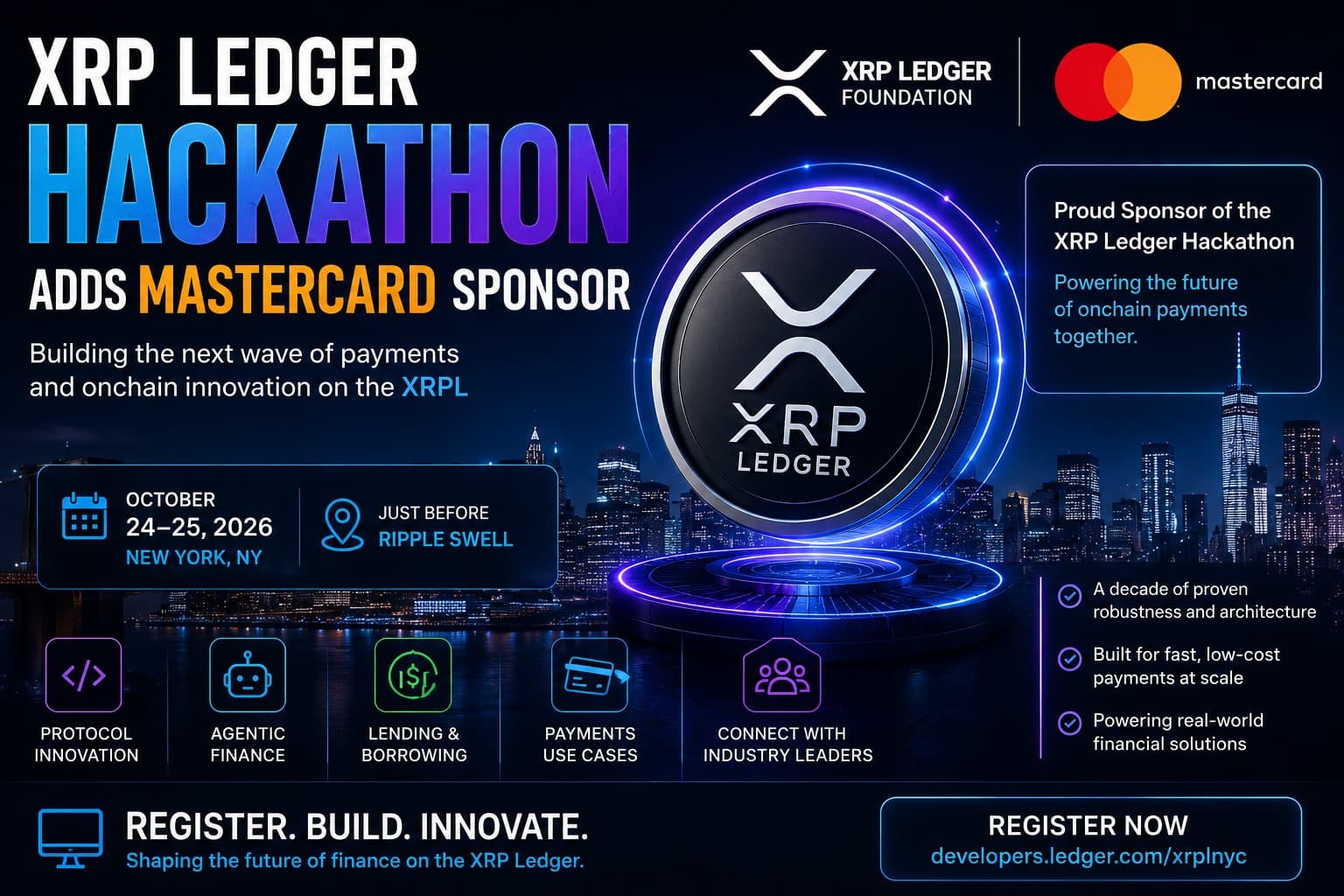
Mastercard has joined the XRP Ledger Hackathon as a sponsor, adding one of the world’s largest payment networks to an event focused on developers building financial applications on the XRP Ledger.
The announcement was made by the XRP Ledger Foundation, which said Mastercard will support the hackathon being co-hosted by XRPL Commons and the XRP Ledger Foundation in New York immediately before Ripple’s annual Swell conference.
CRYPTOCAP:TOTAL3 Real-Time Chart
The timing is notable. The hackathon is scheduled for October 24–25, 2026, while Ripple Swell will take place in New York from October 27–29. The hackathon is structured as a 36-hour sprint designed to give developers an opportunity to build and ship projects before connecting with financial institutions, technology companies and other industry leaders at Swell.
The sponsorship also arrives as Mastercard expands its own blockchain and stablecoin strategy, making its involvement more than a conventional technology-company partnership.
 RLUSD Crosses $2B as Ripple Expands Enterprise Stablecoin Strategy→
 Phantom to Discontinue Support for Sui on September 24: Safe Migration Guide for Wallet Holders→
 ATO Crypto Assets Guide 2026: How Australia Taxes Bitcoin, Staking, DeFi, and NFTs→
 Ripple’s UBRI 2025–2026 Report: Where Blockchain Academia Meets Real-World Finance→
Why Mastercard’s involvement matters
Mastercard has been moving deeper into digital-asset infrastructure throughout 2026.
In March, the company launched its Crypto Partner Program, bringing together more than 100 crypto companies, payment providers and financial institutions to explore practical applications for digital assets. Mastercard specifically identified cross-border payments, B2B transfers, payouts and settlement as areas where blockchain-based infrastructure is gaining traction.
In June, Mastercard announced plans to expand its settlement capabilities to include regulated stablecoins. The company said the new options would support intraday, weekend and holiday settlement and identified Ripple’s RLUSD among the stablecoins that Mastercard plans to support across multiple blockchain networks, including the XRP Ledger.
Mastercard also completed its acquisition of stablecoin infrastructure provider BVNK in August. The company said the transaction would strengthen its ability to connect digital assets with traditional payment rails and support use cases such as cross-border B2B payments, remittances, payouts, settlement and treasury operations.
Against that backdrop, sponsoring a developer event centered on XRPL payments is strategically relevant.
Mastercard is not simply watching the blockchain sector from the sidelines. It is building infrastructure designed to connect traditional financial networks with onchain assets and settlement systems.
XRP Ledger’s payments architecture
The XRP Ledger has long been optimized for payments and asset transfers.
The network uses a consensus protocol rather than proof-of-work mining, allowing transactions to reach ledger finality within seconds while maintaining predictable transaction costs.
The XRPL ecosystem also includes native functionality for issued assets, decentralized exchange infrastructure, escrow and payment channels.
Its payments-oriented architecture is now being complemented by newer capabilities.
The latest XRP Ledger 3.3.0 release introduced several protocol-level features, including atomic batch transactions, privacy-preserving Multi-Purpose Token transfers, granular account-permission delegation and transaction/reserve sponsorship.
These developments matter for enterprise applications because financial institutions typically require more than a fast blockchain.
They need mechanisms for authorization, compliance, asset issuance, transaction controls and operational flexibility.
The XRPL’s developer ecosystem is therefore evolving alongside its traditional payments focus.
The hackathon’s focus extends beyond payments
Although the XRP Ledger Foundation highlighted payments when announcing Mastercard’s sponsorship, the upcoming event is broader than a single use case.
XRPL Commons says the October 24–25 hackathon will include tracks covering protocol innovation, agentic finance, lending and borrowing, and an open category.
That creates an interesting intersection between the XRP Ledger’s established payment capabilities and newer applications emerging around blockchain finance.
Agentic finance
One of the most interesting tracks is agentic finance.
AI agents increasingly need the ability to execute transactions autonomously. That creates a requirement for programmable payment infrastructure capable of handling small, frequent and machine-initiated transactions.
CryptoQuorum recently examined this trend in its analysis of Ripple’s UBRI research into AI, tokenization and quantum-safe infrastructure.
The XRP Ledger’s low transaction costs and fast settlement make it a candidate infrastructure layer for applications where software agents need to transfer value without human intervention for every transaction.
The hackathon could therefore produce prototypes that connect AI agents with payments, identity, compliance or financial applications.
Lending and borrowing
The lending and borrowing track is another signal that XRPL development is expanding beyond its traditional payments identity.
Institutional credit has increasingly become a focus across digital-asset markets.
Recent developments on XRPL include institutional-grade credit infrastructure involving Cicada Credit and Clearpool, with the latter’s infrastructure built around the XRPL Lending Protocol and Single Asset Vault.
For developers, this opens the possibility of experimenting with credit markets, collateral management and programmable lending directly within the XRP Ledger ecosystem.
Mastercard brings payments expertise to the builder community
A major benefit of corporate sponsorship at a hackathon is access to industry knowledge.
Mastercard operates one of the world’s largest payment networks and has decades of experience dealing with transaction authorization, fraud prevention, settlement, compliance and global interoperability.
Those requirements are very different from simply transferring tokens between blockchain wallets.
For developers, exposure to these constraints can influence how applications are designed from the beginning.
A successful institutional payment application needs to consider questions such as:
- How is the sender authenticated?
- How is the recipient verified?
- How are transactions monitored?
- What happens when a payment needs to be reversed or disputed?
- How are sanctions and AML requirements handled?
- How does blockchain settlement interact with existing payment rails?
- How can liquidity be managed across currencies and jurisdictions?
These are precisely the types of questions that determine whether a blockchain application can move from a hackathon prototype to a production financial product.
The Mastercard-RLUSD-XRPL connection
Mastercard’s growing relationship with Ripple provides additional context.
In June, Mastercard announced that its planned stablecoin settlement infrastructure would include RLUSD, alongside other regulated stablecoins. The company said supported blockchain networks would include XRPL, Ethereum, Solana, Base, Arbitrum, Polygon, Canton and Tempo.
This means the XRP Ledger is becoming part of a broader multi-chain settlement strategy rather than being treated as an isolated blockchain.
The distinction is important.
Mastercard is not replacing its existing payment network with the XRP Ledger.
Instead, it is exploring how blockchain-based settlement can operate alongside existing financial infrastructure.
That model is consistent with Mastercard’s broader position that multiple forms of money and payment rails will increasingly coexist.
Expert opinions: infrastructure is becoming the competitive layer
The strongest signal from Mastercard’s involvement may therefore be less about the hackathon itself and more about the direction of financial infrastructure.
Mastercard has described a payments environment in which stablecoins, tokenized deposits, real-time payment systems and traditional rails increasingly need to work together.
That perspective is particularly relevant to XRPL development.
The future competition between blockchains may not be determined solely by transaction speed or token price. Enterprise adoption will also depend on whether developers can build applications that connect blockchain networks to regulated financial institutions.
In that environment, developer programs and hackathons can become an important part of infrastructure development.
They provide a testing ground for new applications before institutions consider deploying them commercially.
A decade of development — but not without risks
The XRP Ledger Foundation described the network as having a decade of proven robustness and architecture suitable for payment use cases.
The network’s history is certainly an important part of its institutional narrative. But a long operating history should not be interpreted as proof that every future application will be secure or commercially successful.
Recent XRPL security disclosures illustrate why continued testing remains necessary.
In July, a manifest-flood incident caused widespread peer disconnects across parts of the XRP Ledger network. The ledger itself did not halt or fork, and validators maintained consensus, but the incident exposed an availability weakness that developers subsequently mitigated with a hotfix.
Earlier this year, developers also disclosed a critical vulnerability in an unreleased Batch amendment. The issue was identified before the affected amendment could be activated on mainnet, and the problematic implementation was subsequently disabled and replaced with a corrected development path.
For an enterprise payments network, this is an important lesson.
Security engineering is not a finished product.
Continuous audits, responsible disclosure, validator diversity, software upgrades and developer testing remain essential regardless of a network’s operating history.
The hackathon itself can contribute to that process by bringing more developers into the ecosystem and encouraging experimentation under controlled conditions.
Ripple Swell creates a powerful follow-up opportunity
The timing of the hackathon may be one of its biggest advantages.
Developers will have 36 hours to build in New York on October 24–25. Ripple Swell begins just two days later, creating an unusual opportunity for projects to move almost directly from development into an environment populated by financial and technology executives.
Swell 2026 is being positioned around the intersection of traditional finance and the onchain economy, with speakers from financial institutions, exchanges and technology companies. The current lineup includes executives from Robinhood, BNY and ICE.
For a developer, that creates a potentially valuable sequence:
Build → Demonstrate → Network → Connect with industry
The strongest projects could gain visibility precisely when financial institutions are discussing how blockchain infrastructure can be used in production.
What developers could build
The combination of XRPL’s payment architecture and Mastercard’s involvement creates several potentially interesting directions for hackathon participants.
| Area | Potential application |
|---|---|
| Payments | Cross-border settlement and programmable transfers |
| Agentic finance | AI agents that autonomously execute payments |
| Lending | Onchain credit and collateral management |
| Stablecoins | RLUSD-based payment and treasury applications |
| Tokenization | Settlement for tokenized real-world assets |
| Compliance | Identity, AML and transaction-monitoring tools |
| Merchant payments | XRPL-based settlement and payment acceptance |
| Infrastructure | APIs and developer tools connecting XRPL with traditional finance |
These are potential development directions rather than announcements of products that Mastercard or XRPL has committed to launch.
That distinction is important for readers evaluating the event.
What this means for XRP and the XRPL ecosystem
The Mastercard sponsorship is unlikely to produce an immediate fundamental change in XRP’s market value.
Its significance is primarily infrastructure-oriented.
A successful hackathon could increase the number of developers building on XRPL, while Mastercard’s participation provides additional credibility among payment and financial-technology professionals.
The more important long-term question is whether applications created by developers can attract users, liquidity and institutional partners.
CryptoQuorum has previously examined this broader evolution in XRP Ledger: Surging Metrics and Institutional Adoption.
The ecosystem is increasingly moving toward a combination of payments, stablecoins, tokenized assets, credit and programmable finance.
Mastercard’s sponsorship reinforces that direction.
The bigger picture
The upcoming XRP Ledger Hackathon represents a convergence of three trends.
First, blockchain networks are moving from experimental payment technology toward institutional infrastructure.
Second, major payment companies are exploring stablecoins and onchain settlement as complements to existing rails.
Third, developers are building increasingly sophisticated applications around tokenization, AI-driven payments and decentralized credit.
Mastercard’s participation puts a major traditional payments company directly into that developer ecosystem.
For XRPL, the challenge now is straightforward: turn developer interest into production-grade applications that solve real financial problems.
The October hackathon will provide a first glimpse of what builders can create.
And with Ripple Swell following immediately afterward, the best ideas will have an unusually direct path from code to conversations with the financial industry.
The XRP Ledger may have spent its first decade proving that a blockchain can support payments. The next phase is about proving what developers can build on top of that foundation.
CRYPTOCAP:TOTAL3 Real-Time Chart
Disclaimer: This article is for informational and educational purposes only and does not constitute investment, financial, legal or tax advice. XRP and other digital assets are volatile and involve significant risks, including market, regulatory, technological, liquidity and cybersecurity risks. References to Mastercard, Ripple, XRPL or potential use cases do not constitute endorsements of any investment or guarantee future adoption. Readers should conduct independent research and consult qualified professionals before making financial decisions.