

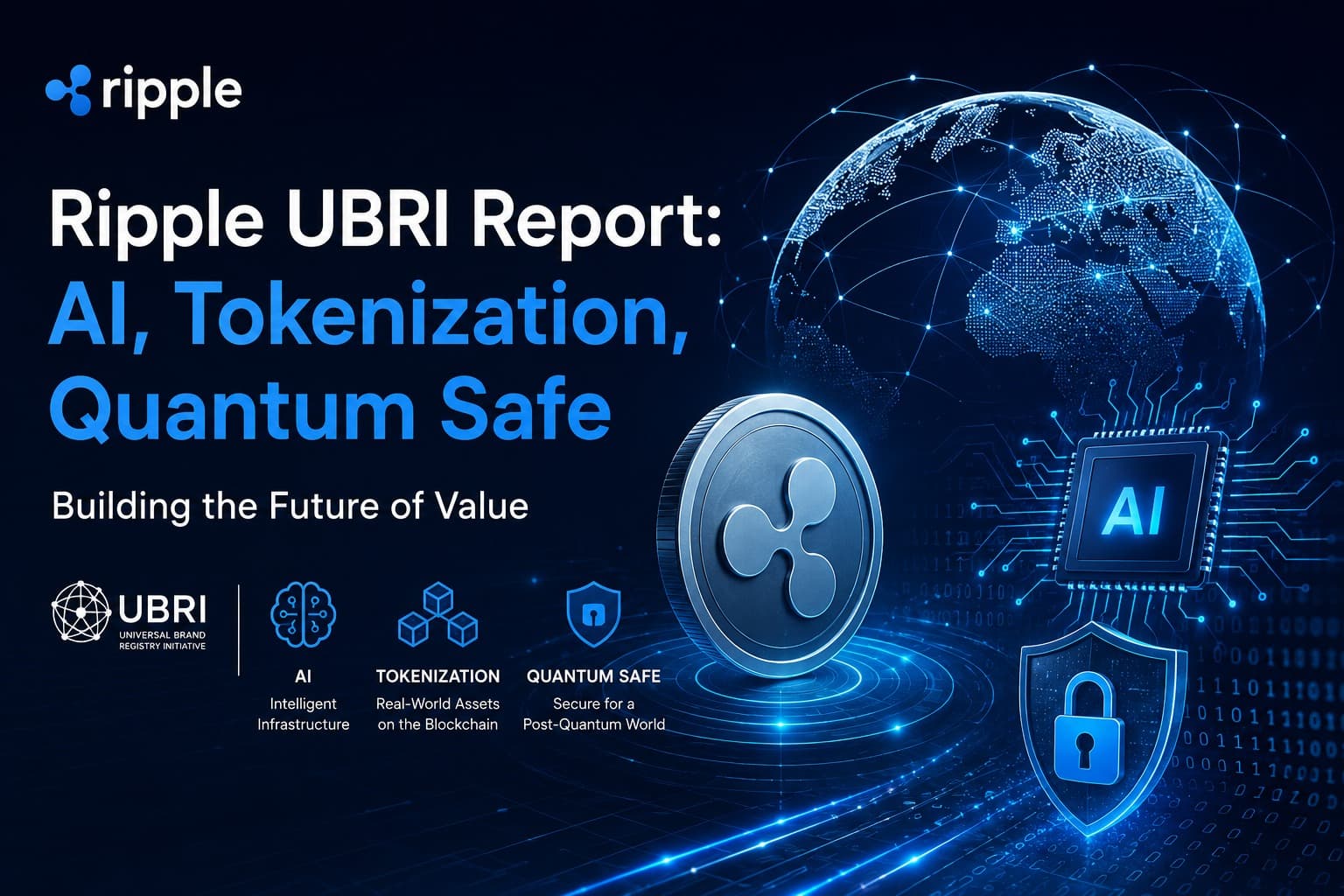
The gap between blockchain theory and financial reality has never been smaller – and a new report from Ripple’s University Blockchain Research Initiative shows exactly how that gap is being closed, one academic breakthrough at a time.
On July 22, 2026, Ripple published its 2025–2026 research report for the University Blockchain Research Initiative – better known as UBRI – the company’s flagship academic programme that has quietly grown into one of the most consequential blockchain research networks in the world. The report, shared via Ripple’s official X account, highlights breakthroughs across three frontiers that are already reshaping financial infrastructure: autonomous and AI-enabled finance, tokenised assets and digital markets, and post-quantum cryptography.
CRYPTOCAP:TOTAL Real-Time Chart
The timing is deliberate. As blockchain technology moves from whitepaper speculation to live financial infrastructure – powering cross-border settlements, tokenised stock markets, and bank-grade payment rails – the academic research that shapes its future is more important than ever. Ripple’s UBRI has been funding, connecting, and publishing that research since 2018. The 2025–2026 report is its most expansive output yet.
What UBRI Is- and Why It Matters Now
Eight Years of Building the Research Foundation
In 2025, Ripple’s University Blockchain Research Initiative entered its seventh year with a sharper mission: moving from building a global academic network to deploying it. Through expanded grants, new accelerators, and hands-on residencies, UBRI turned university research into real-world blockchain applications. Since its launch in 2018 as the first programme of its kind, UBRI has grown into a cornerstone of Ripple’s commitment to innovation, having now supported more than 60 universities worldwide with over $74 million in funding deployed.
 XRP Asia Officially Launches in Seoul to Accelerate XRP Ledger Adoption Across the Asia-Pacific Region→
 Why Crypto Rallied After Clarity Act Failed→
 Coinbase and Citi Expand Stablecoin Payments for Businesses→
 CFTC Clarifies Tokenized Collateral Rules and On-Chain Recordkeeping→
That funding figure – $74 million distributed across 60+ academic institutions – positions Ripple’s UBRI as the single largest sustained blockchain research investment in academic history. The list of partner institutions spans continents and disciplines: Cornell, Stanford, Imperial College London, UC Berkeley, the University of São Paulo, Nanyang Technological University, the Australian National University, Duke University, and dozens more. These are not institutions that accept funding from anyone. Their participation is itself a signal of the programme’s academic credibility.
From Network-Building to Real-World Deployment
The shift in mission framing – from building a network to deploying it – is the most important contextual statement in the 2025–2026 report. For the first seven years, Ripple’s UBRI was, in part, a long-term infrastructure investment: funding research, establishing academic relationships, and seeding a global community of blockchain-literate scholars. The 2025–2026 phase marks a different kind of ambition. The rapid expansion of blockchain and digital asset ecosystems has intensified the challenge of translating academic research into deployable systems and regulatory frameworks. UBRI now examines the architectural and coordination patterns that enable such translation, treating academic-industry collaboration not as a grant-giving exercise but as a system for producing research-to-deployment pipelines at ecosystem scale.
Three specific research frontiers define where that deployment focus is concentrated in 2025–2026.
Frontier One: Autonomous and AI-Enabled Financial Infrastructure
The Agent Economy Needs Blockchain Rails
The most forward-looking of the three research areas is also the most rapidly evolving. Autonomous AI agents- software systems that can independently make decisions, execute transactions, and manage financial operations without human intervention – are moving from science fiction to financial reality at a pace that has surprised even their creators. The question UBRI’s academic partners are now asking is: what does the blockchain infrastructure for an AI-native financial system look like?
Researchers at UBRI partner institutions are developing autonomous AI agent networks on the XRP Ledger to create transparent, modular, and accessible AI platforms that harness blockchain technology. The design requirements for such systems are demanding: agents need deterministic settlement guarantees, sub-second transaction finality, programmable compliance rules, and cost structures that make millions of micro-transactions economically viable. Ripple’s XRP Ledger, with its 3–5 second settlement finality and fees measured in fractions of a cent, is being positioned as a natural candidate for that infrastructure role.
Ripple‘s pitch to its target users – financial institutions – is fast transaction finality, predictable and low fees, and built-in compliance tools. Those users are increasingly curious about the possibilities of the agent economy, and the XRPL is positioning itself to be the place they go to explore those possibilities.
The x402 protocol, which Ripple launched in May 2025 to enable AI-to-AI payments, had handled roughly 35 million transactions across supported chains by March 2026- demonstrating that the infrastructure for autonomous financial transactions is not a research concept. It is already live and processing volume.
Frontier Two: Tokenised Assets and Digital Markets
Academic Proof That Blockchain Outperforms Legacy Rails
The second frontier covers the transformation of traditional financial assets – stocks, bonds, real estate, government securities- into programmable, on-chain instruments. This is no longer theoretical territory. Solana‘s Q2 2026 records showed $5.77 billion in tokenised asset spot volume. Japan’s FIEA reform explicitly opens the path for tokenised equity ETFs. BlackRock has deployed a $255 million institutional liquidity fund on-chain. The academic research emerging from Ripple’s UBRI is providing the empirical foundation for these market developments.
Imperial College London has produced a study on stablecoins and the UK’s financial future, while Stanford has developed a multi-year dataset proving stablecoin payments outperform traditional payment rails in both speed and cost. Stanford’s dataset is particularly significant: it is precisely the kind of rigorous, multi-year empirical analysis that financial regulators, central banks, and institutional allocators require before committing to infrastructure shifts. The fact that it comes from Stanford, with full academic methodology, rather than from a crypto company’s marketing materials, changes how it is received in boardrooms and regulatory offices.
In 2025, more than $1.5 million in renewed UBRI grants have been distributed in Ripple USD (RLUSD), marking the programme’s transition to fully funding partnerships through Ripple’s own dollar-backed stablecoin. Renewed partners include leading institutions such as the University of Michigan, the University of Wyoming, UC Berkeley, the University of São Paulo, and Duke University – each continuing research that advances blockchain and fintech innovation across disciplines.
The decision to fund grants in RLUSD rather than fiat is itself a proof-of-concept exercise: if UBRI’s university partners can receive, hold, and spend grants denominated in a regulated stablecoin, the practical case for stablecoin adoption in institutional settings gets a real-world validation that no white paper can replicate.
Frontier Three: Post-Quantum Cryptography
The Threat That Demands Action Before It Arrives
The third frontier is the most technically complex and arguably the most consequential for the long-term security of every blockchain network currently operating. Quantum computing – the use of quantum mechanical phenomena to perform calculations that are impossible for classical computers – poses a specific, documented threat to the cryptographic foundations that blockchain security depends on.
Research from UBRI partner institutions has identified that Shor’s and Grover’s algorithms can break the security of Secp256k1 and Ed25519-donna – the cryptographic standards most blockchains currently rely on – making them vulnerable to quantum attack. To mitigate this critical threat, researchers propose integrating Post-Quantum Cryptographic (PQC) algorithms into XRPL, focusing on the NIST-standardised CRYSTALS-Dilithium candidate, a lattice-based algorithm that offers robust security against both classical and quantum attacks.
Ripple is treating this not as a distant theoretical risk but as an active operational priority. Ripple is introducing a multi-phase roadmap to prepare the XRP Ledger for a post-quantum future, with a target for full readiness by 2028. The approach starts now, with active testing of quantum-resistant cryptography and a hybrid rollout that runs alongside existing systems before scaling. Ripple is working with Project Eleven to accelerate development, including validator testing and early custody prototypes. The roadmap also includes a “Quantum-Day” contingency plan to enable a secure migration to quantum-safe accounts if current standards are compromised.
Ripple has partnered with the ADAPT Research Centre and Trinity College Dublin – supported by Ripple’s UBRI- to establish the Ripple Blockchain Collaboratory. This partnership focuses on advancing research in post-quantum cryptography, zero-knowledge proofs, and secure validator infrastructure.
Expert Opinions: What the UBRI Network Is Saying
Jun Kyung Auh, Yonsei University: Real-World Finance Meets Cutting-Edge Research
Jun Kyung Auh, Associate Professor of Finance and Artificial Intelligence at Yonsei University, said: “We are excited to receive a grant through Ripple’s UBRI programme, allowing us to further explore cutting-edge research areas and foster a deeper understanding of blockchain’s impact on the finance and management industries.”
The intersection of finance and AI in Auh’s research portfolio is not coincidental- it reflects exactly where the most commercially significant blockchain research is converging in 2025–2026. Understanding how autonomous systems make financial decisions, how those decisions are audited on-chain, and how AI governance structures can be implemented in DeFi protocols are among the most pressing applied research questions in the space.
David Schwartz and the UBRI Advisory Council: Connecting Theory to Protocol
The UBRI Advisory Council brings together XRP Ledger Co-Creator David Schwartz with an inaugural group of distinguished cryptographers and computer scientists from across UBRI’s partner universities, including Dr. Hitesh Tewari of Trinity College Dublin – an applied cryptographer exploring zero-knowledge proofs on the XRPL – and Dr. Yebo Feng of Nanyang Technological University, researching blockchain security and privacy.
David Schwartz’s presence on the Advisory Council represents a rare institutional commitment: the lead architect of one of the world’s most widely used payment blockchains sitting alongside academic researchers to ensure that theoretical breakthroughs actually translate into protocol improvements. That connection between academic output and protocol development is what distinguishes Ripple’s UBRI from corporate research programmes that produce reports but not products.
Professor Echo Huang, National Kaohsiung University of Science and Technology: Taiwan’s Tokenization Frontier
“NKUST is excited about this new chapter, partnering with Ripple’s UBRI to explore the potential of Real-World Asset tokenisation on the XRP Ledger. We believe our work will be instrumental in demonstrating how this technology can unlock new value and opportunities – while also bringing cutting-edge innovation and helping empower Taiwan’s next generation of builders and researchers,” said Professor Echo Huang.
Taiwan’s inclusion is strategically significant. NKUST became UBRI’s 60th partner and 13th in the Asia-Pacific region, reflecting the programme’s growing concentration in one of the world’s most technologically advanced regions – and one where national financial regulators have been actively exploring blockchain applications for asset tokenisation and payment infrastructure.
Cornell University: The Institutional Research Track Record
The depth of UBRI’s academic partnerships is perhaps best illustrated by what has been produced at Cornell. Through Ripple’s UBRI, Cornell has produced 15 events, 21 fellowships, 50 research projects and no fewer than 45 published papers. The DEFT Lab, funded by UBRI, enables cutting-edge research into blockchain, decentralised finance, and the underlying economic challenges – work that is directly shaping how DeFi protocols and regulatory frameworks develop.
Forty-five published papers from a single university partnership is a research output that rivals dedicated academic centres in any field. The fact that this body of work focuses specifically on DeFi economics, payment systems, and digital asset governance means it is producing exactly the kind of peer-reviewed evidence base that institutional adoption requires.
The University Digital Asset Xcelerator: Theory Into Startups
One of the most distinctive additions to Ripple’s UBRI ecosystem in the 2025–2026 period is a product pipeline that didn’t exist two years ago. Ripple launched the University Digital Asset Xcelerator (UDAX) in 2025, partnering with premier academic entrepreneurship programmes around the world to scale blockchain startups and ventures. In partnership with leading institutions like UC Berkeley, Fundação Getulio Vargas, and the University of Oxford, UDAX supports founders developing on the XRP Ledger with hands-on technical and fundraising coaching, mentorship tailored to each startup’s needs, and access to Ripple’s global network and the XRPL ecosystem.
UDAX is the commercial bridge between UBRI’s research output and the market. When a PhD student at UC Berkeley produces a novel approach to cross-border stablecoin settlement, UDAX provides the pathway to test it with real users, raise capital from real investors, and build a product on real infrastructure. The result is an academic research network that generates not only papers but companies – a compounding return on the $74 million invested since 2018.
The Bottom Line: Academic Theory as Market Infrastructure
The Ripple UBRI 2025–2026 report is not a catalogue of interesting ideas. It is a progress report on the intellectual infrastructure being built beneath the financial systems of tomorrow. The three frontiers it highlights – autonomous AI finance, tokenised assets, and post-quantum security – are not research categories that may become commercially relevant. They are already commercially relevant, and the academic work funded by Ripple’s UBRI is helping shape how they develop.
Research emerging from the UBRI network spans stablecoins and tokenised real-world assets, decentralised finance infrastructure, cryptographic security, oracle design, AI-assisted governance, interoperability, and broader institutional implications of blockchain adoption – organised not as isolated outputs but as a systematised analysis of recurring technical and institutional challenges.
For a crypto market that often prioritises price action over protocol development, the sustained, methodical, peer-reviewed work being produced across 60+ universities may be the most underappreciated force shaping where blockchain technology goes next. Academic theory, as Ripple’s report states plainly, is achieving real-world utility. The universities in its network are writing the first chapters of the financial system’s next edition.
CRYPTOCAP:TOTAL Real-Time Chart
Disclaimer: This article is for informational purposes only and does not constitute financial or investment advice. Always conduct your own research before making any investment decisions.