

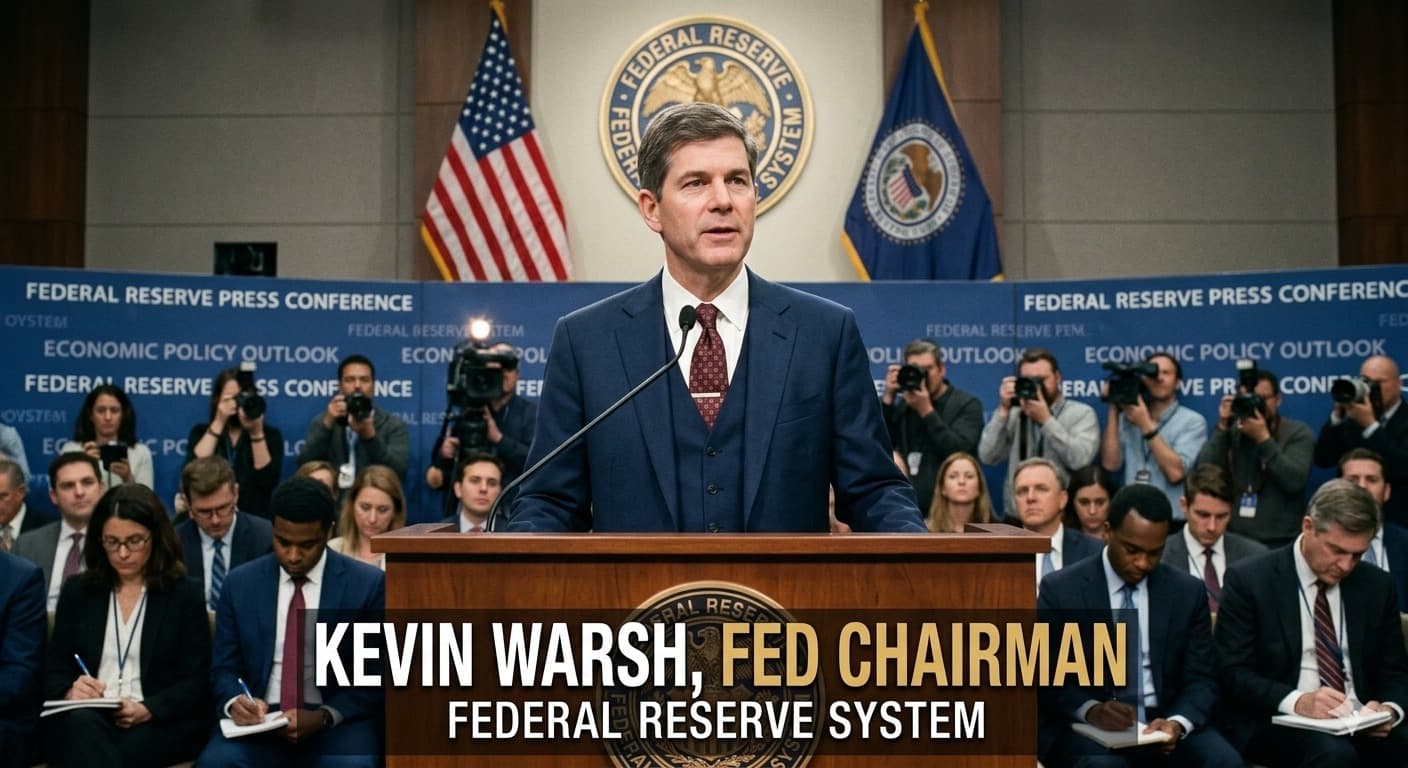
The broader financial world tends to view central banking through a highly simplified lens. When a new leadership regime takes the reins at the Federal Reserve, mainstream attention fastens almost exclusively on interest rate trajectories. Retail commentators obsess over whether the Federal Open Market Committee (FOMC) will adjust the federal funds rate by 25 or 50 basis points at any given meeting. However, seasoned macroeconomic strategists understand that the true, lasting structural transformations occur far away from the public eye.
The real shift under a Kevin Warsh Fed Chairman administration promises to unfold deep within the operational, regulatory, and settlement mechanisms that keep global capital moving.
As highlighted in a critical analysis by CNBC, Warsh’s prospective leadership is poised to bring about a fundamental regime change in Wall Street’s underlying financial plumbing. Rather than focusing solely on traditional monetary levers, his tenure is expected to focus on reforming repo markets, optimizing the Fed’s balance sheet mechanics, and redefining how commercial banks interact with central bank liquidity. For modern financial markets—which are increasingly bridging legacy fiat capital with decentralized digital infrastructure—this operational overhaul could have far-reaching structural consequences.
Who is Kevin Warsh? From Crisis Veteran to Central Bank Leader
To understand why a Kevin Warsh Fed Chairman era will look structurally different from past administrations, one must examine his unique professional trajectory. Warsh is not a traditional academic economist who spent decades parsing theoretical equations in university halls. Instead, his career was forged in the fast-paced environments of investment banking and real-time crisis management.
 Crypto.com Brings Prediction Markets to Institutions→
 Cross River Brings RLUSD Into Core Banking→
 MoneyGram Joins XDC Network as Institutional Validator→
 Mastercard and BVNK have launched a new global payments platform→
The Wall Street Foundation
Before entering public service, Warsh served as an executive director in Morgan Stanley’s Mergers and Acquisitions department. This background gave him firsthand experience with how large corporate entities structure credit, manage liquidity constraints, and assess systemic risk. When he was appointed to the Federal Reserve Board of Governors in 2006, he became the youngest governor in the history of the institution.
The 2008 Crisis Liaison
His true trial by fire occurred during the 2008 global financial crisis. Serving as the primary liaison between Fed Chairman Ben Bernanke and the heads of Wall Street’s major financial institutions, Warsh was responsible for identifying where the financial plumbing was breaking down in real-time. He recognized early on that a financial system could collapse not from a lack of theoretical capital, but from a complete freeze in the overnight interbank lending markets. This experiential background means a Kevin Warsh Fed Chairman administration will naturally prioritize immediate market signals, asset pricing, and credit spreads over lagging econometric models.
Fixing the Pipes: The Structural Reform of Monetary Plumbing
When market analysts talk about “financial plumbing,” they are referring to the intricate network of repo (repurchase agreement) markets, clearing houses, and liquidity facilities that ensure cash moves seamlessly between commercial banks and institutional desks every single day. If these pipes freeze, the entire economy grinds to a halt, regardless of where interest rates are set.
WALL STREET’S CORE FINANCIAL PLUMBING
Repo Market The vital overnight lending network used
to exchange cash for collateral.
Discount Window The Fed’s emergency lending facility,
historically burdened by market stigma.
Balance Sheet The central repository governing reserve
requirements and systemic liquidity.
Reforming the Discount Window Stigma
One of the most anticipated operational changes under a Kevin Warsh Fed Chairman regime is a complete modernization of the Fed’s discount window. Historically, commercial banks have avoided utilizing the discount window during times of stress due to the severe market stigma attached to it; if Wall Street finds out a bank is borrowing directly from the Fed, it can trigger a panic. Analysts suggest that Warsh intends to remove this friction by restructuring the window into a fluid, normalized facility. By transforming emergency lending into a standard operational tool, the Fed can prevent minor liquidity hiccups from escalating into systemic crises.
Crowding In Private Sector Capital
Furthermore, Warsh has long championed the idea that the Federal Reserve should not absorb or distort market mechanisms, but rather empower private-sector capital to distribute liquidity naturally. This approach implies a potential wind-down of heavy-handed central bank interventions in the overnight markets, forcing banks to rely more cleanly on a highly efficient, peer-to-peer credit infrastructure.
The Digital Frontier: Stablecoins, Tokenization, and Central Bank Evolution
A plumbing-first approach to central banking cannot ignore the most significant technological evolution of the current decade: the rise of programmable money and tokenized asset classes. As blockchain networks become integrated into the global financial architecture, a Kevin Warsh Fed Chairman administration will face the unique task of defining how the U.S. central bank interacts with on-chain liquidity.
Unlike legacy regulators who have often viewed digital assets with deep skepticism, a market-driven Fed chair is more likely to view private-sector stablecoins as an opportunity to upgrade the dollar’s velocity. For instance, when European policy choices lean toward heavily bureaucratic, state-controlled public infrastructure, it often inadvertently creates competitive gaps. We have already seen how institutional delays can backfire, as noted in recent analyses detailing warnings of digital dollarisation in Europe by central bank leaders who fear losing sovereignty to highly liquid, private USD tokens.
Under the leadership of a Kevin Warsh Fed Chairman, the Fed could prioritize creating clear, stable operational boundaries that allow commercial banking giants to safely interact with tokenized dollar assets. This alignment would perfectly complement parallel legislative efforts in Washington, such as the Senate Banking Committee passing the Clarity Act, which establishes the concrete legal definitions required for institutional digital dollar issuance. By allowing private innovation to thrive under a clear regulatory framework, the Fed can ensure that the primary plumbing of the next-generation financial system remains firmly denominated in U.S. dollars.
Expert Opinions: Wall Street and Macro Analysts Weigh In
The prospect of an operational, plumbing-focused regime change has generated diverse viewpoints across the economic spectrum. Wall Street veterans, monetary historians, and policy experts are actively debating the long-term outcomes of this strategy.
The Case for Market Efficiency
Proponents of Warsh’s approach argue that a thorough modernization of the Fed’s liquidity facilities is exactly what the modern banking system requires. Institutional fixed-income strategists point out that post-2008 capital requirements have made commercial banks overly cautious, locking up trillions in excess reserves that could otherwise grease the wheels of commerce. By simplifying liquidity rules and reducing the regulatory stigma surrounding overnight borrowing, a Kevin Warsh Fed Chairman can create a more dynamic, resilient interbank lending ecosystem that operates without requiring constant state-sponsored bailouts.
The Risk of Removing Regulatory Cushions
Conversely, more conservative banking commentators and former policy officials urge caution. They warn that tinkering with the structural safety valves of Wall Street’s plumbing could reintroduce systemic risks if executed too quickly. Critics point out that stringent post-crisis regulations were implemented precisely to prevent commercial banks from over-leveraging their positions. If a market-centric Fed eases up on reserve constraints in the name of operational efficiency, any unexpected macroeconomic shock could place immense strain on the core banking system before the automated backstops can fully deploy.
The Macro Strategy: How Liquidity Restructuring Impacts Digital Assets
For active participants in the digital asset and crypto ecosystems, these complex shifts inside Wall Street’s plumbing are of paramount importance. Digital assets do not exist in a vacuum; they serve as a sensitive barometer for global liquidity conditions. When the plumbing of the traditional financial world is optimized and running smoothly, systemic counterparty risk drops, which naturally creates a more favorable environment for institutional risk-on capital allocations.
A highly stable and modernized domestic monetary infrastructure provides corporations with the confidence needed to pursue advanced treasury diversification strategies. We have already witnessed the profound market impact of institutional players implementing Michael Saylor’s Bitcoin accumulation models to hedge against broader fiat debasement. When the central bank focuses on maintaining clean, transparent operational rails, it removes the erratic policy volatility that typically scares corporate boards away from adopting alternative assets.
Furthermore, as the foundational plumbing becomes more accommodating to innovative financial instruments, the bridge between legacy markets and Web3 accelerates. This evolution manifests in massive institutional initiatives, ranging from major multi-asset programs like the Bybit RWA tokenization giveaway to bolder sovereign policy frameworks like the newly proposed US Strategic Bitcoin Reserve bill.
As mainstream financial networks continue to broadcast monumental long-term projections, such as the Bitcoin $1 million prediction discussed on CNBC, the underlying message remains unchanged: the value of any asset class is ultimately tied to the efficiency and health of the network it runs on. A Kevin Warsh Fed Chairman administration signals a historic pivot toward optimizing those networks, proving that the future of finance lies in upgrading the plumbing, rather than simply adjusting the price of money.